Fantasia
1940
Producer: Walt Disney
Starring: Leopold Stokowski, Disney
animators
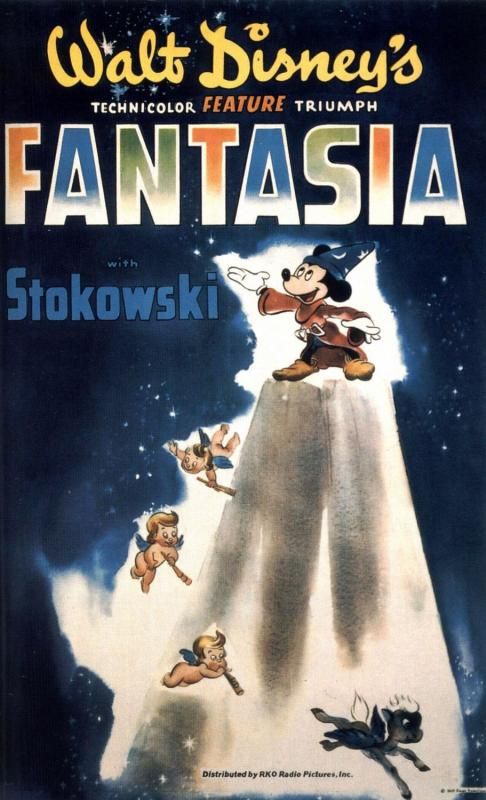
Fantasia is wholly unlike any other
movie out there, excepting, of course, Fantasia 2000. Its entire premise is completely different
from a typical film. It is about
music. Any sort of narrative in the film
is derived entirely from the music, and not the other way around. Any sort of image in the film is derived from
the music, not the other way around. The
music was not implemented after the fact, meant to accompany what had already
been committed to screen; the music came first, and the screen came
second. This is avant-garde filmmaking,
but made by Walt Disney, of all people.
We tend not to think of Fantasia as experimental because it
comes with the Disney tag, but you better believe this is out there in terms of
basic structural design.
Because
this is a movie entirely about music, and classical music no less, most of my
review is going to focus on just that. I
am a classical musician. I have decades
of experience performing in groups, and I listen almost exclusively to
classical music of one type or another.
In
case you want to skip to the punchline, I’ll say this right now: I love Fantasia. Why?
Because it’s entirely and exclusively about the music that I adore. How awesome is that?

There
are seven distinct pieces of music in Fantasia, and given that the entire
film is “about” them, in a sense, I am going to discuss each one. We have J.S. Bach’s Toccata and Fugue in D
Minor (which I’ve played), selections from Tchaikovsky’s Nutcracker ballet
(which I’ve played), Dukas’ The Sorcerer’s Apprentice, Stravinsky’s Rite of
Spring, Beethoven’s entire Symphony No. 6 (played it), Ponchielli’s Dance of
the Hours, and Mussorgsky’s Night on Bald Mountain (played it) smashed together
with Schubert’s Ave Maria. I’m going to
discuss each one because you have to consider this film. These distinct seven pieces were chosen from
all of classical music to BE Fantasia. They were not picked because they would make
a good soundtrack accompaniment to whatever action Disney had already put to
film; they were chosen FIRST, and THEN Disney created images to match.
We
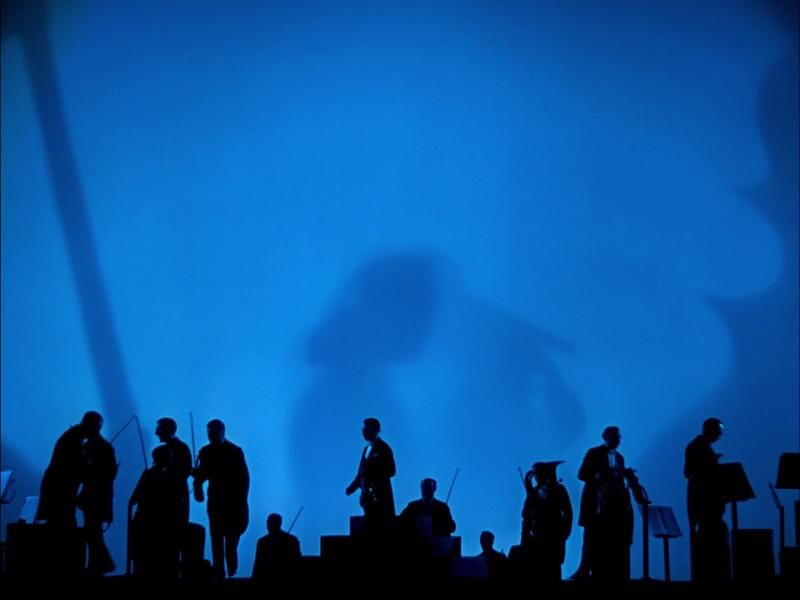
start with Bach’s Toccata and Fugue.
It’s the only baroque selection of music in the film, but it’s fitting
to open the piece. Baroque was one of
the earliest styles of classical music.
In my head, I call it a very “up and down” style of classical music, in
that the focus is mostly on music theory and technique, and not on evocation of
emotion or even imagery. Now, I’m sure
some will argue that last point, but really, when you compare baroque to
romanticism, there IS no comparison about which style is more emotive. Given that, of all the styles of music, I
find baroque to be LEAST emotional, I also think it’s incredibly fitting that
in Fantasia,
this is the one piece that is the most abstract in terms of the animation. There are no recognizable characters, let
alone anything resembling a story. It is
purely impressionistic, which is dead on, spot on perfect for a baroque
piece. The picking of Bach’s Toccata and
Fugue is a fine representation of baroque music, and one that audiences at the
time would have been familiar with. The
iconic work had already been used in horror films (starting with The
Black Cat in 1934).
The
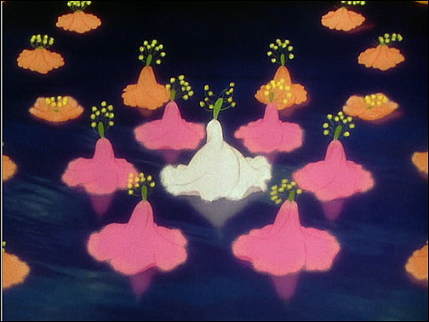
next selections are pieces from Tchaikovsky’s Nutcracker ballet. Now, in order to explain why this is an
interesting selection, I have to give you some history about the Nutcracker
ballet. Nowadays, everyone is familiar
with the Nutcracker. It’s a Christmas
staple, performed in every major city in December, and in many more small towns
as well. You cannot get through a
Christmas season without the music from the Nutcracker being used in multiple
television commercials or piped endlessly through shopping malls.
In
1940, when Fantasia was made, this was not the case.
The
tradition of annually performing The Nutcracker at Christmas is a wholly
American one. When it originally premiered
in Russia in the 1890s, the ballet was not successful. It languished for about half a century, until
it gradually started being performed again in the 1940s. It wasn’t until the 1950s that it got its big
break. George Balanchine started
performing The Nutcracker with the New York City ballet in the mid-1950s. In 1958, CBS television approached him about
airing a live broadcast of the show. It
was a huge hit for CBS, and they started airing it annually at Christmas. Thus was born the completely American
tradition of staging the Nutcracker ballet at Christmastime.
Having
said all of that, let’s go back to Fantasia. How Disney animators picked this particular
piece, given that it held little cultural touchstone appeal for society at the
time, is beyond my comprehension. Surely
Swan Lake would have been a more
famous piece of Tchaikovsky’s at the time, or even his Symphony No. 5. But no, they picked The Nutcracker, and I’m
glad they did. What we have, therefore,
is an interpretation of Tchaikovsky’s Nutcracker that is wholly freed from the
story of the ballet. It is focused
entirely on the MUSIC. While there isn’t
a story associated with the Nutcracker segment in Fantasia, it is not
nearly as impressionistic as the first segment, containing distinct and
recognizable images. The images are
essentially scenes from nature.
I
adore the Nutcracker ballet. I have
either been in it or been to see it every year since I was three. I know the music by heart. And I really love this segment of Fantasia. I love the alternate interpretation of the
pieces, and they are lovely interpretations.
Tchaikovsky,
in terms of musical style, falls squarely within the Romantic era of classical
music, characterized by highly emotional, even melodramatic musical gestures
and pieces. Personally, I love
Tchaikovsky – he has such a distinctive compositional style, I could easily
pick a piece of his out of a lineup – and I think it’s entirely fitting that he
be included in Fantasia.
The
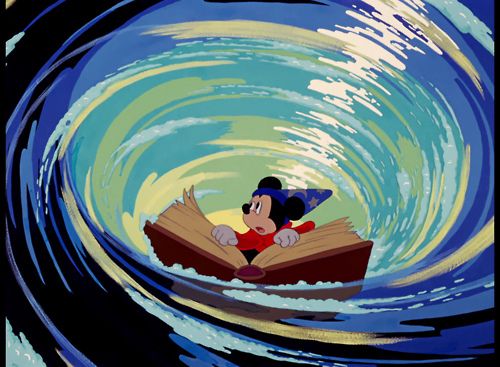
next segment is the most iconic one in Fantasia, Dukas’ Sorcerer’s
Apprentice. This is a terrific piece of
classical music, telling a very definite story, and like Tchaikovsky, falling
squarely in the Romantic era. I like the
animation in this section, and it has, in large part, defined the film as a
whole. How many times have you seen it
parodied on other animated shows like The
Simpsons? From a music standpoint, I
think this is an absolutely stellar interpretation of the piece. There is a moment – a trumpet fanfare – at
the climax of the piece that just makes the entire recording for me. Most recordings of The Sorcerer’s Apprentice
gloss over this very brief fanfare, but Stokowski ever so slightly slows down
the orchestra for this moment. It makes
the entire thing for me. It sends chills
up down the back of my neck. I’ll put it
this way – I never listen to any other recording of Sorcerer’s Apprentice than
the one from Fantasia, because I have yet to find a better one.

The
next segment in Fantasia is easily the most courageous musical choice in the
film. Stravinsky’s Rite of Spring is also
the most musically different piece from all the rest in the film. It debuted in 1913, a mere 27 years before Fantasia,
making it the most modern piece in the film as well. It is a glorious work, immensely complicated,
dissonant, and it freely plays with rhythms and time signatures; yet, unlike so
many of its twentieth century progenitors, there is a definite musical theme
and melody. I have never played The Rite
of Spring, but I have been to two live performances of it, and I’ve seen the
score. It’s fiendishly difficult. The entire Rite of Spring is more than half
an hour long; the Rite of Spring that’s in Fantasia is truncated and
reorganized. I’m alright with that; I
understand that, in order to create a film, some editing needed to take
place.
The
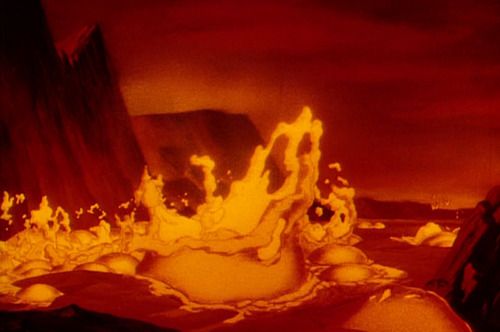
animation accompanying it is sometimes cited as the most exciting segment in Fantasia. It tells of the evolution of the universe, of
our planet, of early life, then of the dinosaurs – the dinosaur segment usually
being the bit that people remember. Rite
of Spring was originally composed to represent a primitive, tribal ceremony,
and I think Disney’s reinterpretation works well. While not depicting an actual tribe or actual
people, the idea, the intent is there.
In terms of violence, this is the most aggressive section of the film,
and to me, that makes absolute perfect sense in terms of Stravinsky’s piece. Rite of Spring is a boldly aggressive piece
of music. Seeing volcanoes erupting and
dinosaurs killing one another just makes inherent sense when listening to
something as deliciously dissonant as Stravinsky.

Next
up is the big one. The central rock of Fantasia,
at least to me. Beethoven’s Sixth
Symphony. I love Beethoven. I’m going to repeat that, because it bears
repeating. I love Beethoven
hardcore. He is my favorite
composer. You might think it a bit
cliché to pick Beethoven as your favorite composer, but trust me, this comes
from years of exposure to many composers’ work.
I keep coming back to Beethoven.
I have an intense emotional connection with Beethoven’s work. He is the only composer whose pieces have
moved me to tears. I don’t think there are
any other composers capable of such painful beauty as Beethoven. In his music, I see such loveliness, but
under it, there is often a melancholy air.
His Sixth Symphony typifies this.
I will never get tired of listening to the Sixth. As a symphony as a whole, it’s my favorite. And trust me, I know Beethoven’s
symphonies. The only item on my bucket
list is to either perform live or see performed live all nine of Beethoven’s
symphonies. I’m missing three: the
second, the third, and the fourth. I’ve
either performed or been to see all the others.
Sure, there are individual movements of his other symphonies that I
think are stronger or more emotional than those in the Sixth, but in terms of
the symphony as an entire work, the Sixth is unbeatable. Yes, more than the Ninth. Yes, I love the Ninth. Yes, I still prefer the Sixth. (Perhaps I am slightly biased – I am a
clarinetist, and the clarinet part in the Sixth is just amazing.)
When
I was a young girl, I loved this section of Fantasia because it was
basically a half hour episode of My
Little Pony. Having grown up now, I
find it to be a little immature for my taste.
Basically, I love Beethoven’s Sixth so much that I don’t like seeing
silly little animal creatures being played for laughs in a piece in which I
find so much emotional profundity.
Having said that, though, I have to go back to my original statement –
when I was little, I loved this section.
And isn’t that huge? I mean, this
part of the movie was instrumental (ha! Get it?) in nurturing my love and
adoration of classical music. So what if
there’s a little bit of silliness or commercialism mixed in there? If it can help youngsters of today get into
classical music as well, then I’m okay with it.
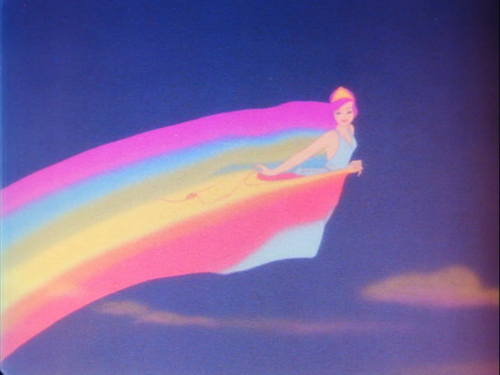
Disney certainly got the “pastoral” part of the piece right,
though. I like the bright pastel color
scheme; I think that fits with the piece very well. I just picture something different than
Disney when I hear the Sixth. Not so
many naked cherub butts.

This
is not my favorite recording of the Sixth symphony. I think the second movement is a little too
slow, the third movement not quite jovial enough and lacking in life, and the
final movement a little lacking in grandeur, plus the whole symphony is truncated. In terms of that last point, again, I
understand why it was truncated, this being a feature film after all. I do not argue the right of the editors to
edit. However, I will argue that if you
wanted Beethoven and you wanted pastoral AND you wanted something shorter, why
didn’t you use the first movement of the Seventh symphony? It’s much shorter and just as “romp in the
countryside” as this. Or, for that
matter, the third movement of his violin concerto. Ah well.
In
terms of musical style, there is a bit of argument as to where Beethoven
belongs, so I’ll just tell you where I think he belongs. Beethoven was the crossover composer; he
ended the Classical era in classical music and issued in the Romantic era. If you listen to Beethoven’s First and then
listen to Beethoven’s Ninth, they are worlds apart. His First Symphony is highly derivative of
Mozart, the king of the Classical era.
By Beethoven’s Ninth, he had fundamentally shifted how he wrote music,
using far more emotional motifs and much less emphasis on technique or
precision. In terms of Beethoven’s
career, I firmly place the Sixth Symphony in the Romantic era.
Man,
I love Beethoven.
Ponchielli’s
Dance of the Hours is the penultimate selection in Fantasia. The piece itself very clearly depicts the
passing of the hours of the day, starting in the morning, then having a sleepy
afternoon nap, then a wild evening party.
Dance of the Hours is by no means the only classical music piece to do
this; von Suppe’s Morning, Noon, and Night in Vienna overture follows a similar
structure. But Dance of the Hours is a
great piece, highly evocative of its title, clearly containing distinct
imagery. This is the also the goofiest
of all the segments in Fantasia, what with ostriches in
pointe shoes, fat dancing hippos, and alligators sadly unable to catch said
hippos. To reiterate some of my comments
about the Sixth, I don’t really like this segment NOW, but when I was young, I
loved it. I feel I’ve somewhat outgrown
this particular animation, but I wouldn’t cast it aside. It’s important to have some kiddie appeal –
this is Disney, after all. I also think
this is the funniest of the segments.
Again, I don’t know how much I personally like it, but I do think it’s
important to have some broad comedy in there.
It helps coat the pill of classical music, making it go down much easier
with little ones.
In
terms of musical style, Dance of the Hours is much akin to Tchaikovsky’s work,
being written within about fifteen years of the Nutcracker ballet. As such, it is also firmly Romantic in its
style. Are we noticing a pattern
here? I hope so.
The
final segment is Mussorgsky’s A Night on Bald Mountain mashed up with
Schubert’s Ave Maria. A Night on Bald
Mountain is an effing creepy piece of classical music. Stephen King is said to have seen Fantasia
and been terrified by this particular segment.
I find that those of my high school students who have seen this film
remember this segment the best. It’s a
towering piece of infernal music, incredibly frightening at its core. The animation that accompanies is absolutely
perfect in its ghoulish splendor. There
seems to be a bit of experimentation with animation techniques to achieve the
ghost effects. The dance of death is so
frightening, perhaps one of the most supernaturally frightening scenes that
Disney ever put to film. In terms of the
animation, it’s probably my favorite part of Fantasia.

All
of which makes me sad that Disney basically took a butcher knife to the piece,
picking and choosing what they wanted, and then discarding the ending. Instead of using the actual ending of A Night
on Bald Mountain, which has a definite Ave Maria sacrosanct feel to it, they
feel the need discard most of it and tack on Schubert’s actual Ave Maria, one
of the most sinfully boring pieces of classical music ever. A Night on Bald Mountain has everything
Disney wanted for this final piece. Why
the hell did they have to mess with it, cut it up, and throw in that damn
Schubert piece? That bugs me.
Again,
going back to musical style, both Mussorgsky and Schubert were Romantic era
composers. So we have seven sections of Fantasia,
and of them, one is baroque, one is twentieth-century, and the other five are
Romantic. Personally, the Romantic era
is my favorite era in classical music, so I suppose I shouldn’t complain, and I
can understand from a storytelling point of view why choosing Romantic pieces
was the easiest as many of them already have distinct emotions or even stories
built it, but I highly question their omission of the Classical era. I mean, Mozart is the behemoth of classical
music, and his work does not appear in either Fantasia or its
sequel. What gives? In my opinion, this is a glaring omission
that should never have gotten past the initial discussion of what this movie
would be.
In
many ways, I wish Disney Studios would return to the studio that produced this
film. Today, Disney is synonymous with
Cash Cow, merely existing to sell little girls the Princess Dream and bank off
whatever Pixar produces. But back in 1940,
when Disney produced Fantasia and then Pinocchio,
it was a much different studio. Artistic
experimentation and expression were more important (or, at least, just as
important) than making money. To this
day, Fantasia
remains the single best classical music movie ever made because it is wholly
about the classical music. The classical
music does not take a back seat to any sort of contrived plot line about
struggling musicians or some other nonsense.
The classical music came first, and the images followed. How brave of the studio, how incredible a
film, and how wonderful for someone like me.
It’s the perfect marriage of two of my greatest passions: classical
music and film coming together.
Arbitrary
Rating: 8.5/10. There are moments of
pure perfection, but also moments that are not so perfect. And this is a hugely significant film for me.