Showing posts with label 1969. Show all posts

Sunday, June 30, 2013

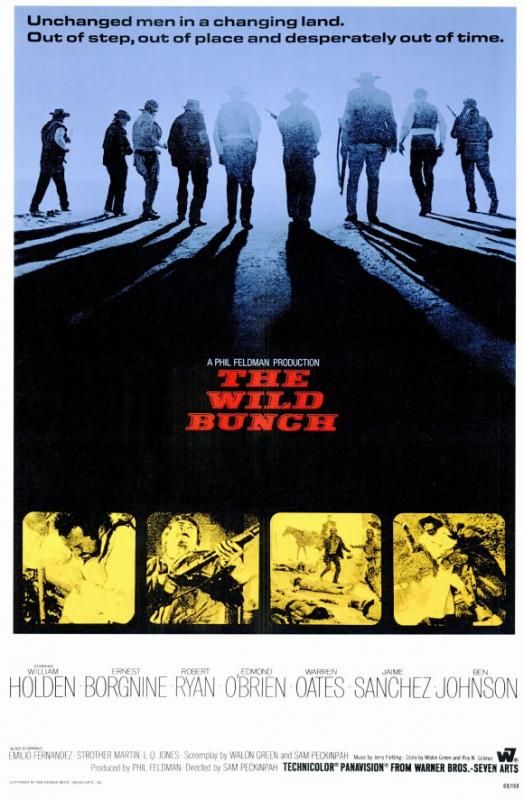
The Wild Bunch


The Wild Bunch
1969
Director: Sam Peckinpah
Starring: William Holden, Ernest Borgnine, Warren Oates, Robert Ryan

In general, I don’t like Westerns, but Peckinpah?  Peckinpah is a whole other ball of wax.  My first introduction to Peckinpah was Monty Python’s “Sam Peckinpah’s ‘Salad Days,’” which still remains one of my favorite MP sketches, and it’s become even funnier since I’ve partaken of Peckinpah’s filmography.  With a reputation, rightly earned, for violence and cynicism, Peckinpah’s vision of the West differs vastly from that of, say, classic western director Ford.  The Wild Bunch is Peckinpah through and through, with plenty of stylistically innovative violence and themes running deep with betrayal and pessimism.

Telling a fairly standard story of outlaws looking for one more score, we follow Pike Bishop (Holden), an aging outlaw who wants to retire as the twentieth century dawns in the American West.  With his colleague Dutch (Borgnine) at his side and old frenemy Thornton on his trail (Ryan), Pike gets entangled with Mexican bandit-turned-generalissimo Mapache (Emilio Fernandez) when they make a deal to steal some guns for him.  As the deal starts to go bad and tensions run high, we understand the bleakness of Peckinpah’s vision.
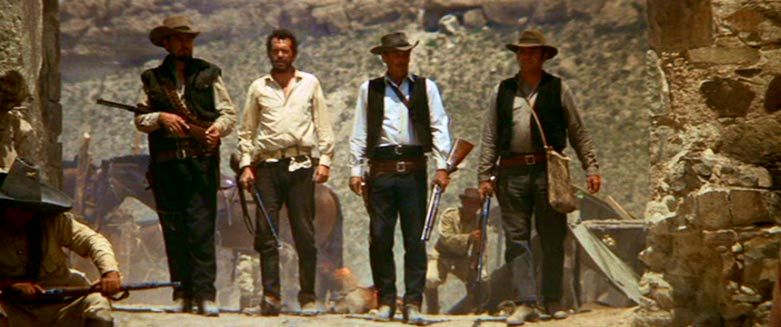

“It ain’t what it used to be, but it’ll do.”  This is the closing line of The Wild Bunch, and it succinctly sums up a major thematic element of much of Peckinpah’s work.  Weeping for a Wild West that had become far too idealized in previous films and television shows to have been real, Peckinpah seemed intent in his work to move that image forward.  In The Wild Bunch, he certainly does that, showing us a western landscape littered not with heroes and villains representing right and wrong, but characters who live somewhere along a spectrum of virtuosity.  Pike is our hero, for lack of a better term, but he opens the film by pretending to be a soldier in order to take part in a daylight raid of a bank in Texas, one that winds up killing many people.  And the phrase “Honor amongst thieves” only goes so far in Peckinpah’s world, for many of the thieves aren’t honorable in the least.  People get left behind or abandoned constantly.  The man hunting Pike is doing is only for bounty and he is surrounded by some of the most unlikeable and ruthless characters in the entire film; yet this man is on the “right” side of the law.  Generalissimo Mapache is the closest we get to a true villain in The Wild Bunch, but Pike, though wary, makes deals with him through most of the story, and Mapache himself seems less evil than a bit stupid and power-hungry.  In short, we don’t have any traditional white hats or black hats here, just people living by whatever code they happen to adopt, be it right or wrong or somewhere in between.  This ain’t yo’ granddaddy’s Western, that’s for sure.
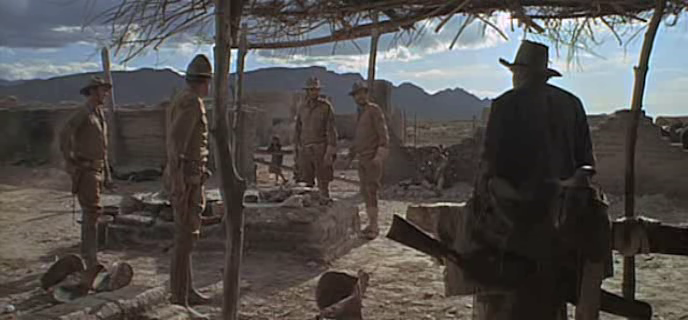

Additionally, the issue of betrayal is constantly looming throughout the story.  Thornton seems continually haunted by the fact that he finds himself hunting his old friend Pike with men he can barely stomach.  Pike and his bunch hardly care in the slightest when their compatriot Angel’s village gets attacked by Mapache, threatening to leave him behind if he can’t get over it.  Pike’s old friend Sykes, who helps out in the gun heist, at one point himself gets abandoned by Pike and the rest because he was wounded.  No one’s actions in The Wild Bunch are beyond reproach; everyone, at some point, does something fairly shitty to someone else, betrays someone they shouldn’t, leaves someone behind whom they should have helped.  It’s a messy world, Peckinpah’s West.
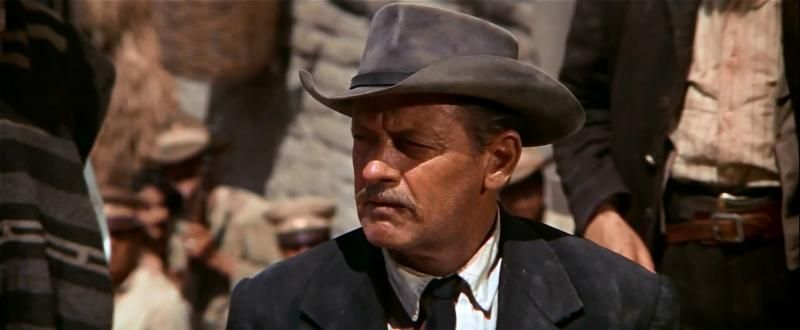

This wonderfully ambiguous morality play is wrapped up in a remarkably innovative cinematic package.  This is, in its own gritty, dirty, disgusting way, a beautiful film.  Peckinpah stylishly blends slow motion, flashbacks, and quick cuts to present a film that is unexpected in its technique.  Watch Angel’s horse get lassoed – we cut between a slow motion shot of the horse falling to some quick-as-a-flash cuts to the men around him.  Just when the film feels a little too staid or predictable in its presentation, we get these fairly exciting shots.  The final bloodbath, famous for its violence, is a prime example of this, with slow motion bodies falling all over the place, graceful in their disfigurement.  
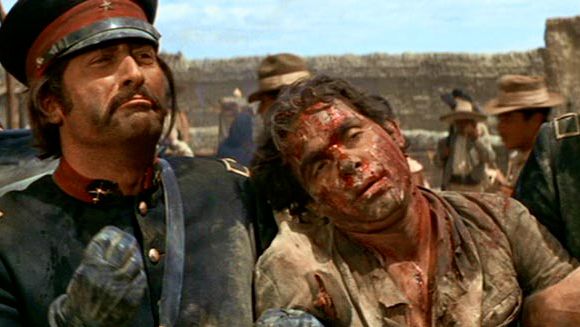

The general attitude of the film is resigned acceptance.  Pike’s final decision seems one not born of his sense of decency, but an unfulfilled death wish, grim in his determination to see this thing through to the end.  Everyone around him seems to know it as well, which is why when men start laughing as they are about to face certain doom, it all seems right, somehow.  The Wild Bunch is grim and bleak, maybe, but never stifling or depressing.  There are just enough light moments sprinkled throughout to make the dark moments bearable. 
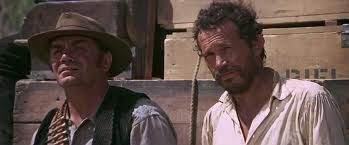

The cast of The Wild Bunch is strong all around.  William Holden, aging out of Classic Hollywood, plays against classic Western types here and does it well, as does Ernest Borgnine.  But for my money, it was Warren Oates as sidekick Lyle and Robert Ryan as Thornton who really steal the show.  Oates is an actor who, after not being able to get his Bennie from Bring Me the Head of Alfredo Garcia out of my mind for at least a week, I can’t tear my eyes away from.  If he’s in a scene, my eyes are on him.  If he’s onscreen, I don’t care what else is going on, I’m watching him.  His charisma and intensity and oddball humor live alongside a sense of sadness and inevitably which Peckinpah must have adored.  Similarly, Ryan’s defeated Thornton is probably my favorite character from the film as we watch him almost sadly track down Pike.  It’s never certain where Thornton really stands, and that’s mostly due to Ryan’s performance, keeping the character just a shade unknowable.  If I could change one thing about The Wild Bunch (although really, why would I want to mess with a classic?), it would probably be to do more with the Thornton/Pike angle. 
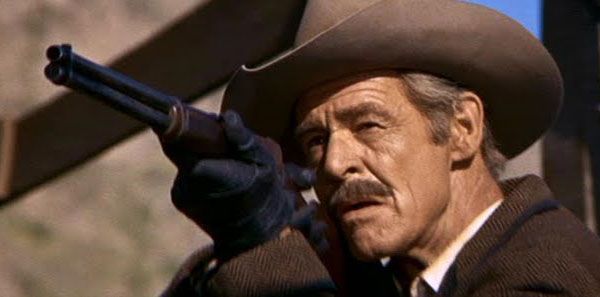

It’s movies like The Wild Bunch that made me realize that there are always exceptions to the rule.  While it hasn’t changed my mind about Westerns as a whole, I willingly make an exception for it.

Arbitrary Rating: 8/10

Tuesday, May 21, 2013

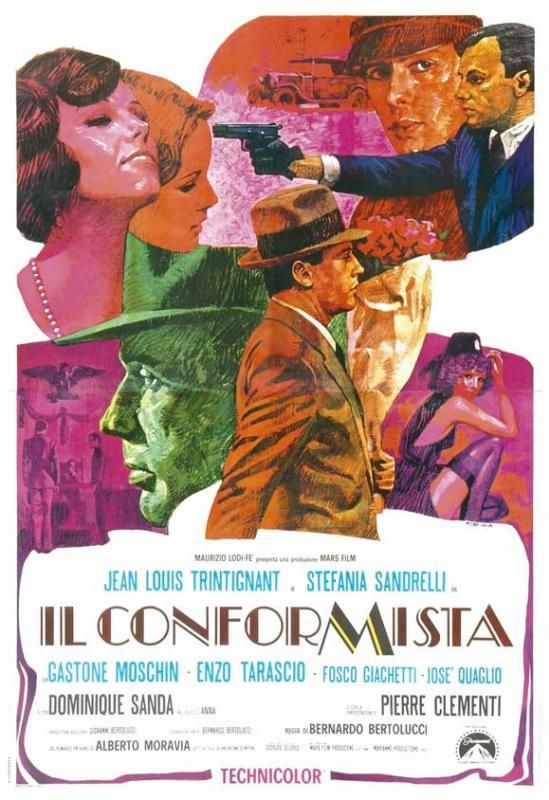
The Conformist


The Conformist
1969
Director: Bernardo Bertolucci
Starring: Jean-Louis Trintignant, Stefania Sandrelli, Dominique Sanda, Gastone Moschin

I love that Netflix keeps track of when I returned something, because it’s how I can tell you that I’ve now seen The Conformist twice – once five years ago, and once last night on the big screen at the Dryden.  My memory of The Conformist from seeing it five years ago was virtually nonexistent: the film failed to make an impact on me.  But I have to say that I am standing by my policy of seeing films a second time before writing a review or even definitively making up my mind.  The Conformist is pretty damn powerful on a big screen, and I was impressed last night. 

 
Marcello Clerici (Trintignant) is living and working in 1938 Rome, and he is more than happy – willing, even – to participate in Mussolini’s fascist regime.  Slowly we learn that Marcello is purposely seeking out conformity, as well as his motivations to do so.  Too many differences in his childhood have made him feel alienated, and he is desperate to fit in, even to the extent marrying a woman, Giulia (Sandrelli), whom he finds thoroughly mediocre.  The government soon asks Clerici to carry out a hit for them, none other than Marcello’s former philosophy professor turned political instigator.  On the pretext of honeymooning in Paris, Marcello seeks to reconnect with his old professor, Quadri, but gets distracted by the professor’s young hot wife Anna (Sanda).

  
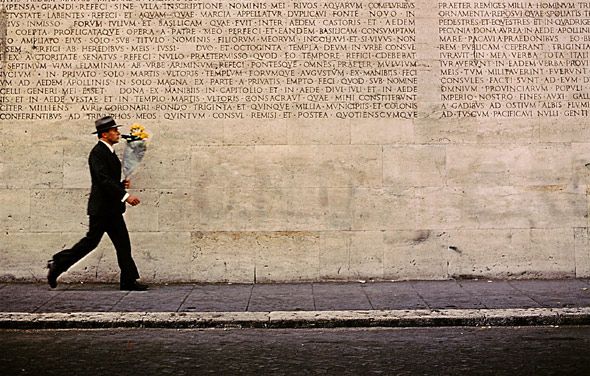
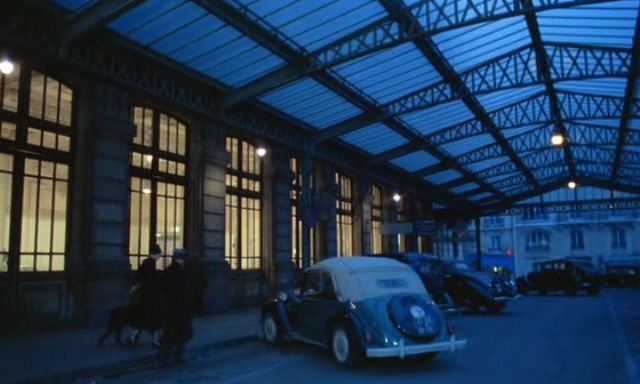
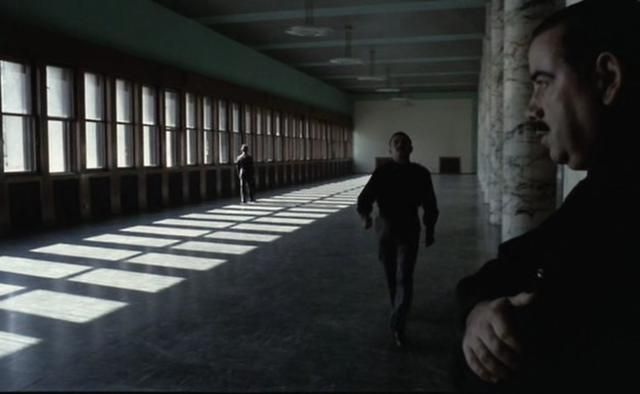
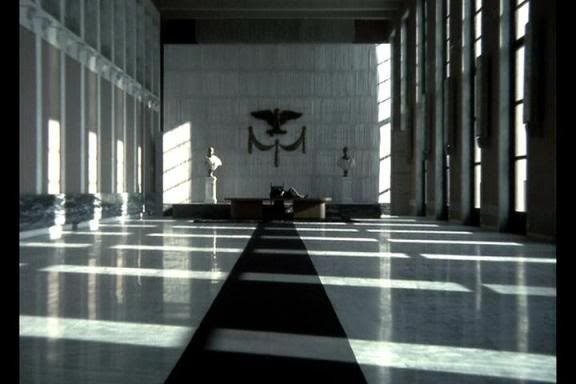
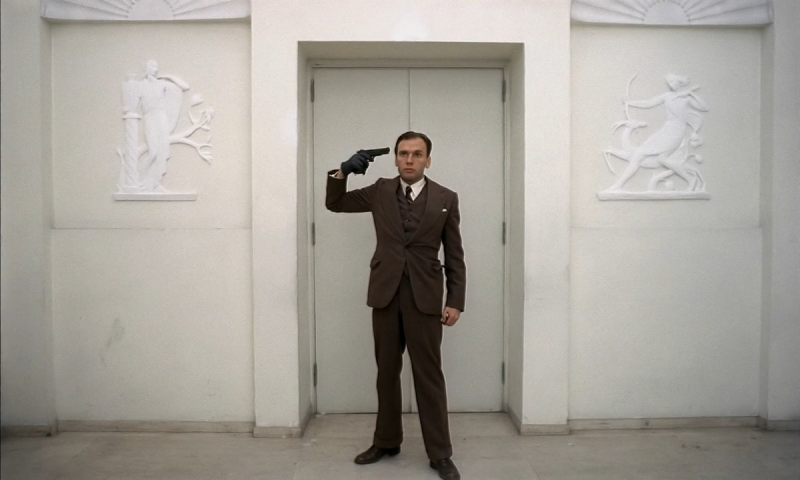
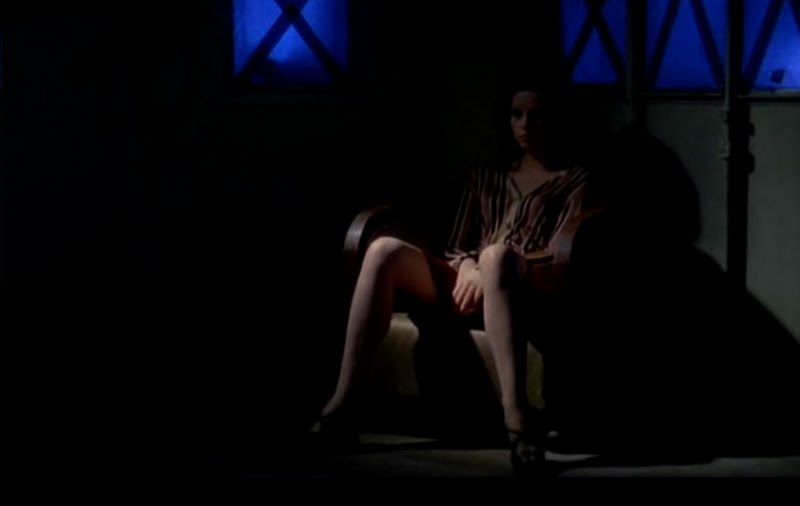
The best part of The Conformist is the drop dead stunning cinematography (evidenced here by my inability to choose no less than seven shots of it to accompany my review, because it's my review, dammit, I can have lots of pictures if I want).  This film is GORGEOUS.  Mostly achieved through the production value and distinct sets, Bertolucci’s cinematographer, Vittorio Storaro, goes to town with the idea of “hard” fascism.  Sparse, cold, stone sets, vast and empty and intimidating, fill the Rome that Clerici inhabits.  Even when the action moves to Paris, there is an emphasis on stone and metalwork backdrops over natural elements.  There is a sense of using materials to control one’s environment, mirroring both Mussolini’s controlling regime and Clerici’s maddening impulse to fit in.  Additionally, the shapes are constantly square and rectangular.  Rectangles are mean, they are hard, they can hurt, they are sharp, and this is everything in terms of Marcello’s world.  There are so many squares framing nearly every single shot, and next to no softness or circles.  In fact, the first time I noticed any kind of an arched frame in a shot was in Professor Quadri’s apartment, which is significant as the Quadris are running a group of political dissidents loudly vocalizing their displeasure with the fascist dictatorship.  They are against everything that Clerici stands for, so it makes sense that we see Anna Quadri lounging up against a huge curved doorway in contrast to all of Marcello’s rectangles.   

  
After the amazing look of the film is the character of Marcello himself, especially as portrayed by the fabulous Trintignant.  He’s tremendously good here, along with Bertolucci, at slowly building Marcello Clerici.  When we first meet him, he seems incredibly focused on pulling off the job, a cold-blooded assassin.  We then flashback to previous portions of Marcello’s life, not necessarily in chronological order, as it is slowly revealed that he was bullied as a child and sexually assaulted by a transvestite servant whom he then shot.  His mother is a morphine addict who is sleeping with her Asian chauffeur who’s also her supplier.  His father is locked up in a mental hospital writing politically rebellious letters to the government when he isn’t asking to be bound in a straightjacket.  His best friend is smart as a whip but blind as a bat.  Marcello, who has been surrounded by oddballs and estrangement his entire life, is desperate – absolutely over the edge desperate – to fit in.  He hates his memories of his childhood.  He loathes his mother.  Even his blind best friend nauseates him from time to time, and we watch with a horrible dawning comprehension as Marcello pulls away from him, being silent and still so his friend cannot “see” him.  When he speaks so callously of his fiancée, I get it.  As awful a person as he is, I understand why Marcello feels the need to conform.  Realistically, it’s something I face every day in my own classroom.  I see the students who have something about them that is different, and instead of embracing their differences, they shun them and try so hard to fit in with the “cool kids.”  They might have more in common with some of the other “outsiders,” but they want nothing to do with them – they only want to be just like the “cool kids,” they want to conform.  If it means being cruel, then so be it.  Such are some of my students, and such is Marcello.  Sad, really.

  
Trintignant’s body language is brilliant.  He holds Marcello’s body as if Marcello is afraid to really move it to its fullest potential.  He’s uncomfortably staid and upright, even uptight.  He never loosens, not for a second.  Trintignant’s Marcello is always rigidly in control of his own action.  Watch him get a gun for the first time – he mimics the movements he’s seen others make with a gun, but the actions don’t seem natural on him.  He moves like a robot.  He doesn’t turn his neck so much as he does his entire body.  Even when he’s with his wife Giulia, he feels uncomfortable with the sexuality of the situation; it’s like he doesn’t wholly know what to do.  It’s a brilliant way of showing Marcello’s mental rigidity manifested outwardly.

  
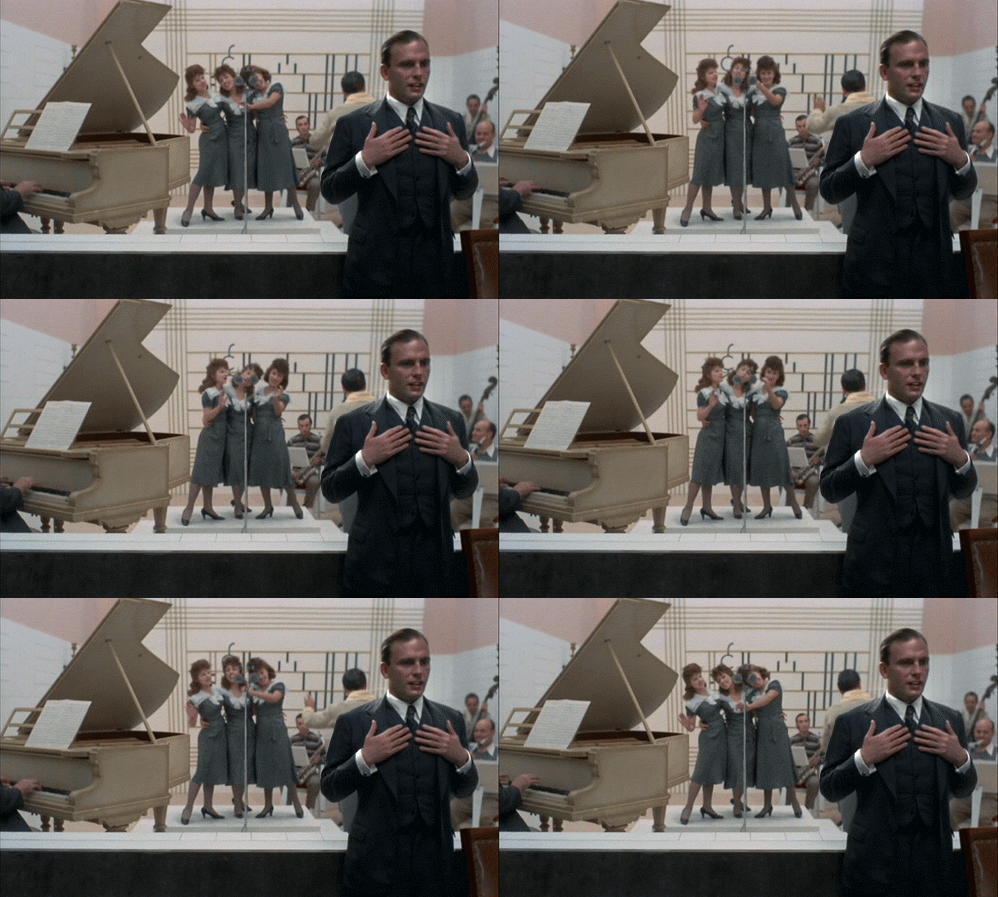
When you combine Marcello’s horrifying descent into frightening levels of conformity with a heavily politicized narrative, I understand the fear that The Conformist could be too dark, too heavy, and all in all too much.  Unexpectedly, however, there is a distinct lightness in tone and many moments of humor that pop up in the oddest of places.  Why, for example, is Marcello’s boss’ desk completely covered with almonds?  Why do we first really meet Marcello when there is a girl group singing a ridiculously cheery popular ditty in the background, complete with silly choreography?  Why is just a gigantic statue head of Mussolini being continually carted around a government building?  These little touches of surrealist humor make the film feel less downtrodden.  Watch Marcello randomly grab Anna and duck into a silly little closet.  Watch Marcello desperately try to wave off his security guard (Moschin) when he doesn’t want to be followed while at the same time not alerting Giulia to his presence.  It’s actually pretty darn funny.  And speaking of Giulia, she goes a long way to lightening the mood of the film; Giulia is all girly superficiality and silliness, and when she can’t keep her hands off Marcello, especially in an early scene, I laugh.  Laughing!  In a movie like The Conformist!  


*******************************DISCUSSION OF THE ENDING**********************************

Realistically, though, the power of Bertolucci’s The Conformist lies mostly in how he chooses to end the film, and although I dislike talking about endings of films in general, I want to talk about this one.  Marcello’s situation in the film, although certainly serious, is always tempered with the oddball touches of humor I mentioned above.  All of that utterly dissipates in the final twenty minutes of the film.  Here, the Fascist regime shows what it is truly capable of and Marcello realizes just how deeply he’s in for it.  He sits by, paralyzed by fear, and watches with inaction as Quadri and Anna are coldly killed.  What’s so utterly unnerving in their death scenes is that their deaths do not come quickly.  They are killed slowly and they are utterly consumed by fear and terror before they are killed.  Listening to the terror in Anna’s voice as she desperately screams for help, and it’s chilling.  It’s scary.  You see precious little blood or gore (again, this was 1970 after all), but the lack of background music and their prolonged deaths are frightening enough.

But it’s not these death scenes that really cap the film off.  No, it’s the epilogue where we cut to Marcello’s life a few years later on the night of Mussolini’s fall.  What horrifies me most about this sequence is Giulia’s character.  In the entire film up to that point, Giulia has been silly and narcissistic and flighty, comedic relief and that’s it.  When we see her a few years later, all of that is gone.  She is stoic and silent, and frankly, it’s horrifying.  This is how I understand the cost of Marcello’s conformity.  Marcello is still Marcello, although he is cracking at this point and he will have his breakdown, but it’s Giulia’s utter, devastating deflation that underlines the tragedy of the situation.  His action (or inaction) has robbed her of her persona, dragging her down to a sad relic of her former self. 

********************************* DONE WITH THAT THEN*****************************************

  
Oddly funny, stunning cinematography, a great lead performance, and a tale that I sadly see too often in modern day high school students meant I got so much more out of my second viewing of The Conformist than I did the first time around.  I’m really not a huge fan of Bertolucci’s work, but this one really struck me.  It was more than worthwhile seeing it in a theater.

Arbitrary Rating: 8/10.  Definitely better than I remember.

Wednesday, January 16, 2013

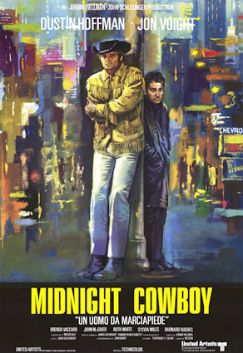
Midnight Cowboy


Midnight Cowboy (repost from my previous site)
1969
Director: John Schlesinger
Starring: Jon Voight, Dustin Hoffman

Notable as the first and only X-rated film to win Best Picture (there, I’ve said it, obligatory historical context mention done), Midnight Cowboy is typical of American films coming out of the late 60s and 70s.  A personal, character-driven drama with a decidedly downbeat turn, this is not a film to watch if you want cheering up.

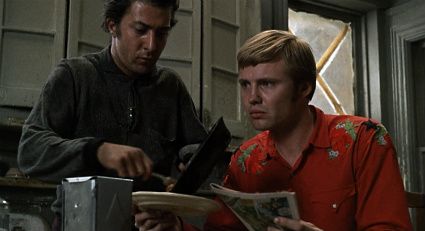
Joe Buck (Voight) is a Texas good ole boy who dreams of striking it rich in The Big Apple.  Deciding that he’ll be able to make it as a hustler (re: male prostitute), he journeys across the country only to realize pretty quickly that he is not accustomed to city life.  He gets taken in by the aptly nicknamed ‘Ratso’ Rizzo (Hoffman) who promptly cons twenty bucks off Joe then abandons him.  Eventually, however, Ratso takes Joe under his wing and helps him survive in the harsh city.  Both dream of better days, better times, better places.  Needless to say, this being an American drama from the late sixties, their dreams are never realized.

The performances are easily the main attraction in Midnight Cowboy.  Voight takes Joe, a naïve prostitute, and turns him into much more than a two-dimensional caricature.  Joe is over-confident and arrogant, but watching him realize his dreams are crumbling is very sad.  And yet, Joe manages to maintain some pluck and positivity along with a profoundly caring personality despite all the stones that life throws at him.  When he finally throws away his cowboy boots at the end of the film, there is an overpowering sense of a boy who has been forced, against his will, to grow into a man.  

  
Schlesinger, the director, uses a wonderful technique to give us background information on Joe Buck.  Instead of traditional flashbacks, he uses flashback montages, for lack of a better term.  Every now and then, Joe starts thinking about his life thus far in a nonlinear manner.  He recalls one memory which then prompts his recollection of a different memory from a completely different time.  We cut back and forth between Joe as a young child and Joe as a teenager, all in one very fast clip.  What I love most about these montages is how they very slowly and very indirectly reveal things about Joe’s past.  We are left to piece together certain details.  Highly significant events are not spelled out in painstaking detail; rather, Schlesinger trusts his audience to get the gist without beating us over the head with it.

Hoffman is, as always, great in his portrayal of Ratso Rizzo, but not for the base characterization.  Rizzo is a cripple, an outcast, a rat who has learned how to live on the scraps of society.  Hoffman’s physical performance and nasal voice creep to the precipice of ridiculous stereotype, but he manages to pull back at the very last moment, creating a surprisingly nuanced character.  Rizzo is, sadly, very real.  Unblinkingly, he takes a funeral wreath from a neighboring headstone and drops it at his father’s grave.  Joe looks judgmental.  Rizzo never flinches or looks apologetic.  He wants his father to know that he was there.  He gets annoyed at Joe for buying medicine for him when he could just as easily have pinched it.    And when his sickness grows worse, he shakily admits to Joe that he wet his pants.  So far from cartoon stereotype. 

The relationship between Joe and Rizzo is clearly the central relationship of the film, and it is a complicated one.  Joe is a male prostitute – there’s no escaping the sexuality there.  But Joe is a bad male prostitute; in his very first outing, after finally finding a rich Park Avenue honey, she starts crying when he asks for the money and he winds up paying HER twenty dollars.  He is also forced to take a few male clients, making his personal sexuality vague.  It is this that drives the ambiguity of the relationship between Joe and Rizzo.  Is Joe in love with Rizzo?  Is Rizzo in love with Joe?

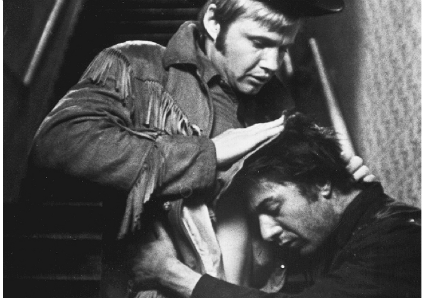
To me, that question is answered with a single still from the film.  Joe and Rizzo are invited to an Austin Powers-esque party (an Andy Warhol scene that feels jarringly out of place in the film).  At the bottom of the stairs, before they head up to the party, Joe looks at Rizzo.  “We have to clean you up,” he says.  Joe has been laundered, washed, and shaved by Rizzo so that he is more appealing to women; Rizzo, on the other hand, reeks of the squalor in which they have been living.  Joe untucks his own shirt and uses it to clean off the top of Rizzo’s head.  Rizzo, for his part, leans in and lets Joe clean him.


Look at Rizzo in this shot.  What strikes me about this is how Rizzo is positioned.  He doesn’t just sit there and let Joe wipe his forehead.  He leans in, then puts his arm around Joe’s waist.  Look at the expression on Hoffman’s face.  It is peaceful, content; it is as if Rizzo is thinking, “This.  This is what I want.”

This scene epitomizes this film to me.  It sums everything up.  These are two disparate characters living in abject poverty; they are dirty, they are filthy, they are unsuccessful.  But they have each other.  It is achingly poignant, the look on Hoffman’s face.  This is a phenomenally quick scene, a throwaway scene, but it’s my personal key to the film.  Others will interpret the relationship in other ways, but this one sadly beautiful image sums up my take on it.  Rizzo is very much in love with Joe, but doesn’t know what to do about it.  He finds a tiny moment of happiness here.

As much of a downer as this film is, there are surprising moments of humor and lightness as well.  In particular, a dream sequence of Rizzo’s, imagining a luxurious life in Miami with rich women, is downright funny.  I love how, even in his own fantasy, Rizzo is cooking for others.

Midnight Cowboy is not the greatest example of American filmmaking from its era, but the pair of incredibly strong performances easily make it worth seeing.  It’s worth watching to remember that there’s much more to Jon Voight than Transformers.

Arbitrary Rating: 7.5/10