Showing posts with label silent. Show all posts

Wednesday, August 21, 2013

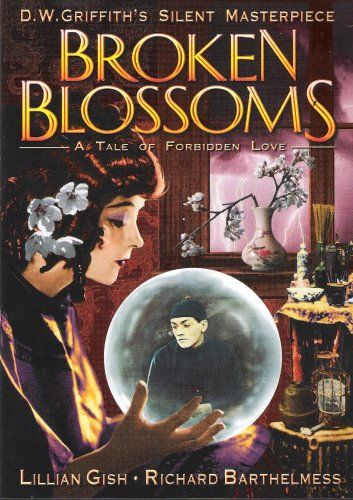
Broken Blossoms


Broken Blossoms
1919
Director: D.W. Griffith
Starring: Lillian Gish, Richard Barthelmess

Silent films are curious.  They are so far removed from the cinema we know today that it can be difficult acclimating to their distinctly separate style.  There are certainly exceptions to this rule; great films are great films regardless, but only a handful of the silents I’ve seen have managed to break through their constrictions of time and place and really, truly impress me.  Films like Keaton’s comedies, City Lights, The Cabinet of Dr. Caligari, or The Unknown are examples of this.  Unfortunately, Broken Blossoms does NOT fall into that category, feeling instead like a film ridiculous in how utterly out of date it is.

Cheng Huan (Barthelmess) starts off in China as a well-intentioned missionary who means to go to London to spread the word of the peace of Buddha.  Once there, however, he becomes addicted to opium and winds up tending a grubby little shop in the Limehouse district.  Lucy (Gish) is a waif who shuffles to and fro in between beatings by her cruel boxer of a father.  Cheng falls in love with Lucy from afar, and one night, when Lucy is left on the streets, he takes her in, feeds her, and nurses her back to health in the most chaste way possible.  Of course everyone will pay for this act of kindness.
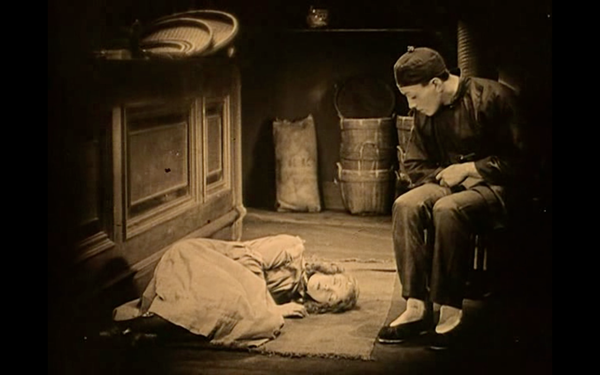
  
Let’s deal with the obvious first, shall we?  This being 1919, Hollywood (and America) wasn’t nearly as progressive as it is today (and frankly, I’m not so sure it’s terribly progressive today).  We have, in Broken Blossoms, a thoroughly American actor playing a Chinese character, complete with squinty eyes and everything.  Oddly enough, this doesn’t completely bother me.  I know it’s repugnant by today’s standards, but is it fair to hold Broken Blossoms up to today’s standards?  I tend to be pretty tolerant to issues like this in very old films, and when you look at the characterization of Cheng Huan in Broken Blossoms rather than simply the outward caricature, he actually becomes the kindest character in the film.  I don’t like watching Barthelmess play an Asian any more than the next blogger, but I have to hand it to Griffith for making the Chinese character the closest thing the film has to a hero, and this in the middle of a phase in American culture called “Yellow Peril” where the fear of Chinese immigrants was reaching a peak.  It’s an odd feeling, really; I very much wish that white actors weren’t playing people of color in Broken Blossoms, but at the same time, I respect the presentation of Cheng Huan in a positive light and understand that the film is ultimately a product of its time.

No, far more than the whitewashing in Broken Blossoms, the thing that turns me off about the film is the unrepentant Melodrama with a capital “M.”  Melodrama, as a genre, has never sat well with me.  Even as a young teen Siobhan, I cringed when having to read books in school like Sister Carrie or any of the “young adult” fiction foisted upon me.  When I was in middle school, I remember being agog at all my classmates who insisted on writing the most utterly ridiculous short stories and poems about drugs, abuse, suicide and the like, none of which were realistic, and all of which ended badly.  Consequently, I dislike films where I have to watch things go badly in the most predictable way possible and with as little nuance as can be managed.  And Broken Blossoms is definitely that film.  Lucy’s father is evil for no other point than to be evil and brutish because the plot demands it.  Oh, okay, sure, I don’t need any kind of believability there, go right ahead.  Gish’s Lucy is so tortured in her childhood that she cannot physically smile and must actually use her fingers to curve her mouth upwards.  To pull out a phrase from my youth, gag me with a spoon.  This style of filmmaking, so popular in the early days and certainly around albeit a bit evolved today, does less than nothing for me.  I really dislike melodrama.  So Broken Blossoms never stood much of a chance.  
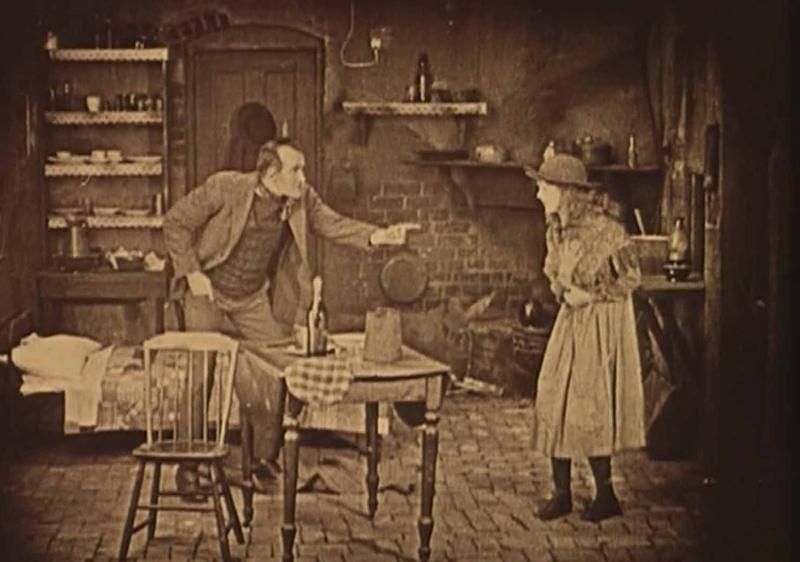
  
A few comments on Lillian Gish in this film.  In general, I am a fan of La Gish; it’s difficult not to be, considering she’s one of the pioneers of cinema.  I’m not sure how much I like this particular performance, however.  For one thing, there is the age of her Lucy.  In 1919, Ms. Gish would have been 26 or 27 years old.  I cannot for the life of me figure out how old the character of Lucy is supposed to be.  In some scenes, it appears as if she’s meant to be late teens; in others, more like 13 or 14.  For her part, Gish plays Lucy on the immature and infantile side, having her entranced with a simple doll and completely unaware of the feeling of love directed at her from Cheng Huan.  Frankly, skewing Lucy so young, even if it’s only emotionally that young, makes things a bit… squicky.  It’s a bit worrisome already that I’m trying to overlook historical whitewashing, but now I have to watch an older man fall in love with a woman who has the mental capacity of a 12 year old girl.  This does not for fun times make.  
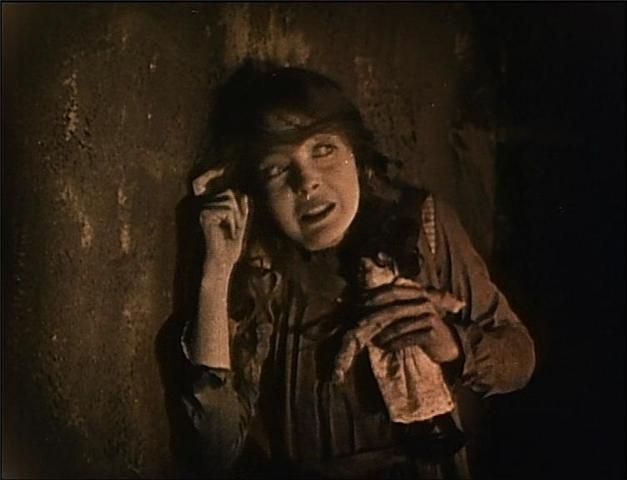
  
But there is one scene in particular where Gish shines, and that is the scene where she has locked herself in a closet to escape the temper of her father, who has just discovered that she had been inside Cheng Huan’s shop.  Here is where we really see Ms. Gish’s acting prowess, as she convincingly gives us a performance of a frightened and cornered animal incapable of seeing a way out.  The naked fear on her face is staggering, and she is sole reason why I found this scene the most emotionally affecting of the entire film.  Her face, her body language, everything is committed to the feeling of true dread. 

I suppose I need films like Broken Blossoms every now and then to remind me just how amazing other silent films are by comparison.  It’s not nearly as preachy as Intolerance or as hateful as The Birth of a Nation, but I’m still not a fan.  Melodrama’s not for me, thanks.

Arbitrary Rating: 5/10


Wednesday, August 7, 2013

Foolish Wives


Foolish Wives
1922
Director: Erich von Stroheim
Starring: Erich von Stroheim, Miss Dupont, Maude George, Rudolph Christians

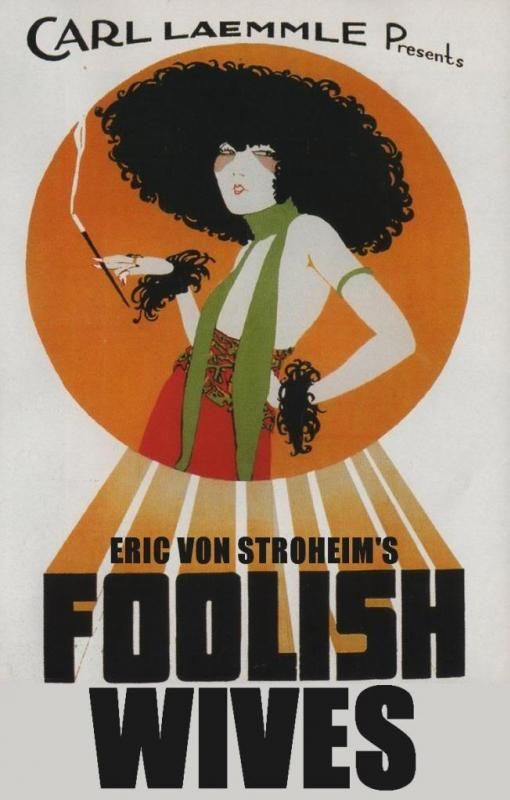
Erich von Stroheim has done it again!  Jump with joy for the anticipation of an overlong, completely over the top morality play!  Oh thank goodness, because there really isn’t enough of that in my life at the moment.

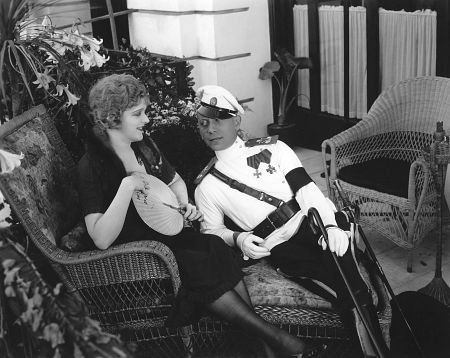
“Count” Sergius Karamzin (von Stroheim) is a con artist masquerading as an aristocrat, preying off of the gullible upper class in Monte Carlo with the aid of his “cousin,” Princess Olga Petchnikoff (George).  When an American dignitary (Christians) and his much younger wife Helen (Dupont) arrive, the tricksters immediately set their sights on fleecing the couple for everything they have.  Sergius sets to work charming Helen, slowly, of course, and trying to keep the husband relatively unaware.  Ultimately, however, Sergius’ womanizing ways catch up with him.

  
As I watched Foolish Wives for a second time, I kept on trying to put my finger on what the story reminded me of.  Was it soap opera?  No, soap opera moves slower than this.  Was it crappy romance novels?  No, crappy romance novels have a hero, and Foolish Wives has no hero, just ridiculous naïve characters and Evil Villains of Evil.  And then it finally hit me.  I thought to myself, “Sergius is Don Juan.”  Which then made me think Don Giovanni, (in particular, Mariusz Kwiecien in Don Giovanni… mmm, Mariusz Kwiecien…) Mozart’s operatic reimagining of Don Juan.  And that’s precisely what Foolish Wives is: it’s an opera plot without the actual, y’know, opera.

Now, I am a definite fan of opera.  Like, pretty darn big time.  All my students know it.  All my friends know it.  Opera rocks, man.  I will preach this from the highest hilltop.

But Foolish Wives does NOT rock, despite this association I made.  Why?  The last thing I’m looking for from my opera is plot, and that’s ALL that Foolish Wives has going for it.

The plots of operas are not the point of the opera itself.  If you wanted interesting story development, no one in their right mind would think, “I know!  Let’s all hit up Il Barbiere di Siviglia tonight!  That’s got one crackerjack plot!”  The operatic plots are mere scaffolds on which fantastic music is hung.  What’s more, they are usually simple to their core.  Any opera I’m familiar with can be summed up in two sentences, three at the most.  If it’s a comedy, it’s “mistaken identities prevent the hero and heroine from proclaiming their love for one another while a baritone gets in the way.”  If it’s a tragedy, “everyone makes bad decisions then dies.”  Yes, I’m oversimplifying, but not by much.  And opera plots are notoriously slow to progress.  Because the plots are so simple, there isn’t a tremendous amount of plot progression, and the story can move rather slowly.  The arias are rarely about plot progression in an opera, instead being about the fabulous music.  Even my mother, whose only experience with opera is when I’ve tied her down and shoved some Juan Diego Florez in her eyeballs, noticed that “everyone tends to repeat themselves in the songs, just singing the same thing over and over.”  Yes, exactly.  And what they’re repeating is usually something straightforward, like “I love her.” Or “I hate him.”  Or “Wow, I’m so happy.” 

 
To bring this back to Foolish Wives, imagine now that simplistic plot that operas have, where everyone says the same thing over and over again, where the plot is ridiculously slow to progress, and then remove the awesome music from it, and you have this movie.  A plot so utterly simple – con man corrupts gullible wife – and a story that moves so damn slowly – I don’t understand why this has to be two and a half hours – that is absolutely full of the characters doing or saying the same thing over and over again – how many scenes do we need of Sergius being a smarmy bastard to Helen?  Add them all together, and you get Foolish Wives, the non-opera opera story.  I don’t watch opera for plot, I watch it for tremendous singing and amazing music, both of which Foolish Wives lacks, making the whole movie rather dull.

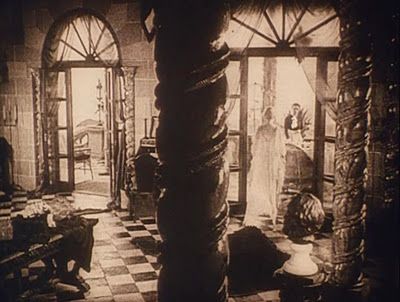
What is impressive about Foolish Wives are the sets.  Watching this through, I assumed it was partially shot on location somewhere; if not Monte Carlo itself, then a spot that looks like Monte Carlo.  But no, it wasn’t.  Nope, von Stroheim being the egotistical bastard he was, he built Monte Carlo, complete with a fake lake, in studio backlots.  Alright, von Stroheim, I’ll give you your due, that’s rather amazing.  Although not perhaps as grand as some of the set work in Intolerance, it’s pretty close.  

  
Many silent films do not translate well with modern audiences.  There are some that do, and some that are still spectacular today, but most feel dated in many ways.  Time has not been kind to Foolish Wives.  The story is one that modern audiences would barely register an interest in, and when you throw on von Stroheim’s ego in insisting this be an “epic” in terms of length, what results is a product few would find compelling. 

Arbitrary Rating: 4/10

Friday, July 19, 2013

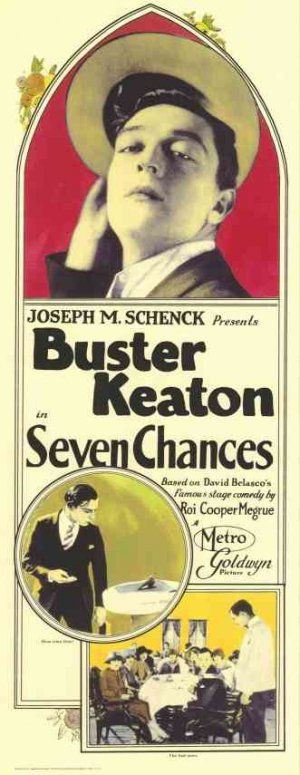
Seven Chances


Seven Chances
1925
Director: Buster Keaton
Starring: Buster Keaton, Ruth Dwyer, T. Roy Barnes, Snitz Edwards

Every time, every damn time I watch Buster Keaton, I’m flummoxed.  Immaculate actor is immaculate.  He’s perfect, amazing, fantastic.  But it’s not just his acting, it’s everything in his films.  Everything is so perfectly choreographed and timed.  Seven Chances is no exception.  For a film that is nearly 90 years old to still provide laughs is amazing enough, but Keaton’s work doesn’t just give you a few laughs, he gives you plenty, and then some. 

Jimmie Shannon (Keaton) is a broker at a firm that’s facing some financial difficulties.  When a lawyer (Edwards) comes to tell him and his partner (Barnes) that Jimmie stands to inherit seven million dollars, they are relieved.  But there are stipulations on the funds; Jimmie must be married by 7pm on the day of his twenty-seventh birthday in order to claim the inheritance.  Jimmie knows who he WANTS to marry – Mary (Dwyer), the girl he’s loved for over a year but been unable to confess his feelings to – but when he botches the proposal, he becomes desperate to find a bride, ANY bride, by 7pm.  Antics ensue.


This scant plot, which is laid out entirely in the first 15 minutes of the film, is all Keaton needs to produce some of the finest silent era comedy I’ve seen.  This is a funny, funny movie.  Although I wasn’t laughing the entire time, I do know that I was smiling the entire time.  Right from the glorious opening scene that establishes Jimmie’s love for Mary, the film won me over.  I was happy and cheery while watching it.  Seven Chances is the film equivalent of valium: watch this movie, and all your woes simply disappear.  You are transported into the gloriously sunny world of Keaton’s comedic shenanigans, and all will be well. 

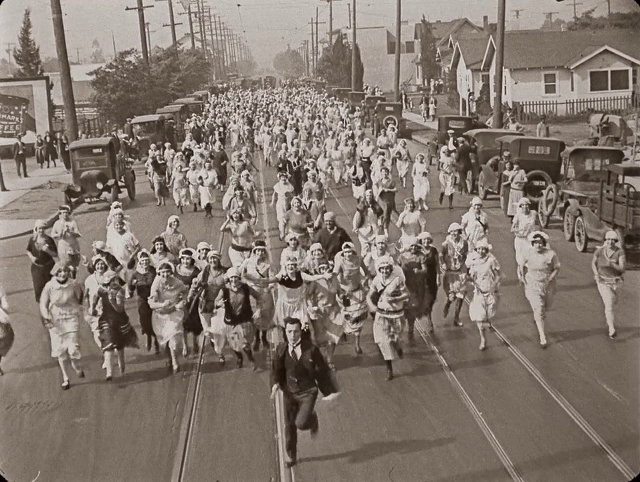
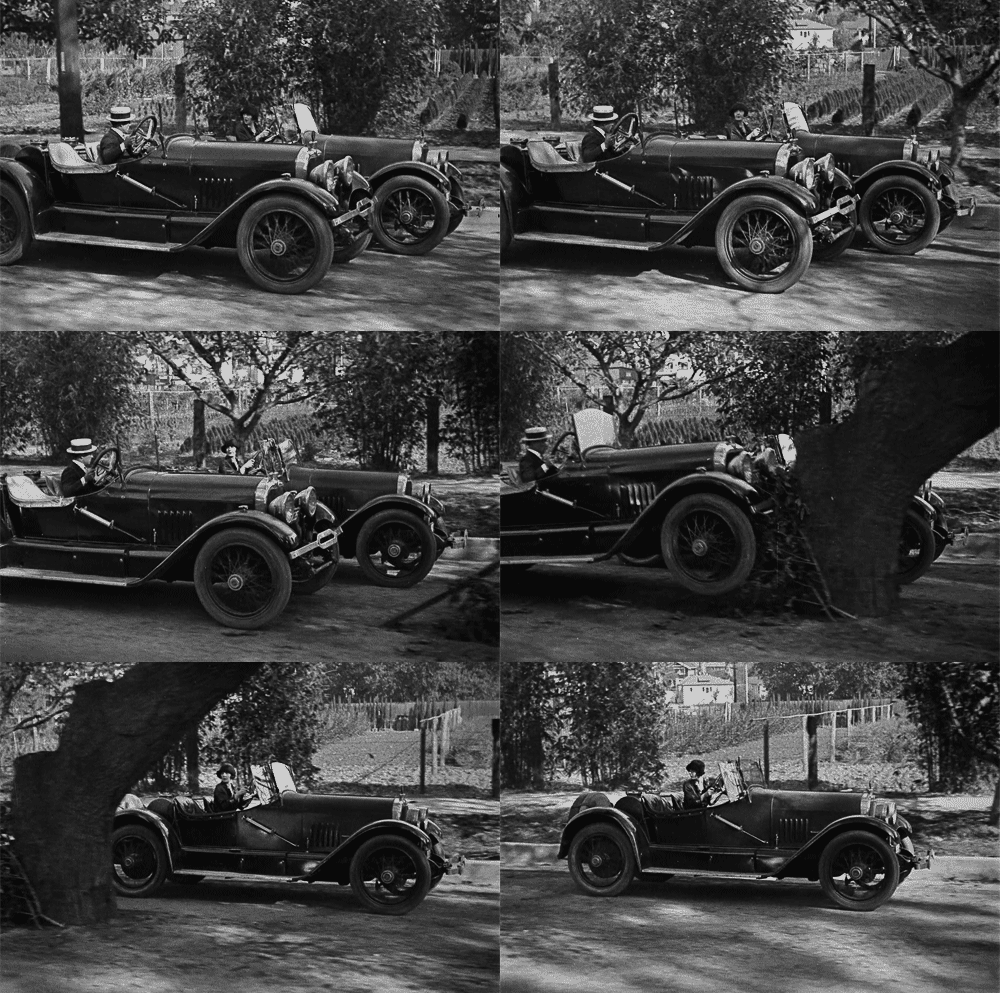
That’s the mood of the film, but I now MUST talk about the laughs, because holy crap on a cracker, this film has them in spades.  Picking a favorite is utterly pointless, because as I watch this over again, there are simply too many to choose from (the hat check girl, the avalanche, the girls on the stairs, the proposal by Jimmie’s partner, the football game, Jimmie’s car unexpectedly hitting a tree, and the classic bride chase sequence are all grand).  What I will say about the spectacular gags is the fact that they all work.  More than that, not a single piece of the comedy feels extraneous.  None of it is there for a cheap laugh.  It’s staggering how well choreographed all the comedy is; one set piece blends seamlessly into the next.  It’s much the same sense of cogency that Keaton has on full display in The General that is, frankly, lacking in many other silent comedies.  In all honesty, maybe this is my favorite thing about Seven Chances; it’s a funny movie that never feels like a disconnected string of skits or gags.  Every laugh you have is because of Jimmie’s attempt to find a bride and get married by 7pm.  We never lose sight of this for a second.

  
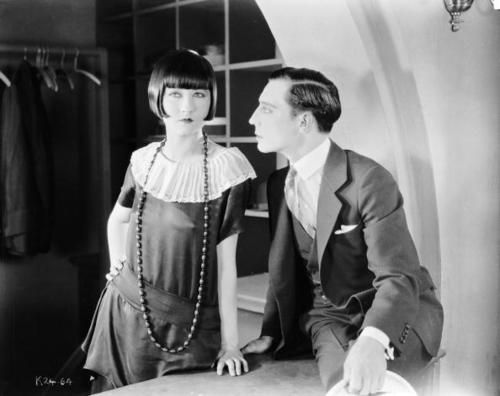
Seven Chances was set in the modern day of the time, and I couldn't get enough of the costumes.  The 1920s fashion that is on display in this film is sublime.  Given that Jimmie is trying to find a bride, we get to see many different women, and they are all decked out to the nines in dripping fringe, cloche hats, fur collars, fantastic coats, and t-strap shoes.  The men are all dapper in straw boaters and immaculately fitted three piece suits.  The wardrobe department did a great job of making everyone look like a million bucks.  If the comedy isn’t enough of a sell, the fashion plate of the film should be.  (I’ll add that I was much amused by all the makeshift veils the horde of brides wears at the end of the film – tartans, towels, bed sheets, whatever will do in a pinch!)

  
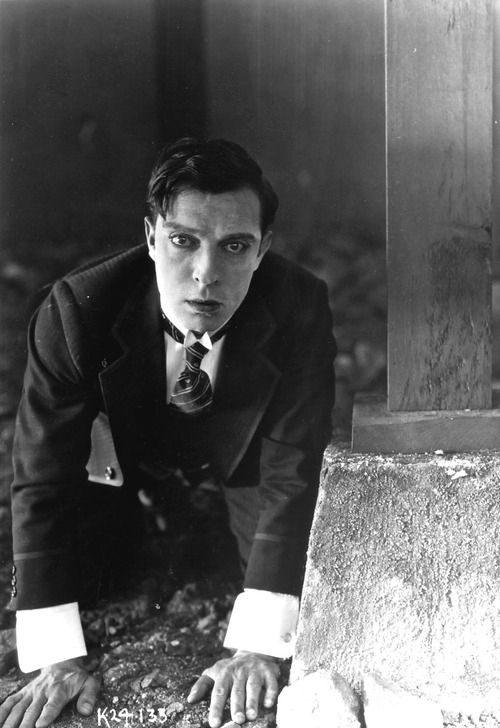
And then there’s the man himself.  Keaton.  Keaton Keaton Keaton.  With this rewatch of Seven Chances, he sealed his case for being my favorite of all the silent comedians (not that there was much doubt).  His classic “stone face” expression provides a straight man around which all sorts of craziness bounces around, and his films are funnier for it.  And then there’s the fact that he does his own stunts, and the stunts in Seven Chances, while not as jaw dropping as those in The General, don’t lack for excitement.  The avalanche sequence in particular is stunning.  And finally, I’ll come right out and admit that despite the fact that this is an old movie, y’know what, I have a bit of a crush on Buster Keaton.  I’ll just leave it at the fact that the man looked damn fine in tight trousers (so much so that I actually managed to find some slightly inappropriate pictures I am choosing not to include here…).

  
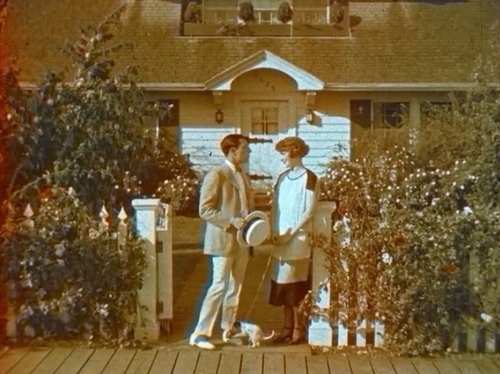
I also have a note on the version I watched, the Kino International edition and that which is available for streaming on Netflix Instant.  The opening shocked me, as it was in color.  A quick bit of research and I discovered this was not added after the fact; Keaton actually shot the opening sequence, where we see Jimmie try to tell Mary how he feels about her over the course of the changing seasons of a year, in Technicolor.  I had known that the three strip Technicolor process was around and available earlier than most people think, but this is the earliest film I’ve ever seen that employed that technology.  It’s stunning, flat out stunning, seeing the flowers and the fashions in an unretouched, true color.  This fact is enough to recommend this particular version of the film, but I will add that the rest of the film, shot in a sepia-toned black and white, is gorgeous and crisp and clear; it looks beautiful even on our 52 inch widescreen television.  I tip my hat to Kino; the Keaton films I’ve seen by them have been gorgeously transferred.   Nice work, guys and gals.  (Their score also works extremely well.)


Seven Chances is a perfect movie to show someone who has never seen a silent film before.  It’s short, it’s light, it’s funny, it moves well, it WORKS.  Keaton was a comedy genius; what he managed to craft in the early days of Hollywood is still so funny it can elicit laughs from modern viewers today.  Seven Chances is absolutely no exception.

Arbitrary Rating: 9/10