Showing posts with label chinese. Show all posts

Saturday, September 14, 2013

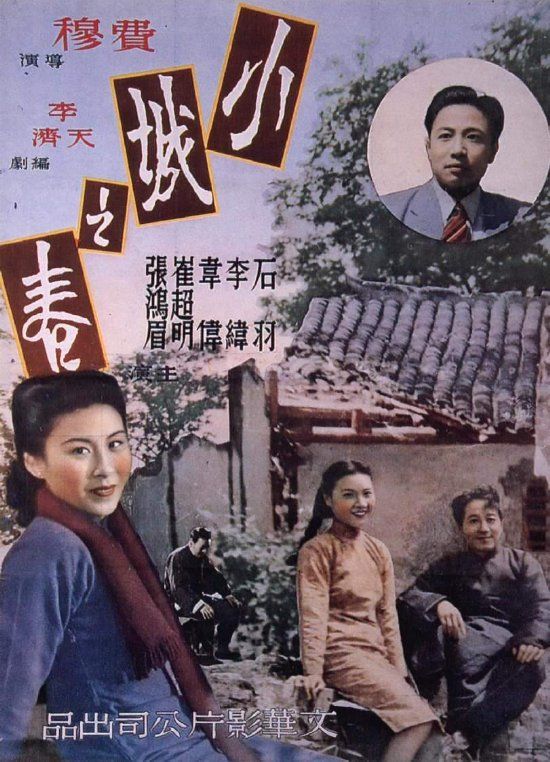
Spring in a Small Town (Xiao cheng zhi chun)


Spring in a Small Town (Xiao cheng zhi chun)
1948
Director: Fei Mu
Starring: Wei Wei, Shi Yu, Li Wei

When I took my first, massive swipe at knocking off titles from 1001 Movies, I went chronologically by decade, something I’m very glad of in retrospect.  The biggest advantage to doing this was to encounter trends in filmmaking as they happened.  The second advantage was watching how national cinemas appeared, or perhaps disappeared.  Take Germany for example: going chronologically, I watched lots of German films in the beginning, then nothing, not for decades.  Rather poignant, that.  On the flip side, there is only one Chinese film that predates Spring in a Small Town in 1001 Movies, indicating that, at least according to the editors of this book, Chinese cinema was still in its birth during the early decades of filmmaking.  Spring in a Small Town was one of the first Chinese films to rise to international stature, one of the first to be considered worth preserving and worth seeing still to this day.

The story is ripped straight from standard drawing room drama tales.  Yuwen (Wei) has been married for eight years to her invalided husband Liyan (Li).  We learn very early on that theirs is a loveless marriage, although they are still affectionate with one another.  She is bored and suffocated by her endlessly repeated existence.  Enter Zhichen (Shi), Liyan’s friend from childhood and Yuwen’s former love.  Her resolve is thoroughly tested as the passion she used to feel and thought dead and buried begins to rise again.
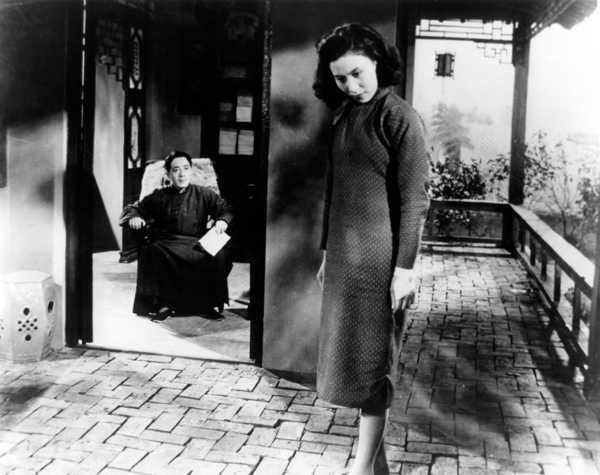
  
I find it fascinating to discover the same sort of tropes I’m used to encountering in Western costume dramas here, in a Chinese film from the forties.  I think that’s telling; it indicates that there are similarities between all cultures, even in basic romantic storylines.  How often have I seen this story played out, this sad sort of repressed love?  Many, MANY times.  I don’t hold this against Spring in a Small Town, the fact that it’s telling a story I’ve heard before; if anything, I like it more for telling a story I am familiar with from its own unique cultural perspective.  And the China that is on display in Spring in a Small Town is from a very distinct time period and culture.  (I will at this point reiterate my comparative ignorance about world history – thank you, New Hampshire public education – so please, this is just a quick review of what I taught myself on the interwebs; if I am grievously mistaken on anything, please let me know.)  The second world war was over, China was no longer under Japanese control, but the Communist Revolution had not yet taken over.  This was a relatively short time period, and the artistic result is a film with very little, if any, political commentary.  Spring in a Small Town is a simple, sad little romance about a repressed woman and her long lost lover who is definitely NOT her husband.  It does not feel allegorical or symbolic of larger issues.  No, it is simply a romantic drama, nothing more or less.  This is probably a large reason of why, when the Communist Revolution did succeed, Spring in a Small Town was roundly denigrated, then forgotten, and nearly destroyed.  I’m glad the film survived, though; it’s worth a viewing, at least one, because of its purity of intent and because, well, it certainly does repression well.
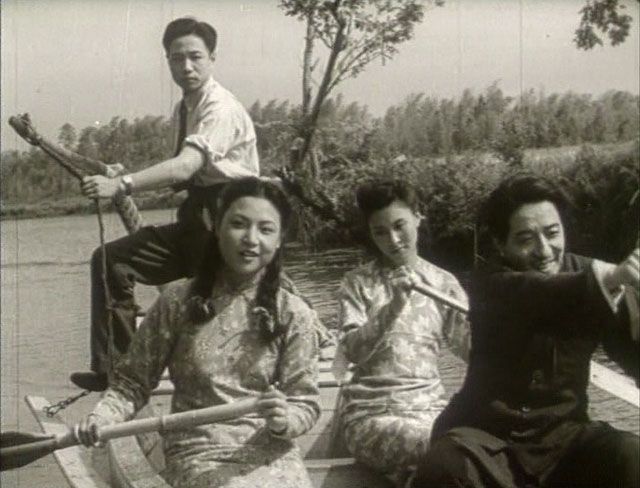
  
Spring in a Small Town gets very angsty.  It moves slowly – it is practically the definition of the slow burn.  And there’s little payoff.  In my first go around with Spring in a Small Town, I remember feeling enraptured by this furtive, repressed romance between Yuwen and Zhichen.  This time, I was less affected by it, but it still has its moments.  Despite the, um, VERY slow build up, I was still caught up when Yuwen gets drunk, slips up, and throws herself at Zhichen.  And it takes every smidgen of strength he has to do the honorable thing.  And I rather enjoy it.

Spring in a Small Town is very reminiscent of Brief Encounter.  Repressed woman narrating her own tale of romantic feelings for a man, a doctor, who is not her husband?  Brief Encounter.  Frankly, Brief Encounter does it better – loads better – but the voice over narration in particular I find important in Spring in a Small Town.  Just like in Brief Encounter, it is crucial in providing us a critical window to Laura’s soul so we understand her, we need that gateway to Yuwen, perhaps even more so.  As much as Laura presents a calm façade to the outside world, Yuwen is one hundred times more serene on the outside, never letting on for a second what might be happening under the surface.  This is actually a bit of a detriment to the film; I needed more than a voice over to convince me of the magnitude of Yuwen’s feelings, and the actress didn’t quite manage to convince me on performance alone.
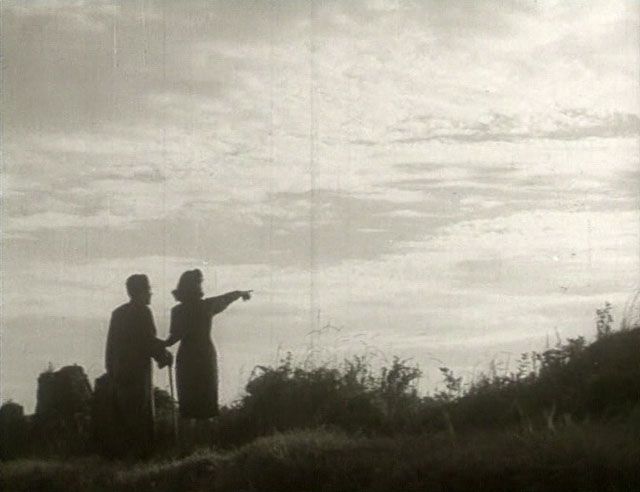
  
The other major mark against Spring in a Small Town is the condition of the film itself.  This is, sadly, a film that has not been preserved well in the slightest.  The DVD is watchable, certainly, and the English subtitles were clear (not always a given), but the image is hazy and foggy and full of scratches.  The sound isn’t any better; it’s muffled and the background static is incredibly loud.  Even the original filming conditions seem less than perfect, as the background noise cuts out in certain parts of scenes, indicating that there was just no sound, PERIOD, while recording.  The story works well enough in Spring in a Small Town, but the logistics are incredibly lacking.  It’s very difficult when it’s this bad not to let this affect my read on a movie. 

Spring in a Small Town was remade in China in the early 2000s, and I’m not surprised.  The story is universal enough and works pretty well, but the original film could use a brush up, more style, better acting, and any sort of a soundtrack.  I have not seen the remake, but I’m glad at least someone thought it worthy of telling again.  Frankly, though, if I want angsty romance, there are plenty of other films I’d choose over Spring in a Small Town (Brief Encounter most definitely).

Arbitrary Rating: 6/10


Thursday, June 6, 2013

A Chinese Ghost Story


A Chinese Ghost Story
1987
Director: Ching Siu-Tung
Starring: Leslie Cheung, Joey Wang, Wu Ma

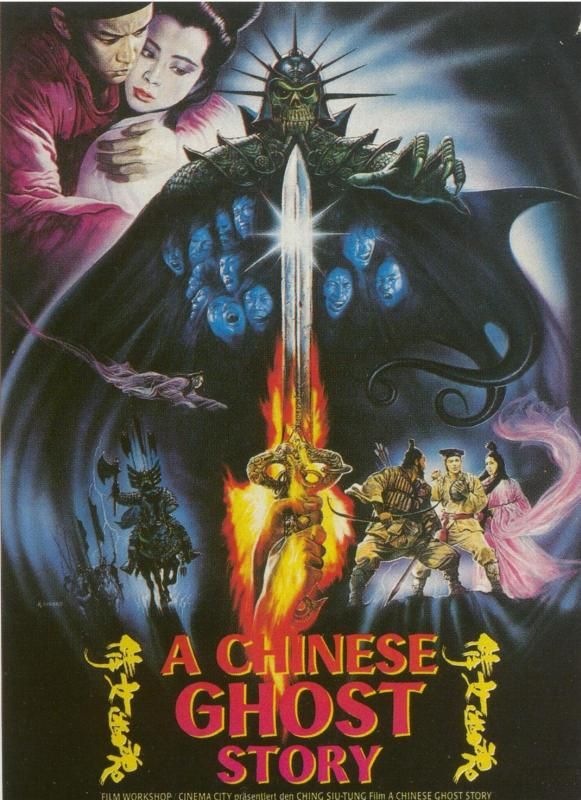
Wikipedia describes A Chinese Ghost Story as a romantic comedy horror film.  Yes.  Agreed.  A Chinese Ghost Story plays fast and loose with the strictures of genre, deciding to be a little bit of everything, albeit a master of none.  If nothing else, A Chinese Ghost Story will entertain (although I highly doubt it will elevate).

The somewhat complicated plot focuses on a lowly tax collector, Ning Tsai-Shen (or at least that was his name in the version I watched, imdb and Wikipedia list a different name for the character played by Cheung).  His work takes him to a town where there is a haunted temple, and he is forced to spend the night there where he encounters a Taoist swordsman (Wu) and later on, a lovely young woman named Nieh Hsiao Tsing (Wang).  Quickly, though, we realize Tsing is a ghost, and later learn that she is shackled to the service of an evil tree monster who forces her to kill wicked men on earth in order to feed on their souls.  When Ning and Tsing fall in love, you’d think the most complicated thing in their way is the fact that he’s mortal and she’s not, but no, the spirits of the underworld are constantly trying to keep their burgeoning romance from getting off the ground.  Not to fear, though, our Taoist swordsman to the rescue!

 
Before I go any further, a massive tip of the hat to Chip from Tips from Chip for supplying me with the video for this rather elusive entry in 1001 Movies.  So thanks, Chip, couldn’t have seen it without you!

As I was watching the opening credits of A Chinese Ghost Story, I noticed a name.  “Produced by Tsui Hark.”  That sounds familiar.  A quick imdb search, and my stomach plummeted.  Tsui Hark was the director of Once Upon a Time in China, that utter waste of my time.  Is this another giant muddled mess?  Well, to cut a long story short, while A Chinese Ghost Story is definitely a bit muddled, it was more enjoyable – dare I say a great DEAL more enjoyable? – than the poop that is Once Upon a Time in China.  Astonishing, the difference a semblance of a coherent plot manages to make.

There a great number of flaws in A Chinese Ghost Story.  This is definitely a Chinese film made for the Chinese people.  There is a cultural disconnect between this film and the type of film typical American audiences see.  The humor in the film is, frankly, utter crap.  Completely over the top, there is not a single drop of comedy in this film more sophisticated than the basest of The Three Stooges gags.  All the side characters aren’t characters but cartoons walking around making funny noises and saying ridiculous lines.  Frankly, it’s stupid.  And then there’s the soundtrack.  Clearly, the unfortunate aspects of eighties pop silliness were not contained to America, as clearly evidenced by the synthesizer heavy, electronic effects-laden accompaniment.  In a rather spectacular display of cheese, we get a power ballad under a montage of flashback scenes that WE HAD JUST WATCHED.  Yes, I know the history of this couple BECAUSE I WATCHED THIS SCENE NOT FIVE MINUTES AGO.  The power ballad… shudder.  And while overall, I do think the plot is coherent, it’s only just barely so.  It comes dangerously close to flying completely off the track completely on more than one occasion.  

 
And yet.

Wikipedia’s romantic comedy horror film does not work on the comedic aspect for me – AT ALL – but it works on both the romance angle and the horror angle.  The horror aspects, while perhaps not being legitimately frightening, are distinctly atmospheric.  And, um, can I just say The Evil Dead?  Because clearly, CLEARLY the group behind making this movie was a big fan of Raimi’s earlier film.  In the opening sequence, the one that establishes the danger of our heroine, we get Raimi’s classic POV tracking shot of something that’s racing along the forest ground toward the unwitting victim.  Later on there are stop-motion animated grisly skeletons buried in the cellar of the remote temple, and when Ning encounters them, there is more than a small “cabin in the woods” feeling.  There is flesh that oozes and dissolves and bubbles, again making me think of very specific scenes from Evil Dead, a gigantic deadly magic tongue – yes, tongue – that is pure Raimi, and even the evil tree with branches that come to life to trap its victims is straight from Raimi’s playbook.  Am I a fan of The Evil Dead?  Not particularly, but it’s interesting that a camp classic American horror film from 1981 manages to fairly profoundly influence the production design of a camp classic Chinese horror film from 1987.

 
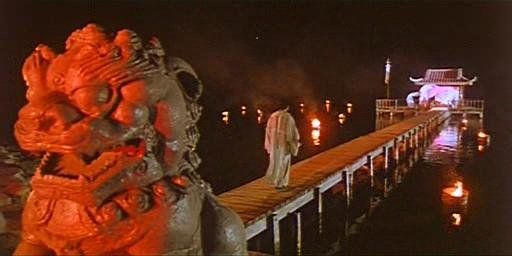
Apart from the abundantly clear and fairly massive nod to The Evil Dead, there is a lyricism to the spookiness and romanticism of the rest of the film.  As Ning walks through the woods at night, flooded with fog and blues and Tyndall scattering, the film is beautiful.  As Tsing rises gracefully in the air and unfurls her silky robe and we watch it wave in the wind, the film is gorgeous.  And despite the ill-timed montage of romantic scenes I mentioned earlier, it’s actually pretty sweet watching Tsing and Ning fall in love.  Ning, despite the screenwriters’ best efforts, manages to avoid most of the cartoon grotesquerie that renders the smaller characters unwatchable, and retains a sense of righteousness that doesn’t feel forced.  He’s just a regular guy with a sense of right and wrong who won’t force himself on a random woman he comes across in the woods (and sadly, that right there sets him apart from nearly every other male character in this movie).  This regular guy who is forced to do battle with the demons of the underworld deserves his happy love story.  I was rooting for him, I really was.

 
While I will definitely admit to A Chinese Ghost Story being more than a little silly, I also rather enjoyed it.  The hero is likeable and not too cartoon-y, the ghost heroine is ten times more badass than the hero, the fight scenes are fun but, importantly, don’t drag on too long, and I latched onto the plight of the central couple very well, which made me root for them and gave me a reason to keep watching.  In short, when you strip away the frills and adornments – the stupid side characters, the pretty awful music, the unnecessary aspects of the plot – there’s a strong central tale that is convincingly romantic and fairly spooky with some cool fight sequences. 

Once Upon a Time in China be damned, I had some fun with this one, its cinematic cousin.

Arbitrary Rating: 7/10

Tuesday, May 28, 2013

The Killer


The Killer
1989
Director: John Woo
Starring: Chow Yun-Fat, Danny Lee, Sally Yeh

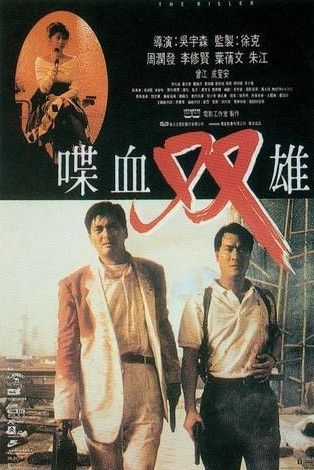
Although I knew this would be a fundamentally different film, I was a little hesitant about popping in the DVD for The Killer based on the complete ridiculous mess that was Once Upon a Time in China, which I had watched only a few days previously.  I kept on repeating to myself, “different director, different setting, different movie.”  I really needn’t have felt even the slightest tinge of worry.  While Once Upon a Time in China has great fight sequences held together with inane and ludicrous “plot points,” The Killer is a very coherent and engaging shoot-‘em-up bloodbath – just what one would expect from John Woo.

 
A killer, who goes by Jeffrey in the English subtitles (Chow), is a hired assassin with a conscience.  When he accidently blinds nightclub singer Jennie (Yeh) in one of his hits, his guilt drives him to reach out to her to make sure she’s alright.  At the same time, determined cop Inspector Li (Lee) starts hunting Jeffrey after he takes out a corrupt businessman Li was guarding.  When Jeffrey doesn’t get the agreed upon payment for a hit, he starts gunning for those who hired him, all while Li closes in on him, getting more entangled in Jeffrey’s world.  

 
A great deal of why The Killer succeeds is because of Chow Yun-Fat and Danny Lee.  Both actors are incredibly charismatic; in his very first scene, Chow Yun-Fat got me on his side, even while pulling off a professional hit, through his sheer force of character.  He’s a killer with a soul, a sense of right and wrong (ironically enough), and he exudes a soft, caring, artistic nature underneath his cool exterior.  When Lee is introduced, it doesn’t take long to establish how awesome he is; he’s intense, brooding, clever, and aggressive, but in an awesomely fantastic way.  Furthermore, both actors are playing very interesting and fundamentally likeable characters.  Despite the fact that Jeffrey and Inspector Li are technically working against one another – lawman versus assassin – it’s hard to pick sides.  They are both so effin’ awesome, so effin’ smart, and so effin’ bad-ass, that I found myself rooting for both of them.  I wanted both of them to succeed.   


And then, just when I was thinking that I couldn’t decide between them, the movie pulls out one of my husband’s all time favorite tropes: the teaming up of mortal enemies in order to fight off even worse enemies.  While my husband probably enjoys that particular story angle more than I do, I like it too, and in the case of this film, it was pitch perfect.  Li and Jeffrey even talk about how alike they are, and the film makes this point very clearly.  The fact that one is an assassin and the other a cop is a mere technicality.  My mother-in-law would call them “twin souls.”  Watching them fight off evil nasty crooked criminals together was a thing of joy.  Their relationship became so intense that the character of Jennie, love interest for Jeffrey and possibly Li as well, felt far more like a clunky plot device than a real character in the film.  I really don’t care about what happens between Jennie and Jeffrey, but I very much care about what happens between Jeffrey and Li.  As the 1001 Movies book notes, the direct translation of the movie title is not “The Killer,” but “Bloodshed of Two Heroes.”  After watching this film, I strongly agree that this title is far more descriptive of the central relationship of the film, focusing instead on the pair of Li and Jeffrey rather than just Jeffrey himself. 

 
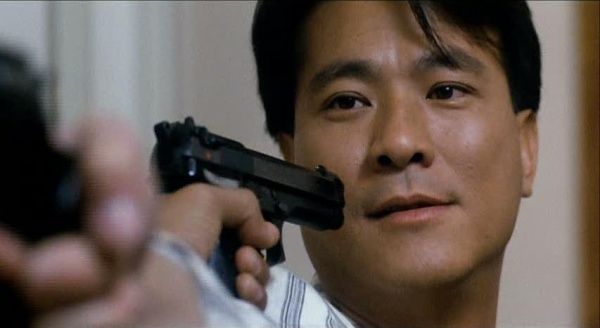
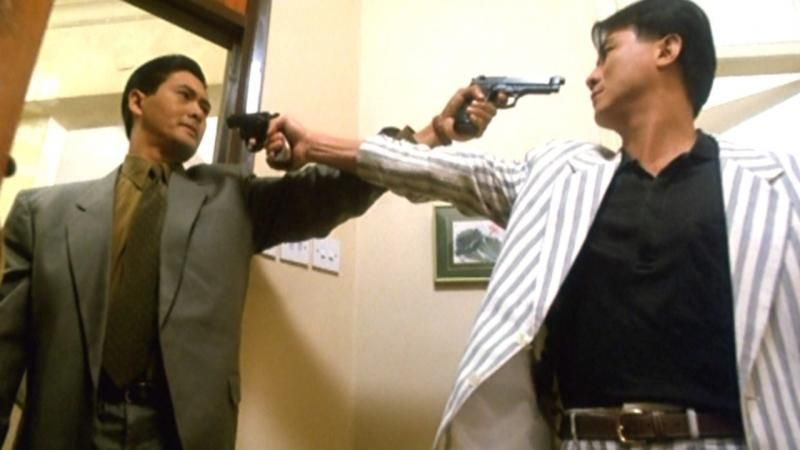
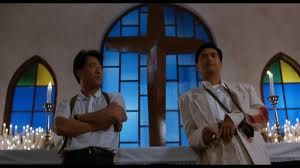
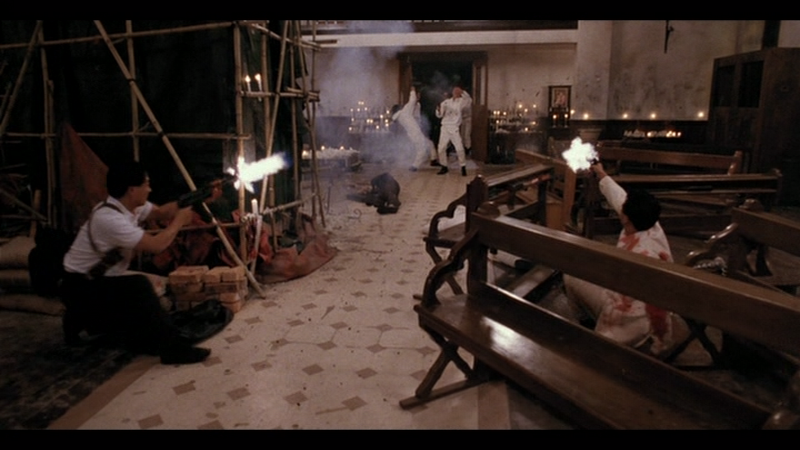
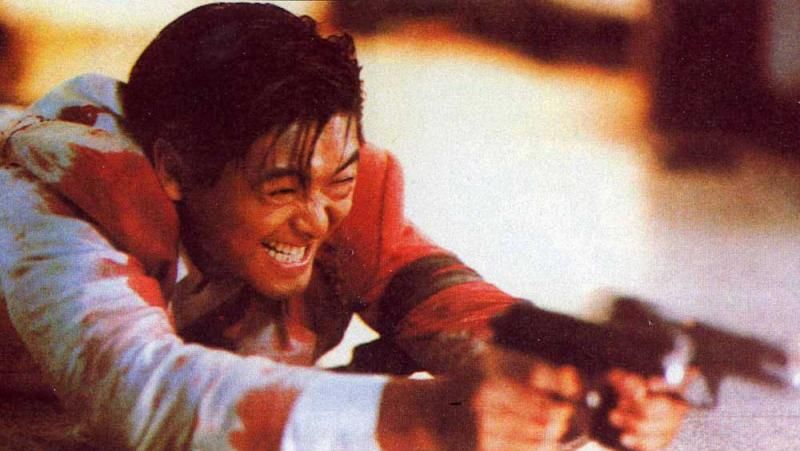
Another part of why I enjoyed this movie as much as I did was the sheer level of bad-assery in this movie.  Seriously, it’s off the charts.  In the opening hit, Chow Yun-Fat, an actor whom I am slowly realizing I don’t know nearly as well as I thought I did, puts all well-known Western action heroes to shame.  He’s so. Damn. Cool.  Throughout the film, he just keeps getting cooler and cooler, and more and more badass.  And then there’s Danny Lee, who’s all badass too, but on the right side of the law, which in a way makes him even MORE badass.  Together, they pull off some crazy bad-ass shit.  A favorite sequence of mine involved the two of them meeting each other at Jennie’s home, each holding the other at arm’s length and gunpoint, all while blind Jennie doesn’t realize the two men are in a standoff.  The fight scenes are beautifully choreographed bloody gun battles, bathed in red and exploding blood packs which allow our two heroes to show off their preternatural shooting abilities and bullet-dodging prowess.  Which, of course, makes them super-badass.  It’s easy to see how this film influenced the likes of Quentin Tarantino, with fight scenes full of such ludicrous bloodshed and body counts where even the innocent aren’t spared, all while occasionally cutting to slow motion to showcase the tranquil beauty of a candlelit church and the flapping of a dove.  Then, of course, Chow Yun-Fat slides across the floor on his back, double-fisting his guns and shooting about a billion bad guys dead, and we’re right back into the insane action yet again.  Like I said: badass.

 
Although I enjoyed the fight scenes, I do think they are absolutely ridiculous.  Chow Yun-Fat is not physically capable of mowing down forty attackers at once while escaping unharmed in real life.  I am amused by how all of the bad guys in this movie have automatic assault weapons and our heroes only ever seem to have six-shot pistols, and yet all the automatic assault weapons seem to constantly miss their targets, while the two dudes with the piddling little guns never miss a single damn shot (or never need to reload, either).  One or two versus fifty?  No problem!  Watch our heroes mow down every villain in their way despite the fact that they are massively out-manned, out-gunned, and out-maneuvered.  The villains must go to some special school of villainy that teaches them how to consistently miss their targets (this is the same school that the stormtroopers attended as well).  Action movies, to me, are totally ludicrous and completely unrealistic.  But if all the ridiculousness is done well, I can absolutely still enjoy them!  Yeah, it’s not realistic, and yeah, to some extent, it removes me from the film, but magically, I can get past that leap of logic and enjoy the movie.  Throwing logic out the window every now and then is good for the movie-viewer’s soul.

 
Overall, The Killer is a very fun movie with killer fight sequences (ha ha), two awesome badass main characters doing badass shit who I wound up having a bit of a crush on by the end (threeway!!!!) and more dead bodies than you can shake a fist at.  More poignant than I was expecting, I am now left wondering why on earth Criterion discontinued its DVD of The Killer.

Arbitrary Rating: 8/10