Showing posts with label japanese. Show all posts

Tuesday, October 1, 2013

Happy Birthday to ME (AND SUNNY D!!!)


It's sad when my birthday gift to myself is FORCING myself to leave work after "only" working a 10 hour day instead of my typical 12.  

ANYWAY, YAY IT'S MY BIRTHDAY SO HERE!!!  HAVE A REVIEW OF A FILM I VERY MUCH ENJOY!!!


Tampopo
1985
Director: Juzo Itami
Starring: Tsutomu Yamazaki, Nobuko Miyamoto, Ken Watanabe

“So, you’re watching a movie too?  What are you eating?”

A guilty pleasure show for both me and my husband is Guy Fieri’s Diners, Drive-Ins and Dives on the Food Network.  We call it food porn because everything looks so damn good, and it makes both of us really hungry for really greasy food.  But when it comes to true food porn, I don’t think anything can really surpass Tampopo, a film that is quite possibly the best foodie movie I’ve ever seen.  A little bit of everything and never taking itself terribly seriously, Tampopo is nothing if not exuberant about the joy of eating.

Tampopo (Miyamoto) is a widowed young mother running the noodle shop her husband left her, but not running it very well.  Toro (Yamazaki) is a truck driver who wears fedoras and is accompanied by sidekick Gun (a young Watanabe).  When Toro and Gun stop by Tampopo’s place, taste her mediocre noodles, save her son from bullies, and beat up the bad guys infesting her restaurant, she begs them to stay to teach her, train her, and help her become the best ramen noodle shop around.

This central story, while not the only focus of the film, is a fascinating journey of doing one thing, and doing it well.  I can only think of the word “joy” to describe watching Tampopo transform her noodle shop.  It’s such a simple premise, but it works.  Slowly, step by step, Goro guides Tampopo through the process of becoming a great chef.  It’s just fun, watching them find a broth expert, then a noodle expert, then an interior design expert.  Everything gets a makeover, including Tampopo herself, and it gives the movie focus, and if there is some skewering of Japanese and American customs along the way, so much the better.  It’s honestly difficult to tell at certain points if Tampopo is presenting its story as tongue-in-cheek, or if it really is just blushingly sincere, and quite frankly, the film can be read either way.  For me personally, however, despite my rampant cynicism in other areas of my life, I choose to read Tampopo’s tale as one of straightforward zeal.  When Tampopo triumphantly serves her excellent ramen at the end of the film, the story has been building so subtly but so insistently that I find myself wanting to stand up and cheer.  Over a bowl of noodles.  There is nothing cynical, to me, in her final success, and I am with her every step of the way.

And yet, if that’s all you think Tampopo is, you’re missing out.  The above is merely the main storyline, the connective thread from start to finish, but there’s so much more here.  There are tangential vignettes, comedy spoofs, and montage sequences that hold everything together, creating some bizarrely humorous yet incredibly endearing whole.  A group of Japanese women are taking lessons on how to eat Italian spaghetti and fail miserably at not slurping the noodles.  A young businessman thoroughly outclasses his older colleagues at French restaurant.  A woman on her death bed rises in order to prepare dinner for her family (it sounds sad, but it’s actually laugh out loud funny, especially when Dad tells the kids to “eat it while it’s still hot!” right after Mom dropped dead).  And then there is piece de resistance, the actual food porn.  I wasn’t kidding with my opening; there is a couple dressed in white that is continually cut back to that include food thoroughly in their love play.  Seriously, this part of Tampopo is food porn.  But it’s never too serious or too melodramatic or even too vulgar; all these odd little asides from the main story help to create a mood of charm and whimsy, that key atmosphere of irreverent and joyous fun that makes Tampopo so special. 

 
Tampopo runs fast and thick with movie references, ranging from the obvious (a Rocky training session even involving the gray sweat suit) to the more subtle (I swear, when a “vagabond” makes a rice omelet for Tampopo’s son, it’s meant to mimic Charlie Chaplin).  Not what you were expecting from a movie about food?  Me neither, but that’s one of the wonderful things about Tampopo.  Goro wears a fedora nearly identical to Indiana Jones’, and in a dream sequence, Tampopo herself is in full-on American Western garb as the film takes on a decidedly “Gunfight at the OK Corral,” John Ford feeling.  The Western themes, in particular, are laced throughout the entire film and are easily the most recognizable to American audiences.  So what if, ten minutes later from the aforementioned dream sequence, Tampopo then swings wildly away by referencing the heartbreaking final scene from Ichikawa’s The Burmese Harp?  Don’t overthink it.  Tampopo is all about food and reverence for food, but only slightly below food is a reverence for cinema. 

All of this makes Tampopo wonderful, but what really sets it over the edge is how the film becomes sneakily emotional in its climax.  Yes, there are hints of a romance between Tampopo and Goro throughout the film, but in the finale, when she finally reopens her wonderful new shop and serves her wonderful new ramen to hordes of people who appear as if from nowhere, the movie becomes sadly wistful.  Goro gazes at Tampopo and sees… what?  Regret?  Pride?  A lost love?  A job well done?  The answer is all of these things, but this is a scene thick with unsaid emotion.  There was definitely a lump in my throat and my eyes got a little misty.

Again, all in a movie about noodles.

With a soundtrack taken mostly from Mahler’s First Symphony (an interesting East-meets-West comment right there) that is as whimsical yet powerful as the film itself, you really can’t go wrong with Tampopo.  It is a joyous celebration of food, life, and cinema, all blended together, never getting too serious, but getting just serious enough.  My only warning is that you will be absolutely dying for a bowl of good quality ramen by the end of the film.

Arbitrary Rating: 9.5/10

Saturday, August 3, 2013

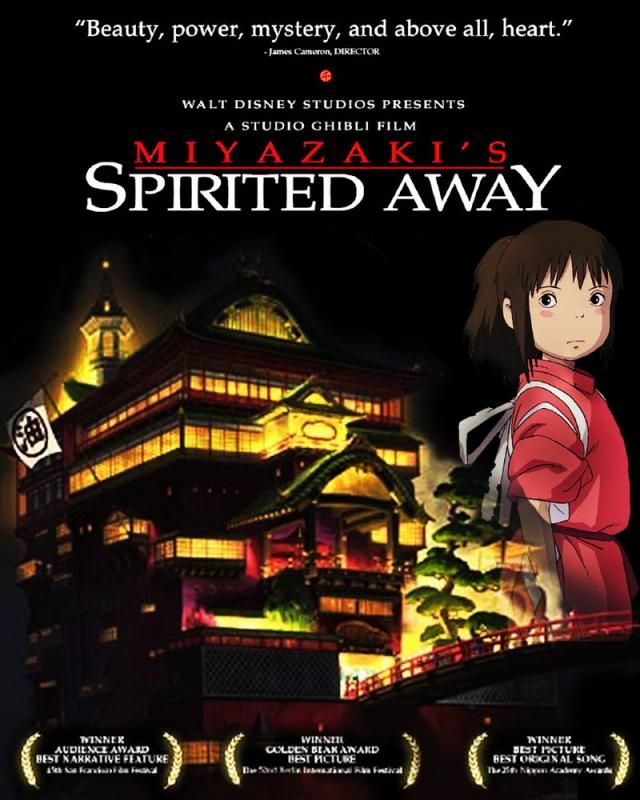
Spirited Away (Sen to Chihiro no kamikakushi)


Spirited Away (Sen to Chihiro no kamikakushi)
2001
Director: Hayao Miyazaki
Starring (in English language version): Daveigh Chase, Suzanne Pleshette, Jason Marsden

I don’t really care for “children’s movies.”  I think I overdosed on them too much when I was growing up; I remember coming home from college and my parents taking the family out to see the latest Pixar movie in theaters when I would much rather have seen, well, anything else.  Too many viewings of Monsters Inc (no offense, Pixar) have kept me from seeking out other animated or children’s fare, so most of the recent children’s films in 1001 Movies I have yet to see.  Spirited Away is a very nice, lovely children’s movie, but it hasn’t exactly changed my mind.

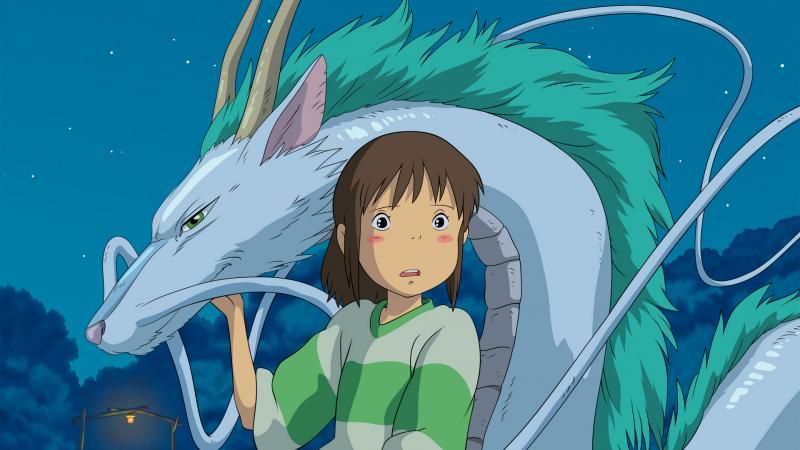
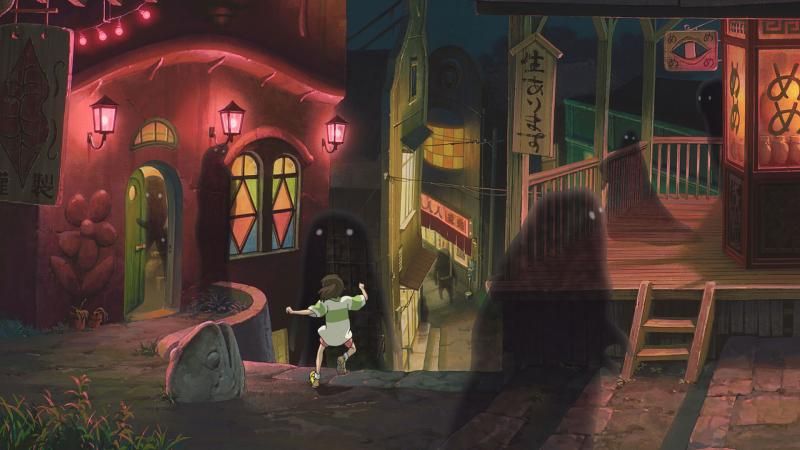
Ten year old Chihiro (Chase) is being carted off to live in the suburbs against her will by her parents.  On their way to the new house, her family stops at what appears to be an abandoned theme park.  Her parents are excited, but Chihiro is wary.  After eating some mysterious food, her parents turn into pigs and Chihiro realizes something is dreadfully wrong.  She has entered into the spirit world, and the place is actually a bath house for wealthy spirits run by the menacing Yubaba (Pleshette).  With the help of Haku (Marsden), a young man who is also a trapped dragon spirit, Chihiro must navigate this new world and learn to play by its rules in order to free her parents and get back to where she belongs.

  
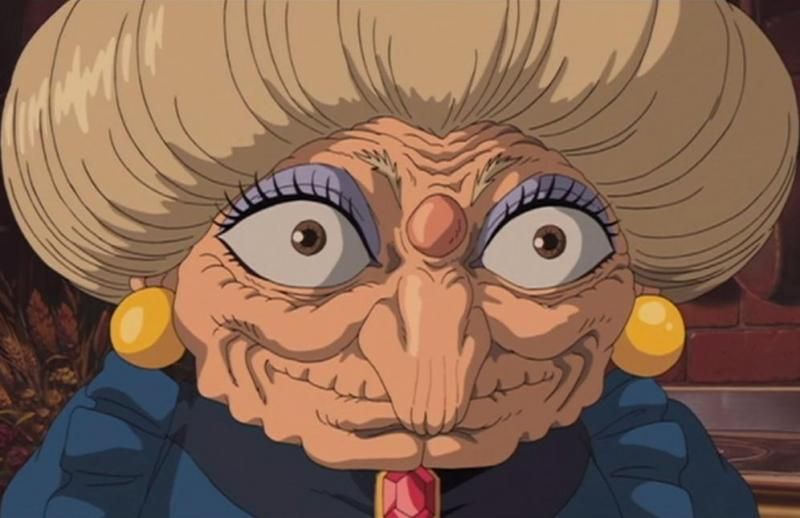
The story of Spirited Away is reminiscent of a fairy tale, and I highly doubt I’m the first to make such an association.  The concept of an ordinary human being journeying through an alternate realm full of magic brings Alice in Wonderland to mind first and foremost, but other standard tales just as well.  I was reminded of Andersen’s “The Snow Queen” in terms of the idea of a human character forced to go through the trials and tribulations of a magic world she doesn’t understand in order to save her family.  Yubaba’s name obviously conjures up images of Baba Yaga from Eastern European folklore, and although the name might be a mere coincidence, the character herself only strengthens such an association.  Yubaba’s face is always precisely what I pictured Baba Yaga to look like (although my Baba Yaga never wore a blue Victorian gown).  Yubaba transforms into a bird, and Baba Yaga lived in a hut on top of a chicken’s leg, and Baba Yaga herself is an ambiguous character.  Although Yubaba is certainly the closest Spirited Away has to a villain, she is not wholly evil, and her twin sister Zeniba is downright kind and maternal, another possible reading of Baba Yaga.  Finding these European fairy tale tropes together in a Japanese film is surprising, certainly, but for me, it helped to cement the world of magic and mysticism.  What’s more, I appreciate that there is always a sense of danger in the magic of Spirited Away, just like there is in so many of the original European folk stories.  This is not Disney’s prettified world, there is still damp and ugly and danger.  This, to me, is what fairy tales are all about.

  
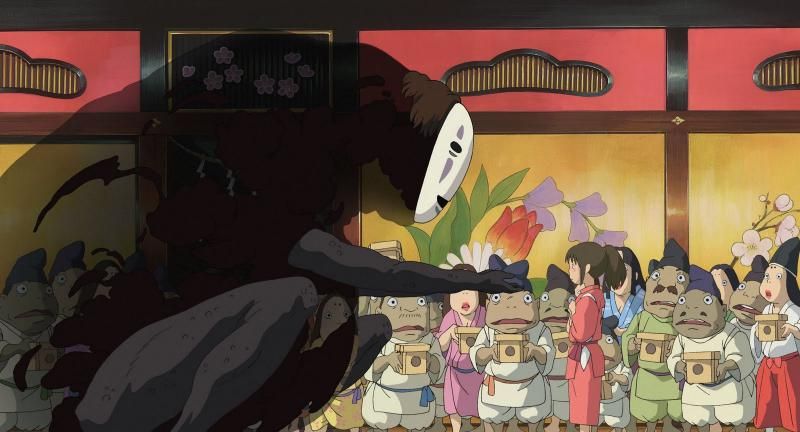
But where Spirited Away diverges most significantly from its fairy tale aura is in its presentation of good and evil.  The only other Miyazaki film I’ve seen prior to this is Princess Mononoke, and both these films treat good and evil similarly.  Miyazaki is a surprisingly even-minded storyteller when it comes to this, as I have yet to see a character in these two films that is completely bad.  Rather, there exists a spectrum, and the characters are fluid in their placement along it.  For example, Yubaba, as mentioned above, is the closest thing Spirited Away has to a villain, and yet at one point, she ecstatically hugs Chihiro.  Motivated less by power and more superficial greed, she bends and compromises when she has to, a trait incredibly uncommon to typical villains.  By the end of the story, she feels not so much evil as merely shallow.  Then consider Haku, Chihiro’s friend and guide.  Although I implicitly trusted him when he first shepherds Chihiro through the world, we are almost immediately met with disparate opinions about Haku.  We are told he is a thief, a henchman, and untrustworthy.  I began to doubt whether I could trust him after all.  No-Face, Lin, Kamaji, and the giant baby are all other characters that are difficult to read.  Whose side are they on?  Are they helpful or harmful?  And the thing is, they’re all a bit of both.  Maybe there isn’t such a thing as ‘all right’ or ‘all wrong,’ and to see this ambiguity presented in a children’s animated fairy tale is impressive.  In fact, the only character who can be considered truly “good” in the typical sense is Chihiro, and we must remember she’s rather sulky at the beginning.  I appreciate this take on morality, and as I said, it coincides completely with what I remember of Princess Mononoke.  The characters in Miyazaki’s films feel richer because of this refusal to simply “pick sides.”

  
Here is where I should probably mention the animation.  Of course it’s amazing, it’s Studio Ghibli.  My favorite component of the animation is the background design.  It’s breathtaking as the world of the spirits is slowly built; as Chihiro and her family explore the abandoned theme park, we see more and more buildings, and then the great bath house appears.  This world, the rooms, the sets, so to speak, are gloriously detailed and full of rich, vibrant color.  Yes, the characters are all incredibly imaginative – No-Face was probably my favorite design – but I really love the backgrounds.  Beautiful.

  
Spirited Away is a lovely, magical tale that clearly coincides with a coming of age story for its central character.  Chihiro must find her strength and adaptability in order to survive this strange new world with its ever-shifting characters.  It’s really quite nice, but I’m not a huge fan of children’s movies in that I would rarely, if ever, choose to watch a film that self-identifies in this way.  Although I don’t think I’d ever watch this again, I enjoyed my time with Spirited Away.

Arbitrary Rating: 7/10

Wednesday, June 19, 2013

Throne of Blood (Kumonosu-jo)


Throne of Blood (Kumonosu-jo)
1957
Director: Akira Kurosawa
Starring: Toshiro Mifune, Isuzu Yamada, Akira Kubo

I have a thing for Shakespeare.  In college, with a biochemistry major and an honors program minor, I had almost no time in my schedule for electives of my choosing.  In fact, I only ever chose two electives, and it wasn’t until my senior year I had the space available in my schedule.  The first elective was the standard Shakespeare literature course the college offered (because biochemistry majors totally need to take Shakespeare).  The second was an independent study with the professor of the aforementioned Shakespeare course where I designed my own project.  What did I design?  I examined different film adaptations of Shakespeare plays and compared them to the original texts.  Again, because biochemistry majors clearly need to do this.

I really wish I had known about Throne of Blood back when I was doing that independent study.  It would have been an amazing film to examine in that context.

  
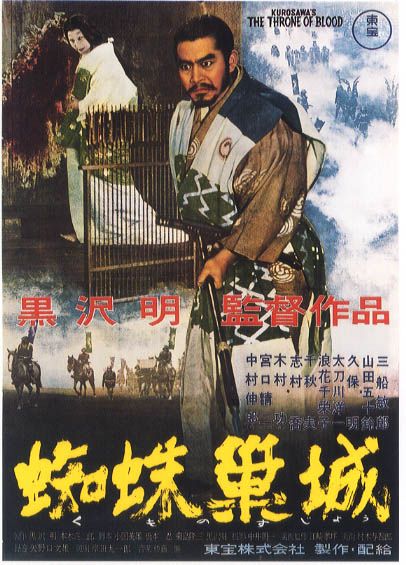
Throne of Blood is Macbeth set in feudal Japan.  Warrior Washizu (Mifune) is Macbeth, and the film opens with him and his friend Miki (Kubo), the Banquo role, riding back to their lord after finding success in battle.  They find a spirit in the woods who tells both of future success, specifically Washizu that he will rule the land, and tells Miki that his son will then rule the land.  Both men laugh, but when the spirit’s predictions begin to come true, the psychological battle begins.  Washizu’s wife, Lady Asaji (Yamada), goads her husband to off his superior to become high ruler.  Issues of power, corruption, greed, and guilt are explored as violence begets violence.


Of all the Shakespeare plays, films, and various adaptations I’ve seen, Macbeth is the play that has been presented most creatively and in many different settings.  I’ve seen it live three times, one of which was a deaf student production with deaf actors on stage acting the roles while speaking actors read the lines into a microphone from backstage, and another of which was a five-person production, with little to no set dressing and each person playing at least half a dozen parts.  Things got interesting when the actor who played Macbeth also played one of the witches – it meant the witches were talking to nobody onstage.  (Man, I’d kill to see the current Alan Cumming one-man Macbeth on Broadway right now… anyone want to take me to Manhattan for the weekend?)  In terms of film and TV, there’s the iconic blood-filled Polanski film version, the much more interesting Shakespeare Revisited BBC version starring James McAvoy that transplants the action to a modern cutthroat restaurant empire, and then there’s Throne of Blood.

And for my money, Throne of Blood is the best of the bunch.

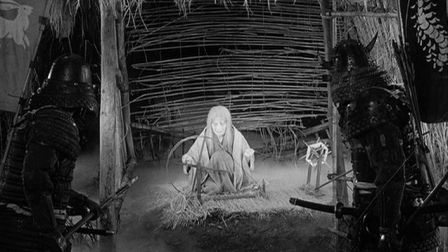
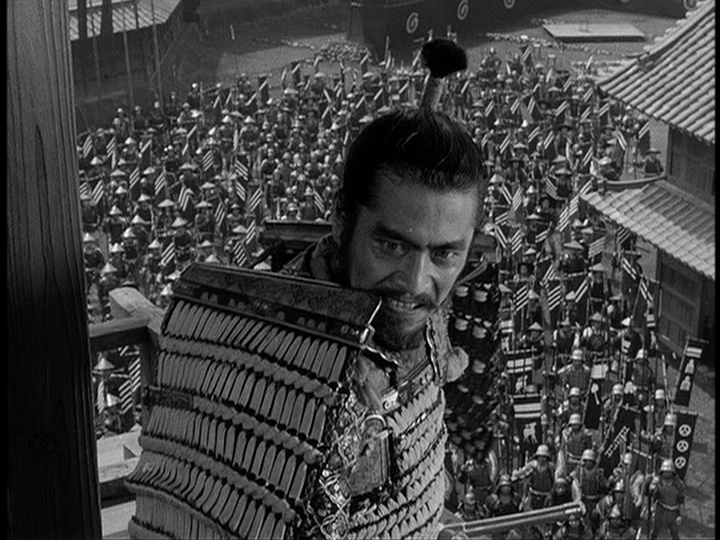
It staggers me how amazingly well Shakespeare’s story, written in seventeenth century England, translates to the feudal society of centuries-old Japan, a place and time Shakespeare himself probably had no idea existed in the least.  The credit for this falls on two men’s shoulders.  First of all, due must be paid to Shakespeare’s original tale, one with such universal themes that it was carried to such an opposite place from the one he originally intended and yet the message still remains.  But Throne of Blood would not work nearly as well as it does were it not for the brilliance of Akira Kurosawa to understand how to translate the Bard’s tale to his own homeland.  It’s Kurosawa’s doing that he knows how to make Macbeth fit into feudal Japan, how to swap kings for kimonos, and Laurence Olivier for Toshiro Mifune (really, not a bad swap).  Everything that makes Macbeth special is still here, and it’s still potent.  The three witches are transposed into a truly freaky single ghost spirit, surrounded by fog, speaking with an unearthly hollow voice, and constantly spinning the web of fate.  The banquet scene with Banquo’s ghost, probably my favorite scene from Macbeth and one that HAS to be right for me in order to enjoy a Macbeth production, is here, and just as disturbing and upsetting.  The camera keeps cutting back to Banquo’s empty chair, then back again to his pale ghost.  It’s a terrific scene, one that certainly allows Mifune to display tremendous range as the paranoid and frightened Washizu, and just one of the many examples of how well Shakespeare works when telling a samurai story.

  
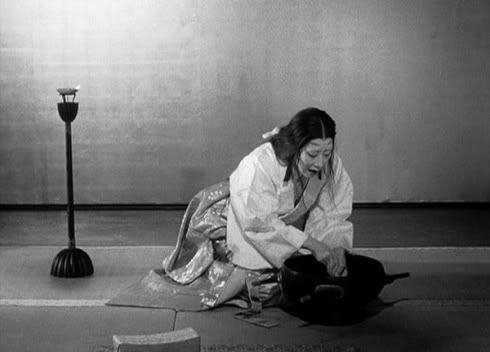
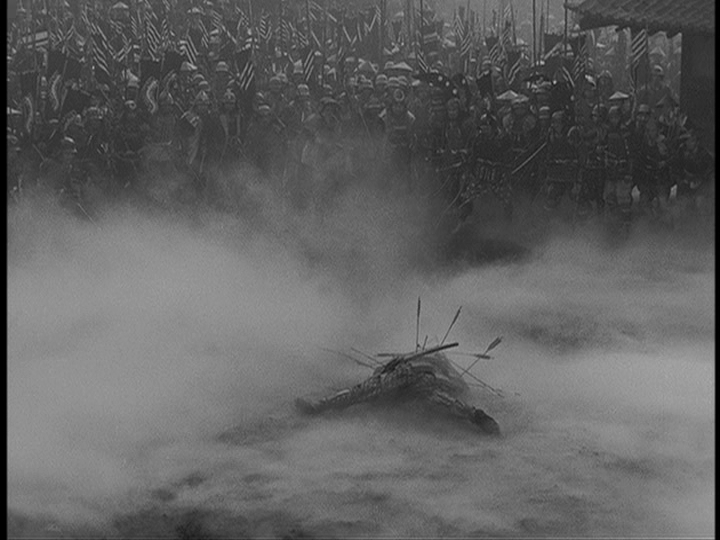
The two standout performances are that of Mifune as Washizu and, to be expected, Yamada as Lady Asaji.  Mifune is always good, always watchable, and I prefer him playing the tragic hero, as he does here, over playing the buffoon as he does in Seven Samurai.  Sure, he yells a lot – that’s Mifune’s style – but Mifune has range.  Here, as Washizu, he can go from scared to paranoid to frightened to angry in the span of about thirty seconds, and it’s entirely believable.  His silence is eerie after he kills the reigning lord in his sleep and thoroughly unnerving.  His death scene, as Washizu is riddled with a ridiculous amount of arrows, is memorable to the last.  (Apparently, in order to ensure the fear on Mifune’s face was real, Kurosawa used real arrows for the shots that were not to hit Washizu.)  In short, Mifune knows how to play Macbeth.  But it’s Yamada as Lady Asaji who really steals the show.  Yamada had great source material to work with, as Lady Macbeth is one of the most magnificent literary villains of all time, but even so, Yamada manages to take the evil and crank it up a few notches.  Her Asaji is frankly frightening in her cool demeanor and cutthroat words.  She barely moves a muscle as she slowly spells out to Washizu that he must take control of his own destiny to fulfill the spirit’s prophecy.  Her decisions to underplay nearly every scene are the perfect balance to Mifune’s aggressive screen presence.  It gives the impression of a calm, cool, and incredibly strict master with a somewhat crazed bulldog on a leash.  The minute the master gives the word, the bulldog will attack. 


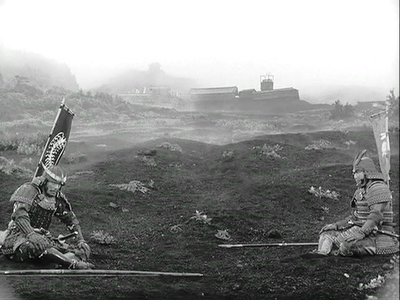
Kurosawa’s production is beautifully imagined and photographed.  Ultimately realizing it would be more economical to just build an actual damn fortress rather than the simply façade, Throne of Blood is done on a grand scale.  The volcanic mountainside of Mt. Fuji is unsettlingly desolate, and the bright fog that seems to envelop nearly every outdoor shot is deliciously atmospheric.  When the woods of Dunsinane – or, rather, Spider Web Forest – begin to move, it’s easily the best cinematic representation of Shakespeare’s moving forest I’ve ever seen.  I love how Kurosawa presents the spirits, how without any computer effects and purely through in-camera techniques, we get an effective representation of other-worldly beings.  The makeup, the altered voices, the flying above Washizu in the forest paths, the disappearing and reappearing: it’s a great interpretation.  The costumes are utterly divine as well.  These are not the poor, destitute, rural warriors of Seven Samurai, but true lords displaying all the trappings of wealth.  If Mifune is not dressed in full armor regalia, decked to the hilt in decorations, then he is wearing luxurious costumes full of layers and billowing fabrics.  This is a beautiful film to watch.

  
Is this the best Shakespeare adaptation I’ve ever seen?  Well, that’s a big ask.  I don’t know if it’s the best, but it’s certainly one of the best, easily top five, and definitely gets the award for Most Imaginative Transposition.  This and Ikiru (which one I pick depends on my mood – do I want adventure or sorrow?) are my two favorite Kurosawa films.  An absolutely brilliant film.

Arbitrary Rating: 10/10.