Showing posts with label 1999. Show all posts

Friday, June 28, 2013

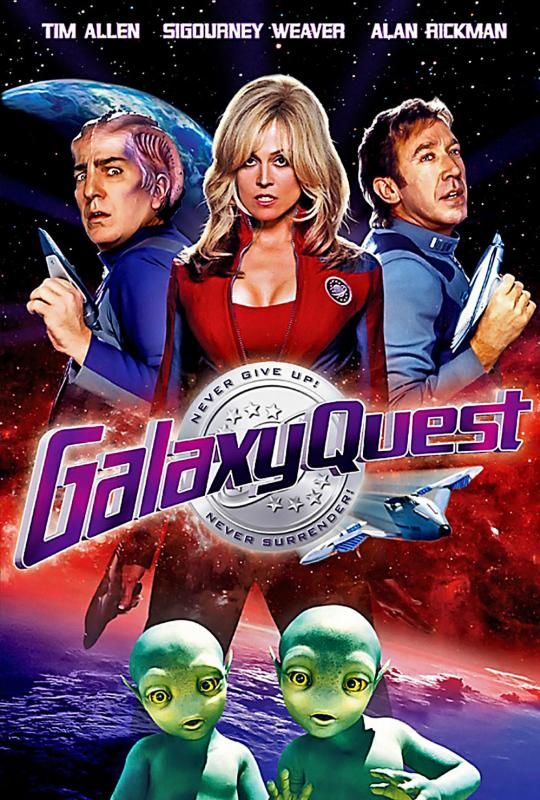
Galaxy Quest


Off Book: Galaxy Quest
Director: Dean Parisot
Starring: Tim Allen, Sigourney Weaver, Alan Rickman, Enrico Colantoni
1999

This looked liked the stupidest movie in the world when it came out.  It looked like a crappy parody of Star Trek.  ‘From the people who brought you Scary Movie 4 and Date Movie comes Galaxy Quest for all your mindless idiotic juvenile humor needs!’  Blech.  Who wants to see that?  Not me.  Then, about a year later, my parents and my sister, all intelligent people whose opinions I trust, informed me that I MUST see this movie.  I scoffed.  My husband scoffed.  My family chained me down in front of a television and made me watch it.

And then I laughed.  And laughed.  And laughed some more.

Holy crap, this movie is funny!  Not only is it funny, but it’s good!  Legitimately good!
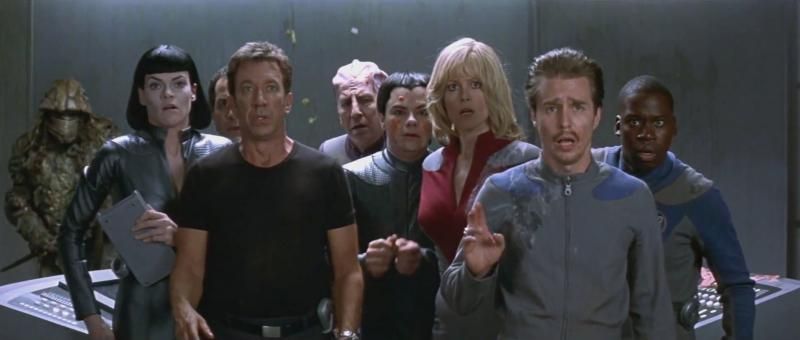
  
As the movie opens, we learn that Galaxy Quest was a science-fiction TV show set in space that has long since stopped filming.  Its actors, however, cannot escape the enormous cult following the series has gained, and as such, they are stuck perpetually in their TV roles, going from convention to convention… until a group of aliens approach them about helping them fend off an attack from the evil alien Saris.  Turns out, these aliens saw the show in space and thought it was real.  Given the crew’s ability to solve any problem and defeat any enemy in the original series, the aliens figure that the crew of the Intrepid is the only group capable of dealing with their perilous threat.  Soon, the hapless washed up actors find themselves being asked to really pilot a spacecraft, to really defeat aliens, to really solve complicated technical problems, and to really save the day!

What might at first sound like a blundering parody of the pop culture phenomenon that is Star Trek is really an enormously loving homage.  This is not parody; parody is vulgar and crass, with jokes coming at the expense of story and characters.  Think Spaceballs.  Spaceballs is parody.  But homage respects and reveres its source material, sending it up lightly without being mean or vicious.


If you’ve ever seen any episode of Star Trek in any incarnation, any of the Star Trek movies, or even just have a basic idea of what Star Trek is about, you will enjoy this film.  Speaking as someone who has seen every single episode of Star Trek: The Next Generation multiple times, this movie gets it right.  Galaxy Quest, the TV show, IS Star Trek.  Moreover, I fully believe that it’s most meant to resemble The Next Generation, with one notable exception.  Tim Allen’s character, Jason Nesmith, played Commander Peter Quincy Taggert, a brash, chest-thumping commander who is a thinly veiled alter-ego of Captain Kirk.  After initially seeing the film, George Takei remarked that Allen had gotten William Shatner’s swagger down pat.  


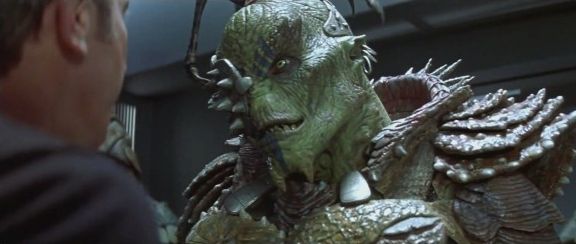
There is so much classic Star Trek in this movie.  The basic spaceship design and the jumpsuit uniforms are the fundamentals, but true fans will get a kick out of more subtle details.  Dr. Lazarus (Alan Rickman as Alexander Dane), who is CLEARLY supposed to be Lt. Worf, has to eat horrid Kep-mok blood ticks that aren’t yet dead.  WORF DID THAT ALL THE TIME.  The “away mission” down to the rock planet to retrieve a replacement beryllium sphere, with the tricorder programmed with the location, the small blue baby aliens, and the fight with the pig-lizard and then rock monster, could be straight from any Star Trek episode – save for the washed up actors not knowing what to do on the mission.  Saris’ ship was clearly modeled on the Romulan vessels.  The fancy metallic casts for broken arms and legs are incredibly familiar.  The ship has to separate at the end of the film, something that was seen in a handful of Star Trek episodes.  Jason Nesmith and Gwen Demarco (Weaver, terrifically funny playing the polar opposite sci-fi heroine from her strong, empowered, courageous Ripley role) end up in the ducts of the Intrepid in order to evade enemy capture and save the day.  Given that all of these wonderful references and settings are couched in the conceit that the people in this situation have absolutely no idea how to handle themselves in space is even more delightful.

Galaxy Quest is hands down one of the funniest movies I’ve ever seen.  It’s that rarest of all comedies, a comedy that actually improves with successive viewings.  Most comedies run out of ammo after the first viewing.  The good ones last another five to ten screenings before running out of steam.  The great ones last forever and seem to actually get funnier the more often they’re viewed.  Galaxy Quest more than meets this last description, and what’s more, it manages to be funny without any sex, violence, or cursing.  Actually, the movie was originally filmed with a handful of swear words which were removed in ADR.  The most notable instance is one scene where Sigourney Weaver says, “Well screw that!” but her mouth does not match, mouthing instead the big f-bomb.  It’s actually refreshing to find a comedy that decided cursing was unnecessary.  Somehow, it didn’t need the swearing to be funny, a concept I wish more modern comedies would embrace.

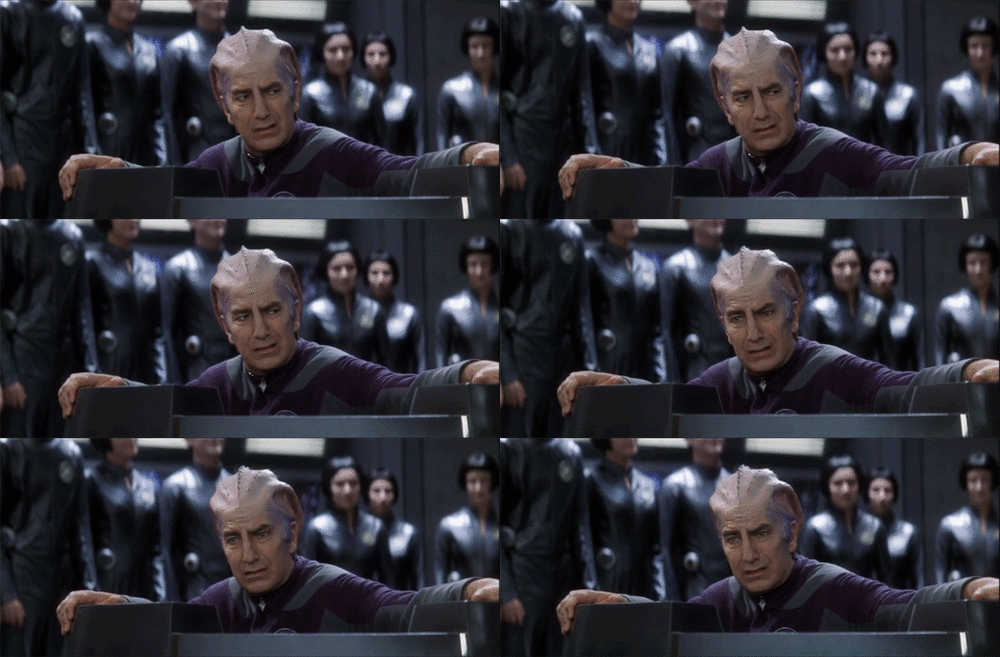
Alan Rickman as Alexander Dane as Dr. Lazarus absolutely slays me.  Alexander Dane is a tortured British actor who used to do Shakespeare.  Now he does conventions in a silly alien headpiece.  The pain that is written all over his face when he is forced to say his character’s signature line (“By Grabthar’s hammer, you shall be avenged!”) is hysterical, not least of which when he has to say it at the opening of an electronics store.  Easily in my top five favorite lines of the film is Rickman’s drawn out and deadened delivery of “By Grabthar’s hammer… *long pause*… what a savings.”  He is so pained by having to say those words, I descend into a fit of the giggles every damn time.  On the blu-ray extras, Rickman admits to having trouble getting out that line because he kept laughing so much.
 
Speaking of favorite lines, this movie has them in spades.  Sam Rockwell gets to deliver most of them as Guy, an actor who played Crewman No. 6 and was killed before the first commercial break in episode 81 of Galaxy Quest.  He is the only one of the actors who ever watched the show with regularity, and as such, is much more aware of the peril of their situation than the others seem to be.  He knows the rules of Galaxy Quest, as it were, so when he says, “There’s a red… thingie… moving towards the green… thingie.  I think we’re the green thingie!” you’re dying with laughter.  Or on the away mission when the pod door opens, “Is there air?  You don’t know!”  Or better yet, “Look around you, can you construct a rudimentary lathe?”  Or even better, when all the other crew members want to cuddle the cute-as-a-button blue baby aliens on the away mission, “Sure they’re cute now, but in a second they’re gonna get mean, and they’re gonna get ugly somehow, and there’s gonna be a million more of them…. Did you guys ever WATCH the show?!?”  To which Gwen eventually responds, “Let’s get out of here before one of those things kills Guy!”
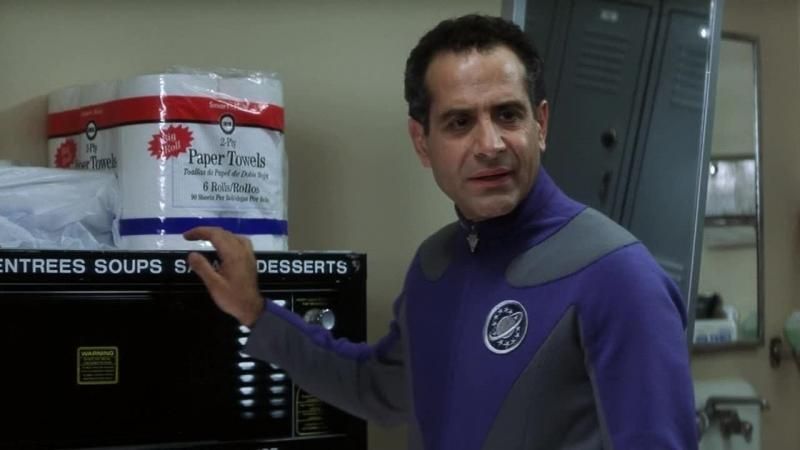
 
Oh god, and Tony Shalhoub as Fred Kwan as Tech Sgt Chen is HYSTERICAL.

I recently had the unbelievable pleasure of watching Galaxy Quest at the Dryden (the capstone of their “To the Moon in June” series).  I chatted a bit with the head programmer right before the movie started, and she was shocked at just how many people were there.  While certainly not full, the theater was very busy for a Wednesday night show; Galaxy Quest was a much larger draw than they had anticipated.  And then as soon as the movie started, the laughter started.  The whole audience, self included, was in stitches in every scene save for the two serious ones.  Every SINGLE scene, and nearly every single line got a laugh.  I missed some of my favorite jokes because people were laughing so hard.  Heck, Guy’s “rudimentary lathe” line actually got extended applause, as did the film when the end credits rolled.  I was hoping that the audience at the Dryden would be as appreciative of this film as I am; needless to say, my expectations were more than met.

Really, trying to explain just how funny I find this film is an exercise in futility.  It makes me laugh every single time.  It is reverent of Star Trek and manages to send it up at the same time.  It’s a feel-good movie too, watching as the actors overcome their inabilities to actually outwit and defeat the tyrannical Saris (named after a film critic!).  If it’s been a long week, if I really need a chuckle, Galaxy Quest is guaranteed to lift my spirits and bust my gut with laughter.

Arbitrary Rating: 10/10

Wednesday, May 29, 2013

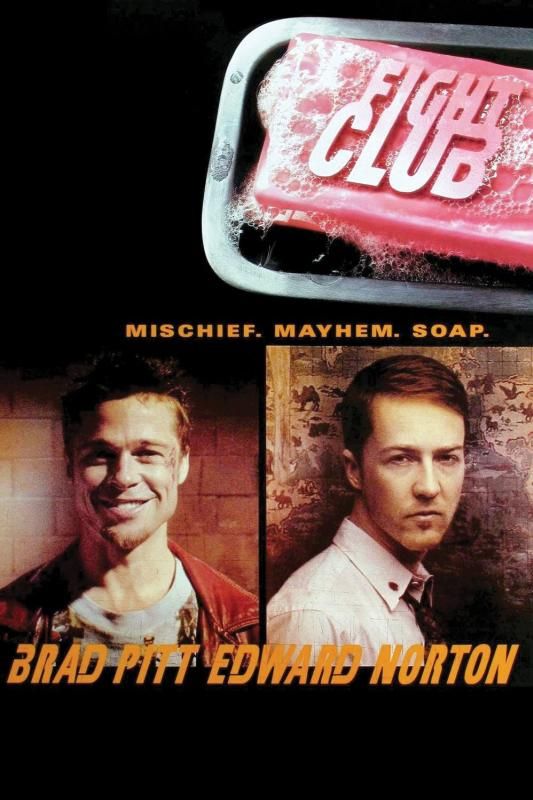
Fight Club


Fight Club
1999
Director: David Fincher
Starring: Edward Norton, Brad Pitt, Helena Bonham Carter, Meat Loaf

Okay, let’s get this out of the way right now: I just watched Fight Club for the very first time two days before writing this review (ETA: which was, in fact, about a year ago, it just took me awhile to post this review, because that’s how I roll, yo.)

“What?” “OMG!” “You’ve NEVER seen it before?” “What’s wrong with you?” “BEST MOVIE EVER!”

There.  Is that out of your system now?  Good, I may continue with my review.

Fight Club pissed me off, but not in the way you’d think.  It pissed me off because as I was watching it, I kept on thinking of how damn GOOD it is.  How, cinematically speaking, it’s both accessible and daring.  And then I remembered that it’s fundamentally a GUY movie.  You know, a guy movie – guys love it, girls hate it.  Dark, gritty, lots of guns and violence, very few female characters.

And that made me mad.

Because the best of the guy movies are awesome.  Seriously, spectacularly awesome pieces of cinema.  In the last twenty-five years, guy movies have given us Seven (same dude, yes, I know), all of Christopher Nolan’s films (Memento, Inception, The Dark Knight), Donnie Darko, Goodfellas, etc.  What fantastic films.  And guys love them.  They are not hard films to love.

 
What are the “great chick flicks” of the last twenty-five years?  Titanic?  Vomit.  The Princess Diaries?  Are you serious?  Under the Tuscan Sun?  Passable at best.  I can get behind Notting Hill, but Notting Hill is not a cinematic masterpiece.  I mean, it’s awesome, but in a “I can turn off my brain now and the movie will amuse me” kind of way.  It’s hardly challenging.

The best guy movies ARE challenging.  The best recent chick flicks… well… aren’t.

And that made me mad.

Because Fight Club is such a great cinematic work, and it’s so fundamentally masculine, and chick flicks are shitty. 

Why are chick flicks so shitty?  Why does Hollywood think that women are content to settle for utter rubbish as long as there’s a hot guy walking around half naked?  Ladies, here’s a hint – Brad Pitt walks around half naked in Fight Club, and this movie is much more worthy of your time than, say, Letters to Juliet.

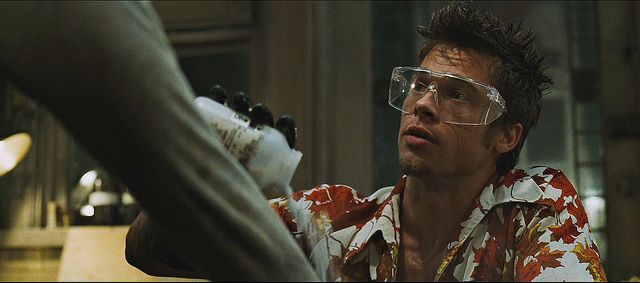
Oh, right, I should probably try to review Fight Club rather than just rant about the dearth of quality “female films” being made in Hollywood.  It tells the story of a desensitized, insomniac insurance claim investigator (Norton) who meets childish and arrogant soap salesman-cum-explosives expert Tyler Durden (Pitt).  Together, they form the eponymous Fight Club.  Marla (Bonham Carter) takes up with Tyler, much to the chagrin of our narrator.  Things start to spin out of control when the men involved in Fight Club start branching out from just hitting each other.

 
For my money, the first half hour of Fight Club is perfect.  Sheer, cinematic perfection.  It’s funny, it’s witty, it’s engaging, and it’s damn unique.  Just when you think you know what’s coming, David Fincher spins the film in a completely new direction.  There’s voice-over narration that blends seamlessly into actual dialogue.  We go from Marla and Norton bickering over which support group the other “gets,” to vibrating dildos in airline luggage, to Meat Loaf’s “bitch tits,” to what you’d name a tumor if you had one.  The camerawork is dizzyingly fresh, zooming through gas lines or up and down a waste bucket, places we wouldn’t expect to see.  The fourth wall gets broken during a brief scene that is so unexpected and so funny, you can’t help but smile.  The film even opens at the neural synapses of the brain and zooms out to Norton’s face, a journey which is disconcerting and takes awhile to place.  The first half hour, man.  It’s so unlike other films.  It’s so entertaining.  It’s funny and sharp and unique.  It’s perfect.

The rest of the film is very good, but it’s not like the first half hour.  With the formation of the actual Fight Club, the film becomes more traditional in its narrative (or rather, as traditional as an out-there story like Fight Club can be).  The ingenuity shown in the filmmaking process of the first thirty minutes gives way to much more straightforward storytelling.  I suppose, in a weird way, it would have been far too exhausting to create a film that was as off the wall as those first thirty minutes. 


Accompanying this shift in technique is a marked shift in tone as well.  The film becomes significantly darker and bleaker as we go into more traditional movie mode.  It’s interesting rewatching Fight Club (yes, this means that I’m watching it twice in two days; rewatching helps inspire me when I write about a movie) and remembering just how funny it starts, and just how dark it becomes.  The narrative is driven to a very frightening place; things go wrong, and it seems as if nothing will ever go right.  Unfortunately, I also feel that, despite the intriguing social commentary, the film starts to feel water-logged.  It gets a bit too heavy, a bit too dreary.  It starts to lag, pace-wise.  It can’t keep up with the fresh and fast pace of the opening.  That being said, Fincher, at the very last moment, brings Fight Club back from the edge of being the most depressing tragedy you’ve seen in awhile and reiterates that what you’ve just watched is, in fact, a comedy.  Technically speaking, in the most basic of all dramatic terms, the difference between comedy and tragedy hinges on death, and for most of the central story of the film, we seem to be careening toward the chasm of tragedy.  There’s funny stuff in the first third, but it becomes so dark and heavy, the “comic” ending feels unnatural for most of the film.  I understand it, though.  It’s bringing the movie full circle, back to the significantly lighter comedy of the opening. 

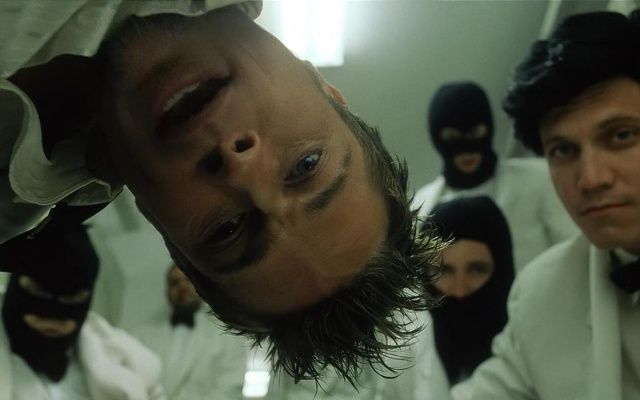
The two leads, Norton and Pitt, are fantastic.  Norton, as our lead, is the one who takes us on a journey from trapped office worker to rebellious fighter to frightened desperado, and, in what I have come to expect from Edward Norton, is phenomenal.  He’s funny when he needs to be, he’s pathetic when he needs to be, and more than anything, he’s believable.  Dancing around him are the two crazies of Brad Pitt and Helena Bonham Carter.  Pitt is the embodiment of the id, easily flaunting society’s rules by only doing what feels good, then literally rewriting the rules of civilization.  While I don’t think his work here is better than his role in Twelve Monkeys (because I love Twelve Monkeys… which I just realized is probably a “guy movie…” dammit…), Pitt does his half-naked crazy dance well. 


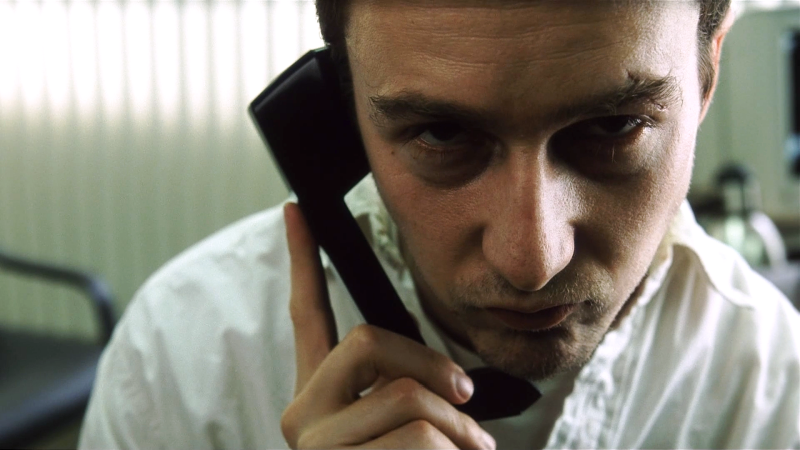
There’s a hyperrealism to the photography in Fight Club that manages to make the movie both ugly and beautiful, real and unreal, all at the same time.  Everything looks like things we know.  The pay phone is a pay phone.  It’s scratched and dirty, like a real pay phone.  But then the camera zooms up close, closer than we expect, and the scratches keep getting thrown into more stark relief, there is more detail than you could possibly have imagined.  The film is full of photographic touches like that; familiar things shot with such excruciating detail that they become artificial.

There was a surprising amount of fairly accurate chemistry in the movie. (Yes, I am now about to nerd out about chemistry.  Brace yourself.)  For the record, as a chemistry teacher, every year I teach the definition of “saponification.”  (the making of soap)  And nearly every year, I’ve had at least one student say, “Oh, like in Fight Club!”  Now I can respond with a tangential discussion of how great the film is, huzzah!  There’s a scene with a chemical burn (I’m guessing it was some sort of hydroxide) that was painful for me to watch because a) I have firsthand experience with chemical burns and b) I actively spend my days trying to prevent such things happening to my darling little students. 

Seriously, you guys, this scene made me cringe because it's exactly what I DON'T want happening to all my lovely little students...


For a film titled Fight Club, I was bracing myself for a level of violence that was damn near unwatchable.  Apparently, my hypersensitivity to violence is mostly confined to war films, because I was surprisingly accepting of the violence in this film.  There is no shortage of deep purple fake blood and plasma, to be sure, and the sound of flesh thwacking against cold hard concrete is distinct and a little stomach churning, but the violence is also not nearly as nonstop as you would imagine.  The focal point, the main message of the film, is much more about eschewing society’s rules (and possible repercussions therein), and much less about violence for violence’s sake. 

Fight Club would make a great double feature with Office Space, made the same year.  I am CERTAIN I am not the first person to associate these two films together, but they both deal with a central character who, tired of the cubicle life, starts to break free from American cultural expectations.  Fight Club makes its point with wild violence and hyperbolic antiestablishmentarianism gestures.  Office Space makes its point with funny gags and a red stapler.  Two drastically different comedies, but an intriguing double feature.  At the very least, I anticipate such a double feature would have you wishing you could properly tick off your boss more. 

Or, in my case, it would make me angry about why guy films are so intriguing and chick flicks are so braindead. 

Arbitrary Rating: 9/10.  Ironically, considering the overall message, I think the film starts to run out of steam in the second half.  But that doesn’t stop the whole movie from being AWESOME!


Sunday, May 5, 2013

Being John Malkovich


Being John Malkovich
1999
Director: Spike Jonze
Starring: John Cusack, Catherine Keener, Cameron Diaz, John Malkovich

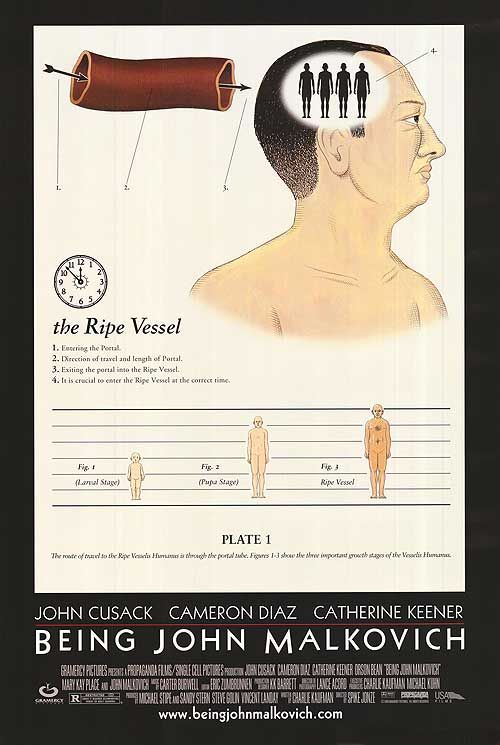
From the off-kilter minds of Charlie Kaufman and Spike Jonze comes what has to be one of the most unique and creative Hollywood films of the nineties.  Being John Malkovich is weird.  Very weird.  But it manages to be weird without ever completely disorienting the audience.  Sure, its world may not make that much sense, but I really like the dark air of sad mystery and fantasy.

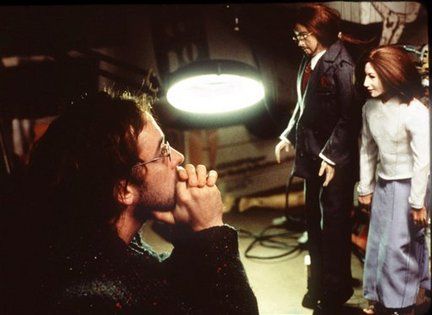
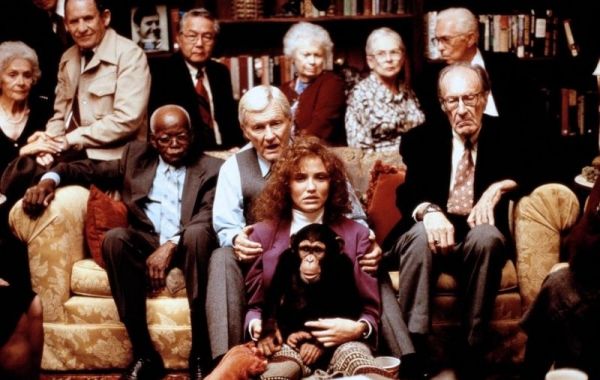
Craig Schwartz (Cusack) is an unemployed puppeteer whose animal-loving dowdy wife Lotte (Diaz) encourages him to get a day job.  He finds one as a file clerk on the 7½ floor of a Manhattan building, and he quickly falls for strong, sexy, and completely out of his league co-worker Maxine (Keener).  One day, Craig discovers a tiny door behind a file cabinet.  Going through it, it takes him into the mind of actor John Malkovich (playing himself) for fifteen minutes before dumping him out onto the side of the New Jersey turnpike.  Craig tells Lotte and Maxine, and Maxine turns it into a business – be someone else for two hundred bucks a pop.  Lotte, however, falls for Maxine after meeting her during her trip into Malkovich.  In the meantime, Malkovich himself starts to realize something is wrong.

I like a great deal about this movie.  I am endlessly fascinated by the meta aspect of it.  I love – LOVE – that Kaufman managed to convince Malkovich to play Malkovich.  Apparently, Kaufman shopped his script around and Malkovich’s production company liked it and wanted to do it, but Malkovich himself thought he wasn’t quite right for the title character and suggested they use a different actor.  Kaufman and Jonze were insistent, however, and eventually wore Malkovich down.  This is probably my favorite part of this movie – that John Malkovich plays some wacky version of himself.  I love how banal his experiences are when Craig and the others slip into his brain.  The first time Craig goes, we are Malkovich eating toast.  Later on, he’s on the phone ordering bath mats.  BATH MATS.  And then we get the ultimate meta experience when Malkovich, played by Malkovich, goes into the mind of Malkovich, where everything is Malkovich.  This movie doesn’t work without Malkovich.  His portrayal of Craig inside himself is hysterical. 

 
There are a lot of little touches of black humor I enjoy greatly as well.  The secretary who can’t understand a word anyone is saying.  The ridiculous orientation video that was clearly made at a D-level production company.  The fact that Malkovich wears a cheesy baseball hat that isn’t fastened at the back.  The disgustingly lewd old man boss.  Charlie Sheen playing himself.  Sean Penn lauding Malkovich moving into puppetry.  Willie Garson’s improvised scene where he compliments Malkovich at a restaurant, saying the word “retard” way too many times.  The Malkovich Retrospective TV special at the end of the film.  There are definitely parts that make me laugh.

I enjoy too how utterly unglamorous most of the characters are.  Craig Schwartz is one of the most singularly unattractive roles I have ever seen John Cusack in, he who usually plays sweet, sentimental estrogen parade heartthrobs.  Craig is a sadsack with almost no redeeming qualities.  Instead of feeling sympathy for his unemployment, we quickly learn not to pity him too much.  This is a very much out of type John Cusack.  Then there is Cameron Diaz, nearly unrecognizable as Lotte.  For an actress who is so tabloid-conscious as Diaz, she sure surprises here.  Although not the most talented actress in the world, she admirably carries the emotional heart of the film in ridiculously frizzy hair and high-waisted Mom jeans.  This all falls in line with the rather unglamorous lifestyle of the character John Malkovich, going right back to his ordering bath mats.  It’s uncommon to see this in film (though, to be fair, not unheard of).  I always enjoy seeing a less glamorous, more realistic world in films, so I respond well to Craig’s disheveled hairstyle and Lotte’s ill-fitting clothes.  

  
But I don’t think this is a perfect film.  My biggest argument against it is with the central triangle of Craig, Lotte, and Maxine.  Their motivations are what drives the narrative forward, and I don’t really understand most of them, nor do I take pleasure in watching them play out.  Craig is a sad, pathetic character who makes bad decisions.  Lotte is kind but a bit irrational.  But it is Maxine who I understand least, and who I must understand in order to follow along.  I can understand her as the bitchy overconfident co-worker who rebuffs Craig, but I don’t really get why or how or even when she falls for Lotte, and then Craig-slash-Malkovich.  With all of Kaufman’s creativity in making this wholly original story, I feel that I am missing a key element here.  The central emotional arc doesn’t have nearly enough heft behind it.  All the wonderful fantastical story elements feel like superfluous nothings if there isn’t an emotional connection. Furthermore, Kaufman is clearly hinting at issues of identity but chooses not to fully explore them, instead focusing on the random asides.  Delve further, I say.  I don’t really care about the idea of the immortal vessel, but say more about personality.  Frankly, I find Being John Malkovich a bit soulless.


Overall, though, this doesn’t get too much in the way of me having a ball while watching Being John Malkovich.  I very much enjoy this movie.  It’s infinitely creative, and I like that a lot.  I’ve never seen another movie quite like it, and that’s saying something.  Plus, and this is a small thing, I am rather fascinated by the puppetry in it.  One doesn’t really see marionettes in film that often, yet they’re given a definite supporting role here. 

Arbitrary Rating: 9/10