Showing posts with label spielberg. Show all posts

Monday, August 19, 2013

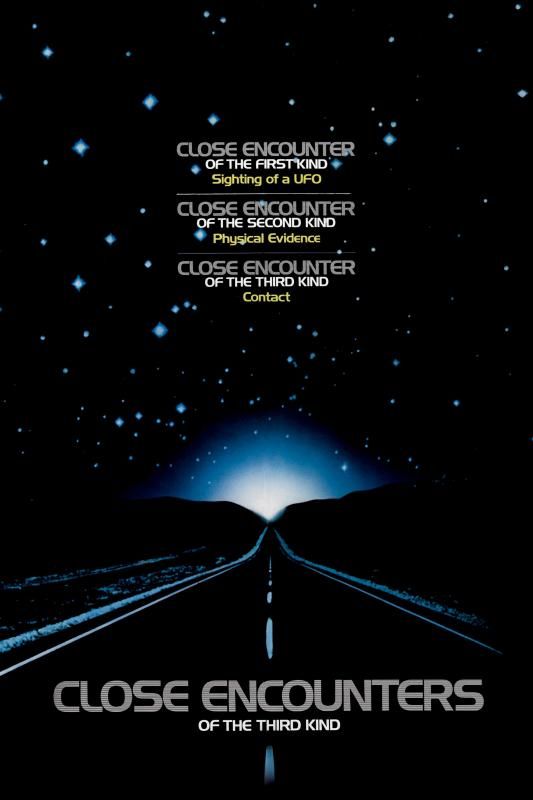
Close Encounters of the Third Kind


Close Encounters of the Third Kind
1977
Director: Steven Spielberg
Starring: Richard Dreyfuss, Melinda Dillon, Teri Garr, Francois Truffaut, Bob Balaban

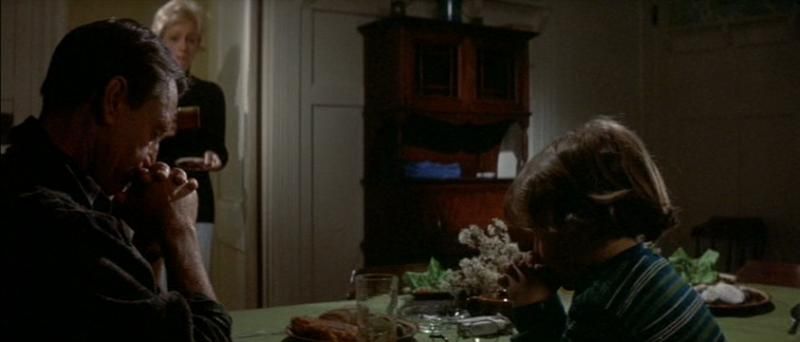
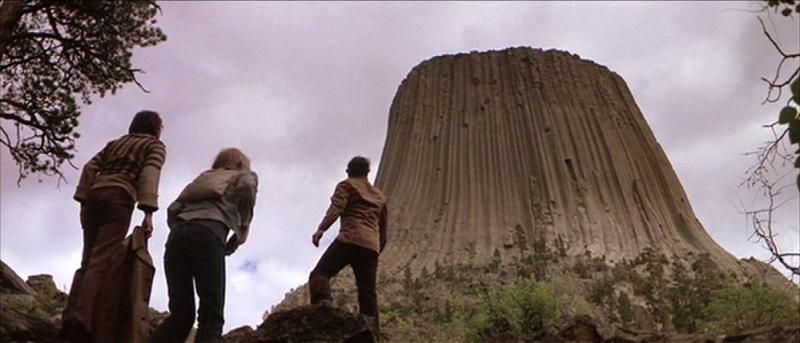
In the summer of 1991, my parents packed up our Dodge Caravan, threw me and my sister in the back seat, and set off for a six and a half week cross country adventure.  We went from New Hampshire to Kansas then got as far southwest as the Grand Canyon, then swung north to complete our loop.  I mention this because a very significant, very important stop along the way was (as you’ve hopefully figured out by now) Devil’s Tower National Monument in Wyoming.  Naturally, one doesn’t go to Devil’s Tower without understanding its cinematic significance, and that means that I had already seen – and loved – Close Encounters of the Third Kind by that early point in my life.  I have loved this movie a very long time indeed; it’s high time I try to do it some justice in blog form. 

[FAIR WARNING: I get a bit spoilery in my discussion of this film, mostly because I love it and its finale so much.]

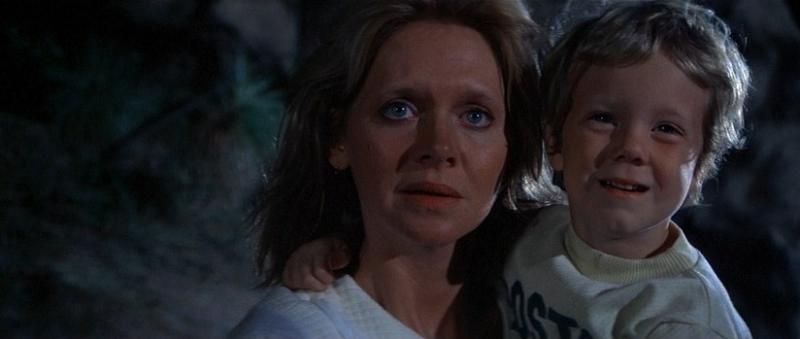
Strange things are happening.  Military planes reported missing in 1945 are showing up in the Mexican desert; ships are showing up in Africa; sounds are heard over India; unexplained lights are being seen over Indiana.  Single mother Gillian (Dillon) has her young son Barry taken from her by the lights in the sky.  Regular family man Roy (Dreyfuss) witnesses those lights first hand when he’s called by work to deal with a power outage.  His wife Ronnie (Garr) and children watch helplessly as Roy becomes more and more obsessed with these lights and the possibility that it might be aliens.  Meanwhile, government agents, including Lacombe (Truffaut) and his cartographer slash English interpreter Laughlin (Balaban), are witness to the alien signals, and plans are underway as to how to best deal with the possibility of an alien visit.

Close Encounters of the Third Kind is the embodiment of everything I think of when someone says “classic Spielberg.”  When I was younger, I didn’t really understand what it was about Spielberg that set him apart as a director, but in these last few years, after watching hundreds of films and writing about hundreds of films, I understand better what the term “Spielbergian” means, and Close Encounters has it in spades.  It’s in the nearly nonstop litany of gently comedic family moments (the toothpaste one being very good), even as Roy’s relationship with his family deteriorates.  The use of the Budweiser beer jingle on television being the in-scene musical accompaniment to Roy’s breakdown, or how Barry’s childhood toys cheerily sing and clatter as he’s being abducted.  The amusing yet threatening reveal of government agents rolling out in Baskin Robbins and Coca Cola trucks.  Spielberg is very good at making you laugh while something serious is going on, better than any director I can think of at the moment. 

There’s also no shortage of stunned awe in Close Encounters, something else I consider “classic Spielberg.”  Given that this is a film about alien encounters, you would naturally expect a feeling of bewilderment, but no one does bewilderment like Spielberg.  Right from the get go, there are tons of close ups on the faces of those who have encountered something they haven’t seen before, and it is mostly through these, their reactions, rather than the encounter itself, that Spielberg communicates the wonder of the experience.  We don’t really need to see what Roy is seeing as long as we can read his awe in his face, all lit up and smiling and wide-eyed.  This sense of awe is paid off in a big way in Close Encounters during the conclusion, especially after Spielberg carefully makes you sit through Roy’s anguish in the first half.  Roy is so utterly driven by something he doesn’t understand that it rips his family apart; the sense of fulfillment when we finally get to see Roy get his desperately sought answers is incredibly satisfying.  He went through so much pain, it makes me happy to see him so happy in the end.
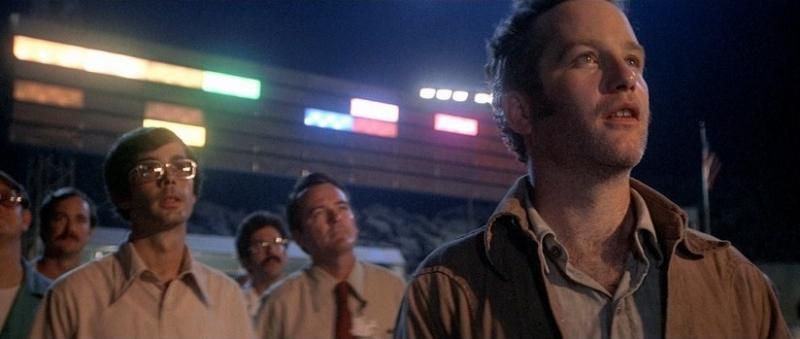

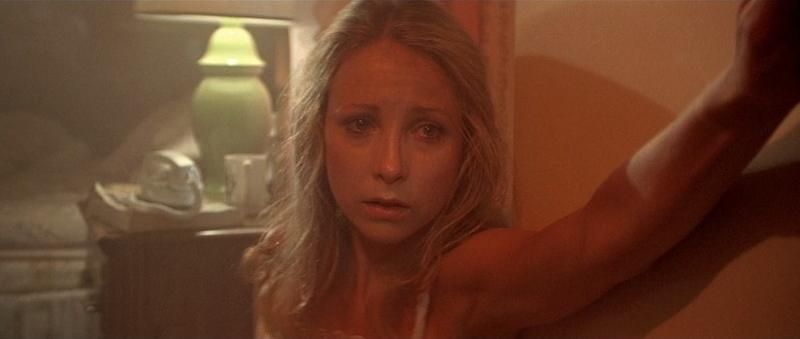
Speaking of Roy, his story drives Close Encounters, and I like that it’s not a wholly happy one.  Poor Ronnie, watching Roy go mad.  I’ve gone both ways on how I feel about Ronnie; sometimes, when I watch Close Encounters, I’m angry at her for not standing by her husband through a difficult time.  Other times, I feel nothing but pity for her, watching her husband descend into what appears to be lunacy, and finally having to strength to do what is most likely best for her children.  And frankly, that I’ve felt both ways about her goes a long way towards the great characterization in Close Encounters.  Even though Roy gets his wish at the end and finds his way to Devil’s Tower, I never forget that it was at a cost.  I always think of Ronnie and Roy’s family, just as little Barry is reunited with his mother.  

And oh, the finale!  Close Encounters has a brilliant one.  More often than not, movie finales or climactic sequences are rather brief, maybe five to ten minutes or so, and to be fair, this is usually appropriate.  But Spielberg doesn’t cheat you in the slightest on the finale of Close Encounters; it’s a full thirty minutes and has its own smaller storyline.  I love the initial gasps and awe of seeing the first three alien crafts, the tension of communicating with them through music, and the complete joy when they answer back.  Like the government agents and scientists who applaud and cheer when those three ships fly off, you think the encounter is over and it was a success.  Ha ha ha, thinks Spielberg, you ain’t seen nothing yet!  There is the “light show,” and then the mother ship, and then the abductees – another great fake out by Spielberg, when you’re expecting to see aliens – and then finally, finally we get a glimpse of the aliens themselves.  The finale builds its own tension throughout and it’s just marvelous.  It’s a spectacular final act.
 
 
I’ve also long had a fascination with codes.  Some of my favorite stories, books, television episodes, and films have to do with cryptography.  I think that “The Janus List,” the season 3 finale of Numb3rs, is, frankly, one of the best hours of television I’ve ever seen because it’s ENTIRELY to do with codes and code-cracking.  Suffice it to say, a lot of my fascination with this stems from my early introduction to Close Encounters, and the scene where Laughlin the cartographer deciphers the alien message (and then the unforgettable rolling of the globe down the hall) is memorable in the extreme.  But it’s not just that scene in Close Encounters that deals with codes, although that one is the most direct.  The entire film feels a bit like decryption; Roy must find it in himself to figure out “what this means.”  It’s not a literal code, but an emotional one.  He’s been sent a message in his soul, and he has to somehow determine its meaning, and by god, I love watching him do it.

Apart from the very good Gustav Holst John Williams score (OH SORRY NOT SORRY), Close Encounters is also fucking awesome for having one of the most ingenious uses of film music of all time.  Once, on my old site, I wrote a series of pieces about the different ways films use music and my favorite examples of them.  The way I see it, there are four different categories of music in film: the film musical, the original film score, the use of previously written music as a scene accompaniment, and “in-scene” music, where characters produce or interact with the music in some way.  It’s in this last category that Close Encounters excels.  Being a musician and a lifelong fan of music in general, I adore the conceit that human beings use music to communicate with alien life.  That music is truly universal.  Written and spoken words have their role, but when encountering beings so incomprehensibly different from us, music makes such perfect sense as a means of reaching out.  The theme is lovely and simple as well, and who doesn’t love it when the alien ships finally respond in kind?
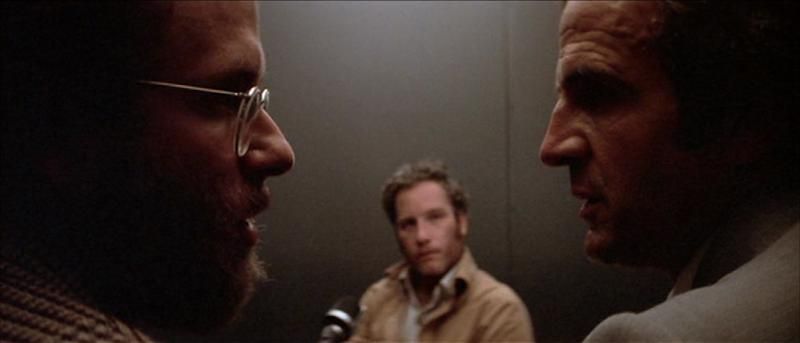

Additionally, Close Encounters remains a big reason why I will always irrationally love Francois Truffaut and his movies, and why I’ll always be willing to cut him all kinds of slack.  Richard Dreyfuss may be the hero of the film, but Truffaut steals the show.  His character has such an aura of powerful calm, and he’s the guy who stands up for those called by the aliens in the end.  He is empathy and tolerance embodied.  He is goddamned cool.  How amazing that Truffaut agreed to be in Spielberg’s film, and what a great job he did with such a cool character.  (Plus he has one of the most awesome lines of the film – “They belong here more than we.”)

It’s one thing to talk about favorite movies, and another to talk about favorite movie scenes.  While I truly love Close Encounters, I don’t think it would make a list of my Top Ten Favorite Films.  It does, however, have the honor of having one of my Top Ten Favorite Scenes.  I’m not even entirely certain why, but the relatively short scene where Lacombe and Laughlin go to India and hear the people chanting in harmony and ask them where the sounds came from gets me every time.  Every damn time.  It sends shivers down my spine and brings tears to my eyes.  There’s something about the men singing, so insistently, so beautifully, and it’s the first introduction of the musical motif in Close Encounters.  It finishes with the absolutely perfect shot of all the people pointing up to the sky.  I love that scene.  Absolutely love it.
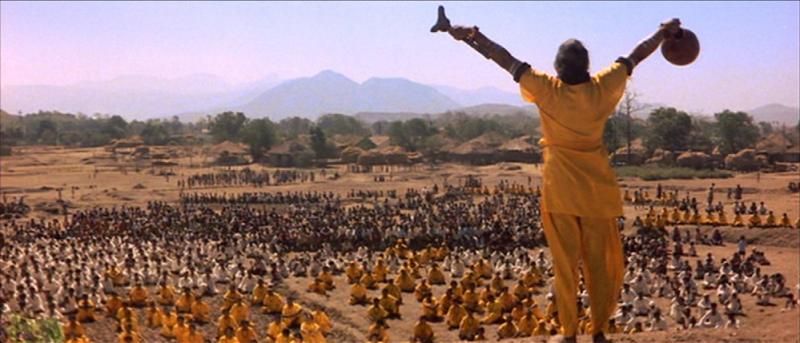

Finally, I have to mention the general treatment of the concept of the close encounter in this film.  We have plenty of movies where aliens land on earth and then promptly proceed to blow it up.  Close Encounters couldn’t be further removed from these types of films.  Everything about alien contact is treated with gravity and seriousness; all right, so Spielberg injects some of his trademark humor, but it never cheapens the experience of making contact.  Few films have had the courage to approach this topic with such seriousness (Contact and The Day the Earth Stood Still spring to mind), and even among this small pool, Close Encounters is different because of how positive and optimistic it is.  Whereas The Day the Earth Stood Still is (somewhat) realistic, it is also incredibly downbeat about human beings’ abilities to maturely communicate with life beyond the planet Earth (to be fair, with definite justifications).  It’s uplifting, then, to watch humanity play out an entirely different tale in Close Encounters, one that shows that we CAN man up, so to speak, and not immediately default to violence and warfare.  That we have it in ourselves to have a peaceful interaction with something utterly foreign.  Close Encounters is a message of hope.

In my humble opinion, this is Spielberg at his finest.  Spielberg has shown in the last two decades that he is obviously capable of doing gritty, violent, and realistic dramas (Schindler’s List, Saving Private Ryan) but… I think I prefer younger Spielberg for sheer entertainment value.  Think Jaws, think Raiders of the Lost Ark, think Close Encounters.  The sheer joie de vivre in these films is off the charts.  They are all engaging and entertaining, and they are everything that makes watching movies fun.

Arbitrary Rating: 10/10.  Duh.

Monday, June 24, 2013

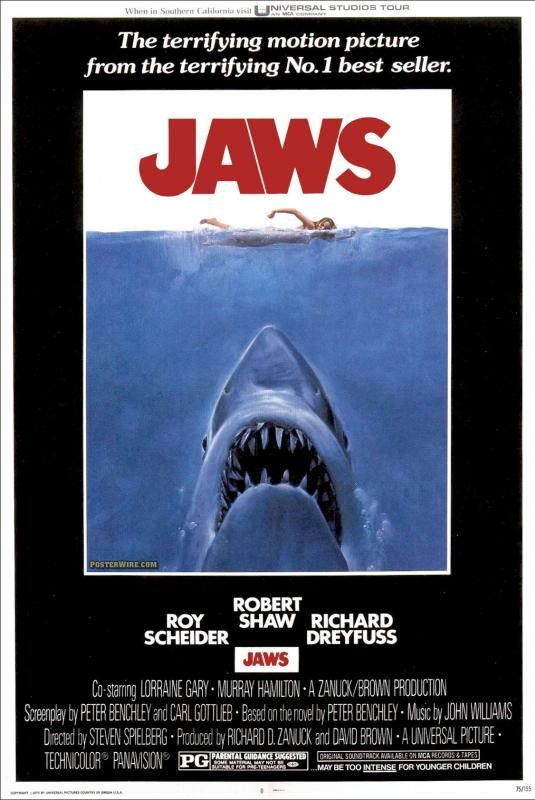
Jaws


Jaws
1975
Director: Steven Spielberg
Starring: Roy Scheider, Richard Dreyfuss, Robert Shaw

I think there is a distinct gap between the public’s impression of Jaws and what the film actually is.  The general impression of Jaws is that it’s a horror film about a monster rampaging shark.  While I would never wholly disagree with this statement, if that is all you want from Jaws, you will probably be rather bored for most of the movie.  In reality, this is a film that defies classification, offering up bits and pieces of multiple genres, all delightfully blended together into a helluva rollercoaster.

  
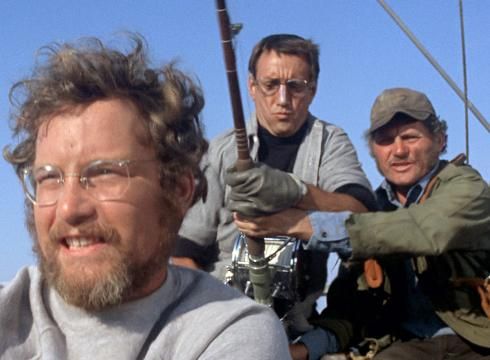
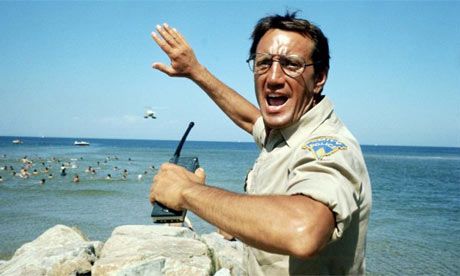
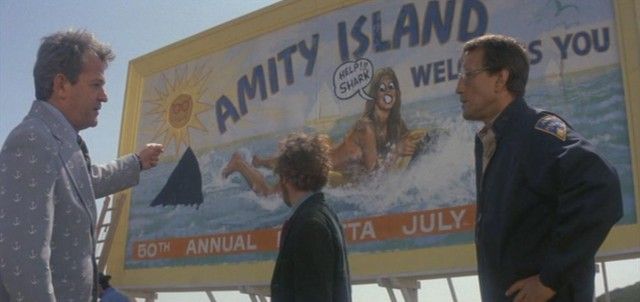
Police Chief Brody (Scheider) is still kind of a newbie on Amity Island, a resort town in the Northeast that relies on summer dollars for its economy.  When mangled human remains are found on the beach, Brody tries to convince an unbelieving mayor that he has a shark problem on his hands.  When panic starts to spread, Brody calls in help from the oceanographic institute in the form of Hooper (Dreyfuss) along with the salty sea captain Quint (Shaw) in an effort to kill the shark.

  
I’m a bit of a wimp when it comes to horror films and violent films and war films.  I don’t have the best tolerance for violence, blood, and gore.  However, I am a huge fan of suspense films and thrillers.  I was scared to see Jaws the first time – I remember that I was in middle school.  There are certain scenes that scared me then (and that still scare me now), but I remember a distinct feeling of “Is that all?” where the blood was concerned after that first viewing.  For all its hype as a man-eating shark horror film, there is little (but not zero!) graphic violence and blood in it, especially by today’s standards. 

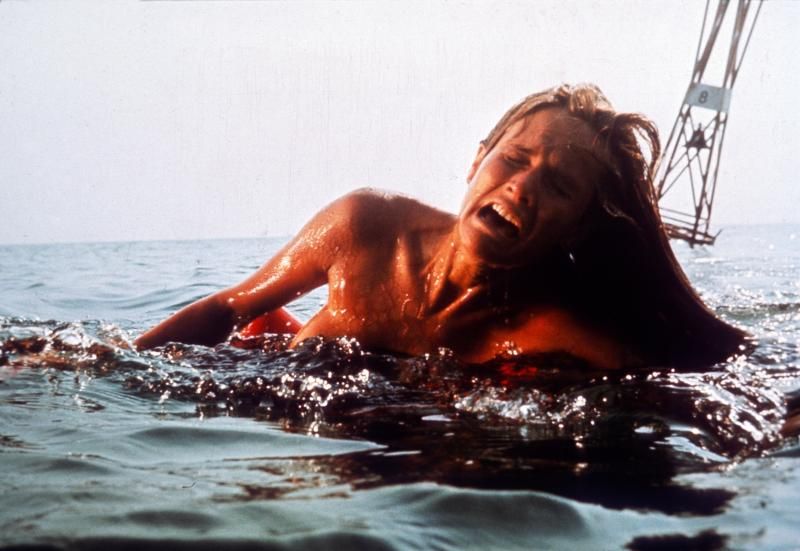
Despite the moderate amount of blood, the film has some very scary moments.  The opening prologue – following a skinny-dipper as she is eaten by the shark – is truly terrifying to me.  Her fear is so primal and all-encompassing, and watching her bob up and down in the water, being pulled back and forth against her will, and then finally pulled down for good… ACK!  Susan Backlinie played the girl who drowned, and her brief performance is my favorite scream queen sequence from any film.  It really wigs me out.  There is so much lore around the making of the movie, how Spielberg had to rely on fear of the unknown instead of a frightening monster, I won’t bother going into detail about it, except to add on that this opening sequence is a prime example of that.  You don’t see the shark here.  The camera, right at water level, only shows you the girl’s head, and you don’t know what’s happening just under the surface.  It’s so visceral, so guttural, and really, REALLY scary.  I’ve seen that sequence dozens of times, and it still gets under my skin.  

  
So after scaring the pants off you in the opening, Spielberg then introduces you to his seventies small town dramedy that is the majority of Jaws.  The interaction of Brody with not only the mayor but the rest of his town, and certainly his family, provides a substantial heart and heft to the film.  Spielberg devotes a great deal of time giving you insight into Brody’s life and relationships, but never doing it in a prosaic or predictable manner.  Brody argues with the townspeople in a decidedly chaotic manner; Spielberg has people talk over one another constantly in this movie, to the point where I thought I was watching a Robert Altman film.  It works, though; it emphasizes that no one really understands what’s going on.  With Brody’s family, Spielberg doesn’t give us staged dialogue between Brody and his wife where they tell each other how much they love each other.  Instead, we see Brody’s wife rub his shoulders, hand him a glass of wine, and purr, “Wanna get drunk and fool around?”  Instead of presenting a scene where Brody hugs his sons and tells them tearfully just how much he cherishes them, Spielberg gives us the incredibly tender mimicking sequence, which speaks volumes about the family dynamic.  Scheider is fantastic as Brody, the police chief of an island community who hates the water.  

  
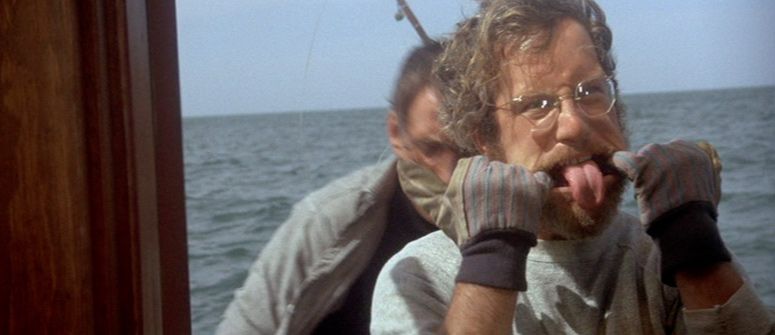
From time to time, I forget what a funny film Jaws is.  So many great lines, so many funny moments.  It’s not primarily a comedy, but Spielberg freely laces in light laughs, mostly in the form of Richard Dreyfuss.  Whether he’s cackling under his breath, “You’re all gonna die!” to a group of ignorant islanders or pulling ridiculous faces at Quint, he’s a great character.  

  
The finale of the film, where the trio embark on their ultimate hunt for the great white shark, is a great piece of filmmaking.  Spielberg doesn’t rush the final encounter.  Instead of one long battle, he breaks it up into much smaller fights between the shark and the men.  In between these fights, there’s a great deal of waiting and preparing and drinking and bonding.  As the men sit around, they swap scar stories, drink apricot brandy, and worry.  The feeling of brotherhood between three men who would otherwise have precious little to do with one another is one of the reasons that this is one of my husband’s favorite films.  And then, just when Spielberg has lulled us into thinking we might be watching a buddy film, the shark appears out of nowhere and everyone jumps out of their seats. 

John Williams’ score is a large part of the success of Jaws.  The deep, throbbing shark theme (shamelessly ripped off from Dvorak, by the way) is established early on a signifier of the shark.  We hear the music, then realize the shark is near.  The rules are established.  Well, then, what happens next?  The rules change, we see the shark without ever hearing the music, and jump out of our seats yet again!  The rest of the score, the non-shark parts, are typical triumphal John Williams in his classic Americana style; rousing and charming.  


Jaws is a rollercoaster of a film, and it’s so much fun.  I don’t wonder that movie-goers flocked to it in droves when it came out.  Spielberg knows how to take you on really terrific ride.

Arbitrary Rating: 9/10

Addendum: I saw Jaws last summer at the Dryden because the Dryden is awesome, but unfortunately, I had a less than stellar theater experience while there.  First of all, the Dryden showed an original print of Jaws, and while this sounds awesome in concept, the original print was in what can only be described as mediocre condition.  There were a lot of small skips and scratches and faded color.  The person doing the introduction described the print as “having character,” which is a nice way to say it’s crap.  Additionally, there was a rather obnoxious group sitting in front of us who consisted of two middle-aged men, presumably brothers, an elderly woman, presumably their mother, and a child who looked no older than 8, more like 6, presumably daughter of one of the men.  I was “lucky” enough to be sitting right behind the poor girl, so I got to witness her excruciating boredom at the first two thirds of Jaws.  Best part of her boredom?  Her vocalization of said boredom at all opportunities and her inability to sit still in her seat.  I THEN got to witness the young girl being utterly traumatized by the final sequences in the film, her shrieks of terror and her quiet sobs as she again couldn’t sit still in her seat, while the adults repeatedly told the girl to “Be quiet!”  They were completely unsympathetic to both her boredom and her terror, and were also rather loud in their indignance toward her.  All of this severely tainted an experience I had really been looking forward to: Jaws on the big screen.  Really, who takes their young child to see this movie?  I am certain there are young kids out there who would enjoy this movie, but not many.  Not the majority.  Thanks, idiotic family.  I know we all have those shitty theater experiences; I’m still really bummed that I had to have such a crap experience with this movie, because Jaws is an awesome movie.

Tuesday, January 22, 2013

The Color Purple


The Color Purple
1985
Director: Steven Spielberg
Starring: Whoopi Goldberg, Danny Glover, Margaret Avery, Oprah Winfrey

When asked about my favorite Spielberg film, this one wouldn’t come close, but the dang thing was nominated for eleven (!) Oscars.  He was about ten years into his career as a major Hollywood director, and apparently, that means that it’s time to make a “serious movie” about “serious things” (with lots of “quotation marks”).  So Spielberg reached for Alice Walker’s novel in order to “prove himself.”

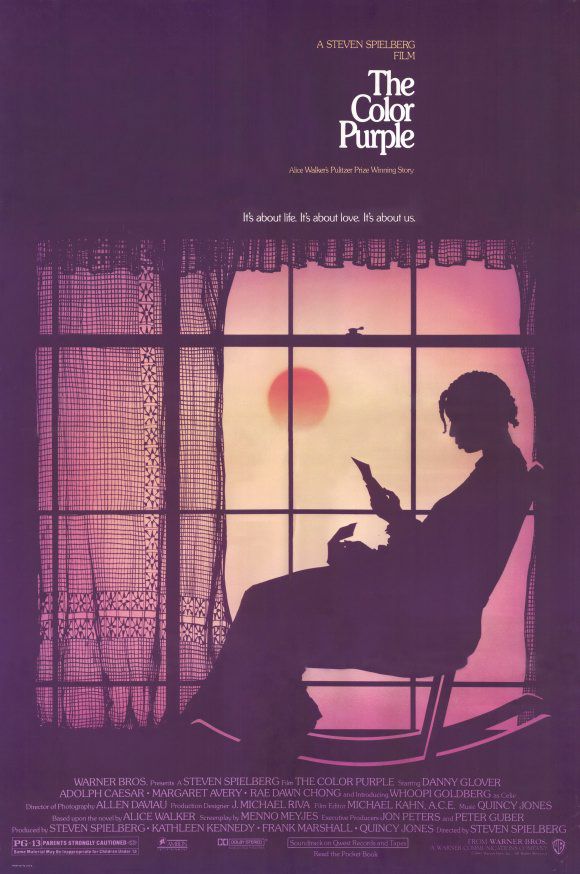
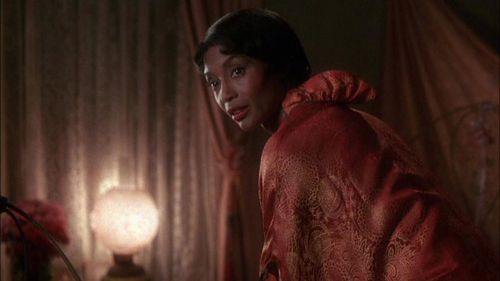
The rather meandering story manages to focus mostly on Celie (Goldberg in her first significant role), a beaten down young woman living in the Deep South at the turn of the last century, essentially auctioned off by her abusive and incestuous father to an abusive husband Albert (Glover).  Celie’s one source of comfort is her sister Nettie, so of course, she is parted from Nettie.  Celie lives life as a doormat, watching as her husband fawns over his lover Shug (Avery), and meeting strong-willed Sofia (Winfrey), who marries Albert’s son. 

Probably one of the biggest compliments I can give this film is the fact that despite the fact that it clocks in at just over two and a half hours, it managed to keep me engaged throughout.  I didn’t completely love this movie, but it absolutely succeeded in drawing me in to its world.  Despite the growing pains I think he exhibited here, Spielberg is a great storyteller, and he knows how to reel in his audience.  He knows how to bend you and twist you and, well, manipulate you into having a roller coaster of an experience; this film is no different.  If nothing else, it was a diverting way to pass a handful of hours.

 
There is no doubt who directed this film; Spielbergian touches are all over the place.  The problem is, classic little Spielberg touches of warm family humor don’t jive terribly well with this particular story.  The end result is a valiant but schizophrenic effort.  Just when you’re about to suffocate under a heap of crippling emotional turmoil, there’s a funny little scene of Danny Glover trying to cook breakfast by using kerosene to heat the oven.  It felt as if Spielberg couldn’t commit to the intensity and raw nature of Celie’s story, so he had to find ways to lighten the mood.  Problem is, though, in a weird way, I didn’t really want Celie’s story lightened.  If I wanted a feel good drama, I wouldn’t pop in a film that is upfront about familial abuse and incest in the first ten minutes.  But Spielberg being Spielberg, he can’t help himself, and every chance he gets, he creates some rosy little pocket of pure nostalgic warmth, right down to the heavy-handed sentimental flower patch bookends.

I admit right now to not having read Alice Walker’s novel on which this was based, but I felt as though Celie’s ultimate uprising felt more than a little out-of-nowhere.  This was a woman so completely crushed under others’ feet that emotional freedom seemed impossible.  Don’t get me wrong, I wanted Celie to break free from her bonds, but so many of them seem to be of her own making that it would take more than a stack of letters to change things.  I had problems buying the conclusion of the film. 

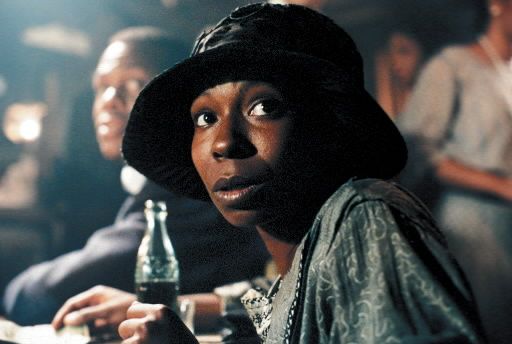
Probably one of the best things about this movie were the stalwart performances from all involved.  Whoopi Goldberg is very good, and she well-deserved her Oscar nomination for this role.  There are so many side stories swirling through the film, but ultimately this movie is about Celie, and Goldberg handles that responsibility with aplomb.  She is far different than the Goldberg she became in subsequent decades in the ‘biz.  Quiet, subtle, and underplaying, even in her scenes of strength; trust me, this is *not* the Whoopi Goldberg you are used to.  Danny Glover is a believable monster as her husband, but he is undercut by Spielberg choosing to alternately playing him as a fool.  Glover does both well, but the two seem incongruous with one another.  He’s an ogre!  He’s the village idiot!  He’ll kill you!  He’ll do a pratfall!  Well, which is it?  I suppose the two can coexist, but it felt more like Spielberg couldn’t make up his mind.  Oprah Winfrey admirably plays a strong then cowed then strong black woman, but her character’s story was one of those that seemed to distract, more than anything, from the central flow of the movie.  Margaret Avery as Shug was delightful, making everyone fall in love with her wherever she went.  I will say, though, that it’s difficult keeping track of her character; she enters, disappears, reappears, all with different men swirling around her.  By the time part of her story line ended, I was a bit confused about her relationship with, well, everyone.  

 
Ultimately, this movie smacks of Spielberg trying to legitimize himself.  “I make great fun joyrides,” he thought, “but if I ever want to win an Oscar, I need to make something ‘serious.’”  So he made The Color Purple.  It’s serious, but somehow not serious enough.  I understand both why this was nominated for Best Picture, but also why it didn’t win.  1001 Movies You Must See Before You Die says, in its entry for this film, that Spielberg bit off more than he could chew.  I couldn’t agree more; this film has more than a touch of the schizophrenic to it.  Still a great Spielberg ride, though, I must admit.

Arbitrary Rating: 7/10.