Showing posts with label 3 out of 10. Show all posts

Sunday, April 21, 2013

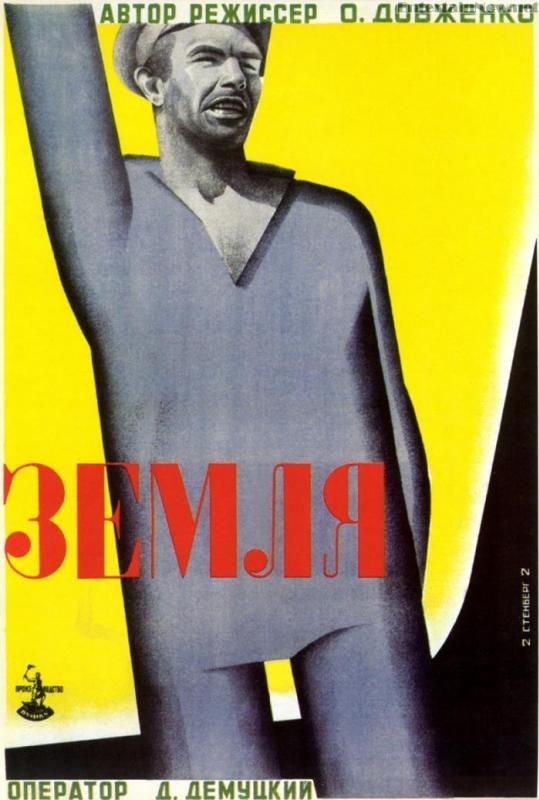
Earth (Zemlya)


Earth (Zemlya)
1930
Director: Aleksandr Dovzhenko
Starring: Nature and a tractor and Ukrainian farmers, in that order.

I don’t know.  I just don’t know about this movie.  It’s… I don’t know.  According to 1001 Movies, this is Dovzhenko’s “ode” (their word, not mine) to the beginning of collectivization in Russia.  Sure it is, that’s totally the message I got from this one, whatever you say.

So this is what I could make of the plot: a small village of Ukrainian farmers celebrates life and death and tractors.  People die, babies eat watermelons, the rich farmers battle it out with the poor farmers, and tractors.  Something about a son dying, which is different from the old guy dying at the beginning of the film, and there naturally is a scene where the men are rallied into a political frenzy.  And then tractors.  And awesome Russian beards.  And apples.  Because, y’know, they’re apples.
 
My favorite parts of this movie were, in no particular order:

  1. How Simon, apparently on his deathbed, sits up with zero effort, demands something to eat, has an apple, then says “Well goodbye, I’m dyin’.”  And then lays down and dies.  That was awesome.
  2. How a man is argued to about politics for five minutes, but we have no intertitles about what the political guys are saying.  They just yell and yell and yell and he listens.  Then they leave, and he says, with intertitles, “Well I’ll be a sonuvabitch, them fellows are real class!”  I bet they were, after yelling at you for five minutes straight.
  3. Simon’s epitaph.  Right after Simon dies, the only thing anyone says about him is “He liked pears.”  That’s a good epitaph.  I want my epitaph to be “She liked pears.”
  4. The utterly ridiculous “bumpkin-izing” of the English translation of the intertitles.  I watched this off of Netflix streaming, and Kino popped up at the beginning of the film, so I imagine this is the Kino edition.  That being said, great effort was made to turn the Russian intertitles into country rube speech.  “Let ‘er fly,” “There ain’t no god,” “You dyin’ Simon?” “Where ye be down there?”  Nothing like silly intertitles to make you laugh.
  5. The apology that came at the beginning of the film.  Before the movie even started, I had to sit through several minutes of an onscreen essay explaining why this was an “important film.”  Here’s a hint: this does not bode well for me if the distributors of the film feel the need to justify the film’s place in history.  The film should speak for itself.  If I want to research the history and politics that surround this film, which I usually will to some extent, then I will do so on my own.  The essay felt like a thinly veiled apology for the silliness of the movie, a weak attempt at justification.
  6. How the filmmaker actually got a horse to nod his head in agreement with the farmers.  That’s doesn’t feel like Mr. Ed at all, oh no, and it certainly helps make the movie more serious.
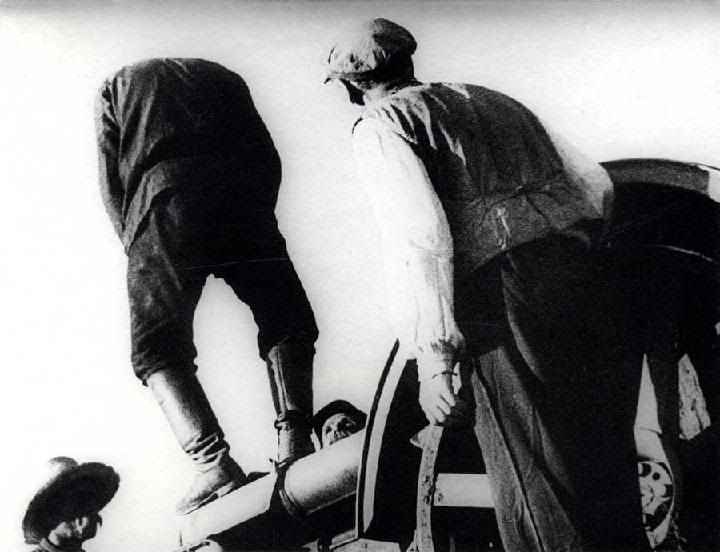
  7. The tractor is the real star of the film.  People talk about it with the same verve and excitement as the Wonderful Wizard of Oz.  So when the tractor goes kaput on the way to the village, the men naturally piss on it to make it go.  And then it does.  That was awesome.
  8. The five-minute long walk this guy takes down a dirt road and then he randomly breaks out in a dance.  And then he gets shot or something.  The best part was I wasn’t able to tell which character he was for his long, slow, and ridiculously drawn out nighttime stroll.  You want me to feel sympathy for this, Dovzhenko?  Then you need to do a much better job making it clear exactly who it is walking down the road.
  9. The never-ending funeral dirge.  That was fun.  Because I need to see every step of a five-mile-long march played out in real time.  That makes for good cinema, oh most definitely.
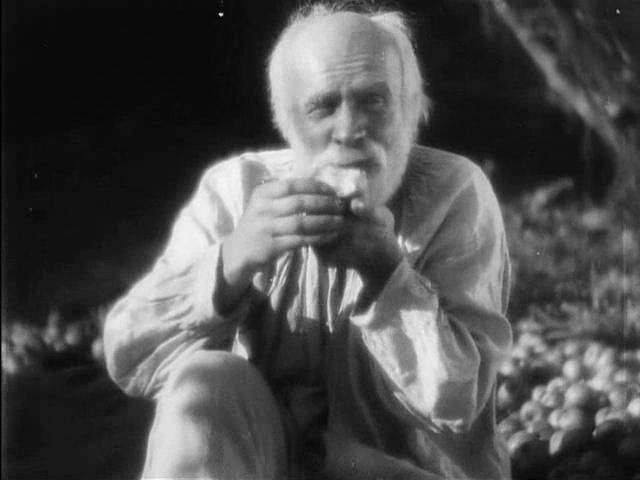
I like apples.


The theme of life and death and nature is clearly Dovzhenko’s main point, pouring on a little bit of politics as well.  When Simon dies at the beginning, he is (rather inexplicably) surrounded by piles of apples, and we keep on cutting to blowing fields of wheat.  Dovzhenko is definitely making the point that death is simply a part of nature.  We get similar cuts to nature throughout the film, always reminding us that we’re part of the great Circle of Life. 

The politicking, though, is a bit odd, especially as everyone in the film are farmers.  There are good farmers and bad farmers, and little reason given for their differences.  I will give the film the benefit of the doubt and lay it on my ignorance.  I am willing to bet that if I was watching this movie as a member of 1930s Russia, I would have a much better idea what was going on with the politics of the time.  All I get from this go around, however, is that the rich farmers are evil bastards because they’re evil.  And that’s about it.

The sequence where wheat is harvested was actually the most exciting part of the film, and where Dovzhenko managed to make a pretty darn good montage.  Helped along (greatly) by a frenetic soundtrack, we follow along from the beloved tractor pulling up the wheat to it being carted off to a factory and eventually turned into loaves of bread.  It wasn’t a story, per se, but it was a neat little bit to the film.  And god help me, it honestly was more exciting than anything else in the movie.  Isn’t that a little sad.
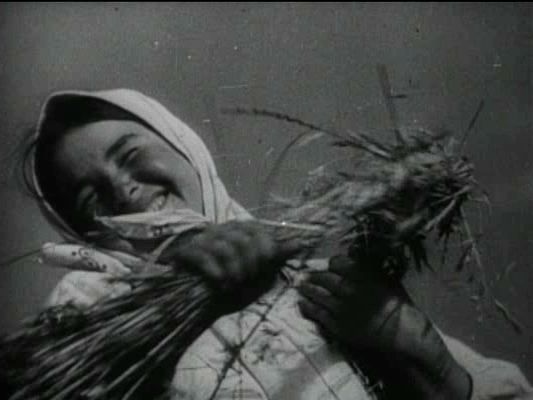
Yay wheat!

Quite frankly, if I’m going to submit myself to a Russian propaganda film, I’d pick something else entirely.  I’d want Eisenstein.  At least Eisenstein has the ability to conjure up some propaganda-fueled anger.  This film is curiously emotion-free.  It’s just trees and fields and villagers running and tractors.  And because it’s emotion-free, holy crap but it feels long, which is a very bad sign because it’s not long, not at all. 

Should you watch it?  Sure, if you like tractors.  Or wheat.  If not, though, take a pass.

Arbitrary Rating: 3/10.

Tuesday, February 19, 2013

The Birth of a Nation


Hide yo' kids, hide yo' wives.


The Birth of a Nation
1915
Director: D.W. Griffith
Starring: Lillian Gish, Mae Marsh, Henry B. Walthall, hundreds upon thousands of extras

I will tell you this from the outset: I have precious little original content to say about The Birth of a Nation.  My opinion of this film is fairly similar to that of pretty much everyone else.  You won’t be gleaning anything terribly new here.

So… let’s get this started, shall we?

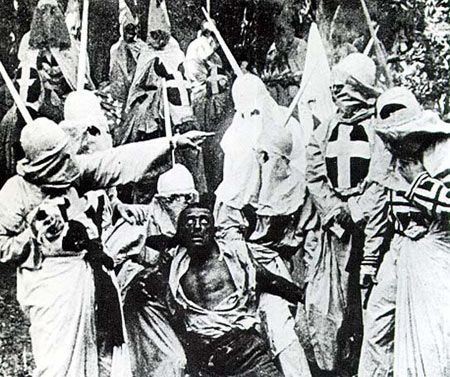
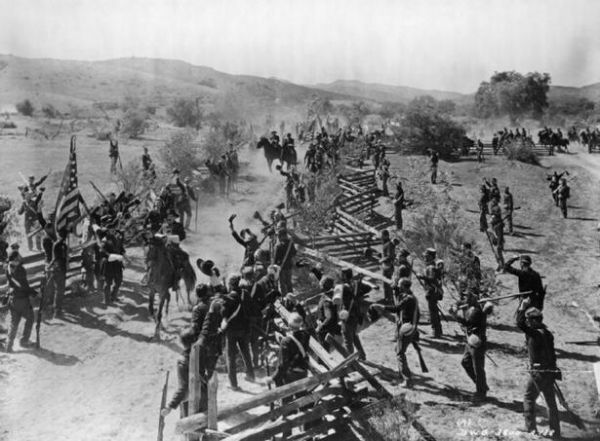
The Birth of a Nation is about arguably the most violent and disruptive of decades in American history, the 1860s.  We get an introduction to two families – the Camerons of the South and the Stonemans of the North – right before the American Civil War breaks out.  The first third or so deals with the war, then later we see Lincoln’s assassination.  The final portion of the film deals with the South after the war, about rebuilding and reconstruction, and, in what is so ridiculously troubling, about the rise of the Ku Klux Klan. 

I’ll start with the good, because there is good to say about this film.  The Birth of a Nation is often credited with “inventing the language of film,” and it would be difficult to argue with this statement.  I’ve seen a few films made prior to this, and I’ve seen another film from the same year as this (Les Vampires).  D.W. Griffith did not invent the concept of the “epic film,” (Les Vampires is even longer than Nation’s three hour running time), but he certainly took the concept of film to a much higher level.  Unlike Les Vampires, which feels like a filmed play, Nation has crosscuts, close-ups, intercutting, flashbacks, and even a bit of a moving camera.  Griffith defines what makes a movie different from a play with The Birth of a Nation.  While this might not be apparent to a thoroughly modern movie-goer, it’s apparent by watching the other films of the 1910s that Nation was a game-changer.  The “language of film” gets a vocabulary lesson.

And yet.


Why, oh why were such inventive film techniques brought to us through such a stomach-churning story?  The first hour, the one that focuses mostly on the Civil War, is fine enough, establishing many classic war movie tropes in one go.  Even the fact that Griffith tells the story from the vantage point of the South (his father was an officer in the Confederate Army), sympathizing them while brutalizing the North, is fine.  But once the Civil War ends we are treated to some of the most ludicrous racial stereotyping nonsense, so horrible that I have trouble getting through it.  The black characters in the film (most of whom were played by white actors in blackface) are nearly all portrayed as lascivious, lawless, power-hungry beasts who will beat the white men into submission while marrying all the white women.  And the only possible way the white race can save itself?  The Ku Klux Klan.  Don’t worry, white women, the KKK will save you! 

I don’t even…

I rewatched most of this film in order to write this review, even though I knew what I wanted to say.  I admit, I had forgotten just how archetypal the Civil War sequence is, how influential it was on war films, and that’s worth noting.  Griffith portrays the jubilation of the South heading off to war, the chaotic frenzy of the battlefield, followed by the despair of returning home to a ruined homeland, all formidably portrayed.  While All Quiet on the Western Front certainly portrays the disillusionment with war with greater sophistication, there is a similar sense here.  So I am glad that in watching this again, I remembered this portion of the film I had forgotten.


But then the film gets silly and the racial absurdities become too many to name, and I feel my stomach literally turning over.  And then our “hero” (Walthall) gets “inspired” to invent the KKK, and my patience is significantly shortened.  I just can’t.  Knowing how much intolerance and bigotry this particular organization has inflicted in the last century in America, how much violence and hatred it has instilled, how its effects are undoubtedly still felt in some areas of the American South, I can’t see them as any type of hero.  Griffith claims to have been blind to what he was doing, and he was, apparently, legitimately surprised when people took issue with his portrayal of race relations.  I just don’t get it.  How could he not know what he was doing? 

I had to stop watching.  I couldn’t make it through the final half hour.  I was impatient, disturbed, and frustrated.  I was NOT going to watch the KKK save the day.  I couldn’t.

The Birth of a Nation is troubling.  It advanced the art of filmmaking by light years, but it did so by telling an utterly reprehensible story.  I would never recommend anyone see this unless they needed to for a class or if you’re a list completist.  I get no sense of pleasure from watching this movie.  I respect what Griffith did in terms of filmmaking techniques, but after that, this one gets a resounding “NO” from me. 

Arbitrary Rating: 3/10.  It scrapes a few points for technical merit.

Sunday, July 8, 2012

Too Early, Too Late


Photobucket
This film is so experimental, it doesn't even have a damn POSTER!


Too Early, Too Late
1981
Director: Daniele Huillet, Jean-Marie Straub
Starring: Countryside vistas and the essays of Marxist writers. No, I’m serious.

Y’know, as pretentious and posturing as I know I can sometimes get about film, I really really do not enjoy avant garde cinema. I just don’t get it. Dammit, I like it when my film tells me a story. And even if there’s a little bit of story mixed in with some experimentation, yeah, I like that too (Last Year at Marienbad, I’m looking at you). But just plain experimental? No plot, no actors? Oooh, then we have a problem.

Too Early, Too Late is exactly that type of a film. The entire film – the ENTIRE film – is very long shots of various countryscapes throughout the world. The narration over these long pastoral shots is readings from famous Marxist essays read in the most possible flat voices you have ever heard in your entire life. The first part of the film is a reading of a letter by Friedrich Engels listing stats of numbers of impoverished people in the French countryside, read over shots of the French countryside. The second part of the film is a similar structure, but now in Egypt, reading an essay by Mahmoud Hussein, describing how the Egyptian people should cast off their European rule to be independent.


Friday, June 22, 2012

Titanic


Photobucket


Titanic
1997
Director: James Cameron
Starring: Leonardo DiCaprio, Kate Winslet, Billy Zane

Sigh. So someone over at my “1001 Movies Blog Club” picked Titanic to be the movie of the week. For realz.

Here we go.

First things first, there’s something you need to know about me, as this will inform most of my opinion of this film.

I.

Hate.

Epics.

Not just “dislike.” Not just “well, I would never choose to watch one, it’s just not my preferred genre.”

No.

Actively loathe. I loathe epics.

Probably my least favorite genre of films ever. It’s just not what I want out of my films.

Why? First of all, no one ever made a short epic. So whatever story you find yourself trapped in, get comfortable, because jesus, you’re not getting out of it for at least three hours. In the case of this one, it’s four. I mean honest to god, there is a virtue to telling a story economically, but you never get that in an epic. EVER. Why so long, epics? Why so long? Don’t get me wrong, I don’t hate on epics just because they’re long, though. There are long movies that I love. But epics are dull. Mind-numbingly dull, filled with show-offy set pieces, one after another, a nonstop litany of drudgery that lasts forever and ever and ever. They are long and dull. They make me want to peel the iris out of my eyes to save myself the pain of ever watching them again.