Showing posts with label 1966. Show all posts

Wednesday, July 9, 2014

Hold Me While I'm Naked


Hold Me While I’m Naked
1966
Director: George Kuchar
Starring: Donna Kerness, George Kuchar

I just plain don’t get, or like, experimental films.  Whenever I see that tag of “avant-garde” on a flick, I tense up.  Oh dear lord, what will this one do to me now?  But 1001 Movies always has a lesson or two to teach me about never discounting an entire genre of films.  There are always exceptions to the rules, and I can’t help but enjoy Hold Me While I’m Naked.  Well, as much as I could enjoy an experimental film.

The scant plot of this scant film (it clocks in at 15 minutes) is of a director (Kuchar) trying to make a movie.  One of his lead actresses pulls out halfway through the shoot (Kerness) so he has to find a replacement.  Meanwhile, off screen, we see said actress having sexy fun times with a significant other while our poor director leads a rather solitary, lonely life.

And that’s it.  I mean, at 15 minutes, it’s barely there.  But I’ve seen films where 15 minutes can feel like a chore, and it doesn’t here.  In fact, I’d even go so far to say I wouldn’t mind this particular film being a bit longer.  Wow, did I really just say that?


Why is this so much more amusing than a typical sixties experimental film?  Simple: George Kuchar.  As both director and star, this film is clearly HIS, and it’s evident from the opening that Kuchar has a huge sense of humor.  His voiceover as he coaches his actress through her scenes makes me smile.  And his dialogue as he’s shooting a love scene later just slays me with its bizarre juxtapositions: “Tomorrow we do the massage table scene and maybe we’ll do the scene where you’re found naked in a fallout shelter and there are those radioactive welts on your thigh.”  Wait… WHAT?  Radioactive welts?  Fallout shelter?  From a love scene?  I honestly can’t help but laugh at that sort of ridiculous swing in imagery.  The circus-esque music in the opening credits sets the stage for such an approach. 

Kuchar also makes me laugh later in the film when we continually cut back and forth between couples having sexy times in a shower and him, Kuchar, taking a shower alone, by himself, and banging his head against the wall.  It’s a bit sad, and there’s definitely a poignancy there about a man sacrificing everything for his “art” even though the art is a bit crap.  It’s rather reminiscent of Ed Wood, really.  And yet, despite the pathetic nature, it’s also funny.  Going back and forth between two people obvious each enjoying their time together to Kuchar banally taking off his socks and stepping in his tiny shower… really, it’s funny.  At least to me.


I first saw Hold Me While I’m Naked at the Dryden when they did an evening of screening art house/experimental shorts from the sixties and seventies, and this was before I could see these shorts on youtube or anyplace else.  This was my only chance to see these films.  There were several Andy Warhol films on the docket that evening, and Blonde Cobra was shown as well.  Hold Me While I’m Naked was shown by Kuchar, as was his later short from the seventies, I, An Actress.  I am sure that this is why I’m rather keen on Hold Me While I’m Naked – because when you spend an evening watching Blonde Cobra and Andy Warhol, and then you watch something by George Kuchar, you leap all over that last stuff.  Kuchar’s sense of play, optimism, and humor, really shines through amongst all the ridiculous posturing of the other shorts.  And I think I, An Actress makes a great companion piece to Hold Me While I’m Naked.  It’s even shorter (9 minutes) but again we have Kuchar playing a director making a movie.  Instead, though, in I, An Actress, the entire short is Kuchar coaching his lead actress through a scene, and it’s hysterical as he grows even more over the top in his delivery of her lines (even the actress can’t keep a straight face).  This wacko crazy approach to film works well for me, at least when you contrast it with the other experimental shorts of the time that drive me absolutely bonkers. 


Hold Me While I’m Naked may not make much sense, but at least it laughs at itself.  At least it will make you laugh.  George Kuchar seemed like a really fun guy, and he clearly loved film.  Honestly, I’m glad this selection is in 1001 Movies.  It’s a diverting, campy little 15 minutes of your life.


Arbitrary Rating: 7/10

Tuesday, April 23, 2013

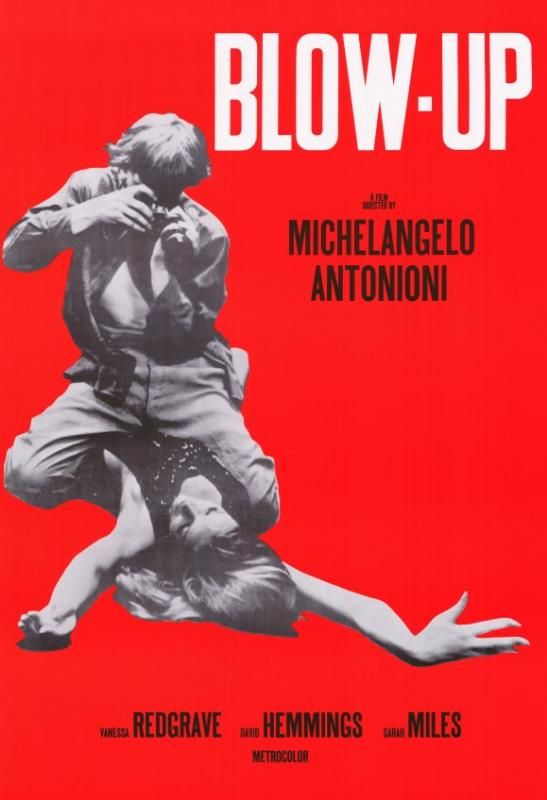
Blow-Up


Blow-Up
1966
Director: Michelangelo Antonioni
Starring: David Hemmings, Vanessa Redgrave

Antonioni is a director that I struggle with, and I don’t feel ashamed to admit it.  His work is hardly what anyone would call “easy.”  He likes to make films about alienation, which is not an easy or entertaining topic.  Of all the Antonioni films I’ve seen, Blow-Up is the most accessible, but even that’s not saying much.  This is my second pass at Blow-Up, and while I feel as though I “get it” a bit more than the first time, it is not what I would consider to be entertaining.

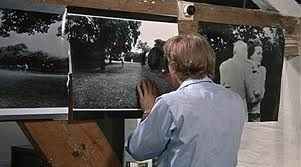
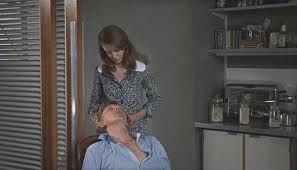
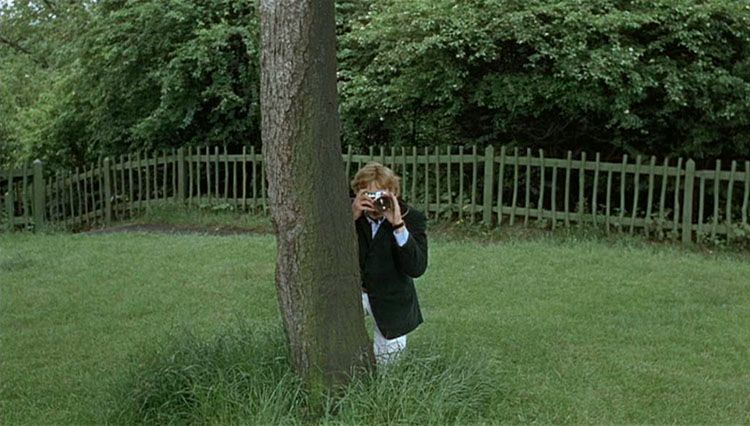
Set in a swinging London mod scene that is everything Austin Powers was skewering, a trendy photographer (Hemmings) is bored.  Bored bored bored.  So one day, to escape the boredom of shooting more vapid fashion shots, he takes his camera to a park and starts shooting landscapes.  He sees a young woman (Redgrave) and an older man who seem to be canoodling, and keeps shooting.  The young woman gets distraught when she sees him and demands the film.  He refuses, she tracks him back to his studio and tries to seduce him to win back the film.  He still refuses, then starts examining this precious film.  The more he looks at it, the more he thinks he sees… something.  But what, exactly, and what does it mean?

 
I think the reason I was a bit disappointed when I first watched Blow-Up, and why I was less so this time, was that initially, I thought it was about the mystery of what was on the photos.  Let me be as explicit as possible here: if you watch Blow-Up expecting a great mystery, don’t.  Just don’t.  That’s not Blow-Up.  The mystery, such as it is, occupies approximately half the film, if that.  The other half of the film is about the photographer’s lifestyle, and that, to me, is what this movie is REALLY about.  By “lifestyle,” I don’t mean the ridiculous swinging mod London, sex with groupies, or rock concerts.  No, I mean the photographer’s personality.  His alienation.  His existential coma.  

 
The first half hour of the film sets up the photographer’s boredom.  He comes alive most when he is taking photos, but not even taking photos is a guarantee that he will enjoy himself.  Look at how awful he is to the models during the early fashion shoot, barking orders at them and treating them with cold cruelty.  He doesn’t seem like he’s having any kind of fun.  We can feel him rolling his eyes as some groupies try to get his attention, and even a conversation with his neighbors, who he appears to like, does little for him.  In the park, though, he gets excited.  We see a sort of animal spirit begin to appear.  This same excitement, after ebbing, comes back when he starts examining the film.  Antonioni seems to be saying that our photographer (IMDB says his name is “Thomas,” but he is never properly given a name in the film) has a life that is empty and hollow, but when he is most embroiled in his craft – in taking pictures of things he likes, of developing interesting film, of blowing up certain shots – then he is most alive.  Then he is not a dead soul.  The possibility of a mystery engages him in a way that vapid sex doesn’t, but the film closes in the last half hour with his spiritual awakening ebbing away for good.  The mystery starts to fade, the proof begins to disappear, and slowly, our photographer is drawn – perhaps against his will, perhaps not – into his superficial life of the beginning of the movie.  The final shot of the film, in which our character literally disappears (that is NOT a spoiler in any way), is a huge statement about this superficiality.  That is the journey of the film: watching a man find something that interests and engages him, then watching it run out of his fingers like cupped water.

Antonioni is known for his color work, and there is very nice color work in Blow-Up.  There are bright reds and blues on the buildings of London, insanely bright whites and ebony blacks in the photographer’s studio, but my favorite is the green of the park.  The park is perhaps the most significant set in the film as it sparks, and then concludes, our photographer’s interest.  This is a brilliant green, a terrific emerald green.  The grass is green, the trees are green, the fence is green.  And the park is surprisingly vacant – the green is not interrupted.  The sky, interestingly, is not blue, but gray and overcast.  I think that’s significant.  Antonioni was highly specific about his colors, to the point where he actually shot the park sequence twice in Blow-Up because he didn’t like the green of the grass on the first go, so he had it spray-painted just the right shade and then shot it again.  If he had wanted the sky to be blue, he’d have waited for a nicer day.  But no, he must have wanted the sky to be gray.  In a way, this seems to make the other colors pop.  I love the contrast of the gray and the green together.  Gray, overcast days are my favorite type of weather, and I think a feel a bit of a connection to seeing this onscreen.

 
This is a very silent film.  I wouldn’t be surprised if all the dialogue from the film could fit on ten pages worth of script.  There are long, loooooooooooong stretches where no one says anything.  And Antonioni doesn’t help cut the silence by providing background music, oh no.  There is almost no soundtrack to this film.  No one talks, and there is no music.  During the scenes where the photographer starts to delve into the mystery of the film, this silence is effective in building tension and excitement.  But for nearly every other part of the film, though, this silence feels tedious.  Yes, it underlines our main character’s dreariness, but it itself is also dreary.

Which leads nicely into my final feelings about Blow-Up.  I understand now, better than previously, that Blow-Up is about ennui.  But does that make it something I like?  I don’t think so.  Frankly, watching a movie about someone who’s bored is, well, boring (Jeanne Dielman, anyone?).  A film about someone suffering from swinger angst, bored to death of his tedious glittering lifestyle?  I have very little sympathy for our main character.  He disappoints me by sick and tired of his superficiality, but then is completely unable to extricate himself from it.  I *was* more engaged in this second go-around, again because I knew not to expect too much from the mystery and to look more at the photographer’s emotional arc, but this film does not earn a rave from me.  I get Antonioni’s message.  But, y’know, that’s about it. 

Arbitrary Rating: 7.5/10.  It was good for me to watch this a second time.  I found more there.  This score is more about appreciation than entertainment, though.