Showing posts with label 1957. Show all posts

Wednesday, June 19, 2013

Throne of Blood (Kumonosu-jo)


Throne of Blood (Kumonosu-jo)
1957
Director: Akira Kurosawa
Starring: Toshiro Mifune, Isuzu Yamada, Akira Kubo

I have a thing for Shakespeare.  In college, with a biochemistry major and an honors program minor, I had almost no time in my schedule for electives of my choosing.  In fact, I only ever chose two electives, and it wasn’t until my senior year I had the space available in my schedule.  The first elective was the standard Shakespeare literature course the college offered (because biochemistry majors totally need to take Shakespeare).  The second was an independent study with the professor of the aforementioned Shakespeare course where I designed my own project.  What did I design?  I examined different film adaptations of Shakespeare plays and compared them to the original texts.  Again, because biochemistry majors clearly need to do this.

I really wish I had known about Throne of Blood back when I was doing that independent study.  It would have been an amazing film to examine in that context.
  
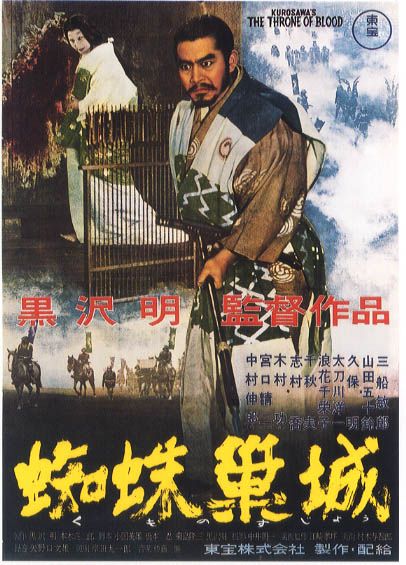
Throne of Blood is Macbeth set in feudal Japan.  Warrior Washizu (Mifune) is Macbeth, and the film opens with him and his friend Miki (Kubo), the Banquo role, riding back to their lord after finding success in battle.  They find a spirit in the woods who tells both of future success, specifically Washizu that he will rule the land, and tells Miki that his son will then rule the land.  Both men laugh, but when the spirit’s predictions begin to come true, the psychological battle begins.  Washizu’s wife, Lady Asaji (Yamada), goads her husband to off his superior to become high ruler.  Issues of power, corruption, greed, and guilt are explored as violence begets violence.
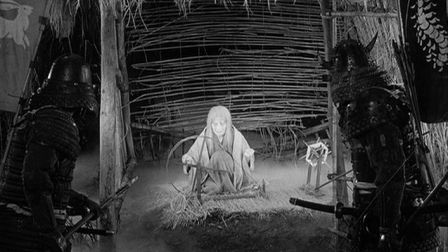

Of all the Shakespeare plays, films, and various adaptations I’ve seen, Macbeth is the play that has been presented most creatively and in many different settings.  I’ve seen it live three times, one of which was a deaf student production with deaf actors on stage acting the roles while speaking actors read the lines into a microphone from backstage, and another of which was a five-person production, with little to no set dressing and each person playing at least half a dozen parts.  Things got interesting when the actor who played Macbeth also played one of the witches – it meant the witches were talking to nobody onstage.  (Man, I’d kill to see the current Alan Cumming one-man Macbeth on Broadway right now… anyone want to take me to Manhattan for the weekend?)  In terms of film and TV, there’s the iconic blood-filled Polanski film version, the much more interesting Shakespeare Revisited BBC version starring James McAvoy that transplants the action to a modern cutthroat restaurant empire, and then there’s Throne of Blood.

And for my money, Throne of Blood is the best of the bunch.

It staggers me how amazingly well Shakespeare’s story, written in seventeenth century England, translates to the feudal society of centuries-old Japan, a place and time Shakespeare himself probably had no idea existed in the least.  The credit for this falls on two men’s shoulders.  First of all, due must be paid to Shakespeare’s original tale, one with such universal themes that it was carried to such an opposite place from the one he originally intended and yet the message still remains.  But Throne of Blood would not work nearly as well as it does were it not for the brilliance of Akira Kurosawa to understand how to translate the Bard’s tale to his own homeland.  It’s Kurosawa’s doing that he knows how to make Macbeth fit into feudal Japan, how to swap kings for kimonos, and Laurence Olivier for Toshiro Mifune (really, not a bad swap).  Everything that makes Macbeth special is still here, and it’s still potent.  The three witches are transposed into a truly freaky single ghost spirit, surrounded by fog, speaking with an unearthly hollow voice, and constantly spinning the web of fate.  The banquet scene with Banquo’s ghost, probably my favorite scene from Macbeth and one that HAS to be right for me in order to enjoy a Macbeth production, is here, and just as disturbing and upsetting.  The camera keeps cutting back to Banquo’s empty chair, then back again to his pale ghost.  It’s a terrific scene, one that certainly allows Mifune to display tremendous range as the paranoid and frightened Washizu, and just one of the many examples of how well Shakespeare works when telling a samurai story.
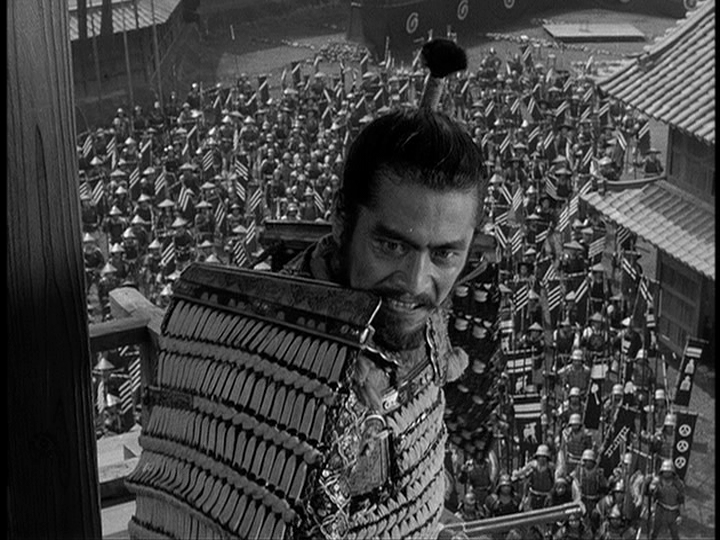
  
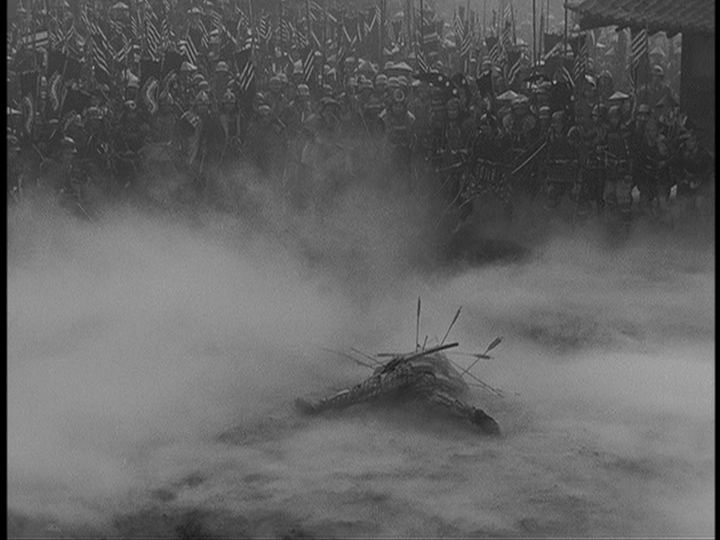
The two standout performances are that of Mifune as Washizu and, to be expected, Yamada as Lady Asaji.  Mifune is always good, always watchable, and I prefer him playing the tragic hero, as he does here, over playing the buffoon as he does in Seven Samurai.  Sure, he yells a lot – that’s Mifune’s style – but Mifune has range.  Here, as Washizu, he can go from scared to paranoid to frightened to angry in the span of about thirty seconds, and it’s entirely believable.  His silence is eerie after he kills the reigning lord in his sleep and thoroughly unnerving.  His death scene, as Washizu is riddled with a ridiculous amount of arrows, is memorable to the last.  (Apparently, in order to ensure the fear on Mifune’s face was real, Kurosawa used real arrows for the shots that were not to hit Washizu.)  In short, Mifune knows how to play Macbeth.  But it’s Yamada as Lady Asaji who really steals the show.  Yamada had great source material to work with, as Lady Macbeth is one of the most magnificent literary villains of all time, but even so, Yamada manages to take the evil and crank it up a few notches.  Her Asaji is frankly frightening in her cool demeanor and cutthroat words.  She barely moves a muscle as she slowly spells out to Washizu that he must take control of his own destiny to fulfill the spirit’s prophecy.  Her decisions to underplay nearly every scene are the perfect balance to Mifune’s aggressive screen presence.  It gives the impression of a calm, cool, and incredibly strict master with a somewhat crazed bulldog on a leash.  The minute the master gives the word, the bulldog will attack. 
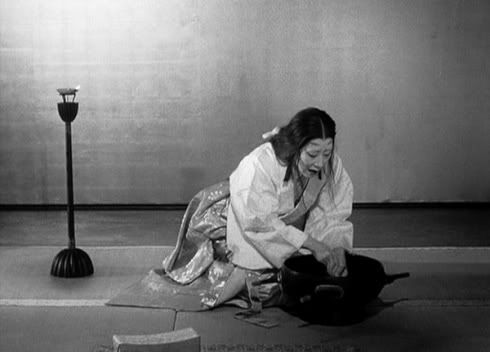

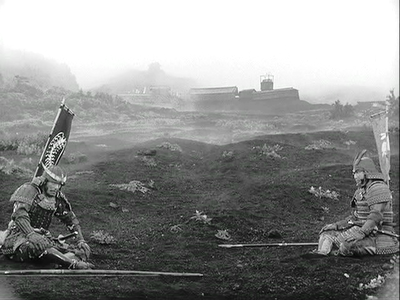
Kurosawa’s production is beautifully imagined and photographed.  Ultimately realizing it would be more economical to just build an actual damn fortress rather than the simply façade, Throne of Blood is done on a grand scale.  The volcanic mountainside of Mt. Fuji is unsettlingly desolate, and the bright fog that seems to envelop nearly every outdoor shot is deliciously atmospheric.  When the woods of Dunsinane – or, rather, Spider Web Forest – begin to move, it’s easily the best cinematic representation of Shakespeare’s moving forest I’ve ever seen.  I love how Kurosawa presents the spirits, how without any computer effects and purely through in-camera techniques, we get an effective representation of other-worldly beings.  The makeup, the altered voices, the flying above Washizu in the forest paths, the disappearing and reappearing: it’s a great interpretation.  The costumes are utterly divine as well.  These are not the poor, destitute, rural warriors of Seven Samurai, but true lords displaying all the trappings of wealth.  If Mifune is not dressed in full armor regalia, decked to the hilt in decorations, then he is wearing luxurious costumes full of layers and billowing fabrics.  This is a beautiful film to watch.
  
Is this the best Shakespeare adaptation I’ve ever seen?  Well, that’s a big ask.  I don’t know if it’s the best, but it’s certainly one of the best, easily top five, and definitely gets the award for Most Imaginative Transposition.  This and Ikiru (which one I pick depends on my mood – do I want adventure or sorrow?) are my two favorite Kurosawa films.  An absolutely brilliant film.

Arbitrary Rating: 10/10.

Saturday, June 8, 2013

The Seventh Seal and Happy Anniversary to Me!


Happy Blog-iversary to me!  Yes, dear readers, precisely one year ago today, I posted my first review (The Great Escape) over here at blogger, after finally deciding to take the plunge and move from Livejournal.  Since then, I’ve posted over 200 film reviews and gotten to know some great fellow movie fans.  I really appreciate all of you out there whose awesome stuff I look forward to reading every day. 

Yes, this is just a blatant excuse to use a Sherlock gif.

For those keeping tabs, I just saw my 901st film from the 1001 Movies list, so I’m making slow progress there, but frankly, I’m more concerned with closing the extraordinarily wide gap between films I’ve seen and films I’ve reviewed. 

So today, in celebration of one year at this site, I bring you a review for an extremely special film to me.  I was saving this one for a special occasion; today seems fitting.


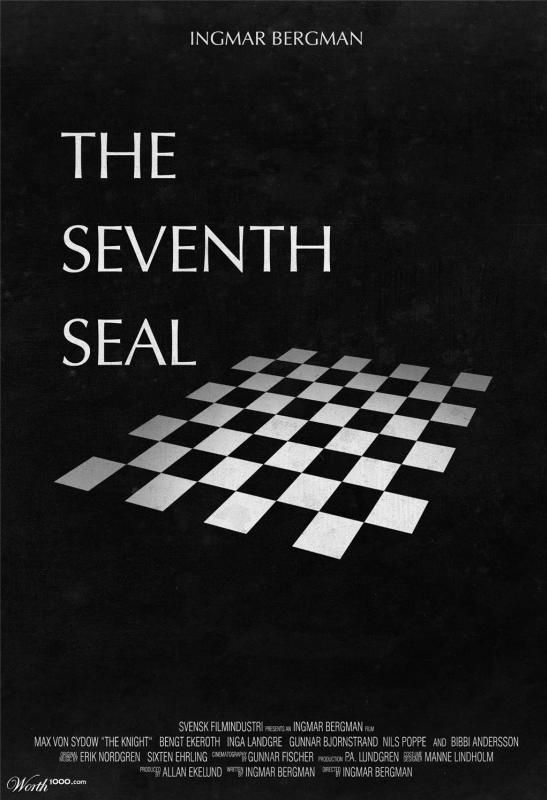
The Seventh Seal
1957
Director: Ingmar Bergman
Starring: Max von Sydow, Gunnar Björnstrand, Bengt Ekerot, Nils Poppe, Bibi Andersson

I know that I can tend towards over-adulation.  I know I am not shy in dealing out perfect scores for films.  I know that I often say “this is one of my favorite films ever!”  I’m not ashamed of this fact; it just means I love movies, and I love a lot of movies.  But with The Seventh Seal, I have to add a new level to “love.”  This film… this is in my top three ever.  I highly doubt it will be toppled.  I love a lot of movies, but even amongst the best and my other favorites, The Seventh Seal stands out.

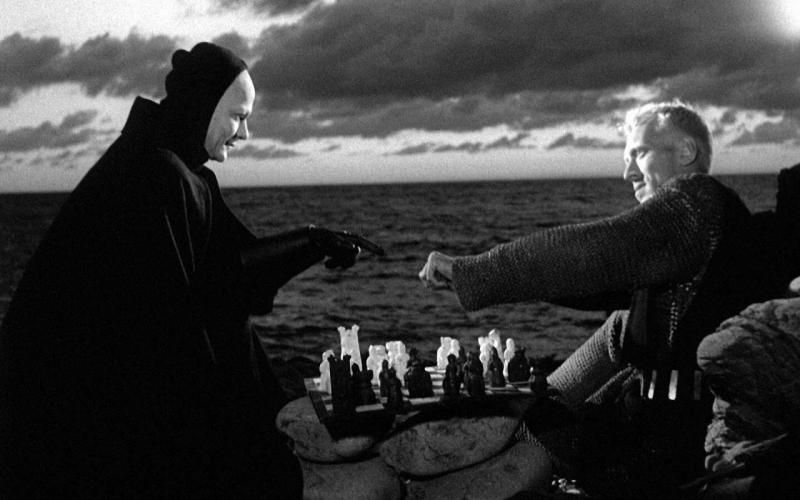
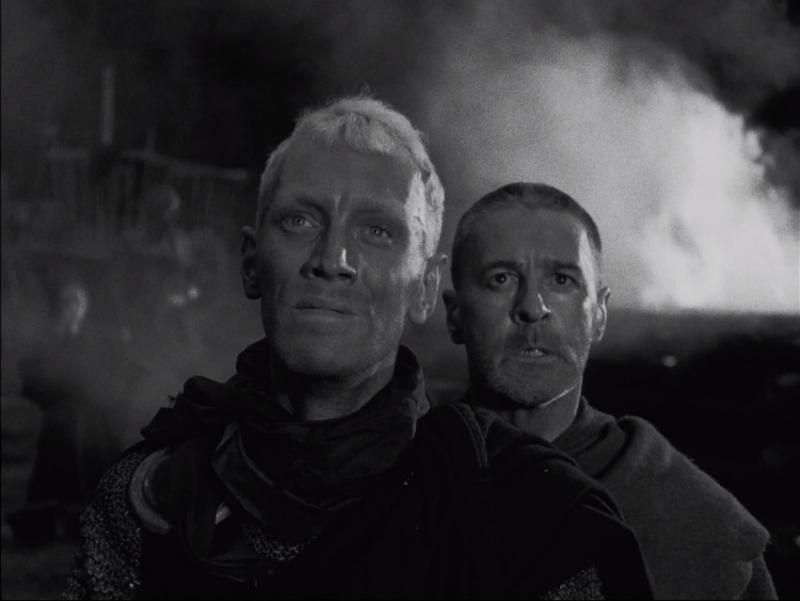
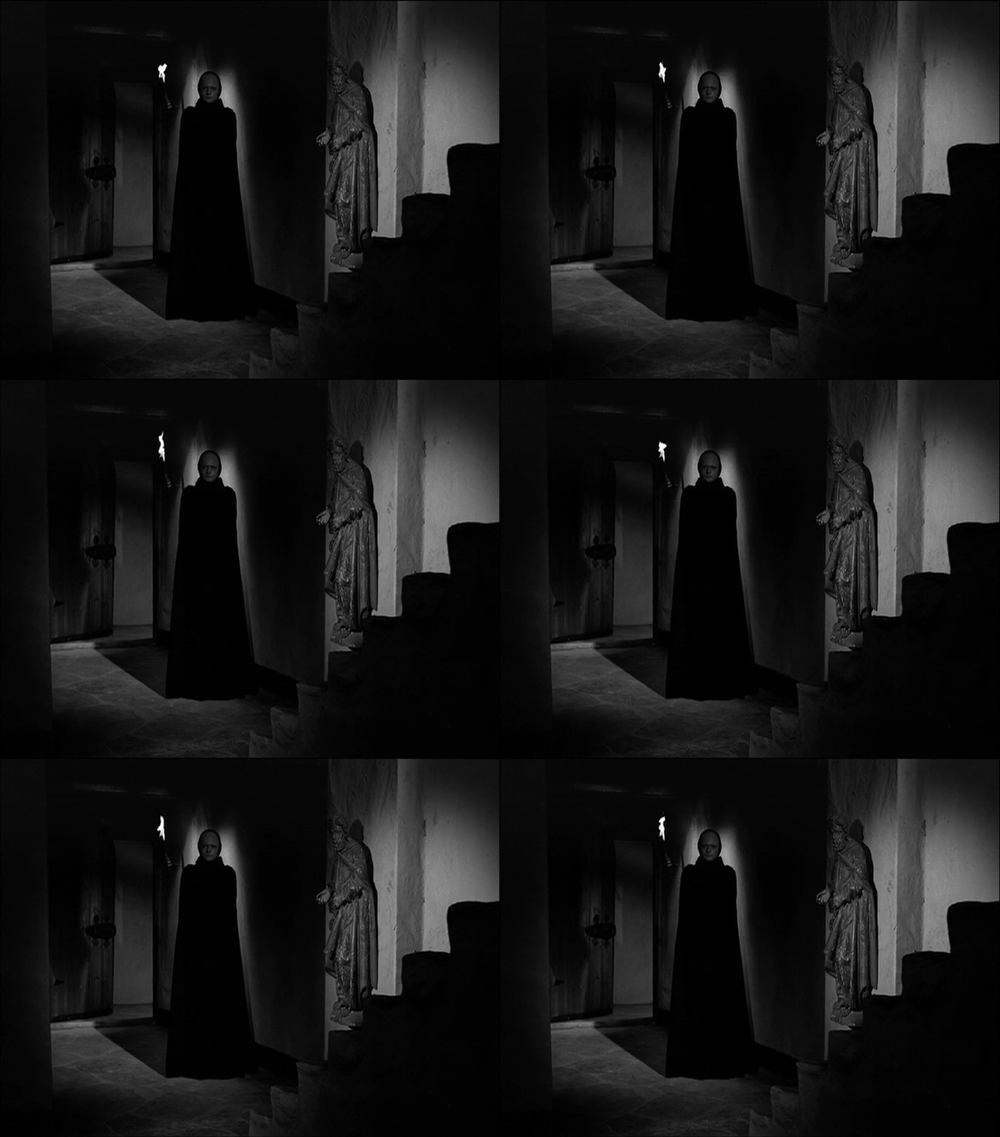
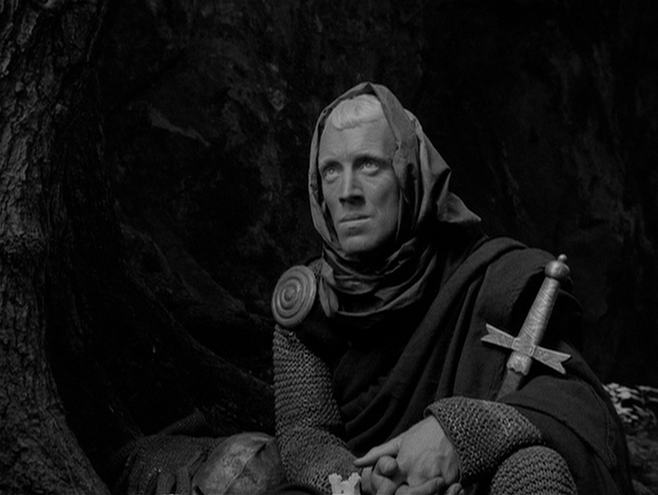
The knight Antonius Block (von Sydow), accompanied by his squire Jöns (Björnstrand), has returned to Sweden from the Crusades in the 14th century only to find the land riddled with the black plague.  Death (Ekerot), however, immediately calls on Block to whisk him away, but Block insists on playing chess with Death for his very life.  This gives Block a stall and he travels the land in search of God, trying desperately to find answers to the very questions of his soul before Death carts him off for good.

I mean honestly... how much more famous a cinematic image can you get...

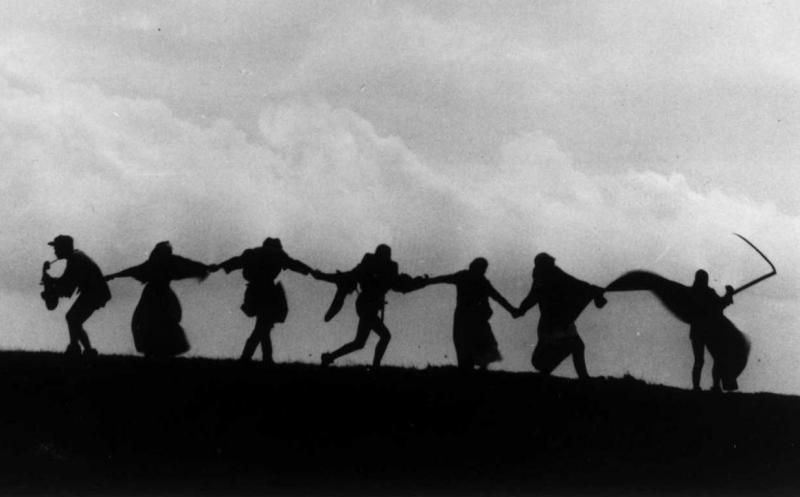
An expectation I always have with Bergman is downright stunning photography.  This film is no exception, and Bergman doesn’t ease us into it, either: we open the film with a fantastic shot of clouds in the sky, then head straight into the definition-of-iconic chess scene on the beach.  The play of light is gorgeous.  Bergman is so smart in terms of where the camera is pointing, always keenly aware of light sources.  I think The Seventh Seal is more about light than shadow, meaning the focus was not on the lack of light, but in its strategic placement.  The scenes in the chapel with Antonius and Death are dark, yes, but we see the profiles of the characters in bright, almost frightening white.  Then there is the sun-drenched scene where Antonius picnics with Jof (Poppe) and Mia (Andersson), travelling actors who parallel Antonius’ journey but only occasionally intersect their lives with his.  And then, of course, there are the two most famous shots (besides the chess game on the beach).  When a character finally meets his death after suffering loud and painful death throes, he is still and silent… and then, to my amazement, the sun slowly breaks through the clouds and the scene is awash in glorious light.  Granted, this was no plan of Bergman’s, and he has admitted he lucked into it, but he was smart enough to keep the camera rolling that few extra seconds.  The final shot of the film, of the players being lead away by Death across the hilltop, was also an example of luck.  All the main actors had packed up for the day, but Bergman saw a gorgeous cloud formation on the horizon that he knew he just had to use, so he quickly threw some of his staff into costume and they ran up the hill.  The shot is everything that cinematic perfection strives for: the gray-white of the clouds, the black of the people, the stark outline, the contrast, the beauty… I love the photography of this film, and I’ve only mentioned the most famous shots.  The rest of it is just as good.  I can’t get enough.

 
The Seventh Seal takes existential angst to its zenith.  This movie is about nothing less than questions of God, of faith, of humanity’s purpose on the earth.  Bergman explores these questions through so many different vehicles, and constantly throughout the entire movie.  There is not a scene in the film that is not, either directly or indirectly, addressing some sort of heavy philosophical question.  This could get incredibly tiresome, as these are not easy questions Bergman is asking.  Instead, then, he is smart about it, and deals with the questions in a myriad of ways.  Antonius Block is the most obvious mouth for the questions, but his squire Jöns is just as much a mouthpiece as Block.  There is a distinct difference, however, between these gentlemen, as if two sides of Bergman’s soul are warring onscreen.  If Block is despairing yet hopeful (at the same time, I know, this is an angsty movie), then Jöns is cynical, resigned, and practical.  They are such important counterpoints to one another.  Despite Block’s despair, he is still searching, still hopeful he will find an answer.  Jöns knows there IS no answer.  Jöns does not see the point in searching at all.  This is an important difference, and one that informs their various responses to situations.  Block’s quest for spiritual fulfillment would feel too pretentious if it was all we encountered, and Jöns’ cynicism would have us reaching for the razorblades if we honestly thought there was no hope.  I love the pairing of the two of them.  They are such an unlikely yet perfectly suited team to discuss questions of deep philosophy.  I see these two characters as two sides of Bergman’s soul.  Bergman famously struggled with issues of religion and belief in a deity throughout his life, stemming in no small part from a tyrannical Lutheran preacher father who habitually mistreated him.  I think that Bergman is both Block, searching desperately for signs that God is here on earth yet holding out little hope, and Jöns, cynical and pragmatic.

  
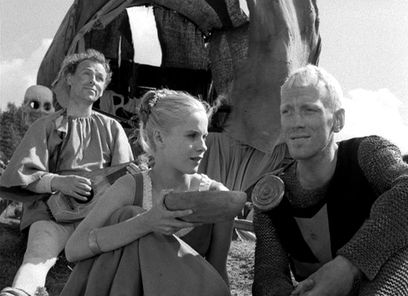
Antonius and Jöns are all about existential angst, but alongside them, there is Jof and Mia, whose presence in the film is just as important.  It’s no coincidence that the English translation of their names are “Joseph” and “Mary,” and that they have a toddler son.  Jof and Mia, to me, clearly represent Bergman’s belief that God is present on earth, perhaps in unlikely places, perhaps even in the lives of traveling minstrels, but there nonetheless.  The scene where Antonius encounters Jof and Mia on the hillside and eats strawberries with them practically brings tears to my eyes.  The knight has an hour of peace, an hour of happiness that gives him a respite from the quest that is torturing his soul.  If only he could realize that the answers to his questions could perhaps be found with the simple life of Jof and Mia…

And then there’s the downright dread of the character of Death.  It’s hugely important that Bergman decided to make the character “Death” instead of “The Devil.”  The Devil implies specificity to a certain religion; indeed, it implies existence of a god, because we cannot have the devil without having God to counteract him.  But Death… Death is not tied to any religion.  Death does not imply the existence of an afterlife.  Death does not confirm the existence of any deity.  Death is universal.  Death is blank.  Death comes to all, regardless of belief.  This is Death who comes for Block, not the devil, and Death is incapable of answering any questions about the afterlife as Death does not care.  Ekerot does not have to exert much effort to convincingly make Death frightening (the shaved eyebrows and wardrobe do most of the work), but I still think his portrayal of Death unnerving.  He’s so human yet so forbidding all at once.  In the chapel sequence, I was fooled my first time watching the film by Death’s disguise, and I literally jumped up in my seat when I realized it was him.  

  
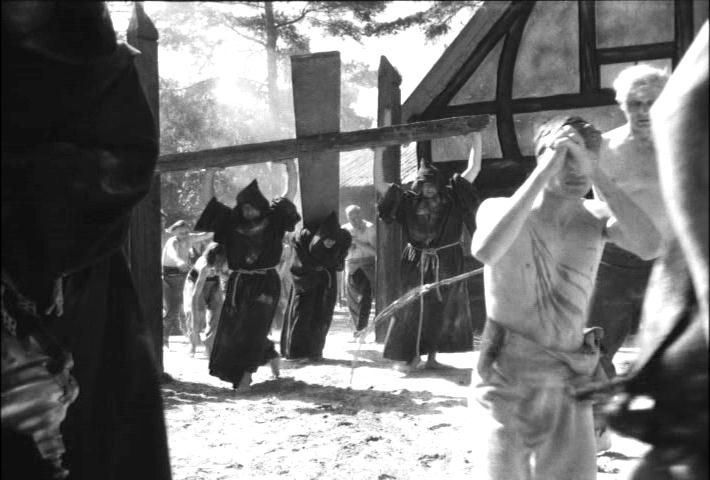
While Bergman may be searching for the existence of God, there is no doubt in my mind that he knows he won’t find it through organized religion.  The Seventh Seal is a vehement condemnation of the evils of religion if ever there was one.  Block’s search for faith is entirely different from a search for church.  Church and faith are not inextricably linked, which is not at all what the Church would have you believe.  The Church, in The Seventh Seal, comes across as a peddler of guilt and blame, convincing innocents they are to blame for the plague, selling them on notions of self-flagellation as a means to “save themselves.”  In fact, the most frightening scene of the film to me is when the train of monks comes to town, interrupting Jos and Mia’s happy little show.  The horror of the brainwashing these monks have inflicted on their stupid followers is beyond belief.  And frankly, Bergman isn’t wrong.  This portrayal of the Church, in fact, seems pretty spot on to me.  I have rejected organized religion in my life, but I have not rejected the notion of deism.  In that way, I feel a profound emotional connection to Bergman.  He and I think very similarly about these issues.

 
All of this, everything I’ve said thus far, indicates an intellectual connection to the film, which is all well and good but not enough to warrant a “Top Three” ranking which I alluded to earlier.  So now, dear readers, the story of “The First Time Siobhan Watched The Seventh Seal.”

I admit I was nervous.  Bergman carries a certain weight, a certain expectation of pretension and difficulty, (and while I will admit he can get a bit pretentious, I do not think he is difficult) and The Seventh Seal has an enormous reputation.  There’s a difference between watching “just another movie” and a movie you KNOW graces nearly every Best Of list ever made.  So yeah, I was nervous.  Nervous I wouldn’t get it, nervous I wouldn’t like it.

I needn’t have been.

(oh god, I’m now watching the scene where Block looks into the eyes of the young girl accused of being a witch… crap, this movie is killing me, it’s so amazing…)

There is an unexpected sense of tension in this film.  It almost played out as a thriller to me the first time I saw it, what with Block’s match with Death and its utter inevitability.  I remember pausing the film about thirty minutes in for some reason, and I realized I had been tensing my entire body while watching it.  In fact, I was hardly drawing breath.  Such is this movie’s powerful effect.  It’s not a thriller in any kind of typical sense, but more a philosophical thriller, a hypnotic film that was utterly engrossing.

 
In fact, after I finished watching it for the first time, I turned off the television and then just sat.  Alone, by myself, in the room, silently thinking about what I had seen. 

Five minutes later, I started to weep.  I started to weep, and I couldn’t stop weeping for twenty minutes.  Not crying, either.  Weeping.  Wracking sobs.  Uncontrollable crying.  I couldn’t get a grip on myself for twenty full minutes.

That was unexpected.

The Seventh Seal is not a “sad” film.  I’d hesitate calling it a tragedy.  But I have rarely wept at a film the way I did with this one.  Which naturally begs the question of “why?”  Why, if this movie isn’t all that sad, did it make me cry?  It really shouldn’t have.  I mean, there are some character deaths in the film, but given that Death has a persona and this is set during the outbreak of the black plague, this isn’t a surprise. 

I wasn’t weeping because I was sad.

I was weeping because I had been profoundly emotionally and spiritually moved by a film, and the only possible physical response was tears.  I was not sad, I was not upset.  The Seventh Seal had touched me, spoken to me in a part of my soul that few (if any) other films had even gotten close to, and it had made me think about the Big Questions.  It had found the sensitive part of me, a part buried under layers and layers of exterior walls.  I was not the same person I was when I started watching it.  It had changed me. 

Weeping felt natural.

  
No other movie has ever, EVER had this kind of spiritual effect on me.  There are movies I love because they make me sad, movies I love because they make me happy, and movies I love because they take me on grand adventures.  But The Seventh Seal is an entirely different beast.  That a movie, a MOVIE, could make me think more honestly about God and faith than years in Sunday school and church services ever could is something amazing.

To this day, this film still brings tears to my eyes.  Let alone the fact that it’s an astonishingly good piece of cinema from a technical standpoint, its message of the quest for spirituality still resonates profoundly for me.  I can’t watch this without getting caught up in Block’s hopeful frustration. 

It’s just… It’s art.  This is not film.  This is art.  This is more.  This… this “movie.”  Too many feels, in the immortal words of my friend Angie.

Perhaps you can see why I say it would take quite a lot for a film to ever knock this one out of its Top Three ranking for me, because this movie has meant quite a lot to me beyond its sheer entertainment value.

Arbitrary Rating: 10/10 with a special note that if I was allowing for bonus points, this film would have earned them.  And it started my love affair with Bergman.  He and I, man… he is a director who speaks to me.

Monday, March 11, 2013

An Affair to Remember


An Affair to Remember
1957
Director: Leo McCarey
Starring: Cary Grant, Deborah Kerr

I have to say this from the outset: I enjoy this film ironically.  Overall, I find An Affair to Remember to be far too melodramatic and, frankly, too silly for its own good.  But if I’m in the right sort of mood, I take a massive cue from Sleepless in Seattle and rather enjoy this particular film in spite of itself.

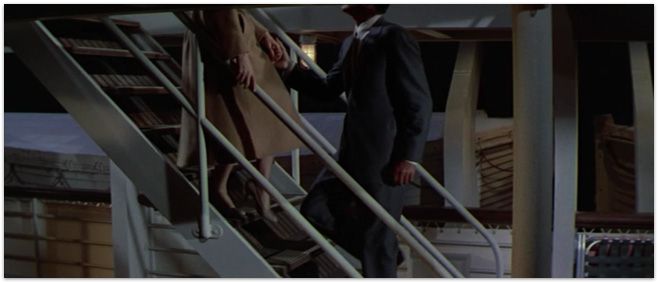
Nickie Ferrante (Grant) is an internationally known playboy sailing across the ocean to meet up with his wealthy fiancée.  Terry McKay (Kerr) is a former nightclub singer sailing across the ocean to meet up with her loyal and wealthy boyfriend.  She is the only person on board not falling over herself to ingratiate herself with him, so naturally, he is intrigued and pursues her.  Naturally, love blossoms despite their respective significant others.  When the liner drops them off in New York, they agree to part ways temporarily to deal with said other romantic interests but also to meet up again in six months at the Empire State Building.  What on earth could possibly happen in six months?!?

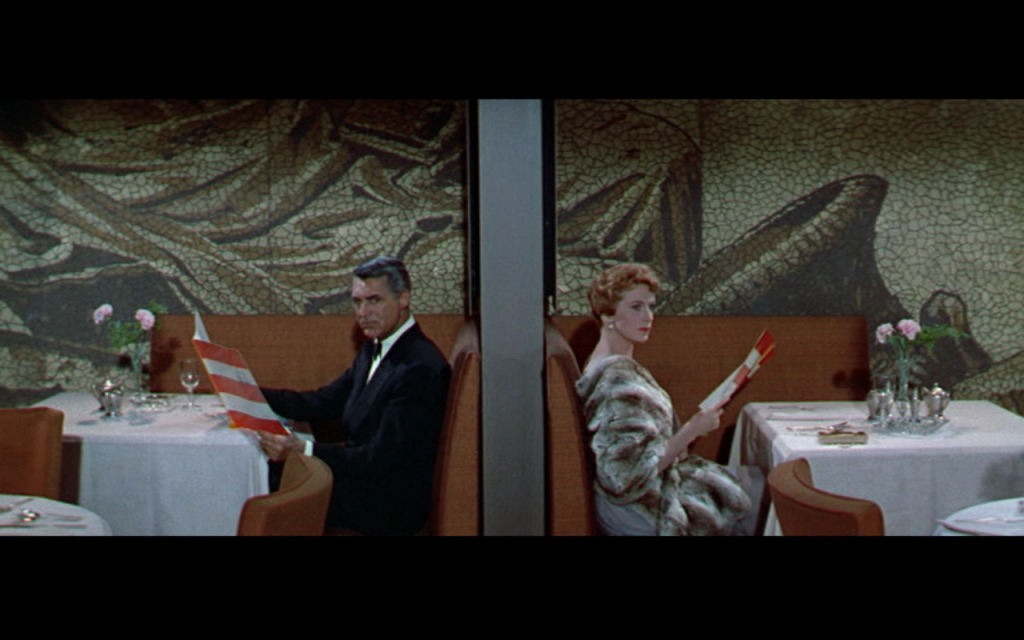
The silliness to which I alluded in the opening paragraph doesn’t really set in for the first half hour, and as such, I enjoy the first half hour completely un-ironically.  The first half hour is full of snappy, sexy dialogue between Grant and Kerr, and their chemistry is spicy.  She has the ability to skewer him with the precisely right turn of phrase, he comes back with some sort of self-deprecating witticism, and it’s just plain fun.  In order to divert paparazzi attention, the two sit back to back at adjoining dinner tables and speak to one another behind the huge menu, fooling no one.  The whole set up of the meet-cute between these two characters is very engaging.

This bit's fun.

But that’s only the first half hour, because as soon as we get to Nickie and Terry visiting his grandmother, the whole movie gets remarkably somber and serious and melodramatic and wholly silly.  There is such a charming lightness that gets completely deflated once our couple starts seriously falling in love.  The movie loses its pace and nearly all its energy, a fact which is not at all helped by some incredibly schmaltzy songs.  Let’s watch Nickie’s grandma play some bland piece at the piano for five minutes.  Seriously, five minutes of the film is just watching her play the piano.  Yes, I get that this is when the two of them are supposed to be falling in love, but holy crap this is stupidly serious.  Every now and then, some of that original snappy repartee comes back, but we don’t get nearly enough of it.  It’s far more spread out, and there’s so much water-logged dialogue in between.  Ugh.  (I will give the film credit for clever and fun scenes that involve a TV reporter interviewing Ferrante.)

This bit's not as fun.

So from this point on, I have to change my outlook in order to have the patience to get through the film.  So I think of Sleepless in Seattle.  I saw Sleepless in Seattle in the theaters with my dad when I was but a wee Siobhan, and I’ve always highly enjoyed the bits in it where the women get all ridiculously weepy over An Affair to Remember (followed by the fabulous scene at the end where Tom Hanks and Victor Garber get all weepy over The Dirty Dozen).  When things get ridiculously melodramatic, I picture Rosie O’Donnell and Meg Ryan weeping their eyes out and I smile.

Seriously.  The dialogue moves from snappy and fun to dirge-like in its seriousness, and it becomes so eye-roll inducing that I have to picture Crow and Tom Servo sitting in front of the screen throwing things at Cary Grant and Deborah Kerr. 

I know that this film is a retelling of Love Affair from 1939, but I kept on thinking of Brief Encounter instead.  Both films deal with people who are in otherwise loving and committed relationships, yet they find themselves falling in love with other people, and this causes them emotional anguish.  The thing is, I find myself getting completely swept up in the angst in Brief Encounter, and ridiculing the angst in An Affair to Remember.  Honestly, I’m not entirely sure why that is.  I’d like to think that Brief Encounter isn’t nearly as schmaltzy, but I don’t know if that’s true.  Maybe it has to do with the situation; although similar, Brief Encounter is a bit more realistic and less fantasy.  A bit.  Maybe it’s Laura’s voice over narrative that helps me into her soul; I have no similar window into Terry’s soul.  Maybe it’s the soundtrack.  Brief Encounter uses Rachmaninov; An Affair to Remember uses an original soundtrack that I consider a step down from lounge music.  I honestly don’t know why I’m so turned on by one film, and find a similar film so much lesser.  Maybe it’s just me.  Ah well.


I do like that the significant others that get pushed aside in An Affair to Remember are presented as very nice, kind, civil people.  We like them.  We should.  If they were horrible people, then why would our hero and heroine suffer emotional anguish at the thought of breaking up with them?  I like that about the film; I like that the hurdles standing in the way of our main couple are not monsters. 

Again, at some point, I just say “to hell with it,” pour myself a huge glass of wine, and laugh at the ridiculous schmaltz that is most of An Affair to Remember.  Cary Grant is always fun and pleasant, and Deborah Kerr can match him well in the witty banter department.  The two have very good chemistry, and the first half hour of the film is highly enjoyable.  But really, wine and a sense of humor is all that’s going to get me through the remaining hour and a half.  I have to stop taking the movie seriously because it’s just too damn silly.

It also has what is possibly the most ridiculous school music concert I’ve ever seen in a film. 

Arbitrary Rating: 6/10, enjoyed mostly from an ironic point of view.  Get me a drink and I’ll just laugh over and over at the silliness that is the unending sea of schmaltz called An Affair to Remember.