Showing posts with label 1950. Show all posts

Sunday, June 1, 2014

Summer Stock


Summer Stock
1950
Director: Charles Walters
Starring: Gene Kelly, Judy Garland, Eddie Bracken, Phil Silvers

I make no secret of my love of musicals.  MGM musicals of the forties and fifties are like crack to me. They will always be there for me.  They will always make me happy.  I can watch them a hundred times (and I have) and they won’t get old.

So I thought writing about some of my favorite non-list musicals might not be a bad idea. 

I know that I alienated nearly all of my regular readers with the preceding paragraphs, but, well, I’ve had a really rough year and MGM musicals make me happy.  Consider yourself warned.

Jane Falbury (Garland) is the beleaguered Falbury sister who is stuck running the family farm while younger sister Abigail runs around chasing her dreams of being on the stage.  When Abigail, on a whim, brings an entire Off-Broadway show to the Falbury Farm with the idea of putting on the show on Jane’s premises, Jane balks at first, but Abigail’s boyfriend and show director Joe Ross (Kelly) convince her to allow the show biz folks to stay by providing Jane with necessary cheap farm labor in between rehearsals.  Sparks fly between Jane and Joe, but Jane’s fiancĂ© Orville (Bracken) and the fact that Joe is somewhat engaged to Jane’s sister are pretty big barriers.  When Jane shows a hidden predilection for the stage, though, nothing can get in the way of true love.


Gene Kelly.  Gene Kelly.  Gene Kelly.  Judy Garland.  Gene Kelly AND Judy Garland.

Jesus Christ, I never stood a chance.

The plot of Summer Stock is not why one watches Summer Stock.  It’s simplistic at best and requires more than a little suspension of disbelief.  It’s one of the ultimate “let’s put on a show” musicals, a gag that was getting whiskers even in 1950.

But Gene Kelly.  And Judy Garland.  Falling hopelessly in love with each other.  While singing and dancing. 


Of all the gags in musicals, the “let’s put on a show” bit is not my favorite – even *I* admit it’s a bit silly – but… Gene Kelly is SO pretty.  Were it not for him (and Judy), I would undoubtedly not be speaking so fondly of Summer Stock.  For those keeping a record, he (along with Cary Grant) are in my Holy Trinity of Sexiest Classic Hollywood Actors.  My feelings for Gene Kelly run deep, and looking back at my childhood, I’m pretty sure he’s the first adult actor (by that I mean not a teen heartthrob) that I had a crush on.  My tag for him on tumblr is “eternal crush on Gene Kelly” because in the twenty-plus years I’ve been watching Gene Kelly movies, I have never not been in love with him. 

And my goodness, if you love Gene Kelly, you NEED to put this movie in your eyeballs as soon as possible.


Reasons why Gene Kelly was never sexier than as Joe Ross in Summer Stock:

1.  Quite literally, he spends the ENTIRE movie with either rolled up shirt sleeves or super tight short sleeves that show off his ridiculously sexy arms the ENTIRE TIME.  I wish men realized just how sexy rolled up shirt sleeves are.  Every time my husband comes home with rolled up shirt sleeves because it was hot at work, I want to jump his bones.  Men, listen up: no matter your body type, ROLLED UP SHIRT SLEEVES.  It works.  It’s a godsend.  And in this movie, ladies (and some gents, I’m sure), you get your fill of Gene in tight rolled up shirt sleeves.  Unnnnnnnnnf…


2.  Jeans.  He wears JEANS.  JEANS.  ROLLED UP JEANS WITH LOAFERS.  Gene Kelly was certainly known for being a bit more down-and-dirty than his cohort Fred Astaire, but still, he rarely wore jeans.  HE DOES HERE.  And if you don’t understand why I find that so ridiculously attractive, then I’m sorry, I can’t explain it to you.  BECAUSE JEANS.  ON GENE KELLY.  KILL ME NOW.


3. He does quite a lot of macking.  For the first half of the film, when his character is still pretty devoted to Abigail, every time they are in the same room, they greet one another by making out for as long as the Hays Code would allow.  And in the second half of the film, he finally gets to start macking on Judy Garland.  There is a LOT of kissing Gene Kelly in this flick.  GOD BLESS. 

4.  Joe Ross is quite possibly the sweetest character Kelly ever played.  In most of his musicals, Kelly’s character usually has some slightly dark or even misogynistic streak.  In both On the Town and Anchors Aweigh, for example, he plays a sailor intent on getting as much booty as he possibly can until the right girl wins his heart.  Even in Singin’ in the Rain, his character is called out for being egotistical at the beginning of the film.  In nearly all the other films I’ve seen of his, Kelly’s character is one who starts out as brash/arrogant/egotistical until he meets The One Girl who wins his heart and changes his ways.  But not so in Summer Stock.  As Joe Ross, he starts as so ridiculously, endearingly honest and kind and caring that we know from the get go that silly, materialistic Abigail is NOT right for him, that only honest, kind, and caring Jane will do.  He’s so winning from the get go, he’s practically the epitome of Prince Charming.  Joe Ross, as a character, is basically a female wet dream written into one person.  He tells Jane that he won’t marry her sister unless he can guarantee their financial stability.  STAHP IT YOU’RE KILLING ME.  He is overcome with guilt by his feelings for Jane due to his obligation to Abigail and doesn’t want to hurt either lady.  DEAD I AM DEAD YOU DEADED ME.  It’s only when Jane effectively ends her “relationship” with Orville, and when Abigail runs away from the show and Joe (oh sorry, spoilers?  Eh, I don’t care, the movie is 65 years old) that Joe finally feels alright with making a move on Jane.  I adore a man with principle and holy crap, but Joe has principle.


Okay, so I have an undying obsession with Gene Kelly.  But believe it or not, he’s not the only reason to watch this movie (if you like musicals.  Because if you don’t like musicals, just give the whole thing a pass).

Oh dear lord the chest hair.

Judy Garland.

Yes, I love Gene Kelly, but I also love Judy Garland.  And not the Judy from The Wizard of Oz (which, ironically, is probably my least favorite Garland flick).  No, I love the Judy Garland from other movie musicals, the one who was allowed to be an adult and allowed to have breasts and play the breathy, shaky female lead love interest.  Judy Garland had such irrefutable star quality.  I once read a quote that said that she was the only dancing partner Gene Kelly ever had who drew your eyes to her more than to him (debatable, given my obsession with Kelly, but I get the gist of the argument and it’s a valid point).  In Summer Stock, Garland is just as luminous as always.  And yes, although she was going through personal hell off screen during the filming, it doesn’t show on the screen.  She is so pretty, so gorgeous, so loveable, I just want to take her and cuddle her and tell her it will be alright.  I could get lost in those big, beautiful brown eyes.


And shut up about pairing Judy with Gene.  Take a male actor I am desperately in love with and put him up against a female actress who brims with gorgeous geniality, and I’m a goner.  The internet even informs me that there’s a name for the pair of Judy Garland and Gene Kelly: Jugenea.  Apparently.  Well, whatever the name is, Judy is easily my favorite pairing for Gene Kelly, probably because she has such inherent star quality in her to provide a suitable pairing to his RIDICULOUS SEXINESS. 


The dancing is top-notch, but I wouldn’t expect any less from a Gene Kelly musical.  His first number, Dig for Your Dinner, is a Kelly solo, and god bless for that.  His dancing duet with Judy, Portland Fancy, at the local dance, is so ridiculously cute and sweet you’ll get tooth decay.  But the two show stoppers are later solo numbers.  The first is the obvious Get Happy, Garland’s defining moment in more ways than one, where Jane finally embraces her interest in the stage and performs in the production with all the gusto that we expect from Judy.  Judy Garland has never been sexier than she is in that number, wearing a smart costume of suit jacket and little else, letting her legs stretch on forever.  If Summer Stock is remembered for nothing else, it will be that number, and rightfully so.  It’s iconic.  The other show stopper is Kelly’s later solo, You, Beautiful You, a gorgeous empty-stage piece where Joe just can’t help but dance about his feeling after having first kissed Jane.  Kelly choreographed the piece and it shows the brilliance that was to come a few years later in Singin’ in the Rain.  Kelly needs only a creaky floorboard and a few sheets of newspaper to make an utterly beguiling dance number, one that even Steve at 1001plus likes!  Seriously, if you like musicals, Summer Stock delivers on the musical number side.


And that’s just Gene and Judy.  Phil Silvers and especially Eddie Bracken are such superb comic relief in this film.  Eddie Bracken steals nearly every scene he’s in as Jane’s practical fiancĂ© who is allergic to pretty much everything under the sun.  Phil Silvers is as goofy as always (if truth be told, more obnoxious than goofy), but I love him because he brings out Gene Kelly’s goofy side.  One of my favorite things about Gene Kelly is that he was never afraid to let himself look like a fool, and every time he’s paired with Phil Silvers, you know they’ll have at least one utterly ridiculous song together.  In fact, every time I get too wrapped up in my Gene Kelly fixation, my husband likes to show me a picture from Summer Stock of one of his duets with Phil Silvers to knock him off his sexy pedestal just a bit. 

Nope, still sexy.
If I may go off on a tangent (like I haven’t already), I showed this film to my good friend Angie (who shares my Gene Kelly obsession) and naturally, she immediately fell in love.  Like I said, if you love Gene Kelly, you need this movie.  Regardless, there is one scene where Eddie Bracken and Phil Silvers, both of whom wear glasses, bump into one another, knock off each other’s glasses, then put the wrong glasses on.  Angie, in all her fangirl awesomeness, immediately started talking about shipping them together.  And now that’s all I can think.  I love to imagine that Orville and Herb run off together and have very nebbish gay sex together at the end of this movie.  Thanks, Angie.  You did this to me.


Is this one of the best movies ever made?  No.  Is it one of my favorite movies?  Yes.  Do I recognize its shortcomings?  Yes, empirically I recognize that this is not Citizen Kane.  Do I care about its shortcomings?  Hell no.  Will this movie always make me happy regardless of my mood?  YES. 

Arbitrary Rating: I’m giving this a very personal 10/10.  It has flaws, for sure, but my love of it overrides the flaws.  Gene Kelly, get in my pants.

Tuesday, July 30, 2013

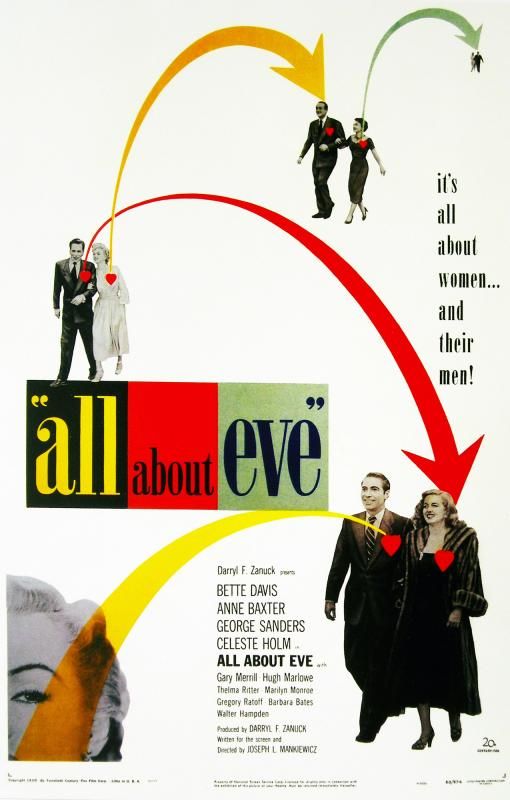
All About Eve


All About Eve
1950
Director: Joseph L. Mankiewicz
Starring: Bette Davis, Anne Baxter, George Sanders, Celeste Holm, Thelma Ritter

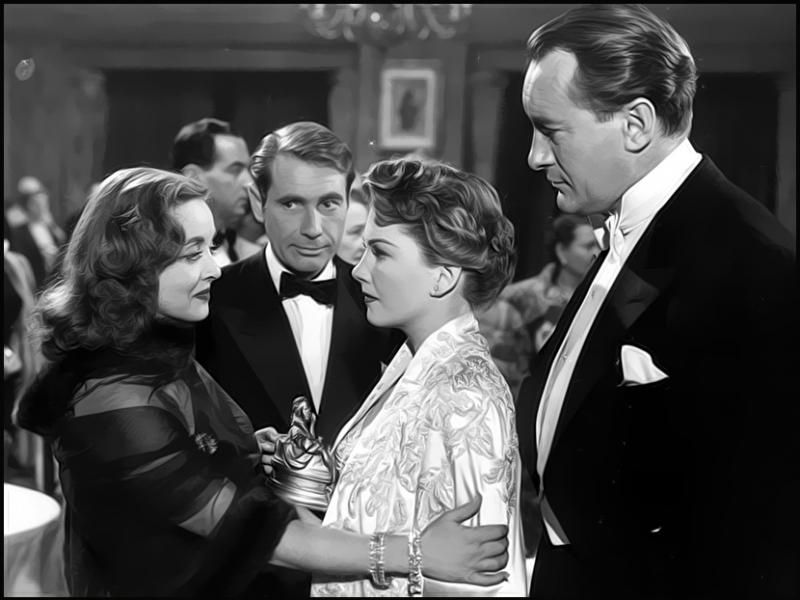
Some movies are famous because they come from a certain director.  Some are famous because they tell a fascinating story, and others are famous because of gorgeous cinematography.  While All About Eve’s director is certainly famous enough, and it’s story interesting enough, I don’t think this is where it gets its power from.  No, All About Eve’s power comes directly from two sources: smart writing and wicked acting, and here, the two go hand in hand.  This entire movie is about characters, about winding them up and watching them interact with each other.  And it’s just phenomenal on that score.

Margo (Davis) is a famous theater actress with a tight knit group of friends, including Karen (Holm), and her assistant Birdie (Ritter).  One night, Karen sees a young woman, Eve (Baxter), who has never missed a performance of Margo’s latest show and takes her backstage to meet her idol.  What inevitably unfolds is Eve’s wrangling her way into Margo’s life, slowly and insidiously trying to not merely follow in Margo’s footsteps, but actually take over her life.  She takes Margo’s place on the stage and tries to steal her boyfriend away.  But even Eve meets her match as soon as she comes up against oily theater critic Addison DeWitt (Sanders).

  
The opening scene sets up the entire plot, even letting us know, more or less, what will happen, and certainly establishes the vicious attitude of the film.  We are treated to George Sanders’ biting voiceover as he sarcastically points out, as only Sanders can, the foibles of nearly every character in the room.  Our first major character introduction, besides Addison DeWitt, is Karen, and Holm is ever so good in keeping a placid façade that nonetheless cannot hide her disgust.  We then have a close up on Margo, and here, even more so than Holm, Davis is barely containing a sense of hatred.  Right from the moment the flag drops, All About Eve is vicious and underhanded, and it’s bloody fantastic.  Although I wouldn’t call All About Eve a film noir, it may be likened to a female noir, at least in terms of character interaction.  There are no guns and no death and certainly no shadowy lighting, but it has a bit of noir attitude.  It’s transplanted from the world of crime to the world of the theater; we get to watch people tear each other apart not with bullets but words and attitudes.  Again, I would never classify All About Eve as a film noir, but I do believe my attraction to this film is related to my attraction for classic noir.  

Plus Marilyn Monroe.  What more could you need?
  
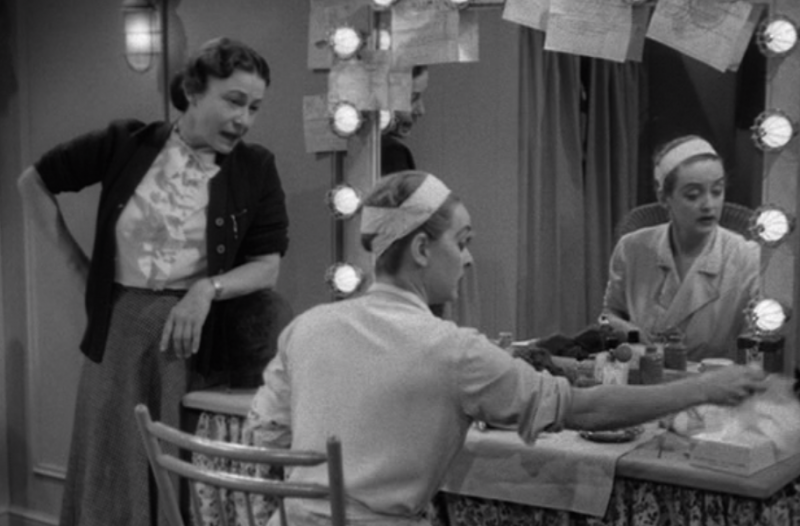
What’s key here is that we know from the get go, from before the first backstage scene with Margo’s crew, that Eve is acting.  We can tell from how Eve bows sycophantically when she is accepting the Sarah Siddons award in the opening scene that nothing about her is genuine.  The fact that Karen and Margo do not applaud is merely confirmation, not a revelation.  When, ten minutes later, she is regaling us with her tale of hard luck and woe, we don’t buy it for a second.  This turns the focus in this scene not to Eve, but to Margo.  We watch with disbelief as Margo swallows every damn word Eve feeds her.  Personally, I love it when Birdie immediately calls Eve out, how Birdie can see through her shenanigans immediately.  That’s key, because it gets us thinking about the distinctions between Margo and Birdie, why Margo buys it but Birdie doesn’t.  Eve’s ploy would never work were it not for Margo and her ego, and this first meeting sets that up perfectly.  Birdie is utterly without ego, a sharpshooter who simply calls it like she sees it.  Margo, on the other hand, while kind and loyal, is also full of herself, and her ego is too well-stroked by Eve to allow her to see clearly, and that is her downfall.

  
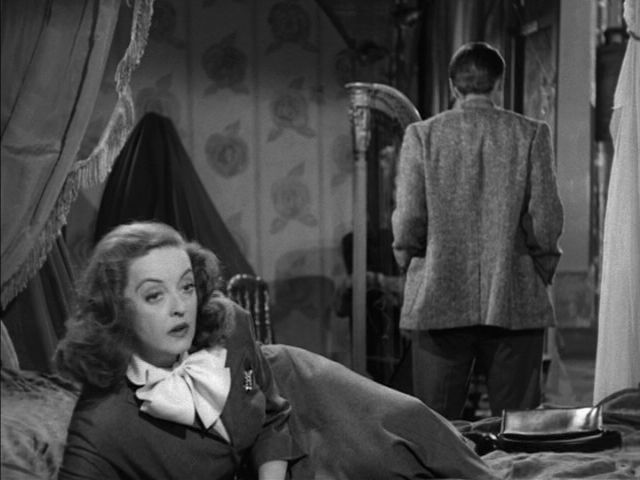
Davis is, naturally, fantastic in this, one of her most iconic roles.  If it were any other actress playing Margo, I would use the term “brave” to characterize this performance, but because it is Davis I will say it is “par for the course.”  “Brave” becomes a redundant term when discussing La Davis; she was an actress full of fearlessness.  In particular, I am astounded at the continual references to age in All About Eve.  Margo seems to comment nearly continually about the age of people around her, knowing full well how young Eve is compared to her.  Margo makes jokes about her age, which is never explicitly revealed, but these jokes always betray a sensitivity towards aging.  Margo realizes that she is too old to play the romantic heroine anymore, and as an actress, what is she now to do?  Her role is changing and she does not want to simply accept her movement to less gracious roles, but sadly, she is forced to do exactly that.  For Davis’ part, she was 42 when she played Margo, and she looks every day of it, perhaps even older.  There are bags under her eyes and creases in her forehead, and her jaw sags ever so slightly.  How sad that I find this unusual, to see a middle-aged woman playing a middle-aged woman and looking exactly like a middle-aged woman, and what a comment on Hollywood.  What roles are there for an actress above a certain age?  With that in mind, it’s stunning that both All About Eve and Sunset Boulevard were released in the same year, as both films tackle the issue of the marginality of the aging woman, but not men.  As Margo says, “Bill’s thirty-two.  He looks thirty-two.  He looked it five years ago, he’ll look it twenty years from now.  I hate men.”  I get the feeling that if we locked both Margo Channing and Norma Desmond in a room together, they would either claw each other’s eyes out or get massively drunk together while swapping anti-aging tips.  

  
Several years ago, I saw All About Eve at the Dryden.  I had seen it before on DVD, but I rarely pass up the chance to see a film on the big screen, as I am all too aware that the right (or wrong) setting can alter the effect of a film.  What I did not know, as I settled into my regular seat, was that All About Eve is an iconic film in the gay community.  My ignorance was quickly wiped away, as it became very apparent very fast that there a large number of, how shall I say this, vocal fans of the film in the audience.  What resulted from this was an absolutely uproarious evening, with booing and hissing at Eve and cheers aplenty for Margo’s bitchiness.  The experience gave me an entirely new respect for the sheer entertainment factor of this film, and it was one I’m glad I got to experience.

I’ve returned every year or so to All About Eve, and every time I do, it keeps getting better.  As I age, although I don’t consider myself old, I find myself enjoying it more.  There’s a great deal going on in All About Eve (and I didn’t even get to mention how much I adore George Sanders!), and multiple watches simply give me more to think about.  The great films bear up to repeated viewings.  All About Eve is undoubtedly a great film.

Arbitrary Rating: 9/10

Friday, May 24, 2013

Sunset Blvd.


Sunset Blvd.
1950
Director: Billy Wilder
Starring: Gloria Swanson, William Holden, Erich von Stroheim

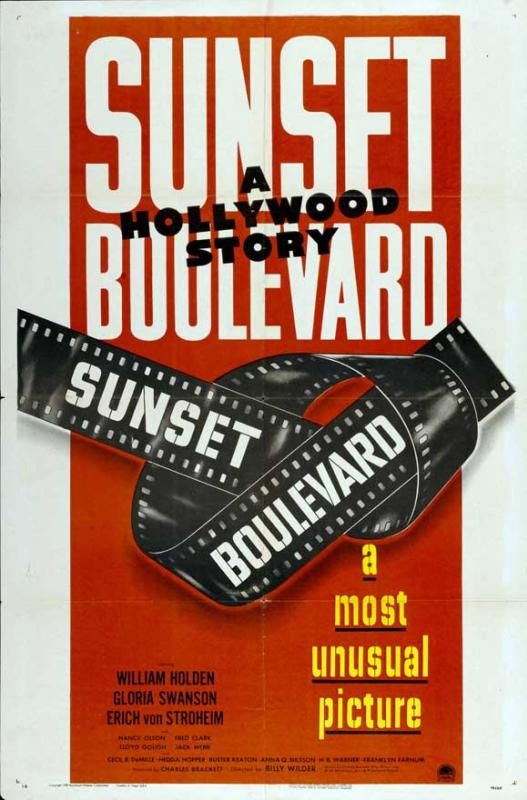
Is Sunset Blvd. the most brutally lacerating film made by Hollywood ABOUT Hollywood?  Possibly.  I’m sure, dear readers, that now I’ve said that, you’ve got at least five other films you’re thinking of to prove me wrong, but you’ve got to admit that Sunset Blvd. is an absolutely eviscerating portrait of the filmmaking industry.  And Christ, I love it.

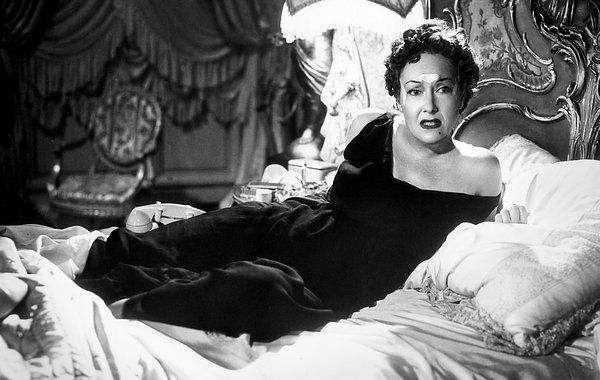
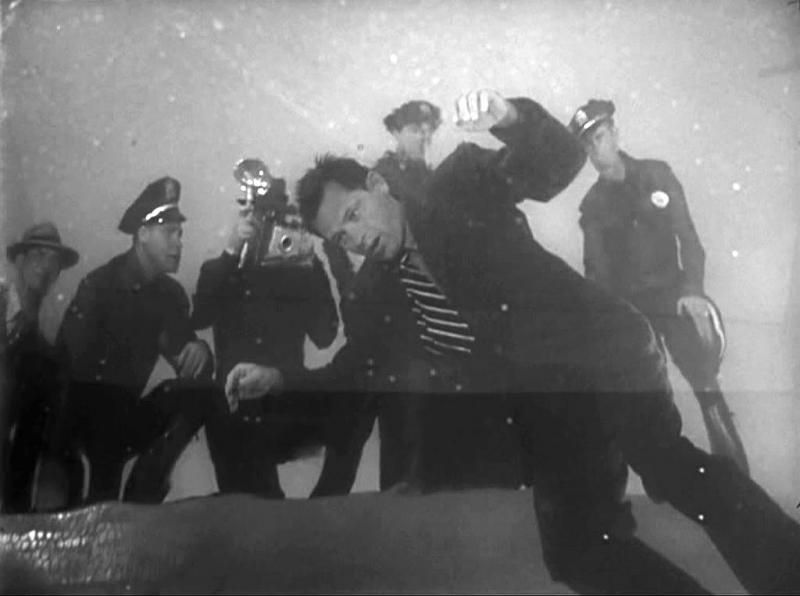
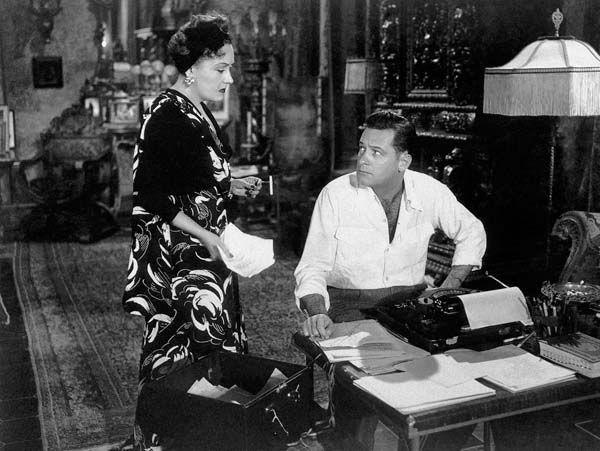
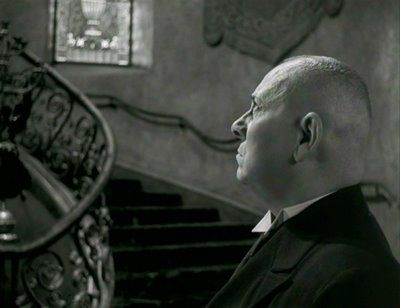
Famously opening with a shot of his dead body floating in a swimming pool, the story is that of Joe Gillis (Holden), a down on his luck screenwriter in Los Angeles who narrates the story of how he wound up dead.  In an effort to evade the repo men, he drives his car one day into the garage of aging silent film star Norma Desmond (Swanson).  Desmond is more than a little eccentric, what with the funeral for her dead monkey, her frankly creepy butler (von Stroheim), and her ridiculously narcissistic view of the world around her (“I am big!  It’s the pictures that got small!”).  She soon ensnares Joe, turning him into a kept man, and Joe goes along with it for awhile, and the two plan Norma’s comeback (“I hate that word!  It’s a return!”).  But Joe can’t live like this forever.

  
There have been plenty of movies made by Hollywood about Hollywood, but Wilder ups the ante on nearly all of them by not bothering to disguise his characters as caricatures.  Oh no, he uses real names, like Zanuck, Ty Power, and “We’re always looking for a Betty Hutton,” and references real films (“You’d have turned down Gone with the Wind!” “No that was me.  I said ‘who wants to see a Civil War picture.’”), and even uses real studios, with most of the action taking place at Paramount, with references to Twentieth Century Fox as well.  Even the main characters in the film are thinly veiled references to the actors who portray them.  William Holden had indeed been pretty hot in Hollywood, but not for some time.  He was certainly down on his luck, and had to convince Wilder to give him a chance.  Gloria Swanson was indeed a silent film star who had not transitioned at all to sound.  Even Erich von Stroheim was playing a version of himself, a former silent film director.  Sure, Holden doesn’t really behave like Joe Gillis, and I’m certain Gloria Swanson wasn’t nearly as crazy as Norma Desmond, but the point is there.  Sunset Blvd. isn’t nearly so much an allegory as a straight up “true crimes” story about the dirty business that is Hollywood.  I love that about this film.  I don’t have to try to guess who each character is supposed to represent, as in the also very good The Bad and the Beautiful, because realistically, everyone is playing themselves, right down to the waxworks of Buster Keaton and Anna Q. Nilsson.  

  
Of all the crazies in Sunset Blvd., it is actually the main character, that of Joe, who most fascinates me.  Clearly, we are meant to sympathize at the outset with Joe, as Norma is, frankly, batshit crazy and does everything in her power to keep Joe within her talon clutches.  But the thing is, Joe isn’t exactly the most sympathetic character in the world.  In fact, he’s kind of a dick.  He acquiesces far too easily to be “kept” by Norma, and he rather shamelessly takes advantage of her wealth.  Sure, you can tell that he’s lost respect for himself when he accepts her expensive gifts or favors, but that doesn’t stop him from accepting them.  Just as much as Norma is using him to help her get back into show business, Joe is using Norma.  It’s an equally parasitic relationship.  This is evident most especially when we are introduced to Betty Schaeffer, a young, pretty script reader at Paramount who Joe eventually starts to work with and develop feelings for.  The best, most noble move that Joe makes in the film is when he shows Betty exactly how far he’s fallen and how much he hates himself.  Joe and Betty’s blossoming romance would never work; he’s too far down the rabbit hole with Norma to make an honest go of it with someone as righteous as Betty, and by bitterly showing Betty his rather ugly side, he pushes her out of his life.  The fact that this is the “nicest” thing Joe does in the film is what makes me easily conclude that Sunset Blvd. is a film noir.  Noirs all have a fatally flawed hero, someone who is good but can’t help himself when it comes to one thing; money, or maybe women, or maybe power.  For Joe, his fatal flaw is clearly luxury.  He can’t help himself but leach off of Norma when given the opportunity.  As much as we are meant to sympathize with Joe getting trapped by crazy Norma, by the end of the film, Wilder has, rather cleverly, slightly turned the tables on us.  Joe is hardly a hero, and Norma actually becomes a bit sympathetic.  For as crazy as Norma is, for as much as Joe complains about being “caught” by her, he is just as much to blame for his downfall.


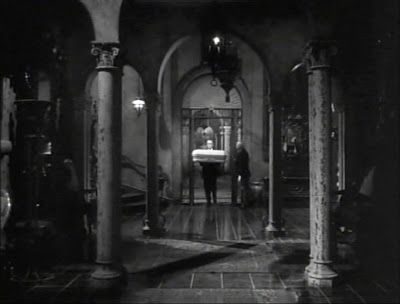
Practically a character in the film in and of itself is Norma Desmond’s estate.  A ridiculous portrait of grotesquerie, Joe Gillis equates it with the house in Great Expectations when he first walks up to it, and the comparison is fitting.  While not quite as full with cobwebs and decay as Miss Haversham’s, it certainly exhibits the same sort of mood.  In Great Expectations, Miss Haversham ensnares Pip and manipulates him, and we have the same sort of relationship between Norma Desmond and Joe.  The fact that this is played out in Sunset Blvd. against a background so stuffed to the gills with ornate, ludicrous luxuries makes the whole story feel unseemly.  You don’t need dirt and grime to make a story feel sordid, oh no.  The set is almost claustrophobic despite the vast expanse of the mansion because no matter where you look, there is some gaudy monstrosity of furniture leaning into the shot, crowding the scene.  It all feels so… so… creepy.  Wrong.  Unnatural.  Which is to say, absolutely perfect for the story at hand.  

  
Honestly, it should go without saying that the script to Sunset Blvd. is sparkling; just look at how many quotes I’ve already included in this review, and I don’t find myself normally including quotes.  Billy Wilder is famous for his screenplays, and when you hear the amazing turns of phrases in this film, it’s easy to understand why.  The great thing about Wilder’s films is that it’s not just great lines, but great lines combined with great stories.  The lines themselves are powerful and potent on their own (“All right, Mr. DeMille, I’m ready for my closeup”), but when you see them in the context of the story, they’re even better.  


Back in my biochemistry grad school days, I had to write plenty of rather wretched research proposals and committee meeting reports.  I remember holing myself up in the basement of the house we were house-sitting in at the time, and putting in either Double Indemnity or Sunset Blvd. (funnily enough, both by Wilder) and putting them on repeat while I eked out the reports on the computer.  It was here, during this fairly crappy time in my life that I learned to love film noir.  It was having these films on repeat, over and over, where I fell in love with the dialogue and the music and the characters and the themes.  I’ve seen Sunset Blvd. more times than I can count, and as sappy as this may sound, I’m glad this movie is a part of my life.

Arbitrary Rating: 9/10.