Showing posts with label 1941. Show all posts

Thursday, July 4, 2013

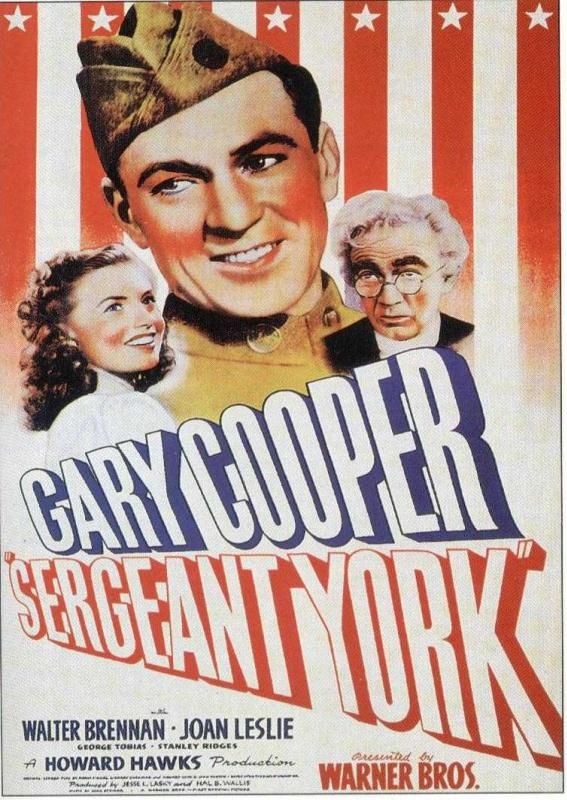
Sergeant York


Sergeant York
1941
Director: Howard Hawks
Starring: Gary Cooper, Walter Brennan, Joan Leslie, Margaret Wycherly

Why am I watching Sergeant York a second time?  Well, two main reasons.  One: it’s been several years since I saw it, and I owe it to the film to watch it a second time before writing this piece.  But that’s not the real reason.  The second reason is that the dang thing clocks in about two and a half hours and it’s taking up a lot of space on our DVR hard drive, so I might as well get it over with and watch it again so I can delete it and free up the space.

The film follows true life hero Alvin York (Cooper) starting with his humble beginnings in Tennessee as a wayward drunk.  Inspired by the pretty Gracie (Leslie), he tries to turn his life around and become an honest laborer, even finding religion with the help of the pastor (Brennan).  Just as he does, however, America joins World War One and Alvin is forced to join up despite the fact that he objects to killing based on his newfound Bible-motivated pacifism.  After a battle with himself, he finds it morally right to fight for his country and pulls off an impressive act of heroism.  But really, Alvin just wants to get back to Tennessee, to Gracie, and to his mother (Wycherly).
  
Y’know, I’m really coming around on Howard Hawks.  I had no idea this film was his when I watched it the second time around (I wasn’t paying attention, clearly, during the credits), but now that I am aware of that fact, I can see these little Hawksian touches I’ve come to recognize in his other films that are in 1001 Movies.  And, while I’m on it, dude has eleven – ELEVEN – films in 1001 Movies.  That’s more than the likes of Buñuel, or Bergman, or Wilder.  And there’s really a pretty remarkable range in terms of subject matter and types of films in those eleven movies. 

Now, don’t get me wrong, I certainly don’t hold Sergeant York to be the pinnacle of Hawks’ filmmaking abilities – in fact, it’s probably the last one of his in 1001 Movies I would choose to watch – but I do see his sly sense of off-kilter humor, even of subverting expectations, that graces the likes of Gentlemen Prefer Blondes and Rio Bravo and Red River and His Girl Friday.  It’s in the way Alvin meekly, while inebriated, waits for his mother to throw a pail of water in his face.  It’s in the bar fight scene, played far more for laughs than danger or poor moral choices.  It’s in the traveling salesman trying to hawk ladies’ bloomers to the pastor.  It’s in the wholly charmingly comical romance, one that never gets too sexy, between Gracie and Alvin.  For a movie called Sergeant York, Alvin spends most of his screen time not a sergeant at all, but of course, that’s on par for Hawks.  You’re expecting a war film with a title like that, but it’s truly not.  Far more about York the farmer than York the soldier, it’s not at all what I remembered or expected.  But that’s Hawks for you.
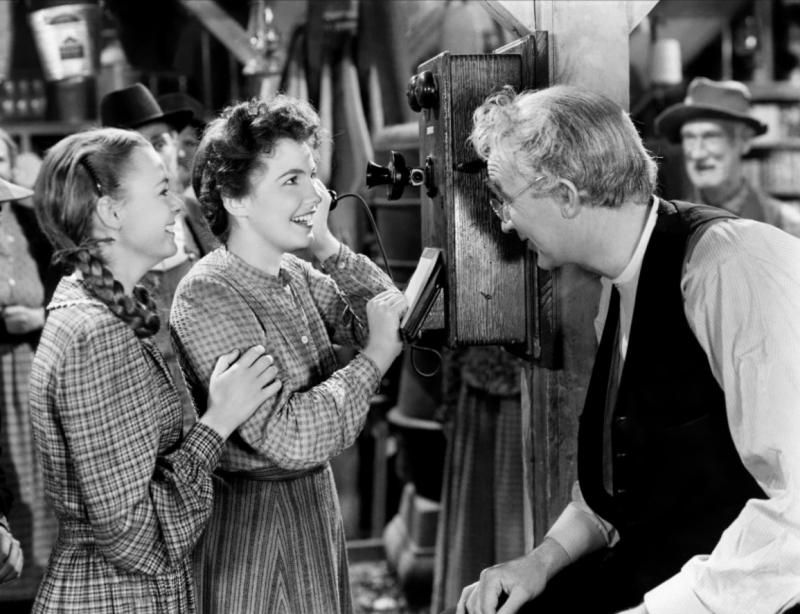
  
I remember being bored stiff the first time I sat through – yes, sat through – Sergeant York.  I wasn’t as bored this time, but it’s still a bit of a ridiculous pill to swallow.  My best summation of Sergeant York is Hollywood sanctioned propaganda.  With World War Two already raging in Europe and the US awfully close to being drawn into the fray, Sergeant York’s ridiculous aw-shucks, we’re-on-the-side-of-right theme makes sense, even if it doesn’t make it palatable.  With its choice of a hero being a person who undergoes several rather unbelievable changes in attitude, all while remaining ridiculously humble, it’s clear that Sergeant York intended to inspire a contemporary audience to adopt similar philosophies.  There is no subtlety – none at all – in the film, a fact which rubs me the wrong way, frankly.  It’s waving its American flag from the opening to the end, all while preaching loudly from the pulpit that it’s best to remain humble and serve the Lord.  It’s awfully hard to swallow this kind of, well, propaganda in this day and age.  But then, I keep on telling myself, this film wasn’t intended for me.  It was intended for a different audience.   And Hawks’ episodic structure, along with his odd little touches of humor, made it a little easier to sit through a second time around.  But it was still a bit of a chore.
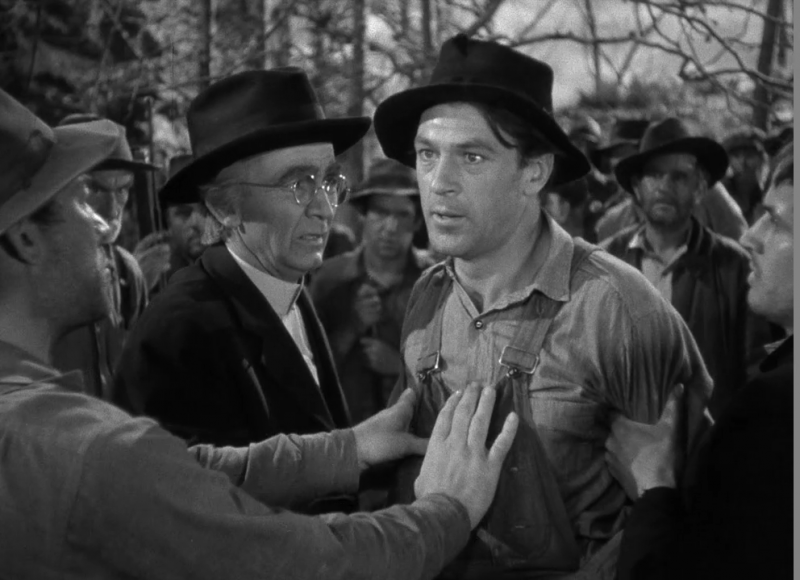
  
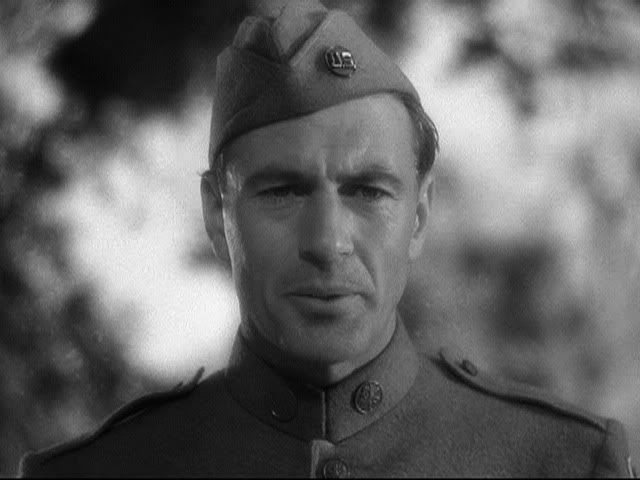
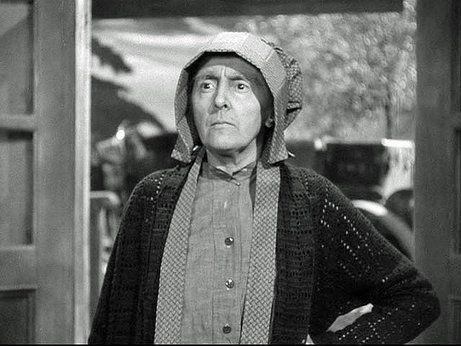
I like Gary Cooper, but I don’t love him, and I certainly don’t love him as Alvin York.  Frankly, I don’t think Cooper is a very good actor.  Whenever I see a film of his, he’s always himself.  He’s always, ALWAYS, Gary Cooper.  He can’t help himself.  He never morphs into anything other than who he is.  He was never Alvin York to me, just… Gary Cooper, the same Gary Cooper from Ball of Fire, or even High Noon.  He was just wearing a different costume in this film.  When you add onto this his frankly painful rural Southern accent, and I’m sorry Mr. Cooper, but I’m laughing at you.  Hearing him say with such rigid delivery “Them thar hills” is so far from believable, I dare you not to laugh either.  He’s not exactly helped along by his fellow actors, with Brennan playing his usual caricature (this time he’s a preacher, that’s totally different!), Wycherly as York’s unbelievable saint of a mother, Joan Leslie’s histrionics as giggly Gracie, and York’s fellow soldiers portrayed as nothing more than a series of one-dimensional heavily-accented cartoons.  Put all of these together, and you have a mass of performances that don’t really do much to help the movie. 
 
Overall, I liked Sergeant York a bit more in its second go-around due to Hawks’ slightly crazy touches of humor and zaniness, even in this, a piece of propaganda.  But it’s still propaganda, and utterly unsubtle propaganda at that.  And Gary Cooper is still awkward as all get-out with his stupid Southern accent.  And it’s still long.  I like Howard Hawks, I do, but this is not my favorite film of his.

Arbitrary Rating: 5/10.  Small note: I recognized Howard Da Silva in a small role as one of Alvin’s Tennessee neighbors, which made me happy, as Da Silva played Ben Franklin in 1776, which I love. 

Wednesday, October 24, 2012

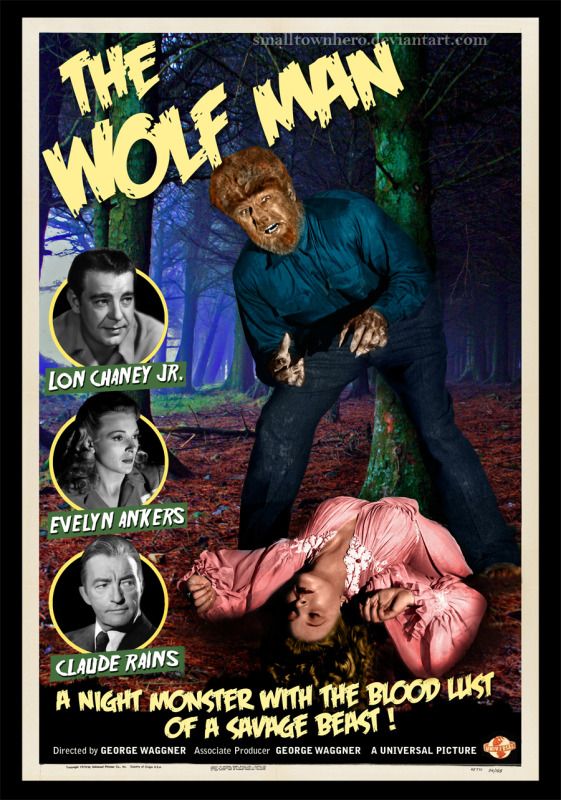
The Wolf Man

 
The Wolf Man
1941
Director: George Waggner
Starring: Lon Chaney Jr., Claude Rains, Ralph Bellamy

When you think “classic horror,” you think Dracula, Frankenstein, and the Mummy. Rounding out the list would undoubtedly be the Wolf Man. Unlike the other monsters on this list, though, the Wolf Man is unique in several ways. Instead of being based on centuries-old mythos or classic literature, the Wolf Man came mostly from the mind of screenwriter Curt Siodmak. Similarly, because he was a relatively new invention, the Wolf Man is treated far less as a monster and far more as a very real human tragedy. For these reasons, The Wolf Man is easily my favorite of the early classic monster films.

Larry Talbot (Chaney) is the prodigal son returning home to his scientist father’s (Rains) estate in Wales. He meets and woos shop girl Gwen (Evelyn Ankers), which takes him out into the fog-filled forest in search of a gypsy fortune teller on their date (Bela Lugosi, in a rather fitting cameo). Unfortunately, Bela’s a bit crazy, and he turns into a wolf and attacks. Larry kills the wolf, but when he realizes he also killed the gypsy, he is wracked with guilt. Bitten by the wolf, Larry starts to realize that he himself is turning into the Wolf Man.

On the most literal level, I respond incredibly well to the tragedy found in The Wolf Man. Lon Chaney Jr. proves he’s got chops as he holds nothing back from poor Larry’s story. Larry is just a regular guy, the younger brother, good with tools but not science, who has to take on the mantle of elder brother due to a family tragedy. Larry wants to do right by his dad and his family and his birthright, but when he starts to realize that he is the one causing the violence, he is horror-struck. His remorse at killing the gypsy is all-consuming, and he becomes obsessed with the idea of becoming a werewolf himself. He closes himself off from his friends and family, even insisting that he be locked up and bound at night to prevent his wolf form from escaping and killing his loved ones. Larry is sad and sympathetic all the way. He never feels like a traditional movie monster.

Saturday, September 29, 2012

Sullivan's Travels


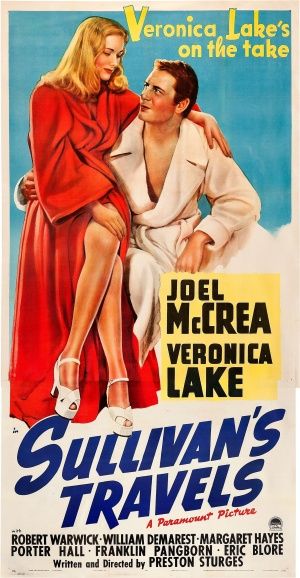
Sullivan’s Travels
1941
Director: Preston Sturges
Starring: Joel McCrea, Veronica Lake, Sturges’ stable of stock supporting staffers

I love screwball comedies, and if one loves screwball comedies, then Preston Sturges is like manna from heaven. No one made screwier screwballs than Preston. But poor Preston couldn’t leave well enough alone. Oh no, he had to go getting all serious, trying to make a “big social point,” and in my opinion, lost nearly all his magic with Sullivan’s Travels. That the film is typically regarded as his finest work is a bit beyond me.

Hollywood screwball comedy director John L. Sullivan (McCrea) wants to make a big serious drama, a movie that strikes at deep issues and social problems. His studio heads want him to make another comedy. In order to learn about poverty in America for his big serious drama, Sullivan decides to go on the road undercover as a hobo, with only ten cents in his pocket. Along the way he meets a charitable girl (Lake), and he eventually tells her who he really is. She insists on accompanying him as he continues his little experiment. Situational antics ensue.

I understand why Sturges wanted to make such a movie. It must be tough, being so brilliant at a genre of films that is easily discarded and denigrated. It’s something that hasn’t changed with time, either; consider, each year, how many dramas are nominated for Oscars, versus comedies. Sullivan, something of an alter-ego for Sturges, wants to make a “big important drama.” Well, why does he want to do this? He gives little reason, he’s just insistent to the point of absurdity that’s what he wants to do. My guess, for both Sullivan and Sturges, it is the desire to be taken seriously and to win some acclaim. Frankly, I can understand that desire. It’s always nice to have someone tell me that they realize how hard I work and they think I am doing a good job. The greatest comedies look so easy, and when something looks easy, most people tend to assume it didn’t require any work to create it.

Tuesday, August 7, 2012

The Maltese Falcon

Photobucket

The Maltese Falcon
Director: John Huston
Starring: Humphrey Bogart, Mary Astor, Peter Lorre, Sydney Greenstreet
1941

It’s daunting to know where to begin when speaking of a film as grand and prominent in the American film lexicon as The Maltese Falcon. There is so much to speak of historically when referencing this film. It’s John (Anjelica’s father) Huston’s directorial debut, a man who went on to have an amazingly prolific career spanning decades (Treasure of the Sierra Madre, Prizzi’s Honor). It’s Humphrey Bogart’s first role as the legitimate hero of the film; he had been languishing for ten years as a B-movie supporting gangster before Huston had the sensibility to promote him. And most importantly for me, it’s considered by some, myself included, as the first true entry into one of my most favorite genres, American film noir.

In terms of noir, there is so much that makes The Maltese Falcon fit within the genre, yet it is also notably lacking a few significant pieces. As Roger Ebert points out, almost all the action takes place within tidy and well-maintained middle of the road hotel rooms; there is not the dank, dark grit and sleaze of Force of Evil or Detour. It is notably absent. Furthermore, there is astonishingly little use of significant shadows, such as those that make The Third Man an amazing visual experience. However, when it comes to hard-boiled dialogue and harder-boiled, dangerous characters, The Maltese Falcon has noir in its blood in spades. Literally – Sam Spade is our hero.