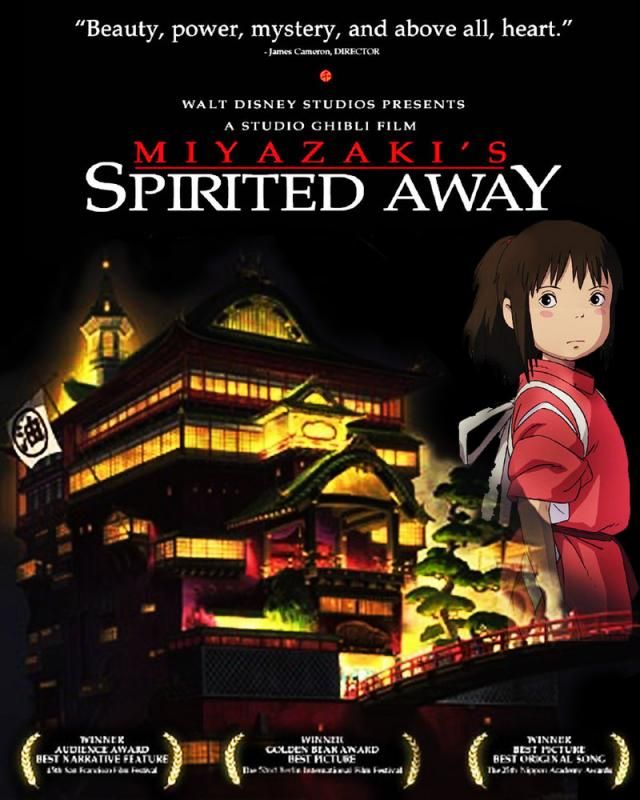
Spirited
Away (Sen to Chihiro no kamikakushi)
2001
Director: Hayao Miyazaki
Starring
(in English language version):
Daveigh Chase, Suzanne Pleshette, Jason Marsden
I
don’t really care for “children’s movies.”
I think I overdosed on them too much when I was growing up; I remember
coming home from college and my parents taking the family out to see the latest
Pixar movie in theaters when I would much rather have seen, well, anything
else. Too many viewings of Monsters
Inc (no offense, Pixar) have kept me from seeking out other animated or
children’s fare, so most of the recent children’s films in 1001 Movies I
have yet to see. Spirited Away is a very
nice, lovely children’s movie, but it hasn’t exactly changed my mind.
Ten
year old Chihiro (Chase) is being carted off to live in the suburbs against her
will by her parents. On their way to the
new house, her family stops at what appears to be an abandoned theme park. Her parents are excited, but Chihiro is
wary. After eating some mysterious food,
her parents turn into pigs and Chihiro realizes something is dreadfully
wrong. She has entered into the spirit
world, and the place is actually a bath house for wealthy spirits run by the
menacing Yubaba (Pleshette). With the
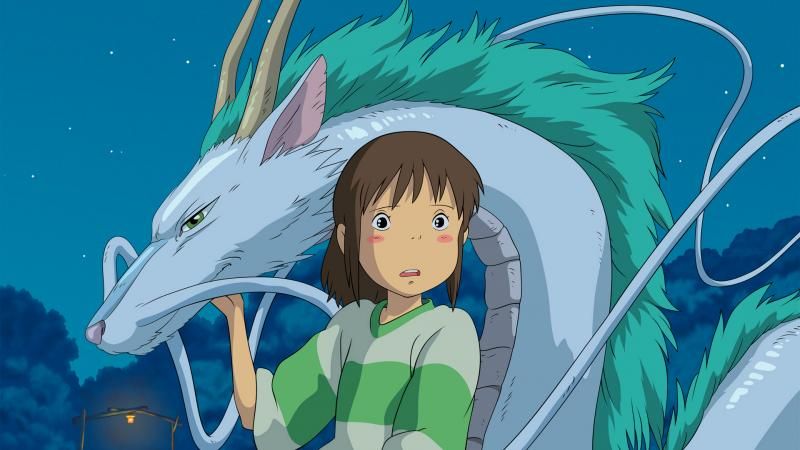
help of Haku (Marsden), a young man who is also a trapped dragon spirit,
Chihiro must navigate this new world and learn to play by its rules in order to
free her parents and get back to where she belongs.
The
story of Spirited Away is reminiscent of a fairy tale, and I highly
doubt I’m the first to make such an association. The concept of an ordinary human being
journeying through an alternate realm full of magic brings Alice in
Wonderland to mind first and foremost, but other standard tales just as
well. I was reminded of Andersen’s “The
Snow Queen” in terms of the idea of a human character forced to go through the
trials and tribulations of a magic world she doesn’t understand in order to
save her family. Yubaba’s name obviously
conjures up images of Baba Yaga from Eastern European folklore, and although
the name might be a mere coincidence, the character herself only strengthens
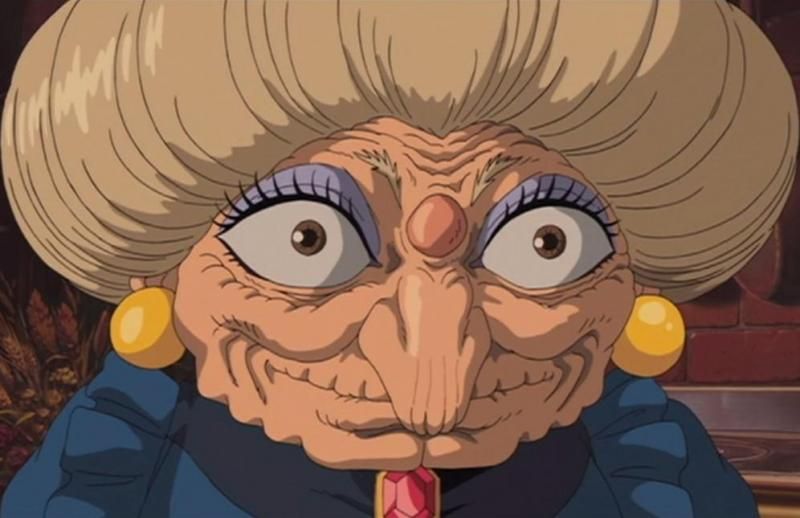
such an association. Yubaba’s face is
always precisely what I pictured Baba Yaga to look like (although my Baba Yaga
never wore a blue Victorian gown).
Yubaba transforms into a bird, and Baba Yaga lived in a hut on top of a
chicken’s leg, and Baba Yaga herself is an ambiguous character. Although Yubaba is certainly the closest Spirited
Away has to a villain, she is not wholly evil, and her twin sister
Zeniba is downright kind and maternal, another possible reading of Baba
Yaga. Finding these European fairy tale
tropes together in a Japanese film is surprising, certainly, but for me, it
helped to cement the world of magic and mysticism. What’s more, I appreciate that there is
always a sense of danger in the magic of Spirited Away, just like there is in
so many of the original European folk stories.
This is not Disney’s prettified world, there is still damp and ugly and
danger. This, to me, is what fairy tales
are all about.
But
where Spirited Away diverges most significantly from its fairy tale
aura is in its presentation of good and evil.
The only other Miyazaki film I’ve seen prior to this is Princess
Mononoke, and both these films treat good and evil similarly. Miyazaki is a surprisingly even-minded
storyteller when it comes to this, as I have yet to see a character in these
two films that is completely bad.
Rather, there exists a spectrum, and the characters are fluid in their
placement along it. For example, Yubaba,
as mentioned above, is the closest thing Spirited Away has to a villain, and
yet at one point, she ecstatically hugs Chihiro. Motivated less by power and more superficial
greed, she bends and compromises when she has to, a trait incredibly uncommon
to typical villains. By the end of the
story, she feels not so much evil as merely shallow. Then consider Haku, Chihiro’s friend and
guide. Although I implicitly trusted him
when he first shepherds Chihiro through the world, we are almost immediately
met with disparate opinions about Haku. We
are told he is a thief, a henchman, and untrustworthy. I began to doubt whether I could trust him
after all. No-Face, Lin, Kamaji, and the
giant baby are all other characters that are difficult to read. Whose side are they on? Are they helpful or harmful? And the thing is, they’re all a bit of
both. Maybe there isn’t such a thing as ‘all
right’ or ‘all wrong,’ and to see this ambiguity presented in a children’s
animated fairy tale is impressive. In
fact, the only character who can be considered truly “good” in the typical
sense is Chihiro, and we must remember she’s rather sulky at the beginning. I appreciate this take on morality, and as I
said, it coincides completely with what I remember of Princess Mononoke. The characters in Miyazaki’s films feel
richer because of this refusal to simply “pick sides.”
Here
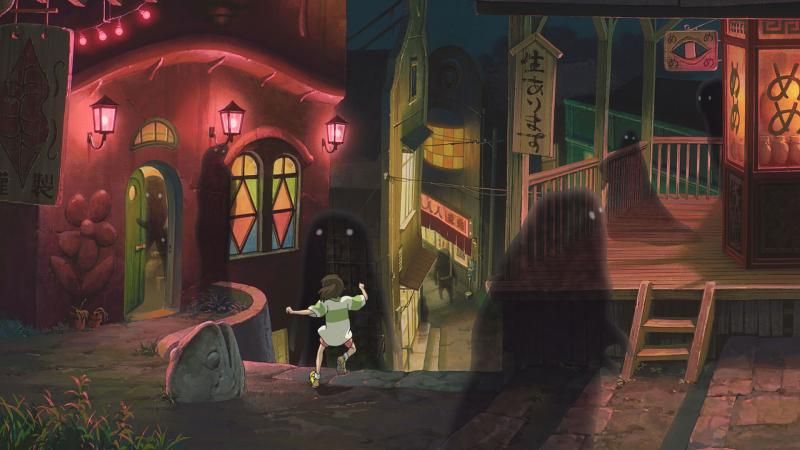
is where I should probably mention the animation. Of course it’s amazing, it’s Studio
Ghibli. My favorite component of the
animation is the background design. It’s
breathtaking as the world of the spirits is slowly built; as Chihiro and her
family explore the abandoned theme park, we see more and more buildings, and
then the great bath house appears. This
world, the rooms, the sets, so to speak, are gloriously detailed and full of
rich, vibrant color. Yes, the characters
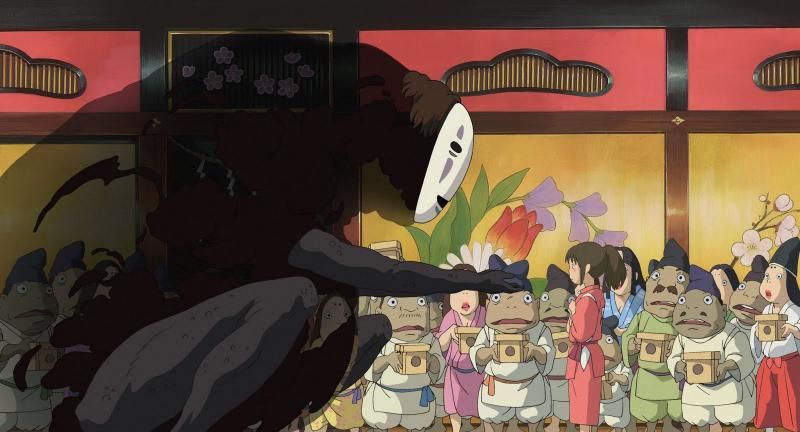
are all incredibly imaginative – No-Face was probably my favorite design – but
I really love the backgrounds. Beautiful.
Spirited
Away is a
lovely, magical tale that clearly coincides with a coming of age story for its
central character. Chihiro must find her
strength and adaptability in order to survive this strange new world with its
ever-shifting characters. It’s really
quite nice, but I’m not a huge fan of children’s movies in that I would rarely,
if ever, choose to watch a film that self-identifies in this way. Although I don’t think I’d ever watch this
again, I enjoyed my time with Spirited Away.
Arbitrary
Rating: 7/10

