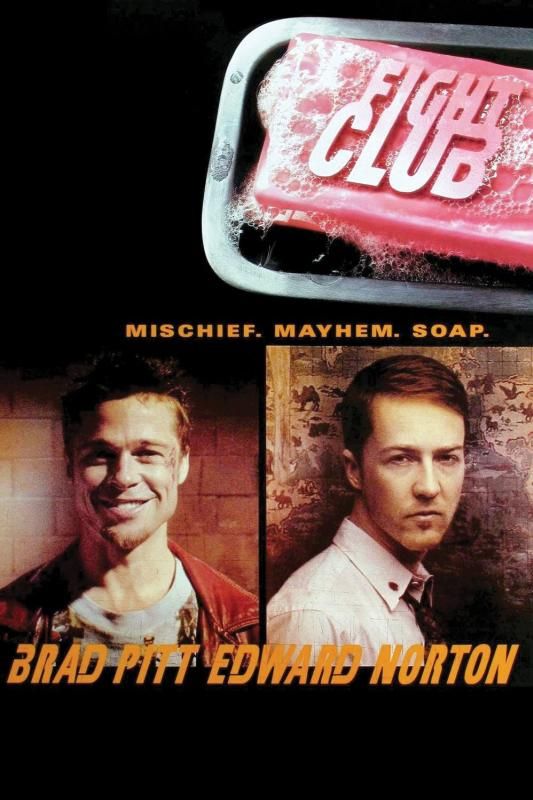
Fight
Club
1999
Director: David Fincher
Starring: Edward Norton, Brad Pitt,
Helena Bonham Carter, Meat Loaf
Okay,
let’s get this out of the way right now: I just watched Fight Club for the very
first time two days before writing this review (ETA: which was, in fact, about
a year ago, it just took me awhile to post this review, because that’s how I
roll, yo.)
“What?”
“OMG!” “You’ve NEVER seen it before?” “What’s wrong with you?” “BEST MOVIE
EVER!”
There. Is that out of your system now? Good, I may continue with my review.
Fight
Club
pissed me off, but not in the way you’d think.
It pissed me off because as I was watching it, I kept on thinking of how
damn GOOD it is. How, cinematically
speaking, it’s both accessible and daring.
And then I remembered that it’s fundamentally a GUY movie. You know, a guy movie – guys love it, girls
hate it. Dark, gritty, lots of guns and
violence, very few female characters.
And
that made me mad.
Because
the best of the guy movies are awesome.
Seriously, spectacularly awesome pieces of cinema. In the last twenty-five years, guy movies
have given us Seven (same dude, yes, I know), all of Christopher Nolan’s
films (Memento, Inception, The Dark Knight), Donnie Darko, Goodfellas,
etc. What fantastic films. And guys love them. They are not hard films to love.
What
are the “great chick flicks” of the last twenty-five years? Titanic? Vomit.
The Princess Diaries?
Are you serious? Under
the Tuscan Sun? Passable at
best. I can get behind Notting
Hill, but Notting Hill is not a cinematic masterpiece. I mean, it’s awesome, but in a “I can turn
off my brain now and the movie will amuse me” kind of way. It’s hardly challenging.
The
best guy movies ARE challenging. The
best recent chick flicks… well… aren’t.
And
that made me mad.
Because
Fight
Club is such a great cinematic work, and it’s so fundamentally
masculine, and chick flicks are shitty.
Why
are chick flicks so shitty? Why does
Hollywood think that women are content to settle for utter rubbish as long as
there’s a hot guy walking around half naked?
Ladies, here’s a hint – Brad Pitt walks around half naked in Fight
Club, and this movie is much more worthy of your time than, say, Letters
to Juliet.
Oh,
right, I should probably try to review Fight Club rather than just rant
about the dearth of quality “female films” being made in Hollywood. It tells the story of a desensitized,
insomniac insurance claim investigator (Norton) who meets childish and arrogant
soap salesman-cum-explosives expert Tyler Durden (Pitt). Together, they form the eponymous Fight Club. Marla (Bonham Carter) takes up with Tyler,
much to the chagrin of our narrator.
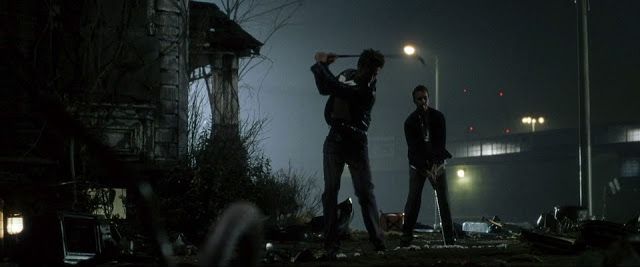
Things start to spin out of control when the men involved in Fight Club
start branching out from just hitting each other.
For
my money, the first half hour of Fight Club is perfect. Sheer, cinematic perfection. It’s funny, it’s witty, it’s engaging, and
it’s damn unique. Just when you think
you know what’s coming, David Fincher spins the film in a completely new
direction. There’s voice-over narration
that blends seamlessly into actual dialogue.
We go from Marla and Norton bickering over which support group the other
“gets,” to vibrating dildos in airline luggage, to Meat Loaf’s “bitch tits,” to
what you’d name a tumor if you had one.
The camerawork is dizzyingly fresh, zooming through gas lines or up and
down a waste bucket, places we wouldn’t expect to see. The fourth wall gets broken during a brief
scene that is so unexpected and so funny, you can’t help but smile. The film even opens at the neural synapses of
the brain and zooms out to Norton’s face, a journey which is disconcerting and
takes awhile to place. The first half
hour, man. It’s so unlike other
films. It’s so entertaining. It’s funny and sharp and unique. It’s perfect.
The
rest of the film is very good, but it’s not like the first half hour. With the formation of the actual Fight Club,
the film becomes more traditional in its narrative (or rather, as traditional as
an out-there story like Fight Club can be). The ingenuity shown in the filmmaking process
of the first thirty minutes gives way to much more straightforward
storytelling. I suppose, in a weird way,
it would have been far too exhausting to create a film that was as off the wall
as those first thirty minutes.

Accompanying
this shift in technique is a marked shift in tone as well. The film becomes significantly darker and
bleaker as we go into more traditional movie mode. It’s interesting rewatching Fight
Club (yes, this means that I’m watching it twice in two days;
rewatching helps inspire me when I write about a movie) and remembering just
how funny it starts, and just how dark it becomes. The narrative is driven to a very frightening
place; things go wrong, and it seems as if nothing will ever go right. Unfortunately, I also feel that, despite the
intriguing social commentary, the film starts to feel water-logged. It gets a bit too heavy, a bit too
dreary. It starts to lag, pace-wise. It can’t keep up with the fresh and fast pace
of the opening. That being said,
Fincher, at the very last moment, brings Fight Club back from the edge of
being the most depressing tragedy you’ve seen in awhile and reiterates that
what you’ve just watched is, in fact, a comedy.
Technically speaking, in the most basic of all dramatic terms, the
difference between comedy and tragedy hinges on death, and for most of the
central story of the film, we seem to be careening toward the chasm of
tragedy. There’s funny stuff in the
first third, but it becomes so dark and heavy, the “comic” ending feels
unnatural for most of the film. I
understand it, though. It’s bringing the
movie full circle, back to the significantly lighter comedy of the
opening.
The
two leads, Norton and Pitt, are fantastic.
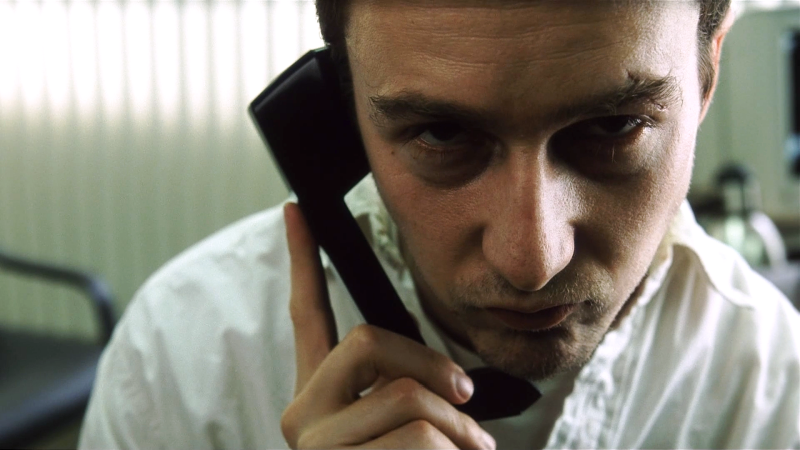
Norton, as our lead, is the one who takes us on a journey from trapped
office worker to rebellious fighter to frightened desperado, and, in what I
have come to expect from Edward Norton, is phenomenal. He’s funny when he needs to be, he’s pathetic
when he needs to be, and more than anything, he’s believable. Dancing around him are the two crazies of
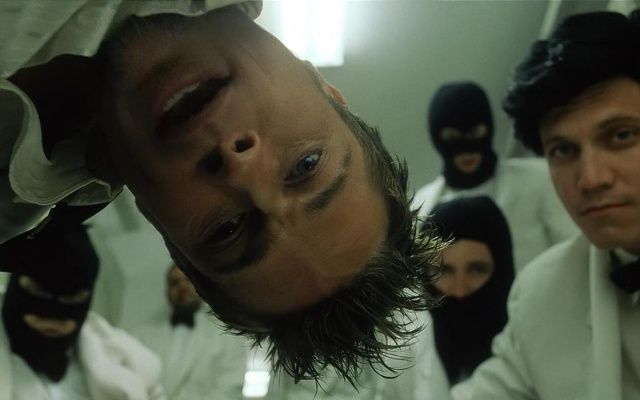
Brad Pitt and Helena Bonham Carter. Pitt
is the embodiment of the id, easily flaunting society’s rules by only doing
what feels good, then literally rewriting the rules of civilization. While I don’t think his work here is better
than his role in Twelve Monkeys (because I love Twelve Monkeys… which I
just realized is probably a “guy movie…” dammit…), Pitt does his half-naked
crazy dance well.
There’s
a hyperrealism to the photography in Fight Club that manages to make the
movie both ugly and beautiful, real and unreal, all at the same time. Everything looks like things we know. The pay phone is a pay phone. It’s scratched and dirty, like a real pay
phone. But then the camera zooms up
close, closer than we expect, and the scratches keep getting thrown into more
stark relief, there is more detail than you could possibly have imagined. The film is full of photographic touches like
that; familiar things shot with such excruciating detail that they become
artificial.
There
was a surprising amount of fairly accurate chemistry in the movie. (Yes, I am
now about to nerd out about chemistry.
Brace yourself.) For the record,
as a chemistry teacher, every year I teach the definition of
“saponification.” (the making of
soap) And nearly every year, I’ve had at
least one student say, “Oh, like in Fight Club!” Now I can respond with a tangential
discussion of how great the film is, huzzah!
There’s a scene with a chemical burn (I’m guessing it was some sort of
hydroxide) that was painful for me to watch because a) I have firsthand
experience with chemical burns and b) I actively spend my days trying to
prevent such things happening to my darling little students.
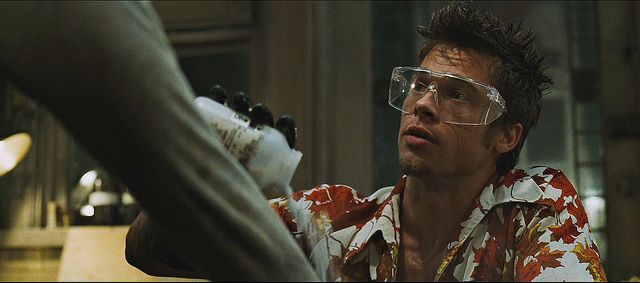 |
| Seriously, you guys, this scene made me cringe because it's exactly what I DON'T want happening to all my lovely little students... |
For
a film titled Fight Club, I was bracing myself for a level of violence that
was damn near unwatchable. Apparently,
my hypersensitivity to violence is mostly confined to war films, because I was
surprisingly accepting of the violence in this film. There is no shortage of deep purple fake
blood and plasma, to be sure, and the sound of flesh thwacking against cold
hard concrete is distinct and a little stomach churning, but the violence is
also not nearly as nonstop as you would imagine. The focal point, the main message of the
film, is much more about eschewing society’s rules (and possible repercussions
therein), and much less about violence for violence’s sake.
Fight
Club would
make a great double feature with Office Space, made the same
year. I am CERTAIN I am not the first
person to associate these two films together, but they both deal with a central
character who, tired of the cubicle life, starts to break free from American
cultural expectations. Fight
Club makes its point with wild violence and hyperbolic
antiestablishmentarianism gestures. Office
Space makes its point with funny gags and a red stapler. Two drastically different comedies, but an
intriguing double feature. At the very
least, I anticipate such a double feature would have you wishing you could
properly tick off your boss more.
Or,
in my case, it would make me angry about why guy films are so intriguing and
chick flicks are so braindead.
Arbitrary
Rating: 9/10. Ironically, considering
the overall message, I think the film starts to run out of steam in the second
half. But that doesn’t stop the whole
movie from being AWESOME!
