Showing posts with label steve mcqueen. Show all posts

Sunday, January 19, 2014

12 Years a Slave


12 Years a Slave
2013
Director: Steve McQueen
Starring: Chiwetel Ejiofor, Michael Fassbender, Lupita Nyong’o

There is something very un-Hollywood about Steve McQueen, and god bless for that. In the hands of a typical director, 12 Years a Slave would be precisely the sort of film that I would feel morally obligated to see, appeasing a deep seated sense of American guilt. It would feel like something I had to see, vegetables that accompany my dinner, something rather difficult to swallow yet somehow knowing that it is quote-good for me-unquote. But Steve McQueen is not a typical director, and what could have been a massively heavy handed and overtly melodramatic tale of slavery in the South is instead quiet, even subtle (rarely a word used to describe slavery-slash-Civil War films), but not for a moment lacking the power and anger the subject matter demands.

Based on a true story, Solomon Northup (Ejiofor) is a free black man living in Saratoga, New York, in the early 1840s.  He has a wife and two children and a very well-to-do life; that is, until he is kidnapped and sold into slavery in the American South and given the new name of Platt.  Passed around from slave auctioneer to foresting plantation to sugar plantation to a particularly brutal cotton plantation run by the brutal Master Epps (Fassbender), he learns that in order to survive, he must keep his head down and his mouth shut.  Were word to come to his new masters that he can read and write, he would certainly be killed. 


And although I often try not to discuss the ending of a film when I review it, I *will* be mentioning a bit more about the plot than normal, so fair spoiler warning.

The only other film of McQueen’s that I've seen is Shame, and that was a rare film that earned a "perfect" score of ten out of ten on its first go around. I tend not to give films perfect scores after a first viewing; perfect scores are for films that have cultivated a place in my heart, films that I have cherished for a long time. It's not that I don't think new films are good, it's more recognizing the importance of longevity. Shame, on the other hand, demanded I throw that system out the window, so resounding was its power. I mention this because it’s an exception I rarely make, and McQueen, with that film, earned my respect and then some.

I was not entirely interested in seeing 12 Years a Slave originally (even despite the immense ovary-exploding draws of Benedict Cumberbatch and Michael Fassbender combined) because of aforementioned sense of "chore." Powerful, undoubtedly, but chore nonetheless. Then I saw that McQueen directed it. And then I was much more interested.

I could not reconcile in my head how a director whose only work I had seen had been a small scale character study, a work that was all about the emotionally damaged lives of two broken people, a film shot with a devotion to long, uncomfortably quiet takes, could take on a period piece about slavery.


And indeed, McQueen delivers as atypical a piece on American slavery as I could possibly imagine.  What McQueen does in this film is essentially remove any sort of trope or expectation I associate with "slavery film," while still making a film about slavery.  It’s not at all the heavy-handed morality play with swells in plot and soundtrack that are as predictable as dammit.  Thank god. And just like Shame, there are long, unbroken takes. Many dialogue sequences are shot in one take, interrupting infrequently, somehow allowing the characters to finish their thoughts. There are a myriad of slow, lingering shots of trees, of swampland, of the sky. The most memorable moment was a quiet close up on Ejiofor towards the end of the film. He speaks no words, simply turns his face towards the camera. The shot is easily thirty seconds long. Does it further the plot in an obvious way? Not in the slightest. But it's a hugely important shot, angry in its quiet, and reminding us that Solomon's life is not at peace, that everything is wrong, that although Solomon has "learned" how to survive, although we have not heard him mention his wife and children since the opening of the film, he has not for a second forgotten them. We don't need an expository scene of Solomon explaining how much he misses his former life, not when an infinitely more lyrical close up will do the trick.

Gratuitous photo of Benedict Cumberbatch.  Because reasons.

What is also refreshing in 12 Years a Slave is, similar to above, not all characters are pure good or pure evil (a very typical approach when making slavery films and war films alike). There is Master Ford the plantation owner (played by a dreamy Benedict Cumberbatch) who is clearly compassionate but seems unwilling to stick his neck out too far. There is the hard plantation contractor who unexpectedly saves Solomon from a hanging, but then doesn't cut him down, leaving him tied and bound for hours. The white man who ultimately ventures to the south to reclaim Solomon's freedom is portrayed as shady.  Yes, there are a few ancillary characters who are allowed to be one-dimensional, but nearly anyone with more than two scenes is given an unexpected depth.

The performances are top-notch.  Nominated for three acting Oscars for Ejiofor, Fassbender, and Nyong’o as cotton plantation slave Patsey, everyone is strong.  Ejiofor carries the film with a heavy heart, Nyong’o shines playing a character full of strength and spirit who has been depressingly beaten down, but for my money, Fassbender steals every scene he’s in.  His Epps is insane in a way not often shown.  Clearly the film’s main antagonist, Epps is the “Evil Plantation Owner.”  What’s interesting is that Epps is mad, mad with brutality and sexual obsession, but only a little mad.  He’s a “believable” mad.  I can see how society would let someone like this exist, would let them get on with their lives, would even allow them to come to some prominence because they have money.  Fassbender is not off the deep end, but he’s about waist-deep and slowly wading his way over.  It’s a very good restrained evil genius.


One of the most interesting aspects of 12 Years a Slave is the theme of guilt, a theme also heavily examined in Shame. We watch Solomon make several choices in the film that are ugly choices but born of necessity. In an early instance, another black woman who has been kidnapped into slavery is sold, while her young children remain to be sold to different owners. Rather than fight to help the mother stay with her children, Solomon takes up a violin and starts playing a jaunty tune in an attempt to drown out the wails. It is this that Ejiofor portrays so painfully well, this sensation of being driven to horrible acts of compliance in order to not be killed and how it eats away at his soul. When the film hits its climax, where Solomon is finally rescued by his friends from the North, there is more of a focus on his abandonment of Patsey and the other slaves on Epps’ plantation rather than the joy or triumph at his wrong being righted.  Really, this is what makes this film so fascinating to me. There is no triumphant finale where Solomon cheerfully returns to his home. How can there be? What he has gone through has eaten at his very humanity, least of all because of the hard labor. Although the film certainly celebrates his ultimate return to freedom, it is utterly lacking in pomp. Indeed, Solomon asks for forgiveness upon his return. Forgiveness. The guilt at not always helping, at sometimes turning a blind eye, at abandoning the others on the plantation... Of course he is grateful for his newfound freedom, but this film recognizes that one man’s success is hardly a significant win for making real progress on the issue.

There is still a slight sense of “eating my vegetables” while watching 12 Years a Slave, but it is mostly kept at bay.  Smart directing choices by McQueen and standout performances from the cast turn what could have been a meat-fisted over-the-top guilt-fest melodrama into something far more potent, powerful, and inexplicably subtle.  I’m pleased that such a complex film is getting the level of attention being heaped on it during this current awards season.


Arbitrary Rating: 9/10

Friday, August 9, 2013

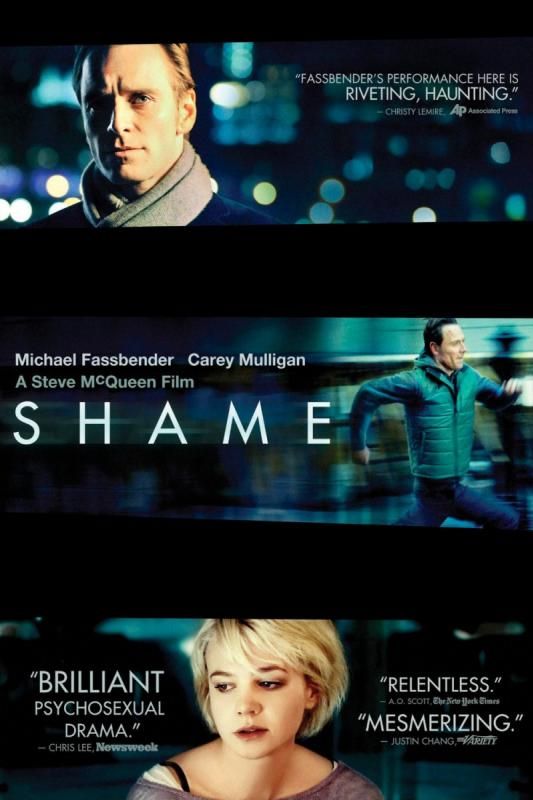
Shame


Shame
2011
Director: Steve McQueen
Starring: Michael Fassbender, Carey Mulligan

2011 was THE breakout year for Michael Fassbender.  Rare is it to have such a tremendous burst into the collective Hollywood consciousness, but he managed to do it with the help of a comic book summer blockbuster, a costume drama (two, actually), and Shame, an intense, gritty indie film.  Shame already had a check or three in the plus column for me, as even before going in, I found Fassbender rather attractive and I knew him to be tremendously talented.  After watching Shame, I’ll say two things.  One: my crush has now only gotten bigger (and undoubtedly colored my reaction to the film, all things being fair) and two: I knew the man had talent, but I really had no idea how MUCH talent.

Brandon (Fassbender) is a New Yorker working in an unspecified and rather generic job where he earns good money so that he can pay for his nice apartment and fuel his sex addiction.  His boss is a douche bag, but also the closest thing he has to a friend, which isn’t saying much.  When his younger sister Sissy (Mulligan), a freewheeling singer who can’t quite seem to get a grip on her life, unexpectedly crashes at his flat, Brandon’s efforts to keep his controlled life in place begin to crumble.

  
I had certain expectations about Shame before I finally popped it into the DVD player, and they were due to two things.  One: this film is rated NC-17.  That means sexually explicit content (because you can have all the violence you want and that’s fine – show a penis in a non-comedic manner, and it’s NC-17).  Two: other reviews I had glanced at of Shame and the cover sleeve from Netflix, both of which reference Brandon’s sex addiction.  In my head, I thought this was going to be a movie where I would see far too many uncomfortable scenes of Michael Fassbender jerking off.  But Shame surprised me.  Yes, there is sex, yes, there is Michael Fassbender’s penis, and yes, there are a few scenes where Brandon is jerking off, but, as weird as this sounds, there wasn’t as much sex in it as I thought there would be. 

In other words, I was preparing myself for ugly rotten intense guilty angry sex in nearly every other scene, to the point where I figured it would be gratuitous.  What I got was one of the most intense character dramas I’ve seen in quite some time – and honestly, I felt none of the sex scenes were gratuitous in the least.  In fact, the rest of my review has NOTHING to do with the sex scenes at all.

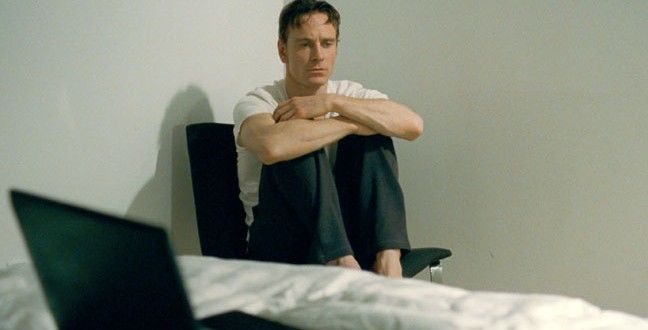
This movie is all about Brandon.  This movie is all about Michael Fassbender.  The entire story is told from his perspective.  The camera only ever knows what Brandon knows, sees what Brandon sees.  We are locked completely and utterly in his head, and in a lesser film and in the hands of a lesser actor, that would be a rather boring place to be.  Not so in Shame.  Shame shines because Brandon is a fully formed character played with smart subtlety by a fantastic actor.


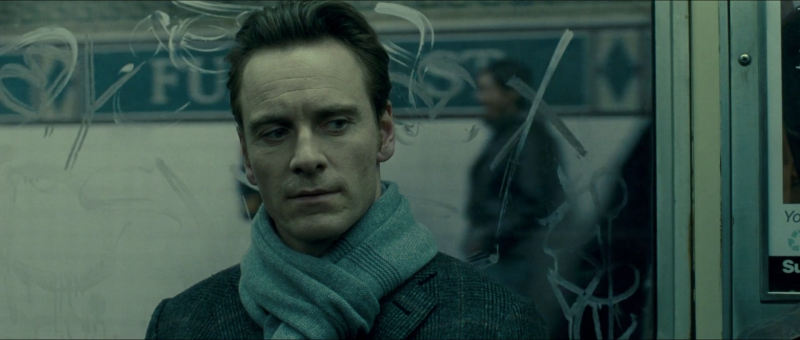
How brilliant do I think Fassbender is as Brandon?  Let me put it this way.  Fassbender takes a character who is a sex addict, who snorts cocaine, who has some obvious anger issues and a very ugly violent tendency – all in all, rather unlikeable traits – and makes me sympathize with him.  For all of Brandon’s deep flaws, Fassbender made me weep for him.  How?  It’s in the way he is too buttoned up, too controlling, too timid.  His boss, his “friend,” is quite opposite, as he openly hits on women (while maintaining a wife and kids, by the by) and talks comfortably with anyone he meets.  I can read Brandon’s jealousy and idol worship of his boss’ behavior, how he wishes so desperately he could be that loose and free.  In one heartbreaking tiny touch, his boss slightly tucks Brandon’s scarf back into the inside of his coat, as if to say to Brandon, “You can’t be looking mussed, now, can you.”  It’s the smallest of gestures, and it comes across as both affectionate and mocking, as if the boss knows that yes, Brandon would hate to have the scarf out of place, and isn’t that just rather ridiculous.  I can also read the disgust he has for his boss when said boss insists on hitting on all skirts, including Sissy, that cross his path.  Like so much in his life, Brandon both loves and hates his boss. 

There is a sequence in the film where we finally see Brandon unbutton himself, and it is unpleasant.  Much has been made of the threesome sex scene that ends the sequence, but for me, the most telling part of the scene is where Brandon hits on a girl in a bar while her boyfriend is just the other side of the room.  It’s how Brandon speaks to her – openly, aggressively, filthily – that is most shocking in this entire sequence of events, for this is not the Brandon I have seen thus far.  This is Brandon letting his addiction control him, the thing he’s been working so hard, exerting so much energy, to avoid doing.  He cannot contain it any longer, and it turns him into someone much uglier.  It’s his personality in this scene that retroactively helps me to understand why he puts so much energy into controlling his addiction.  He does not WANT to be this person – you can read the shame and hate underneath the surface as he relentlessly speaks to the girl in the bar – but he will become Mr. Hyde unless he controls himself.

So, then, why did Brandon unbutton himself?  Sissy.  As the film progresses, it becomes clear that Sissy is a trigger for Brandon.  She, like his boss, is open, expressive, easy, flighty, everything he is not.  There is deep affection there, but also a great deal of tension.  And after a crippling discussion where Brandon tells her she is a weight around his neck, that is when they both break – he in his way, she in hers.  Director McQueen hints, in no uncertain terms, of unresolved sexual tension between the siblings.  The first time we meet Sissy, she is naked in the shower, and after a dialogue exchange, the in-scene music proclaims “I Want Your Love.”  Later, when Sissy walks in on Brandon unexpectedly, he reacts badly, but not before giving us more than a bit of unbridled heat.  My read on the film, one I am certain I am not alone on, is that Brandon’s deep affection for his sister conflicts with his sex addiction, giving him feelings that he knows are inappropriate and can never be acted upon.  However, the longer Sissy stays with him, the more energy he has to exert to keep those appetites at bay, and the more he sees her, the more he hates both her and himself.

  
For the part of Sissy, Carey Mulligan turns in a very good performance.  She is honest and open, but she has less to do than Fassbender and did not, pardon the pun, blow me away the way Fassbender did.  Compared with the brutal three dimensionality of Brandon, Sissy is a bit more expected, a bit less surprising, a bit more two dimensional.  The absolutely lovely and poignant scene where she sings “New York, New York” is her shining moment, no doubt.  Chip from Tips from Chip mentioned in a comment that he could “read” Sissy’s storyline in advance, and I somewhat agree here, which is not to say it’s not an effective storyline, but it lacks the surprising nature of Brandon’s journey.  What amazes me about Fassbender’s Brandon is that he was constantly surprising me, and I really respond to that; Sissy was good, and an effective foil to Brandon, but her actions were more expected.

McQueen favors uncomfortably long takes with a mostly static camera that moves only as much as it has to.  Like Ozu, there are many scenes where characters enter and exit the space and the camera simply waits for them to appear and run their course.  The long takes are exquisite, and an excellent reminder that one can make an interesting, gripping film without cutting every five seconds.  Jean Luc Godard is quoted as saying “Every edit is a lie.”  McQueen takes this as a challenge, and counters with long takes that imbue verisimilitude to Shame.  The protracted shots mean awkward conversations full of fidgeting that allow me to see all of Brandon’s contrasting emotions.  McQueen doesn’t cut away from the somewhat embarrassing pauses in chit chat, which in turn makes the situation feel uncomfortably real.  It also utterly hypnotizes me, captures me in the scene, and I am locked in.  When you add in the fact that the film looks absolutely gorgeous, full of golds and greys and blues, I admire Shame not only for its fascinating characterization but also being a damn fine film to look at.


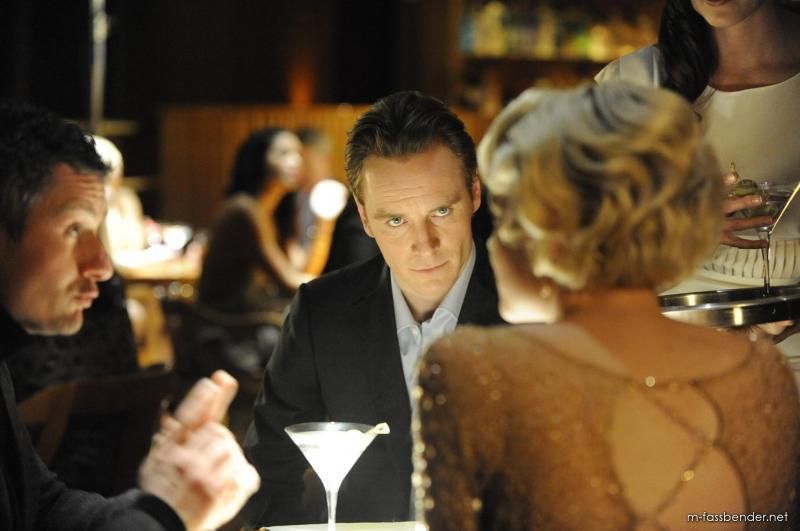
My heart breaks for Brandon.  It shatters into a million pieces.  How he’s far too compliant in the restaurant scene, simply agreeing to everything the waiter suggests, and then how he later becomes aggressively cruel to Sissy.  I love how, by the end of the film, I feel as though I was getting closer and closer to understanding Brandon, and yet he was still surprising me.  And honestly, the last thing I ever expected before seeing Shame was feeling this sense of sympathy for the main character.  The fact that the Academy didn’t even nominate Fassbender’s staggering performance here is utter crap (although I can “understand” it from the Academy-being-political-in-its-decisions vantage point and the film’s NC-17 rating) (still a crap decision, though).  Shame is precisely the sort of intense, small, character-driven drama that I just adore, and I now want to seek out more from Steve McQueen. 

Arbitrary Rating: 10/10.  And I don’t normally give a 10 to a film I just saw for the first time mere hours ago.  But Shame?  Crap.  It earned it.