Showing posts with label 1959. Show all posts

Tuesday, July 9, 2013

The 400 Blows


The 400 Blows (Les Quatre Cents Coups)
1959
Director: Francois Truffaut
Starring: Jean-Pierre Leaud, Claire Maurier

I started watching films from 1001 Movies in early 2006, so most of you know I’m pretty far along in the list, but not nearly as far along in my reviewing (partly because it took me awhile to realize that I not only wanted to SEE these films, but reflect and engage in a discourse about them as well).  What this has meant for me is that in order to write cogently about a film I’ve only seen once five or six or seven years ago, I make an effort to see it a second time in order to gain inspiration.  For most films, this has actually helped them in my eyes; by taking the time to see a film again with an open mind, I’m giving it a second chance, and usually, they fare better in a second go-around.

Never has this been more true than with The 400 Blows.

Because crap, I don’t even know what I was thinking the first time around when I gave it a 6 out of 10 on imdb.

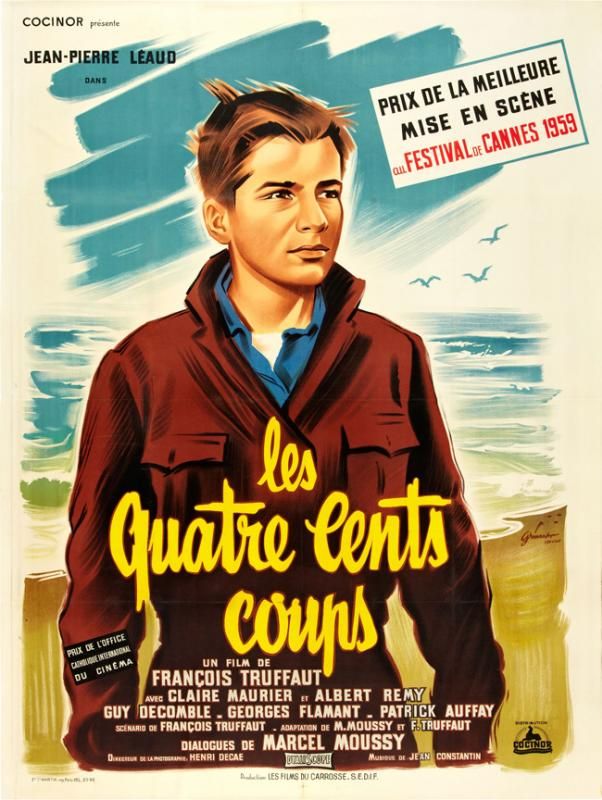
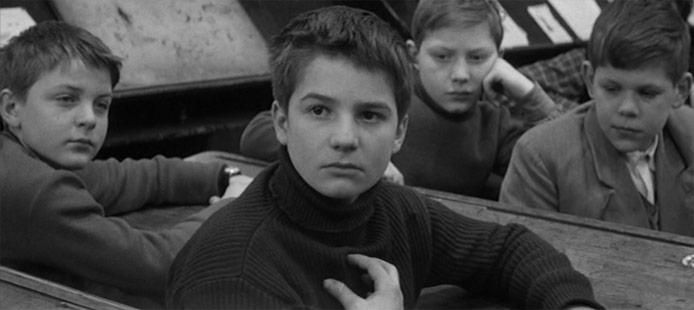
Antoine Doinel (Leaud) is a troublemaker, according to his teachers and his parents.  Although lots of students goof off at school, Antoine seems to be the one who gets caught, and his mother (Maurier) is constantly nagging him at home.  After skipping school one day with his best friend, he lies to his teachers next day and tells them he was out because his mother died.  When his mother finds out about this, Antoine runs away from home for the night.  Although eventually returned home, he ultimately gets kicked out of school, steals a typewriter, and his parents cart him off to a juvenile academy.  
  
In my initial blitzkrieg through 1001 Movies, the French New Wave was a major sticking point.  I just didn’t get it.  I’m not sure I totally get it now, but I feel like I’m slowly starting to understand.  And I really didn’t get The 400 Blows the first time.

I rated The 400 Blows on Netflix initially in December 2006 (thanks, Netflix, for storing that data!).  That’s important because that tells me I saw it before I went into teaching, and during an especially dark period in my life when I was dreadfully unhappy.  I am now in a much better place, I just finished my fifth year as a teacher, and seeing The 400 Blows a second time was almost like a revelation.  This movie has so much heart and so much soul, it’s almost painful.  I want to reach my arms into the screen and hug Antoine and never let him go, and I think the reason why I found this movie so much more moving than initially is, frankly, because I’m a teacher.
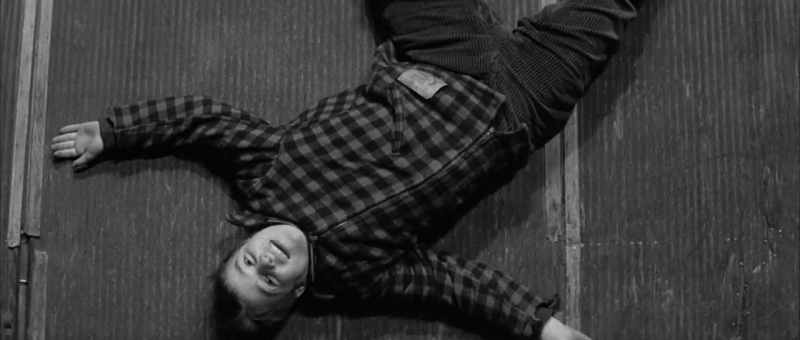

I found the asshole teacher in The 400 Blows absolutely appalling.  (Actually, all the teachers in this movie were appalling – especially the phys ed teacher who loses his entire class when he takes them out for a walk around Paris.)  He has a classroom full of constantly misbehaving students but only ever blames one or two of them, and Antoine is definitely a scapegoat.  (and really, who keeps their backs turned to their students as long as he does?  The idiot…)  Antoine writes an essay he’s actually proud of about Balzac (well, cribbed from Balzac), and the way the teacher mocks him in front of the class broke my heart.  I would never, not in a million years, call out a student who had done something like that in front of a crowd.  And with Antoine in particular, I would want to encourage his interest in the works of a noted author rather than constantly stamp out any spark of passion he has.

Because really, that’s what happens in The 400 Blows.  Antoine is not a bad kid, he really isn’t, but nothing goes his way.  He wants to get his homework done, but then his parents start nagging him to buy flour and set the table and put out the trash.  He wants to go to school but his best friend convinces him to skip.  He wants to return the stolen typewriter but gets caught in the process.  He has so much good in him, SO MUCH, but he cannot escape.  He’s not perfect, I don’t mean to imply he’s some angel, because really, kid stole a typewriter, there’s no getting around it, but he’s not what everyone makes him out to be.  He has so much heart, so much soul, so much good.  He’s fundamentally a good kid.  And he gets treated like crap.
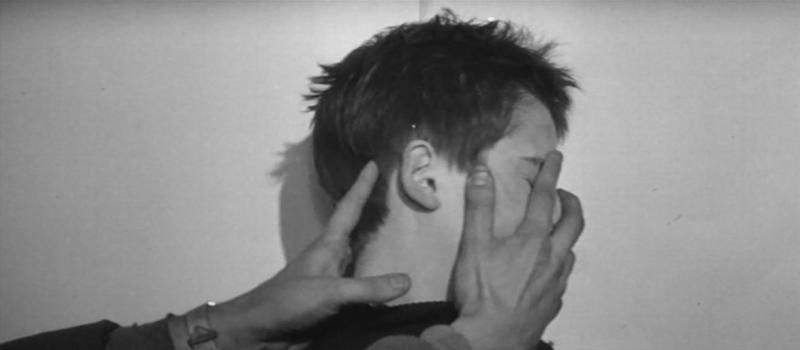

Really, the biggest difference for me in this second pass was my understanding of Antoine.  Seeing him through the lens of a teacher (hopefully an empathetic one, I always try), rather than as a disillusioned grad student made the film come alive in a way it never did in its first pass.

Leaud as Antoine is amazingly good.  Leaud and Truffaut grew up together on film, Leaud as an adolescent to adult, and Truffaut as a young adult to a confident man.  Having seen all of Truffaut’s other films from 1001 Movies by this point, I actually enjoyed going back to see his and Leaud’s first again; I felt I had a sense of perspective on this cinematic pairing that I lacked the first time around.  Somehow knowing the relationship between the two over the future years to come strengthened my attachment to the film.  It’s no secret that The 400 Blows is heavily based on Truffaut’s own experiences as an adolescent, and Leaud is essentially channeling Truffaut himself.  Still, Leaud’s performance, even with Truffaut’s obvious help, is fantastic.  He can somehow manage to bring all these different sides to Antoine all at once, such as how Antoine loves his mother and craves her attention but also rather hates her at the same time.  He’s so utterly real as Antoine.  His lines aren’t forced, his flames of emotion don’t seem to be coming out of nowhere, and the final sequence is utterly devastating because of Leaud and Leaud alone.  His eyes, his face, his body language, his sense of freedom and rebellion… my heart goes out to Antoine because of Leaud.
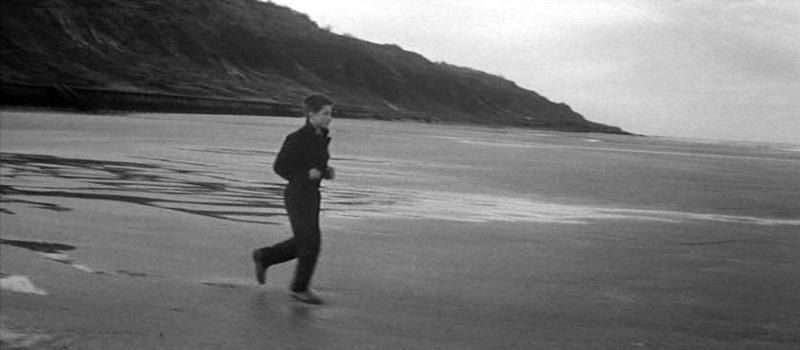

After this thoroughly unexpected and, frankly, emotional response to The 400 Blows, I am making a fairly huge amendment to my previous tastes.  I used to say that I while I appreciate the French New Wave, I don’t really like it.  I am now going to say that I think I am coming around on the French New Wave.  I really think I am.  Whereas before I felt utterly alienated by the films, this one included, I would never describe my reaction to Antoine here as “distant.”  The 400 Blows aches with heart and soul.

Arbitrary Rating: 9/10


Sunday, May 19, 2013

Ride Lonesome


Ride Lonesome
1959
Director: Budd Boetticher
Starring: Randolph Scott, Pernell Roberts, Karen Steele

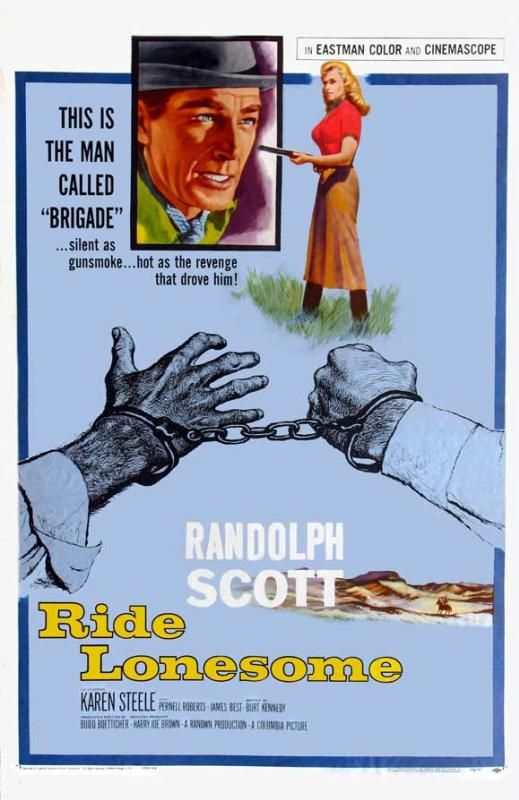
Ugh.  Westerns.  Up to this point, the westerns that I’ve written about have had something a little special going for them, something to make me like them despite my protestations that I’m not a big fan of the genre.  Goodness me, it was starting to sound as if I actually *enjoyed* westerns.  And then I decided to watch Ride Lonesome for a second time in order to write about it.  And then I remembered just how much “typical” westerns don’t work for me.

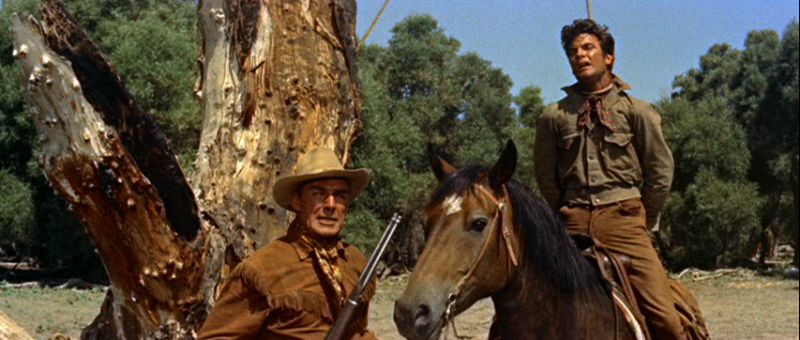
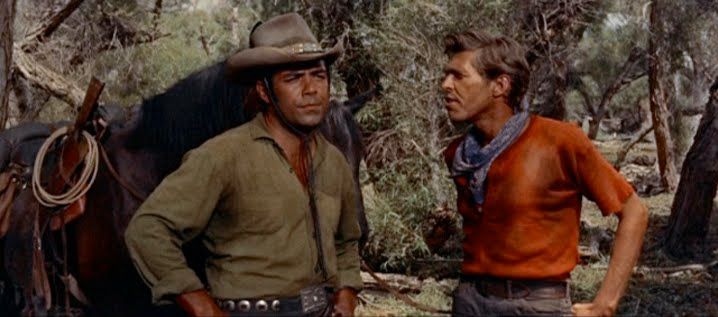
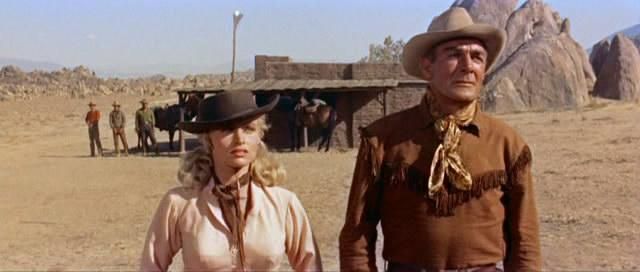
Ben Brigade (Scott) is a bounty hunter who opens the film by capturing smarmy criminal Billy John (James Best).  But Billy John has a brother (Lee van Cleef) who doesn’t want to see him hang, and Brigade knows the clock is ticking on getting Billy to Santa Cruz.  Along the way he picks up a Marilyn Monroe lookalike who sulks, pouts, and wields a shotgun (Steele) and a pair of fun frenemies in Boone (Roberts) and Whit (James Coburn) who want to take Billy from Brigade in order to collect the bounty – and the amnesty that comes with it – themselves. 


From a critical standpoint, Ride Lonesome is, at first glance, very classic Western with a capital W.  Our hero struts about with his chest thrust out (wearing a tasseled shirt, nonetheless) while speaking little.  Indians randomly come and attack our band every now and then for utterly no reason (other than the whole “stole your land, infected your people” thing).  The token female looks unnaturally clean for living in the middle of nowhere and goes through the classic “I hate you… no wait I love you!”attitude change towards our hero.  The night scenes are even shot day for night, something I’ve always found jarring (really, does the moon cast a shadow THAT dark?).  There are shoot-outs aplenty, runaway carriages, and classic fifties dialogue like “That tears it!”  Oh yes sir, this is most definitely Classic Western.

And yet, I will give Ride Lonesome its due and say that it has a few novelties in term of character development and setting that made me understand how it could help bridge the gap between the westerns that predated it and the Leone-esque westerns that followed.  For one, I love that Ride Lonesome wasn’t filmed in Monument Valley.  Instead, we have a much more varied landscape than I would expect in a fifties western.  Interesting rock formation, distant mountain ranges, bleached white desert sand, and sparse, arid forests are the backdrops for Ride Lonesome.  I can see how Sergio Leone would have seen this and preferred this style of location over the earlier westerns that can’t seem to think past Monument Valley. 


The team of Boone and Whit is fun in terms of never really knowing what they’re up to.  Are they helping Brigade?  Are they going to kill him?  Their cheerful, morbid banter certainly gives the film a little bit of sorely lacking spice.  And Billy John is likeable in his ridiculous smarminess – he’s a bad guy you want to see get his due, but you also don’t mind him being a constant needle in Brigade’s side.

But that’s about all I can say about Ride Lonesome that’s good, and it was hard for me to come up with that much.  At 73 minutes, this is definitely a short feature film but holy crap it felt four times longer to me.  I had pause it at least three time to take breaks to do other things, that’s how incapable I was at making it through the film in one go.  And that’s sad.  Absolute, utter tedium.  The fun with Boone and Whit is good, but it’s not nearly enough to get me through the soporific rest of the movie.  I got bored about ten minutes in and started checking my email.  Then making lunch.  Then playing with my cats.  Then grabbing my copy of 1001 Movies to read just why I was watching this movie, because I’m a bit flabbergasted at the moment.

How Randolph Scott became a western star is beyond me, because the drive-thru attendant at McDonald’s speaks with more passion and feeling than him.  It’s laughable how monotone he is.  Every single line, EVERY SINGLE LINE, is delivered with the exact same vocal inflection.  And he has only one facial expression.  He looks stern for the entire film and spits out his lines with slow deadpan diction.  I thought Hayden Christensen was wooden in Star Wars Episode II: Attack of the Clones, but jesus christ, Scott makes Christensen look like Laurence Olivier, what with his emotional range of absolute nil.  It doesn’t help matters that he was getting a bit long in the tooth by the time he filmed this one (he was 61 in 1959) and the “love interest” between him and the little piece of very much younger cheesecake felt absolutely ridiculous and completely forced.

  
And the story is hardly cohesive.  Ride Lonesome suffers from a distinct lack of central tension.  It’s as if the film can’t make up its mind – is it going to focus on the apparent war between our gang of heroes and the Indians?  For twenty minutes or so, that seems to be it.  Yeah yeah, Indian wars, yeah, that’s what this movie is all about.  But then, NOPE NO MORE INJUNS!  WE’RE DONE WITH THEM!  Okay, what about the conflict between Brigade and Boone?  After all, Boone wants to take Billy in himself.  Oh yeah, we should come back to that and keep having Boone make these rather random death threats against Brigade.  Yep, THAT’S our central tension.  Oh wait, no… no it’s not.  Darn it, we forgot about Billy’s brother, the guy who’s supposedly tracking Brigade down in order to free his brother.  Forget all that other stuff, THAT’S the main point of the plot.  That’s what we’ve been building towards throughout the film even though we only just remembered to mention it about twenty minutes out from the end. 

I don’t even know.  And frankly, I don’t care.

There are westerns I like, really there are.  But Ride Lonesome is very, VERY much not one of them. 

Arbitrary Rating: 4/10.  The central music motif is nice, if not rather derivative of the Grand Canyon Suite.

Saturday, April 13, 2013

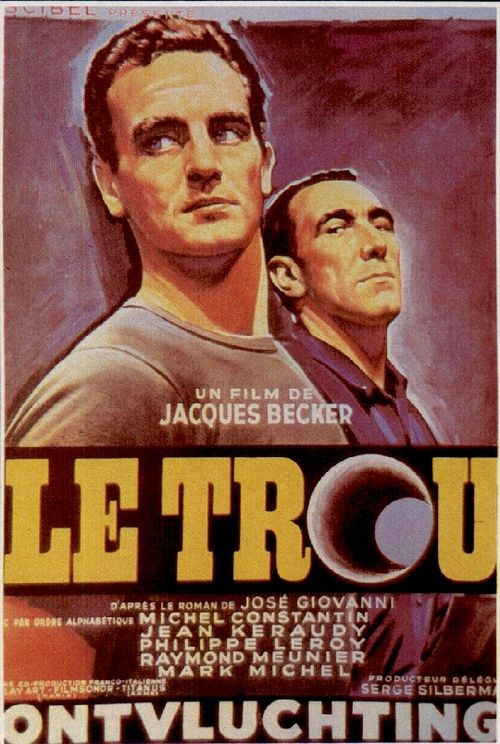
Le Trou (The Hole)


Le Trou (The Hole)
1959
Director: Jacques Becker
Starring: Philippe Leroy, Marc Michel, Jean Keraudy

I can’t think of a way to start this review other than by saying I really enjoy this movie.  I’ve seen it twice now, once in my initial blitzkrieg through the films from 1001 Movies, and once more tonight to refresh myself on it in order to write this piece, and both times, the movie has utterly sucked me in.  It’s hypnotic, it’s engrossing, and I find it fascinating.

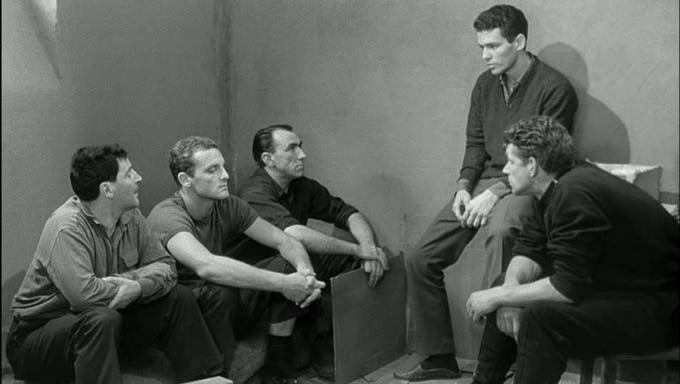
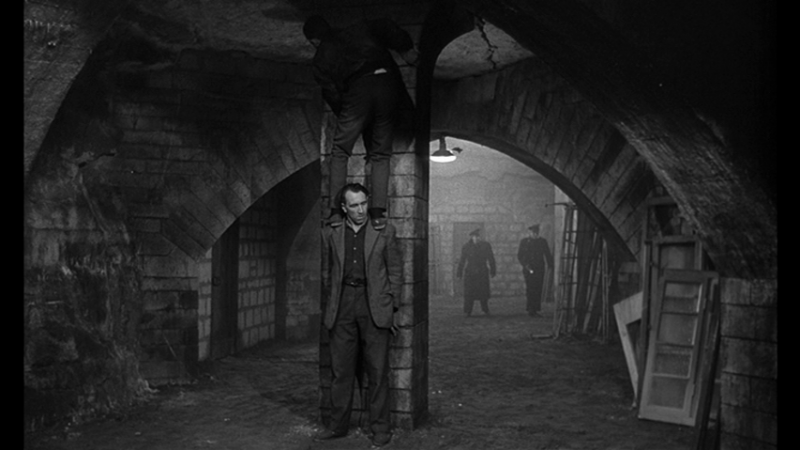
Claude Gaspard (Michel) opens the film by being transferred to a new cell at La Santé prison.  His new cell has four inmates in it, and, headed by Manu (Leroy) and Roland (Keraudy), the four quickly decide to let Gaspard in on their escape plan.  They slowly and carefully dig their way through various barriers, keeping their eyes peeled for guards and finding ingenious ways to make tools.  But Gaspard is still the new one in the group, and there is tension between him and the rest of the room.

Le Trou is based on a real story.  And when I say “based on a true story,” I mean “obsessive about the real details of a real prison break from 1947 to the point of insanity.”  The film opens with a statement that the story is true, but even so as the film progresses, I was thinking to myself, “Yeah, okay, there has to be some embellishment here.”  For everything I can tell, for all the research I did, however, I don’t think there was.  The prison was recreated with meticulous detail.  The stories of the process of the prison break were taken from the prisoners themselves.  It gives the film an extra sense of impressiveness.  This really happened.  

  
The entire drama of the film is focused on watching this group of men dig their way out of their prison cell.  What sets Le Trou apart from other classic prison break films, though, is that Becker is bound and determined to show us exactly what it takes to break out of prison.  It’s practically a master class.  He makes this more than clear when the men take their first step breaking out of their cell.  They must pound their way through the cement floor in order to gain access to the cellar underneath.  Becker gives us a four minute long unbroken shot of Roland, then Manu, pounding relentlessly on the floor with a makeshift hammer.  Again and again and again.  There is no cut between Roland starting and then a hole that appeared as if from nowhere.  No, we are actually watching a dude digging his way through the floor, and it’s hard.  And it takes a lot of work.  And it’s utterly engrossing.  Becker shows us many similar shots in the film: filing through a bar, banging through the concrete in another wall, and he is relentless in giving each of the processes the amount of time it needs.  But by not compromising and giving in to movie editing expectations, we are drawn into the world of the prison break in an unnervingly realistic way.

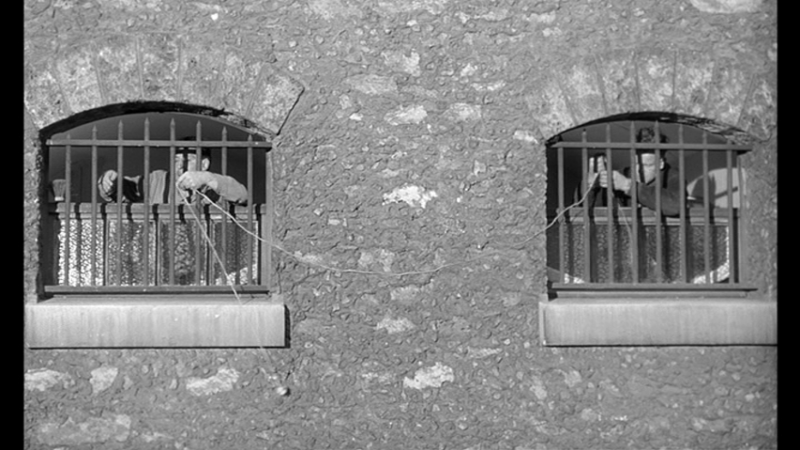
Additionally, Le Trou is all about precision and ingenuity.  We watch with almost fetishistic attention to detail as tools are constructed from simple materials.  There’s the intense close up on Roland’s hands as he makes a “periscope” out of a small illegal mirror, thread, and a toothbrush.  But what’s more, we watch him, in real time, make the necessary piece of equipment.  In a thrilling scene, we watch Roland and Manu avoid the night watch guardsmen by the closest of margins in a breathless manner.  When the prisoners run into the issue of keeping track of time, they find a way to construct a rudimentary clock.  I’m fascinated.

  
Becker used mostly nonprofessional actors as the prisoners, even going to the extent of casting one of the actual prisoners involved in the real prison break as Roland.  I find nonprofessional actors to be a bit of a crapshoot: they can either turn in wonderfully understated yet compelling performances, or they find themselves in over their head and are incapable of delivering the needed emotional impact.  Frankly, I think the nonprofessionals in Le Trou hit it out of the park.  This is a film all about tension, and underplaying the lines while maintaining unflinching eye contact amps up the tension like crazy.  All the actors do a great job, but Leroy as Manu, the defacto leader, was most impressive.  The man oozes screen presence.  In fact, he currently has 183 titles listed to his name on IMDB; while Le Trou was his first film, and he was a nonprofessional actor, he was such a standout star he has gone on to a highly successful film career. 

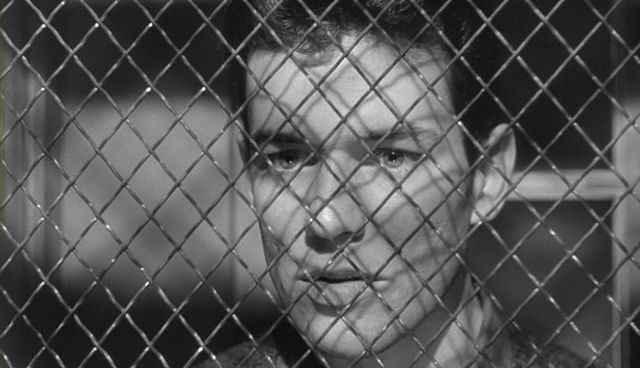
The black and white photography is gorgeously stark.  There are many different types of black and white cinematography; in the case of Le Trou, it’s fantastically crisp.  Because it’s set in a prison, it should go without saying that there is limited set dressing.  There is such simple beauty in the shots of faces of our actors against the white cement wall of their cell.  Watch Roland and Manu walk down a dark, black tunnel illuminated only with a small candle.  It made me smile, it was so clear and exciting.  This is a beautiful film.

  
Becker is stringent when it comes to the use of sound in Le Trou.  There is no background music at all.  Given that the actors are nonprofessionals, there are long stretches of silence.  Furthermore, I’m convinced that Becker actually cuts sound in some scenes, removing all background noise to hear absolutely nothing as the scene progresses.  This fits the film.  The tension of watching the escape plans being realized would not work nearly as well if there was some generic strings-laden score whining in the background.  Silence seems a boldly appropriate choice.

There is also a subtle social commentary to Le Trou.  Gaspard is the only prisoner that we get specific background information on, the only one whose crime is spelled out.  He is also always continually on the outside, a fact which seems to be related to the fact that we learn he is from the upper middle class.  He is hesitantly welcomed into what is clearly a very tight knit quartet of others, and he is treated with standoffish restraint throughout.  He cannot buy their loyalty, and of all the prisoners in the cell, we see Gaspard participating in prison break-related activities the least.  The other prisoners, although not explicitly stated, seem to be of the lower middle class, and their crimes are never even hinted at.  Even in prison, even in their bid for freedom, there are distinctions being made and invisible lines being drawn.  

  
I really like this movie.  The slow pace works for me.  The process of the prison break is fascinating.  The acting fits the purpose of the story well.  The photography is terrific.  I know it’s not exactly the most eloquent way to say it, but heck, I just plain like this movie.

Arbitrary Rating: 9/10.

Monday, November 12, 2012

Pickpocket

 
Pickpocket
1959
Director: Robert Bresson
Starring: Martin LaSalle, Marika Green, Jean Pelegri

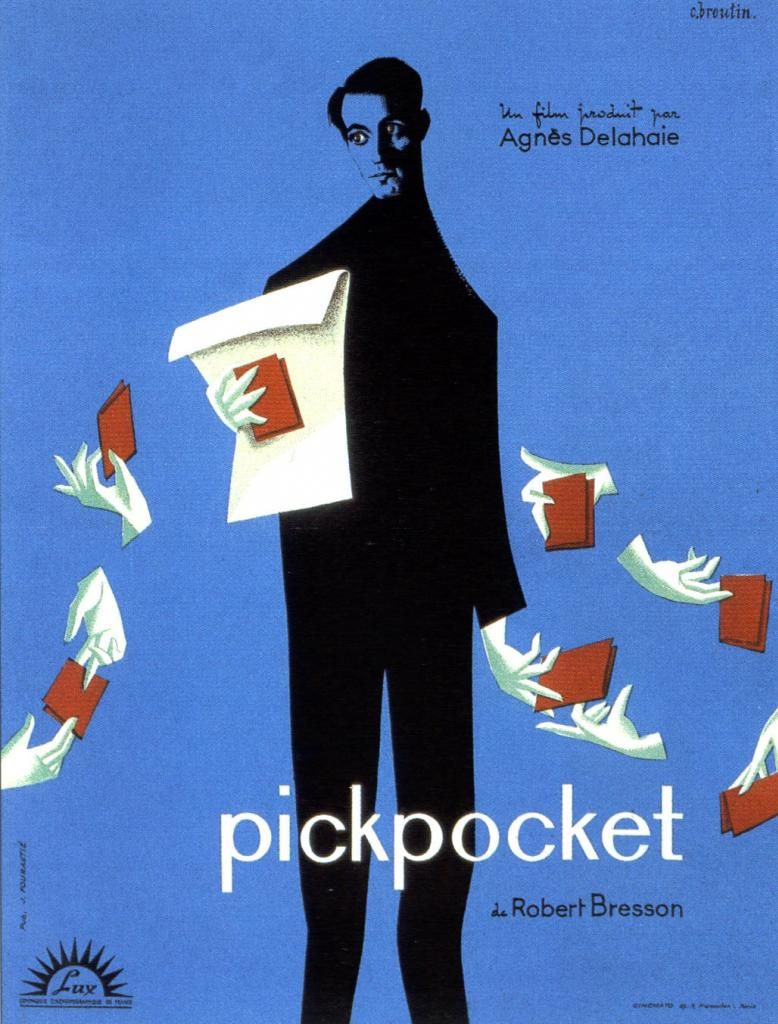
A race track. The bell sounds. Everyone is jostling for position, craning to see the horses. Everyone except Michel (LaSalle). Although he is looking in the same direction as the crowd, it is clear that his attention is focused on the people around him, not the horses. His hand reaches for a lady’s purse in front of him. With incredible care and suspense, he slowly unhinges the clasp on the purse, visibly jumping when the clasp breaks free.

Ah, Michel, the “hero” of Bresson’s crime drama Pickpocket. Of course, because this is a Robert Bresson film, Pickpocket does not fit the mold of a traditional crime drama. Michel is a pickpocket by choice, not by situation or circumstance. He sees himself as being better, somehow, than other men, and actively uses it as an excuse for his crime. Even the death of his mother does not imbue a sense of law and order into him, but it does introduce him to Jeanne (Green), a young woman who tries to show him the way to his moral salvation.

Wednesday, August 29, 2012

Black Orpheus

Photobucket


Black Orpheus
1959
Director: Marcel Camus
Starring: Breno Mello, Marpessa Dawn, Lourdes de Oliveira, Lea Garcia

The old stories, the classic stories, simply will not die. They are told time and time again, in different cultures, in different languages. I am always fascinated by how a story of one culture can be reinterpreted and retold, usually with great success, by a completely different culture. Black Orpheus is a great example of this, how a classic story of Greek mythology is reinterpreted in 1950s Rio de Janeiro during Carnaval.

As stated, the film is a retelling of the Orpheus myth. In this case, Orfeu (Mello) is a streetcar operator in Rio, and he meets Eurydice (Dawn) when she rides the trolley car to the end of the line her first day in town. She is there to visit her cousin Serafina (Garcia), but Orfeu is more concerned with marrying his shrill harpy of a fiancée Mira (de Oliveira). Eurydice confesses to Mira that she fears Death is stalking her. Eurydice and Orfeu fall in love over Orfeu’s music, and Orfeu spends most of Carnaval avoiding a jealous Mira. When Death finally claims Eurydice, Orfeu must "descend the depths of the underworld" to find her again.

Friday, August 10, 2012

Some Like It Hot

Photobucket

Some Like It Hot
1959
Director: Billy Wilder
Starring: Tony Curtis, Jack Lemmon, Marilyn Monroe, George Raft, Joe E. Brown

I have what I call “comfort movies.” Movies I can count on to cheer me up when I’m feeling blue, movies I know will make me laugh or distract me from my problems. I’ll be up front about this right now: these movies get a bit of a free pass from me when it comes to critical evaluation. If a movie is capable of repeatedly making me feel warm and fuzzy when I need it most, it gets entered into the pantheon of “comfort movies,” and is forever cherished. Some Like It Hot is one such movie. Fortunately, though, my adoration of Some Like It Hot doesn’t need to be apologized for; the film stands up for itself.

Set in Prohibition-era Chicago, broke jazz musicians Joe (Curtis) and Jerry (Lemmon) have the misfortune to be witness to a mobster’s (Raft) hit. Fleeing the city for their lives, the only transportation or work they can find is for an all-women ensemble heading to Florida for the winter, so they decide to dress up like dames to land the gig and get out of town. Problems arise when Joe, posing as Josephine, falls for the band’s lead singer Sugar (Monroe), and Jerry, posing as Daphne, catches the wandering eye of a bachelor millionaire (Brown) looking for his next ex-wife.

Thursday, July 12, 2012

Rio Bravo


Photobucket


Rio Bravo
1959
Director: Howard Hawks
Starring: John Wayne, Dean Martin, Ricky Nelson, Walter Brennan

Howard Hawks didn’t like High Noon. Apparently, he didn’t like how the character of the sheriff played by Gary Cooper was dependent on the townspeople, the ones who turned their backs on him. Hawks held fast to the idea that a sheriff in a classic western should be strong, dependent on no one. So he made Rio Bravo to have a similar situation to High Noon, but a different leading character.

Sheriff Chance (Wayne, playing Wayne), has arrested Joe Burdette, the brother of an infamous wealthy criminal Nathan Burdette. Figuring that Nathan will come gunning for his brother, he enlists the help of Dude (Martin), an alcoholic trying to go straight, Colorado (Nelson), a young gunfighter, and Stumpy (Brennan), a crippled prison guard.

This is straight-up classic western, down to the good guys wearing white and the bad guys wearing black. There’s no attempt to make it any more than what it is, which is exactly what makes it fun. It’s just a tale of good versus evil in the idealized American west. I really can’t fault it for that; personally, I tend to like my westerns with more bite, more of a message, or with more characters who have shades of grey. But y’know, sometimes, you just want a classic western, and that’s what Rio Bravo is.