Showing posts with label 1984. Show all posts

Sunday, July 7, 2013

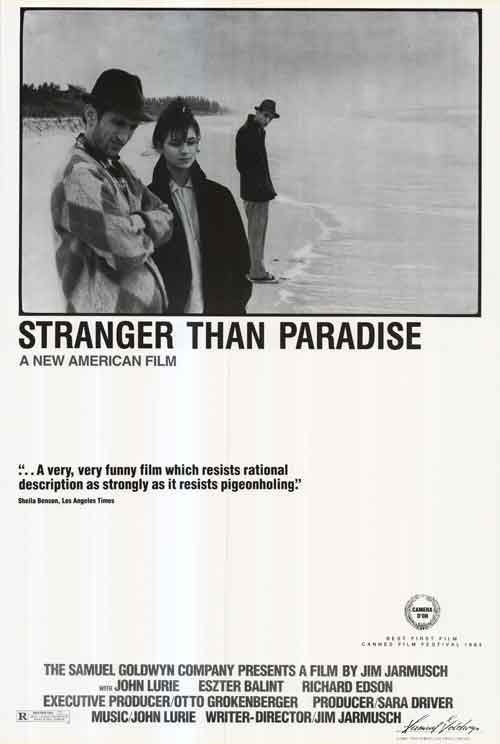
Stranger Than Paradise


Stranger Than Paradise
1984
Director: Jim Jarmusch
Starring: John Lurie, Eszter Balint, Richard Edson

There is no doubt in my mind that had it not been for the work of Jim Jarmusch in the 1980s, the world of independent cinema would not have exploded so fully into mainstream consciousness in the 1990s.  Stranger Than Paradise is independent film before it was called independent film and Jarmusch’s first feature.  Clearly shot on a shoestring budget, clearly mostly improvised, with only the vaguest of storylines tying everything together, Stranger Than Paradise is a movie that’s easy to appreciate for its sheer gumption, but a bit of a black hole to watch.

Willie (Lurie) is an unemployed hipster slacker living in New York who gets paid an unwelcome visit by his sixteen-year-old cousin Eva (Balint) visiting from Hungary.  She has to stay at his place for ten days because of an aunt who’s in the hospital, during which time she meets his friend Eddie (Edson), who is just like Willie, and bickers with Willie every chance she gets.  Eva then goes out to Cleveland to stay with family, and eventually, Willie and Eddie decide to take a road trip to visit her.  Adrift, Willie and Eddie then decide to take a road trip to Florida and take Eva with them.  
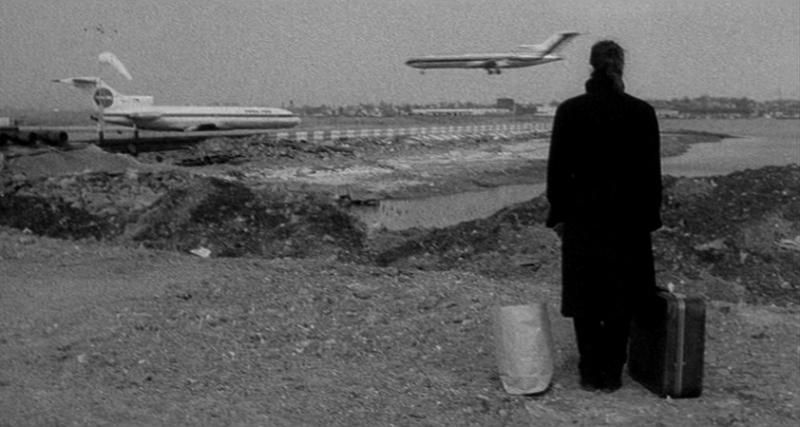
  
The best part of Stranger Than Paradise is the character of Eva and how she interacts with Willie and Eddie.  It doesn’t take long to figure out that Willie and Eddie embody the notion of “adrift,” as they have no job and seem perfectly content to while away their days eating TV dinners and playing card games.  Eva, on the other hand, is an undercover spitfire.  Willie assumes he’ll be able to walk all over her while she is forced to stay at his apartment, but when it turns out she has a backbone, he is cowed.  When she shoplifts food and cigarettes for him, he is impressed against his will.  Willie insults her music, and she tells him to “bugger off.”  She can see who Willie is as clear as the light of day; in fact, much of her time onscreen is spent looking around, her eyes constantly wandering, taking in her surroundings but also deducing what those surroundings mean.  She likes Willie because he is her cousin and because he is eventually kind to her, but she can also see his stupor.  She is not always free from the same sort of rut that Willie and Eddie live in, but she is at least entirely aware that she is in a rut and is willing to take steps to get out of it.  Eva is kind, biting, sharp, and funny.
 
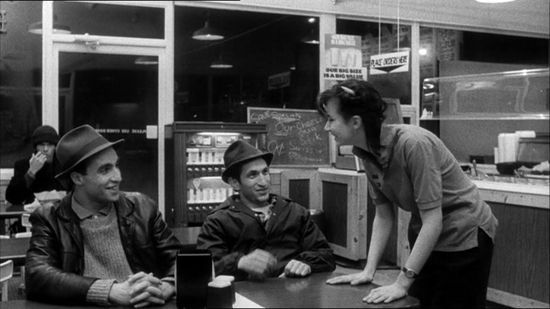
Willie and Eddie eventually become likeable because of their attitude towards Eva.  Clearly annoyed at the outset, it’s actually phenomenally sweet watching both Willie and Eddie take a slow shine to Eva.  When Eva leaves the first time, there is a clear sense of vacuum in Willie’s apartment.  The two men look at each other with wide-eyed wonder, as if saying, “Well what are we going to do now?”  Although Willie and Eddie never wholly break free of their soporific lifestyle, the only bright spot they have is the prospect of visiting Eva and they know it.  It’s probably the smartest thing they’ve ever done, seeking out her company.  Were it not for their attitude towards Eva, Willie and Eddie would be entirely unlikeable characters; their only redeeming quality is that they at least know how to latch onto a good thing, a good person, when she comes across their path.

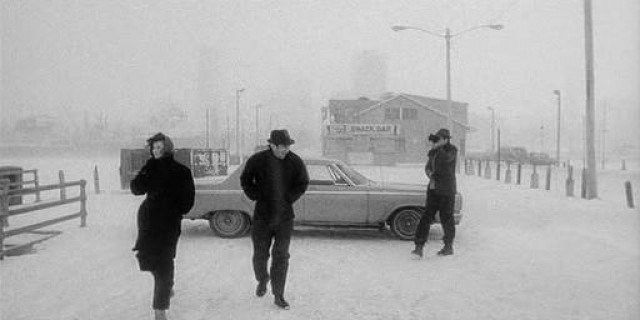
The film’s three acts coincide with the three places the trio visit: New York, Cleveland, and Florida.  But Jarmusch is careful to never really show any of these places.  The only thing that sets Cleveland apart from the other two places is the snow, and Florida is distinguished only by the beach.  We never see anything that looks like “classic New York.”  In fact, most of the film is shot in interiors, in drab motel rooms or grimy apartments, depressing living rooms that close in on you from all angles.  The only exterior shots we get could not be more nondescript, to the point of having to take Jarmusch’s word for it that yes, this indeed is Cleveland, because it might as well be Budapest as Eddie says.  The bland interiors and indistinguishable exteriors are external manifestations of Willie and Eddie’s meandering life.  They travel but do not see; they live, but not meaningfully.  They move from playing card games in New York to playing card games in Cleveland to playing card games in Florida.  One place is just as good as another – what does it matter in the end?  
  
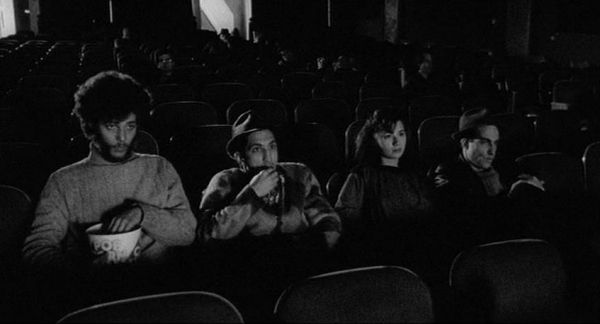
There is a very subtle humor in Stranger Than Paradise which, when it occasionally rears it head, I quite liked.  Little touches, like Eva’s date trying to impress her by taking her to an art movie and then she says she’d rather see a kung fu movie, or Eva saying on the phone, “I’m his cousin… No, I’m really his cousin,” at Willie’s apartment, or the drug dealer/gang member mistaking Eva for a drop, help lift up the film from the banality of its characters’ existences. 

Ultimately, though, Stranger Than Paradise feels like a first film.  Its incredibly low production values show in nearly every scene.  The uncomfortable silences betray uncomfortable ad-libbed lines.  The acting is a bit stilted and forced.  There are long stretches where nothing happens – and I do mean NOTHING happens.  Coming in at just under 90 minutes, it still feels long because crap, it’s a bit tedious.  Watching Willie try to tell Eva a joke but forgetting it halfway through sums up most of the movie to me: awkward as all get out to witness.    It both feels like and looks like an independent film made for next to nothing.  
  
There is stuff to like here; Stranger Than Paradise most definitely has a heart, but it takes a bit of prodding and contemplation to uncover it.  On the surface, it is just as vapid and detached as its main characters.  Under the surface, there is more connection, but you have to look past a lot of boring detritus to get there.

Arbitrary Rating: 6/10

Sunday, June 9, 2013

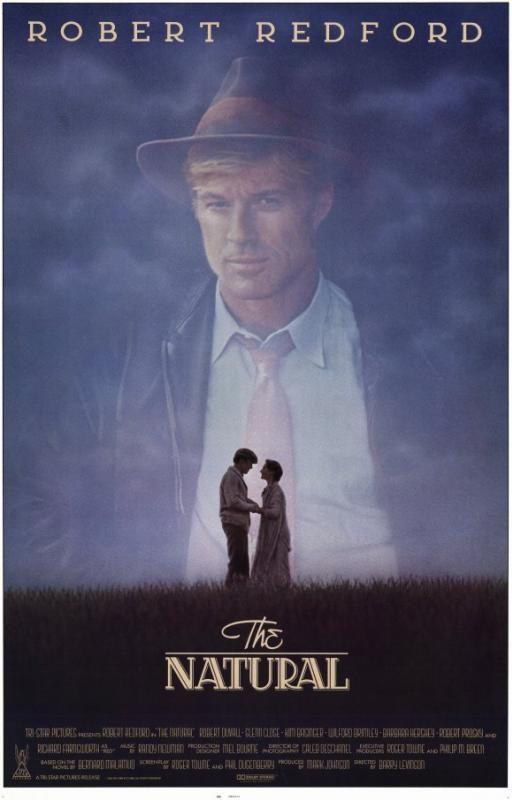
The Natural


The Natural
1984
Director: Barry Levinson
Starring: Robert Redford, Glenn Close, Robert Duvall, Kim Basinger, Darren McGavin

I don’t entirely get baseball.  I should, I was raised on it (or at least in the household of some die-hard Red Sox fans).  I played my obligatory year or two of kiddie softball.  I’ve been to a handful of games live, I’ve seen a ton of games on TV.  But heck, I’m just not a sports person.  Really, really not.  In fact, the one sport (cycling) I love is one that I came to much later in life.  So movies about baseball… or really, any sport you want… aren’t really my thing.  And when you have a movie like The Natural that preaches that baseball is nothing less than God’s Word On Earth, I get a little… skeptical. 

Roy Hobbs (Redford) is a promising young player whose father instills in him a strong work ethic, so naturally, when dad snuffs it, Roy gets determined and makes a magic bat out of a magic tree.  (No, really.)  Roy gets called up for a tryout but tragedy strikes when an evil woman in black (Barbara Hershey) shoots him for no reason.  Years pass, and Roy takes a second stab at playing in the majors, but this time more cautiously.  His appearance as if from nowhere, as a long-in-the-tooth rookie, no less, causes a lot of questions, especially when he starts hitting homers like it’s nothing.  A love from his past seeks to reconnect with him (Close) just as the evil powers-that-be seek to destroy him.

  
If you love baseball, you’ll love this movie.  The Natural treats baseball with a reverence so complete, so pure, you’d think the stadium was a church.  The world begins and ends with baseball.  The world turns because of baseball.  There is nothing beyond baseball.  And The Natural is a decent film, so I can understand why people (like my parents) love it so much.  They love baseball, ergo they love The Natural.  It’s really a no-brainer, and I totally understand.

But if you haven’t yet bought into the mythos of baseball before the film, The Natural is nothing less than a ridiculously heavy-handed attempt to convert you.  It’s like attending an uncomfortable cult meeting.  “Join us… join us…!”  “Um, on second thought, I need a drink, where’s the door?”  “THERE IS NO DOOR!  JOIN US!” 

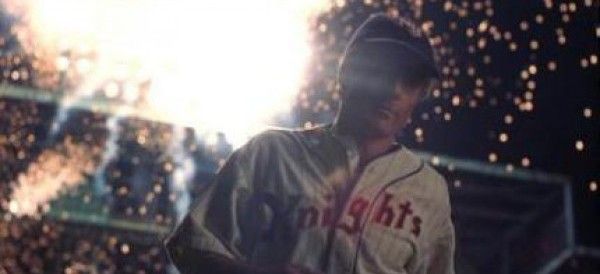
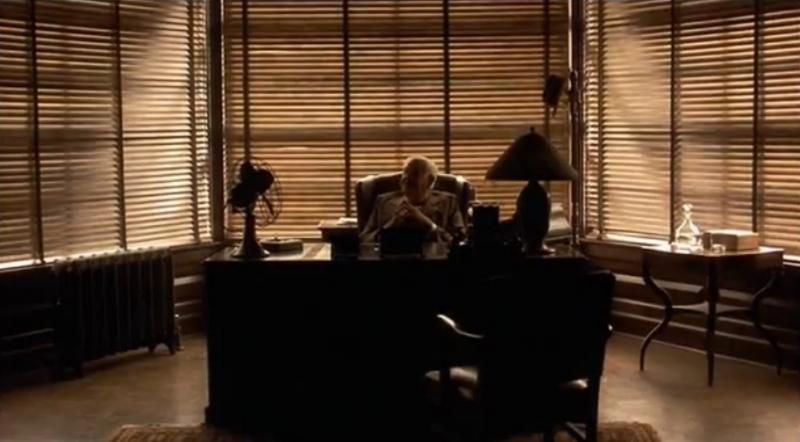
Levinson invokes the notion of mythology early on in the film with a David vs. Goliath showdown between young buck Roy and a Babe Ruth-esque star slugger (played amusingly by Joe Don Baker).  The match up goes in Roy’s favor, of course, but it significantly attracts the attention of Barbara Hershey, who speaks to Roy of Lancelot and Homer.  That is, in case you hadn’t figured it out by now, what with the magic bat and defeat of the giant Whammer, Levinson really, reeeeeeeeeeally wants you to know he’s channeling mythology here.  Nothing is intended to be too realistic in this film (or, at least, I hope it isn’t, because it sure doesn’t play that way).  Hobbs’ team is “The Knights.”  The evil boss lurks from an office on high, shrouded in darkness.  An evil minion with a magic eyeball sees all.  And you thought regular ballplayers were superstitious?  The notion of “luck,” both good and bad, is taken to somewhat comical heights with The Natural.

  
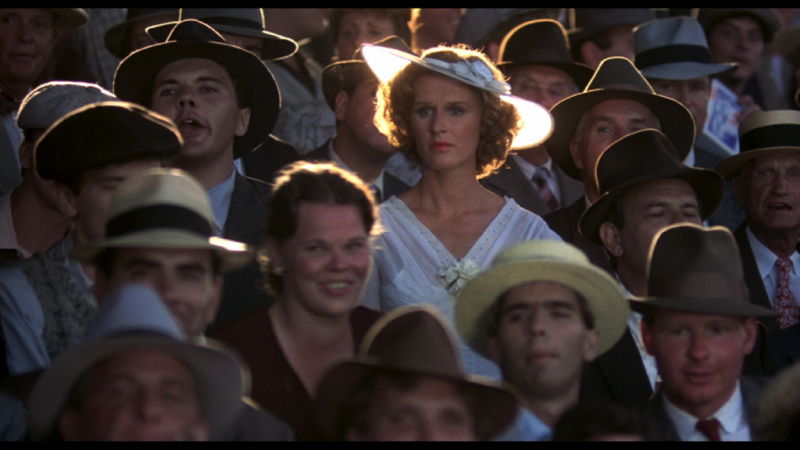
There is zero subtlety in this film.  Playing on the idea of mythology, everything is either right or wrong, black or white, good or evil.  And director Levinson doesn’t trust that you’re smart enough to figure it out for yourself, so he makes sure you’re beaten over the head with this.  Iris (Close), Hobbs’ childhood sweetheart, is good.  Therefore, she wears white.  All the time.  She even has a halo in a few scenes – no, seriously.  OK, Levinson, I get it, she’s good, she has some sort of angelic charm over Roy.  And then there’s Memo (Basinger), a seductress in the employ of the bad guys.  She wears black.  All the time.  She even lies to Roy over the phone, telling him she’s wearing white when she’s wearing black.  I get it.  She’s evil.  Furthermore, the baseball team itself is utterly absurd in its talent.  They are either firing on all cylinders and can do no wrong while Roy hits home runs at every SINGLE at bat, OR they look like a bunch of Little Leaguers, making baubles and errors so bad the producers at America’s Funniest Home Videos would think they were staged.  There is NO middle ground.  Either everyone’s good and perfect, or everyone’s evil and the team can’t play their way out of a paper bag.  

In case you couldn't tell she was angelic, the point WILL be slammed down your throat.

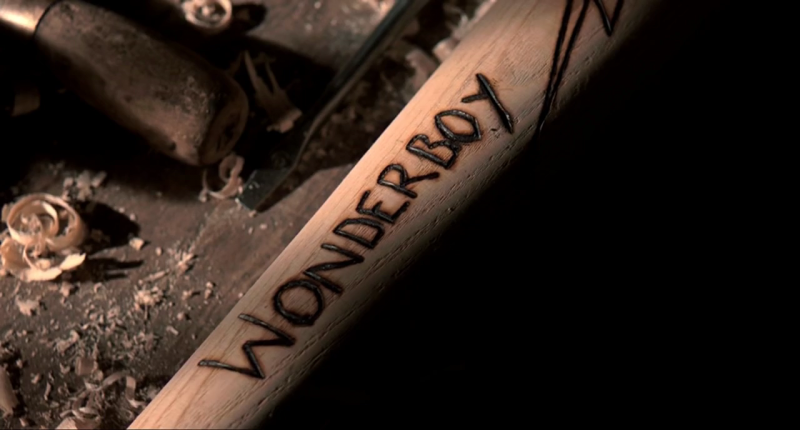
But Levinson doesn’t simply stop with mythologizing the game of baseball; he takes it a significant step forward, and outright deifies the character of Roy Hobbs.  Roy Hobbs is NOT merely some Greek hero returned to save the besieged city from the evil outsiders.  No, he is the second coming of Christ himself.  Think I’m kidding?  Examine the symbolism.  First there is the association with carpentry, as Roy shapes his own bat.  Next, and fairly significantly, Roy has a promising career when he is young, then he disappears for sixteen years.  No word of him.  He reappears, as if from nowhere, and starts performing miracles – like hitting the ball so hard the cover rips off.  Then there is his wound from Barbara Hershey’s lady in black, a gunshot wound in his abdomen.  During the climax of the film, when Roy must literally sacrifice his health in order to save the team, the old wound reopens and he is bleeding.  (I am now rolling my eyes at this blatant Christ symbolism.)  You want more?  OK, I’ll give you more.  The concept of temptation is an important one in the film, and Roy must constantly overcome temptation from the evil overlords in order to lead his disciples – I mean teammates – to salvation.  We even have a Judas moment, as Roy realizes that one of his disciples – I mean teammates – has succumbed to the temptation of the overlords.  No, this is not simply hero worship or mythology.  This is downright religion.  This is deification.  This is Christ in baseball.

 
Which, as I am neither a fan of baseball or organized religion, does not really appeal to me.  You have not sold me on “baseball as a house of worship,” and the heavy-handedness of the symbolism is a bit oppressive.

I have one more gripe with the film and then I’ll say some nice things.  This movie has the stupidest movie death I have EVER seen.  We have a problem character in the film in the form of one Bump Bailey.  Bump is a problem because he plays the same position as Roy Hobbs, and in order to give Roy playing time, Bump has to be “taken care of.”  So what does the script do?  Oh no biggie, it just has Bump run through the outfield fence.  And die.  By running through a board of wood.  A board.  Of wood.  Running through it.  Dead.

What.  The.  Fuck.

No “Oh no, Bump broke his leg, Hobbs you’re in!”  No “Oh no, Bump has a concussion, Hobbs you have to take over!” 

No.  He dies by running through a plank of wood.

I rarely yell at my television screen during a film, but I started shouting at it when I realized that I had just seen what I thought I saw.  This is so GODDAMN STUPID.  STUPID!!  WHAT THE HELL KIND OF MOVIE DEATH IS THAT?!?  I had to call my husband in to watch the scene, and his jaw dropped as well. 

“Wait, he died?”  YES.  “By running through the wall?”  YES.  “WHAT IS THAT?!?”  I DON’T KNOW.

I expect that kind of nonsense from, oh, Scary Movie, but The Natural is “serious.”  This kind of utter stupidity really, REALLY bothers me. 

In case you couldn’t tell.

Died by running through a wall… of all the idiotic… jesus christ, pun intended…

 
OK, having now railed against The Natural for several hundred words, believe it or not I have good things to say as well.  Shocking, I know.  For one, if I let go of my annoyance at the heavy-handed deification of a game of sticks and balls, the story is well told.  The baseball montages are fun and entertaining and the swing band score that accompanies these bits got my toes tapping.  Sure, you’ll be sick of slow-motion and golden back-lighting (again with the Jesus motif!) by the end of this movie – I was tempted to turn it into a drinking game – but Levinson has a flair for storytelling.  The sets and costumes are gorgeous and glitzy, befitting of the 1930s time period.  And the score, the main theme, and climax, of The Natural has been parodied hundreds of times, so it’s nice to see the original.  The score is certainly rousing, meant to convince you of the heroics of our main character.  

  
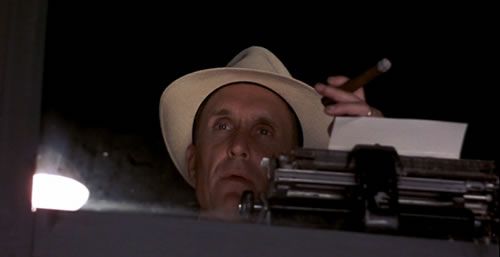
Additionally the performances are all sound.  Redford has little to do other than look and sound earnest, but considering that’s his major strength as an actor, he pulls it off.  Glenn Close is a little hard for me to believe as a beacon of angelic purity and goodness, but that’s because her career since this film has tended to typecast her as a villain, and that’s no fault of her own.  I kept on wanting to shout “DIABEETUS!” at Wilford Brimley, but hey, that made for entertaining watching.  Richard Farnsworth is an actor I utterly adore, so I was thrilled to see him play his typical aw-shucks persona here.  It’s nothing new, but with Farnsworth, I lap it up.  Darren McGavin, in an uncredited role, is a great deal of fun as well, but it is Robert Duvall who really stole the show.  Duvall is the one character with any hint of ambiguity in what is otherwise a painfully black and white film.  Who is he anyway?  Whose side is he on?  Duvall has more than enough charm to hint at one thing, swing in the other moral direction, but then come right back again.  He’s the only thing in this film to keep you guessing.  Everything else is rather painfully telegraphed.

Like I said earlier, if you love baseball, if you believe in baseball, I’d bet you’d love The Natural, because The Natural has a massive hard-on for baseball.  But I don’t love baseball.  So to me, it was over two hours of ham-fisted unnecessary religious idolatry.  I don’t think I shall be introducing this one into my regular line-up.

Arbitrary Rating: 5/10

Saturday, February 16, 2013

Once Upon a Time in America


Once Upon a Time in America
1984
Director: Sergio Leone
Starring: Robert De Niro, James Woods, Elizabeth McGovern

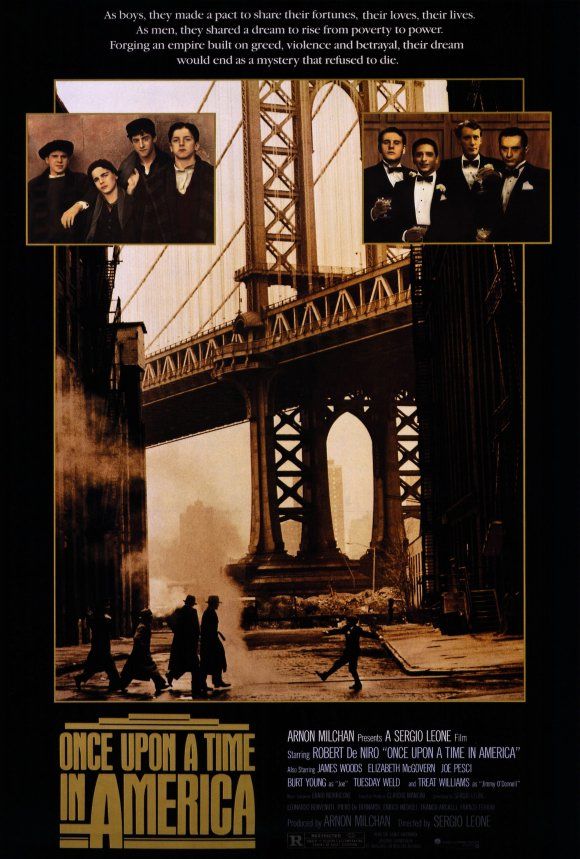
Lately, it seems as though I’m tackling my first reviews of works by some of the most renowned directors ever.  I recently wrote my first pieces on Kurosawa and Woody Allen, so I suppose that today, I follow suit in writing my first piece about Leone.  I’m not an enormous Leone fan.  I find that I can appreciate him, but I tend not to have that feeling of “YES THIS IS AWESOME!” from his films.  Once Upon a Time in America is no different.  I liked it, it was fine, but I feel no compunction to ever watch it again.

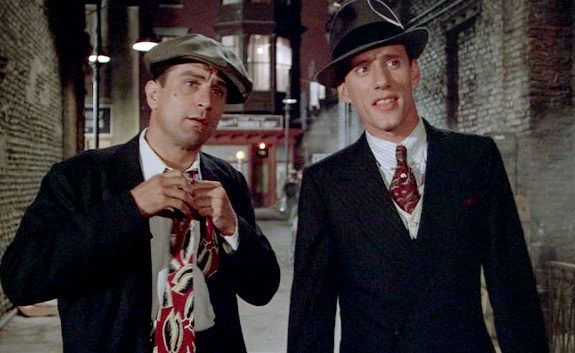
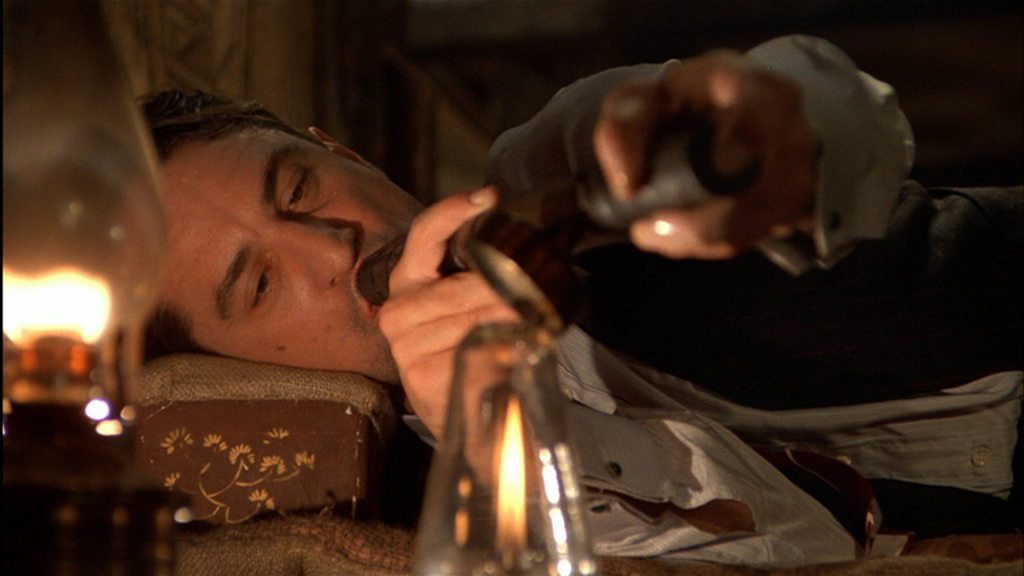
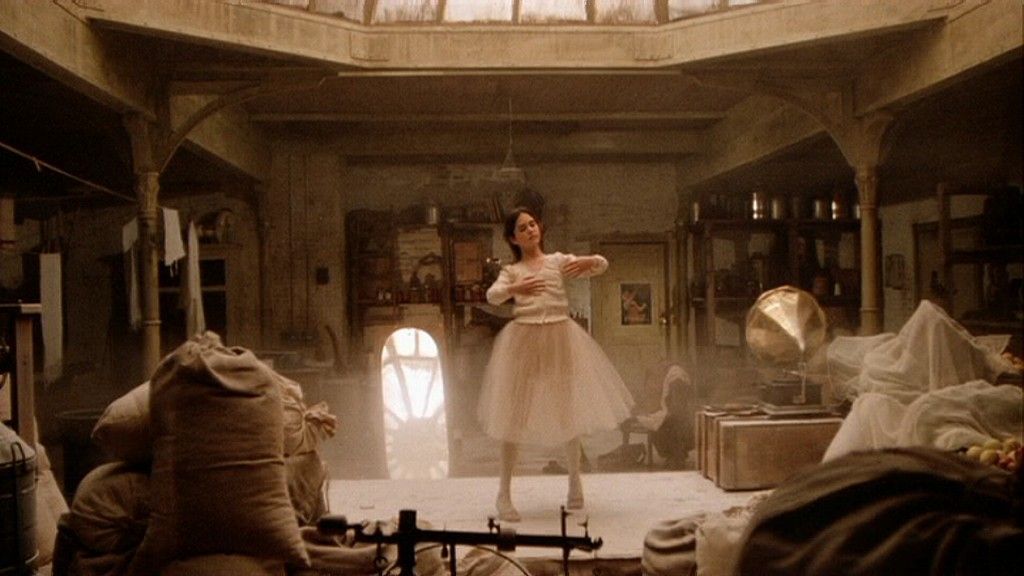
The (rambling) story tells of David “Noodles” Aaronson (De Niro as an adult), a young man growing up in the world of organized crime in the early twentieth century Jewish ghettos of New York City.  The film opens (and closes) with Noodles in a 1933 opium den.  The film cuts between Noodles’ youth where he meets his friend and gangster co-conspirator Max (Woods as an adult) and falls for lovely aspiring dancer Deborah (McGovern as an adult), then to Noodles’ adult career where he and Max have graduated to serious gangster activities, and Noodles’ life in 1968 as an old man mysteriously called back to his old haunts.  


This movie is more about people and mood and feeling than story.  There’s very little plot; it’s much more a character study than a narrative.  Where I felt Leone had some of his strongest moments were in the first half hour.  These 30 minutes cut between all three timelines in the film, but there is a bare minimum of dialogue.  We are introduced to several characters, we determine who they are, but this is done mostly through mute sequences.  It reminded me of the opening ten minutes of Once Upon a Time in the West with the gunslingers at the train station.  The opium den scene, which bookends the film, gives the feeling of a dopey, hazy high.  Leone returns to this feeling several times at various points in the film; every now and then, a dreamy feeling starts to take over.  Leone himself has said that interpreting the entire movie as Noodles’ recollections and dreams of the future while he’s at the opium den is not necessarily wrong.  It’s certainly an interesting way to read the movie.  


 It wouldn’t be Leone without violence.  I had some trouble with the violence in this one; it was a bit too brutal for me.  Proportionally, there isn’t a ton of bloody scenes in the film, but the ones that were there made me turn away.  I couldn’t watch all of them.  I’m rather hypersensitive to violence in film, and this was a movie that pushed the wrong buttons for me.  Leone fanatics will probably say that was on purpose; I say it made parts of the movie downright unpleasant.

The women in the film drove me nuts.  I don’t know if Leone himself was actually a misogynist, but he does not like the women in his films.  Like nearly every other Leone movie I have ever seen, all of the women in this film are either prostitutes, nymphomaniacs, or exhibitionists.  All of them fall into one of those categories, even lovely Deborah, who is the most sympathetic female character.  She made a few key decisions in the film (which I shall not give away) that I found rather unforgivable.  She claims to snub her nose at the world of organized crime that Noodles is involved in, but she did not.  Not really.  And another note to filmmakers: I don’t enjoy watching rape.  I really don’t.  And you know what?  Women don’t enjoy being raped, just FYI.  I completely understand that this film is set in the world of organized crime, that this is a really nasty, seedy world, and that the men are hardly more redeemable than the women in this film, but I was still bothered by it.  Significantly.  Having a man think it’s okay to do that… no.

  
Scored, as you would expect, by Ennio Morricone (this IS a Leone film, after all), I found the main theme of the film haunting.  The simple pan pipe melody, played with echo effects, is certainly evocative of a dreamy feeling of recollection.  That fit the film very well.  What didn’t fit was basically every other part of the score, which felt like a poor reimagining of “Summer Breeze.”  It was schmaltzy, sentimental, and unimaginative.  I know that it’s illegal, apparently, to criticize anything Morricone wrote EVER, but I really felt as though he came up with a beautiful and unique theme to the film, then completely phoned in every other portion of the score. 

Ultimately, I didn’t really care for any of the characters in this movie.  I didn’t really want to spend time with them.  I think Leone did a decent job, I can certainly see his fingerprints all over this movie, and setting it in the Jewish gangs rather than typical Italian gangs was something new.  Fundamentally, though, I kept thinking to myself “If I want to watch a Prohibition-era gangster movie, I would much rather watch The Untouchables than this.”  That’s what it boils down to for me.  I guess I liked it.  I know, I know, high praise!  But, as I said at the beginning, I’m not a huge Leone fan.  I don’t diss his work, it’s just… not for me.  It was too misogynistic, too violent, with too many distasteful characters.  I shan’t be watching this one again.

Arbitrary Rating: 6/10.  It’s alright.