Showing posts with label hong kong. Show all posts

Wednesday, July 17, 2013

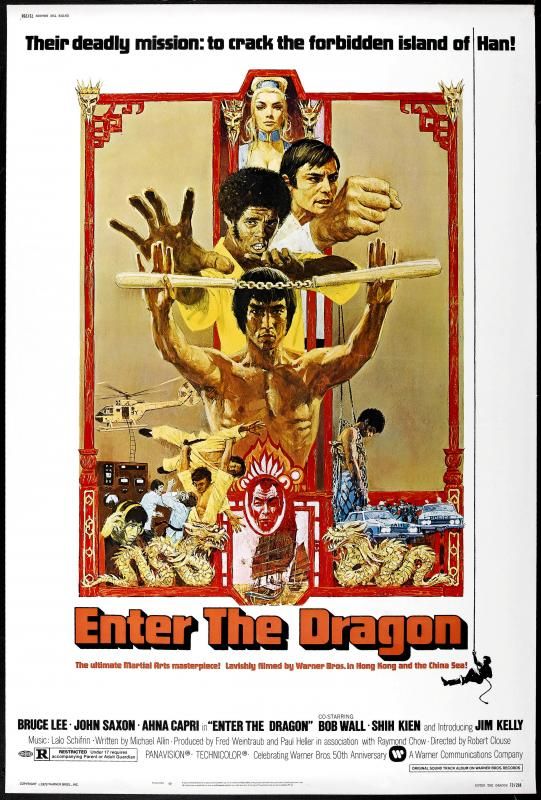
Enter the Dragon


Enter the Dragon
1973
Director: Robert Clouse
Starring: Bruce Lee and that’s all you need

Y’know, I am really glad that the list I am working off of is called “1001 Movies You Must See Before You Die,” and not “The 1001 Best Movies Ever Made.”  There’s a big distinction between something that’s deemed “good” or “quality filmmaking” by critics, and films that have some sort of cultural import.  Sometimes, for this reason, we get a few stinkers (like Flaming Creatures), but sometimes, we get the crazy, silly, stupid fun of Enter the Dragon.  It might not be Oscar bait, but one’s entire diet cannot consist of steak alone.

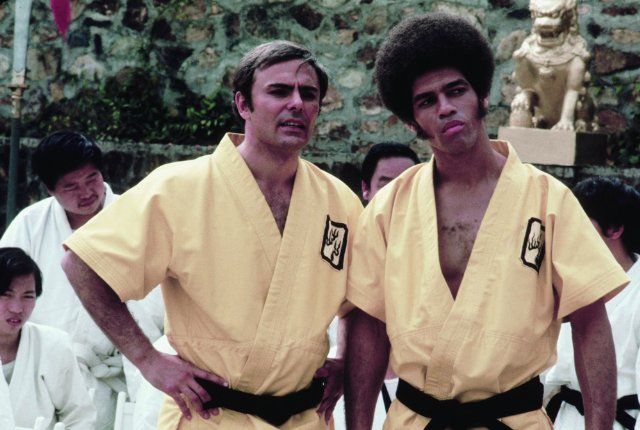
Lee (Lee) is a talented martial artist who is recruited to spy on evil druglord-slash-martial arts enthusiast Han.  Han runs a prestigious martial arts tournament every three years as a cover to recruit new talent to his opium operation.  This tournament takes place on his reclusive Evil Island of Evil, where guns are strictly forbidden in order to keep the authorities at bay.  Lee meets the other competitors, including gambling addict Roper and fro-tastic Williams, played by martial arts expert Jim Kelly.  There is spying and fighting; there are drug rings and secret passageways; there are girls, girls, and a helping or three of gratuitous nudity (oh, the seventies), but at the end of the day, Lee triumphs over Evil and a good time is had by all.


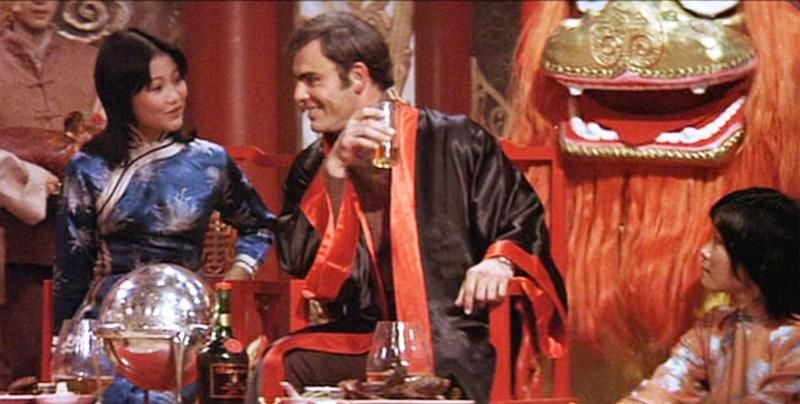
Enter the Dragon is a bit of a “James Bond as martial artist” film.  The influence is clear, from the electric bass soundtrack, to the labyrinthine Evil Fortress of Evil that Han runs, to Lee’s meeting with upper crust British official Braithwaite at the beginning informing him of his mission.  The ladies are all decked out in classic Bond girl attire, and the women on Han’s island could have come straight from any Bond flick from the seventies.  This is a definite reason why Enter the Dragon is a great deal of fun; Bond films tend to have that “forget about reality, we’re going to take you for a glamorous if not ridiculous ride!” feeling, and Enter the Dragon is definitely shopping at the same store. 

Ultimately, however, despite the dressings of Bond and the spy thriller scaffold for the plot, Enter the Dragon is NOT James Bond, and that’s because it’s Bruce Lee.  This was his final completed film before his untimely death, and from the (admittedly) little I’ve seen of other martial arts films, Enter the Dragon is a fully realized vision, a successful martial arts crossover movie made for America.  Although never pretending to be more than sheer entertainment, it has a clear premise and plot progression and it never once feels confusing or lost, unlike other films of the genre.  Lee, for his part, plays to his strengths.  Not the most gifted actor (a “stern look” he gives to a guard at one point looks more like a zombie stare), he is mostly silent and thoughtful until he lets loose in fight sequences, which suits him just fine.  And about those fight sequences – there aren’t as many here as you would think.  Don’t get me wrong, if you came here for some awesome martial arts, I doubt you’ll be disappointed.  But the well choreographed sequences are spaced out, as if Lee knew to avoid overdosing his audience.  This is not a film where the fighting starts with the opening credits and doesn’t let up until the end, and thank goodness.  Lee and director Clouse did a good job of translating traditional Hong Kong martial arts stories into something an American audience would appreciate, while never abandoning its roots.  In a very fitting manner, Enter the Dragon feels like both a Hollywood movie and a Hong Kong movie.
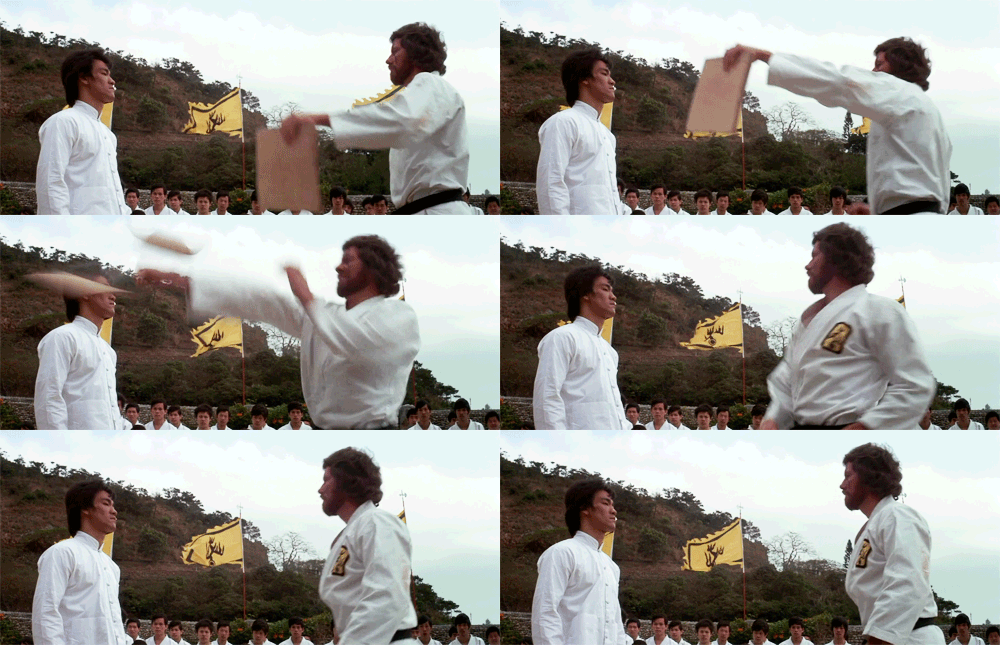
  
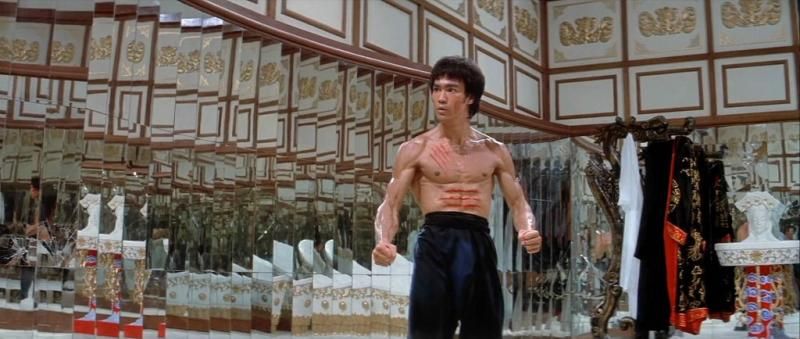
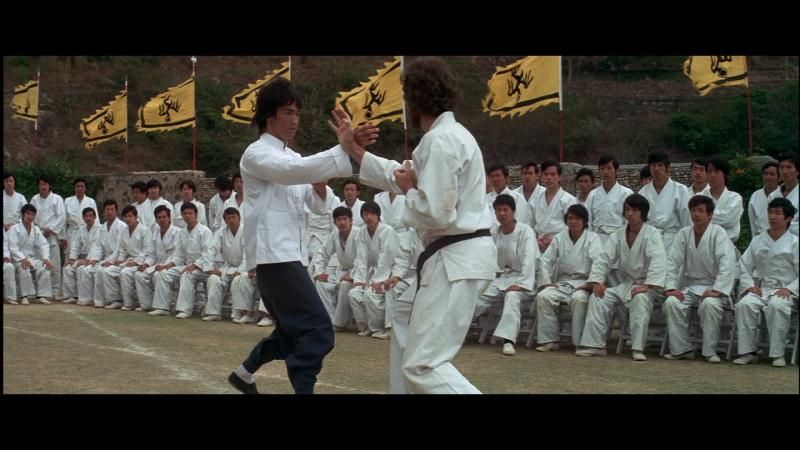
Additionally, one of the last things I expect in a martial arts film is decent cinematography, but Enter the Dragon is a rather pretty movie.  I know, I wouldn’t think so either, but it’s true.  The legions of Han’s men all practicing in white uniform on the island is impressive, as is the climactic battle in a hall of mirrors.  The colors are rich and the sets sumptuous in that gilded seventies way, but it works.  More than I expected (which was, admittedly, zero), I found myself impressed with a particular shot.

Oh, the one liners.  Williams and Roper are full of nonstop quips, as befits the comic side characters.  “Here’s another mess you got me into,” Roper says to himself, and really, try not giggling when Williams picks out his evening, um, treat.  Even Lee himself manages to be the source of a few laughs, most notably when he sits with a bored look on his face, waiting for the guards to finish freaking out about a snake he just loosed on them.  These lines and attitudes make the film feel a bit tongue in cheek, which might be the filmmakers’ way of telling you not to take anything too seriously.  Sit back, have a few laughs, and enjoy the ride. 

I’m not a kung fu freak like Jennifer Aniston in Office Space.  But fun movies are fun movies, and Enter the Dragon is a fun movie.  Is it ridiculous?  Heck yes, but ridiculous in a palatable way.  Would I ever choose to watch it on my own?  No, probably not, as martial arts films are very much not my bag, but I enjoyed my time with Enter the Dragon.  I even popped a bowl of popcorn, did it up right. 

Arbitrary Rating: 7/10

Friday, February 22, 2013

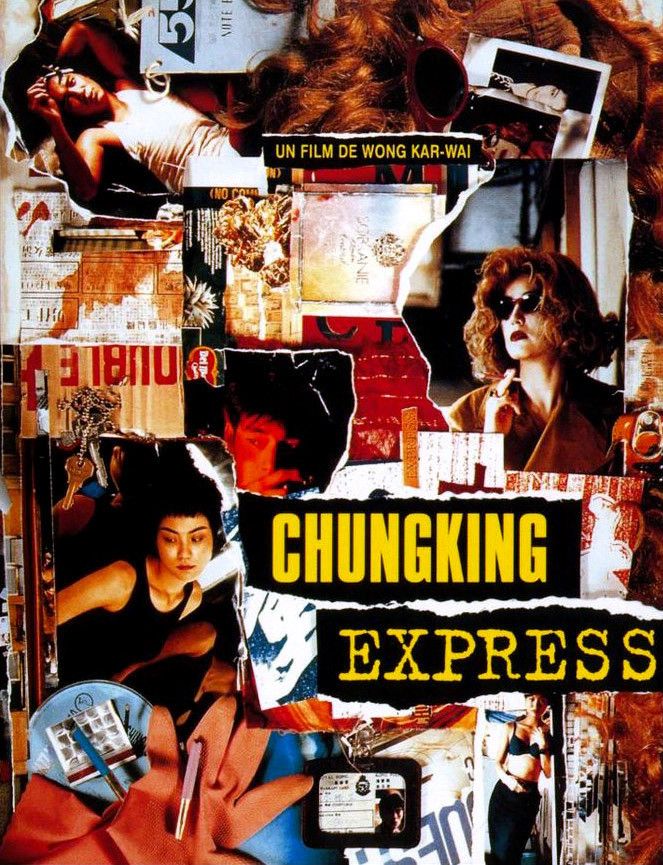
Chungking Express


Chungking Express
1994
Director: Wong Kar-Wai
Starring: Tony Leung, Faye Wong, Takeshi Kaneshiro, Brigitte Lin

Both written and directed by Wong Kar-Wai, Chungking Express takes the viewer on trip through the dank physical and emotional underbelly of 1990s Hong Kong, a city on the precipice of change, as the 1997 handover from the British to the Chinese looms in the background.  We follow several young people through their lives as they intersect at various points and in different ways with one another.

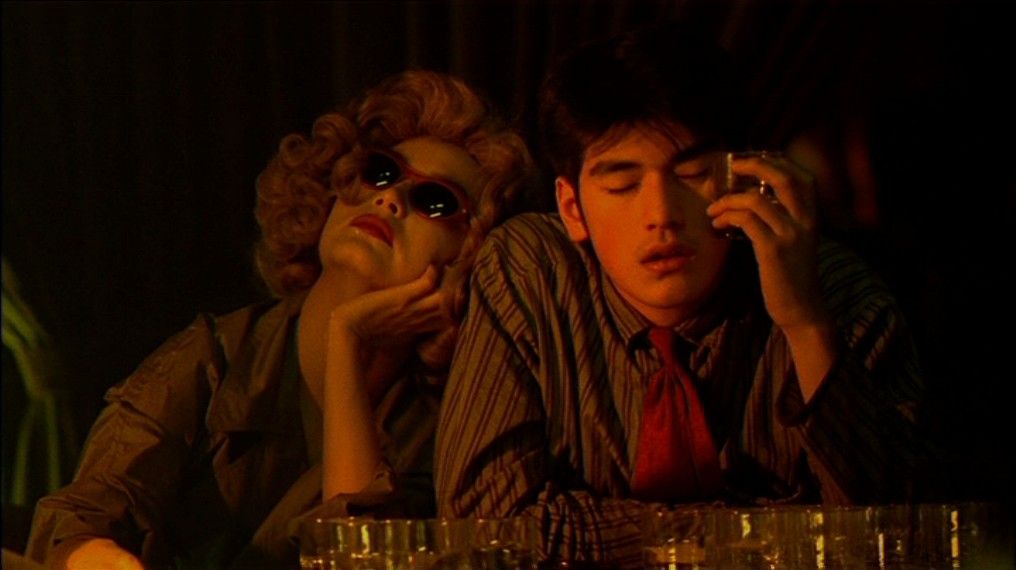
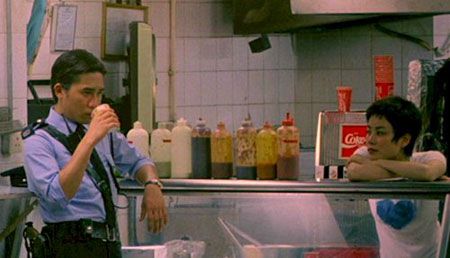
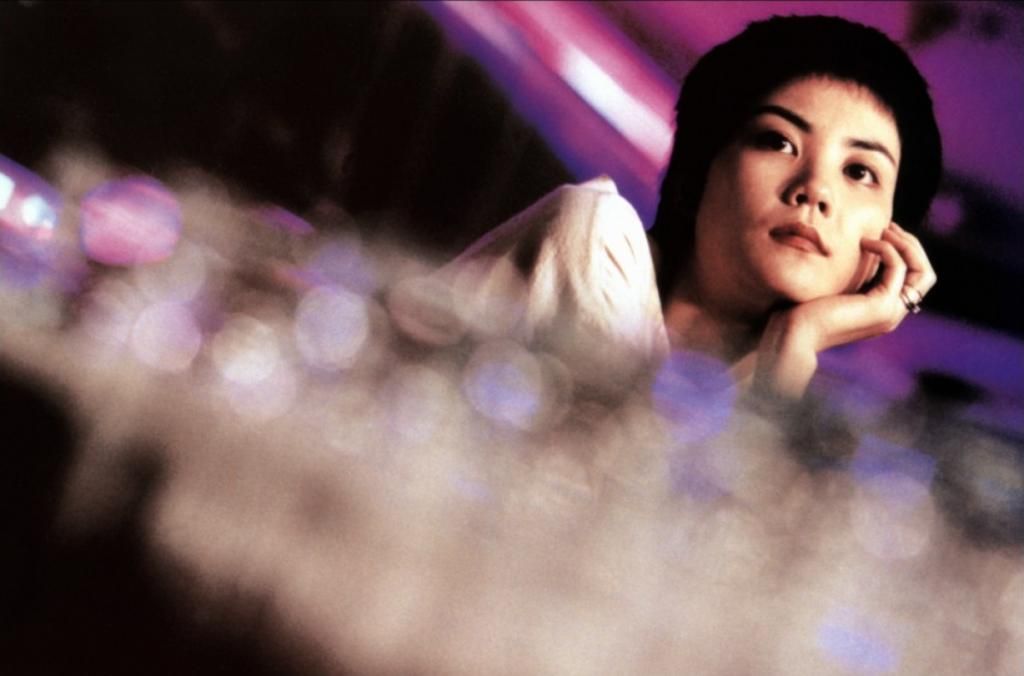
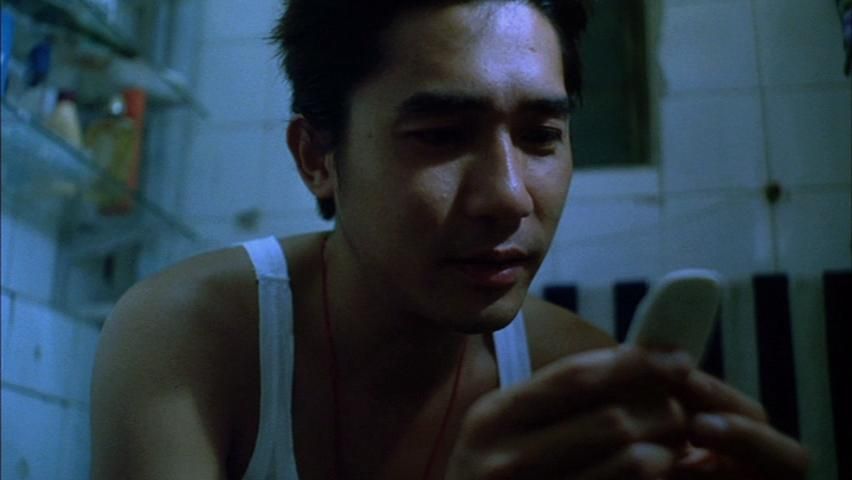
The narrative tells two distinct stories separately.  First up is that of plain clothes cop Qiwu, badge #223 (Kaneshiro).  His girlfriend May, perpetually offscreen, has just dumped him and he’s having a hard time coping.  He hangs out at street food joint “The Midnight Express” and calls May’s family, checks his voicemail, and considers asking out other women.  He buys cans of pineapple with the expiration date May 1st, 1994.  When he realizes May is not coming back, he turns his affections to blonde-wigged drug smuggler (Lin), just as she is reaching a crisis point in her career.  At this point, we abruptly switch stories to a different cop, this one badge #663 (played excellently by Leung).  He has also been recently jilted by his stewardess girlfriend, and hangs out at the same Midnight Express, where he meets quirky Faye (Wong) who works behind the counter.  She falls in love with him, but he is too sad to notice.  While he is working, she breaks into his apartment and cleans it up for him, gives him new goldfish, replaces his sardines with a different brand, and replaces his soap.  As 663 gradually realizes what is going on, Faye starts to spook about the idea of a relationship with him.

Our first story.

  
Our second story.

The two stories, while they share several elements, have very different tones.  In the first, there is a distinct sense of danger and gangster underworld activities, all channeled through our blonde-wigged smuggler.  She is not a woman to be trifled with; she actively reminded me of Phyllis Dietrichson.  Meanwhile, she is counterpointed with 223, a man so immature he is clearly still a boy; in fact, he turns 25 in his tale.  He is childish in his pursuit of his ex-girlfriend, childish in his buying of May 1st pineapples, childish in his eating of platefuls of fries with ketchup, and childish in his decision to fall in love with the next woman he sees.  The fact that Wong brings these two together is interesting and unexpected, as they both manage to give one another what is needed despite their disparate temperaments.  She helps welcome him into adulthood in the chastest possible way, and he steels her nerve to do what her job requires.  We have the odd dichotomy of cold, cruel gangsters with wide-eyed, naïve adolescence. 

The second story deals with neither.  Although we still have a cop known only by his badge number, we now have a full blown love story of two people scared to fall in love.  This is sweet and endearing, whereas the first story was gritty and dank.  663 is too wrapped up in his own sorrow to realize Faye likes him, but that’s probably a good thing for her, as she wouldn’t know what to do if he really liked her back.  Flighty and quirky, Faye Wong is phenomenal in her role here; I was shocked to discover she was originally a singer, and this was one of her first large acting roles.  She is a perfect counterpoint to Leung’s swoon-worthy introverted intensity; I found myself wishing more and more, harder and harder that these two souls could find a way to be together.  As off-kilter as their courtship is, it is nonetheless winning and winsome.  

  
Overall, despite the romance in both sections of the film, Wong seems to comment far more on the nature of urban youth rather than simply their love stories.  Throughout the film, we are met with characters that do not have names.  Our two cops are known primarily as their badge numbers – and that’s all.  The blonde-wigged smuggler does not have a name at all, and I only know that Faye is the name of the girl behind the counter in the second story because IMDB told me so.  There is a profound sense of identity lost with these characters.  They live their lives constantly surrounded by others in their urban jungle of Hong Kong, but they fail to connect in meaningful ways.  The world whizzes past them every day, but they are too narcissistic or immature or disillusioned to either notice or care.  Both tales end in ambiguous fashion, doubtful of whether or not the souls they feature actually managed to enact long-lasting change, uncertain of whether they will find the respite they so desperately crave with others.  There is optimism laced into the endings, but Wong refuses to spell everything out for us, leaving it up to the imagination of the viewer.  

  
Along with the tale of urban disillusionment, there is tremendous style in Chungking Express.  Wong plays fully and freely with all kinds of camerawork, including slow-motion, stop cuts, canted angles, handheld jittery shots, and the fascinating combination of slow-motion with sped-up shots.  This helps imbue the movie with a sense of frenetic modernity and disjointed connections.  Wong lights the film with mostly reds, yellows, greens, and blues, occasionally making everything on screen appear slightly sickly.  It’s the same bright color work I remember from his In the Mood for Love.

I suppose I would call Chungking Express a “romantic comedy drama.”  There are elements that are quirky and funny, plenty of elements that are very sweet, but the whole film is tinged with a sense of sadness and anxiety.  It’s a diverting film, telling its tale with a heaping helping of style, and you’ll be left humming that obnoxious Cranberries tune for the next four hours.

Arbitrary Rating: 8/10.