Showing posts with label italian. Show all posts

Sunday, February 16, 2014

Salo, or the 120 Days of Sodom


Salo, or the 120 Days of Sodom
1975
Director: Pier Paolo Pasolini
Starring: the most uncomfortable two hours of my life.

My usual modus operandi for writing these little blog pieces is as follows:

1. Watch the film in question, giving it my full attention, and thinking critically about what I can say about it as I watch it.
2. When I feel ready to write about the film, be it immediately following the viewing of the film or a few days later, put the film on for a second time and have it on in the background while I write so as to remind me of scenes/moments/thoughts I want to comment on.

I shall not be holding to this strategy for today’s film, and the reputation of the film in question is more than enough to tell you why.

The story unfolds in 1944 Fascist Italy, where several powerful men, accompanied by some aging female prostitutes and young men that they have decided are their guards, kidnap eighteen young teenagers and take them to an estate.  What then proceeds is a non-stop sadistic (fitting, as it was based on a story originally penned by the Marquis de Sade) horror story, as pain, rape, humiliation, and eventually torture and murder are in store for the unfortunate teenagers.


Ladies and gentlemen, I wear it as a fucking badge of honor that the one and only time I saw this film was in a theater.

Why?  Well, back when I was borderline obsessed with getting through the 1001 Movies list, Salo was unavailable on DVD.  Or VHS.  Nowhere could one find a copy of it at a reasonable price, and I wasn’t about to pay two hundred bucks for an out of print laser disc copy from ebay.  Turner Classic would hardly air this film. 

And then the Dryden, as it always does, came to the “rescue.”  In the summer of 2007, they had a screening of Salo.  What was slightly unusual about the screening is that the Dryden took greater pains than normal to warn the audience about the nature of this film, and had a strict “No one under 18 admitted” policy.

So, because Salo graces the pages of 1001 Movies and I had no other options, I traipsed out to watch a film I knew would horrify me.  Fantastic.

The Dryden is not an enormous theater.  It seats 500 and has two sections, an orchestra section and a balcony.  The screen itself is moderately sized; it’s not a giant screen in the slightest.  I mention this because I nearly always choose to sit in the orchestra section to feel closer to the film.  Because the screen isn’t enormous, if I sit in the balcony, I feel too far-removed from the film to have that immersive movie theater experience. 

Although I hadn’t seen Salo before that night, I knew its reputation and before I sat in my normal spot (back row center orchestra), I paused.

Did I *really* want to be close to THIS particular film?

No.

Balcony it was.

I physically distanced myself from this film before I had even seen it, and god, I’m glad I did. 


What do I remember of Salo?  I remember sitting in that darkened movie theater and cringing.  Physically cringing.  I didn’t go quite so far as to put my hands in front of my eyes, but I did start pulling a turtle and trying to hide myself in my hoodie, my body curling in on itself as a defense mechanism.  I grimaced, I tried to turn away, and then it eventually became a question of simply making it through the movie.

I remember never having felt so goddamn uncomfortable while watching a movie.  This was a level of discomfort that no war movie, no bizarre experimental film, and no film that has anything to do with pets (all of which are my least favorite kinds of movies) had ever put me through. 

I remember it finishing, the lights coming back on, and thinking, “Thank god.  Time to get the fuck out of here.”

I do not remember the exact plot, and I’m fine with that.  I do not remember all the details of all the scenes of sexual humiliation, and I’m fine with that.  I do not remember character’s names, and I’m fine with that.

I am perfectly fine with never seeing this movie again.  Ever. 

Hell, even reading a detailed description of the plot on Wikipedia was too much for me, and I wound up only skimming it. 

I mean, what else am I supposed to say about a movie where a girl is punished for crying by being made to eat human poo? 

The other film I think of when I think about films dealing with humiliation is John Waters’ Pink Flamingos.  That’s another film that I don’t enjoy, but I’ll say give me Pink Flamingos over Salo any day of the week.  At least Pink Flamingos is rife with camp and tongue-in-cheek attitude that lessens the feeling of horror.  Sure, it’s obnoxious, but at least it has an intent of comic outrageousness, and that coats the humiliation just a bit, making it easier to get through.

Pasolini is so damned unapologetic about what he puts up there on the screen in Salo that it feels as if he is purposely torturing the audience as well as the cast of characters.  There is no attempt on his part to “make it go down easier.”  Nope, he’s saying, this material is hard, and I’ll be danged if I make it easier for you.

Salo is getting a low score for me, but I’m not giving it the lowest possible score, and here’s where, oddly enough, I feel like I need to explain why.  (Funny, me explaining why it won’t actually get a one out of ten.)  Because, as repugnant a film as it is, I don’t feel as though it’s repugnant just for funsies or by accident.  There is intent here, and there is anger here, and there is passion here.  Underneath all the horrible scenes set to film in Salo, Pasolini has a message about corruption and power and perversion.  It’s not pretty to sit through, but it’s undeniably there.  What’s more, it’s well-constructed film.  Awful, yes, but Pasolini knew what he was doing in terms of cinematography.  There’s a reason that this is called “an art film,” because it honestly looks like art.  Sometimes horrible, horrible art, but art nonetheless.  So I must give Pasolini his due and admit to Salo, despite its awfulness, is well-imagined awful and made with the intent of being awful and with purpose.  (I’m giving the side-eye to films like Vinyl which seem to have absolutely no intent whatsoever here…)

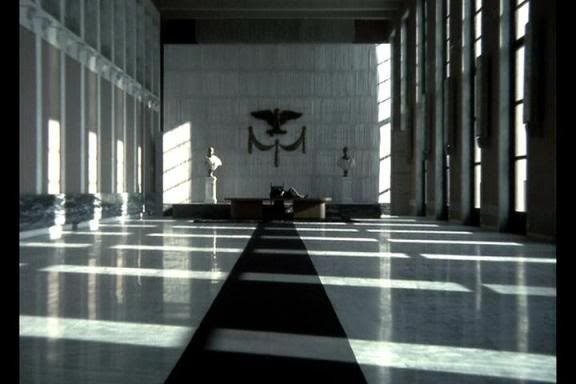
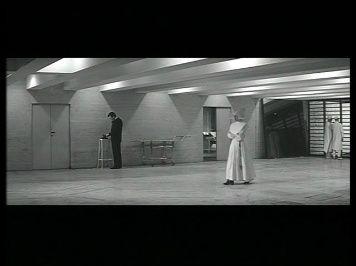
I mean, if nothing else, I can appreciate that the above shot is pretty. 

Did I have to see Salo before I died?  I’m not sure.  Frankly, given the enormous reputation of the film in film circles and the immediate reaction the film gets whenever anyone brings it up in any conversation, I begrudgingly admit to being glad I’ve seen it, if for no other reason than I can meaningfully participate in said conversations.  Do I need to see Salo again before I die?  HELL NO.

Once was more than enough.

Arbitrary Rating: 2/10.


Friday, July 26, 2013

Three Brothers (Tre Fratelli)


Three Brothers (Tre Fratelli)
1981
Director: Francesco Rosi
Starring: Charles Vanel, Philippe Noiret, Michele Placido, Vittorio Mezzogiorno

Nothing like a death in the family to start out a movie in dreary fashion.  Three Brothers, while not actually depressing, feels like the cinematic equivalent of a sleeping pill.  It’s slow, it’s rather dull, and it made me feel rather woozy and disconnected.  Not, perhaps, its point, but that’s what it did to me.

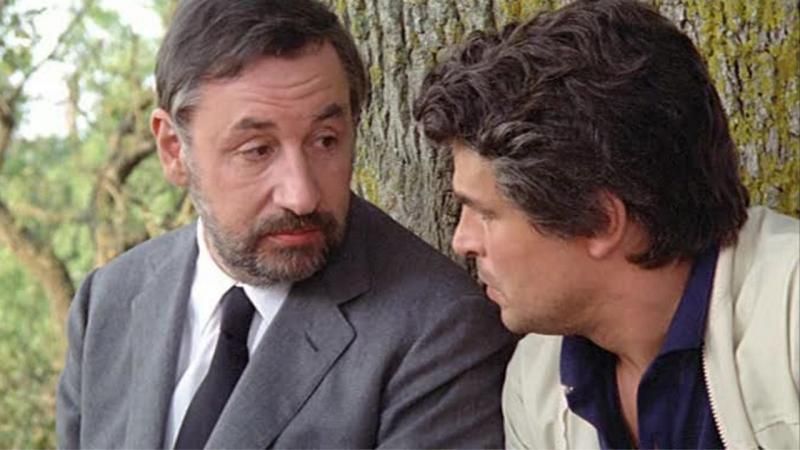
The death of their mother calls grown sons Raffaele (Noiret), Nicola (Placido), and Rocco (Mezzogiorno) from their modern lives to their ancestral home to aid Donato (Vanel) their elderly father.  Each of them brings their metaphorical baggage as well.  Raffaele, a judge, is being targeted with death threats by terrorists for a case he is considering accepting and it haunts him.  Nicola, a labor organizer, dreams of better conditions for work but also is tortured by his impending divorce.  Rocco is the head of a school for juvenile delinquents.  Feelings of grief but also isolation and disillusionment run rampant for everyone.

  
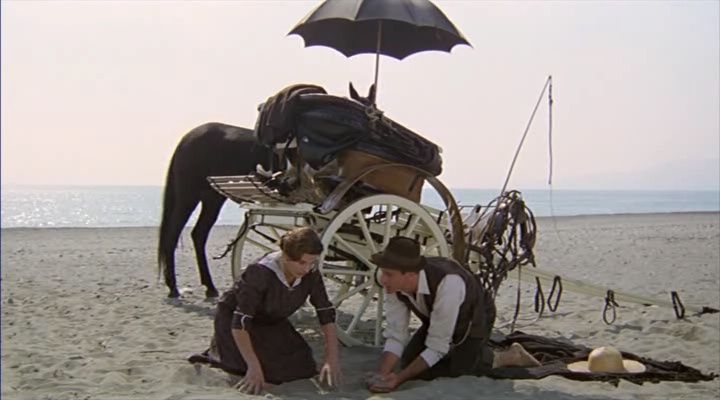
How memories and fantasies blend together into the narrative of the film is probably Three Brothers’ strongest attribute.  The death of the mother naturally brings everyone together but also has them reminisce and reflect and dream for what they want in the future.  The flashbacks work very well within the context of the story.  They are brief and clear and emphasize a point.  The memory of Donato, the father, as he recalls a day at the beach with his young wife was particularly touching.  Later in the story, we have some dream sequences as the characters turn their thoughts to the future, and these are equally well done.  Raffaele has nightmares of being shot over his job, Nicola fantasizes of reuniting with his estranged wife, and Rocco dreams of cleaning up the streets and displaced youths of Italy.  Fitting in well, these moments were the highlight of the film for me.  I wish there was more of them.

  
Why do I wish there was more?  Because the rest of it dull.  Oh my god dull.  I watched Three Brothers on a day when I was tired and ill, and I know from my own experience that I have so much more patience for slow-moving films if I’m tired and less agitated – it’s easier for me to get lost in the world of the film if my brain is less keyed up.  But still I was unable to get wrapped up in the world of Three Brothers that day.  I understand that the film is trying create an attitude, a feeling of sadness, of laconic grief, of that depressing realization that you’re no longer connected to your childhood home, and it does in fact manage to do this rather well.  However, I found myself struggling to stay awake and struggling even harder to focus on the film, and I never, NEVER have trouble staying awake for a movie.  So take it as you will that this one nearly put me to sleep.  It’s desperately slow and nothing really happens. 

Strike that – there is one thing that happens over and over and over again.  Raffaele and Nicola debate politics in every other scene.  Raffaele the judge is calm and even-minded, always seeing both sides of the story, while Nicola the union worker is passionate in his siding with laborers looking for rights.  We get a change of pace when Raffaele debates politics with his old friends down the pub instead of with Nicola.  Oh yes, much different.  Then back to issues with the politics of Raffaele’s job.  Then back to Raffaele and Nicola arguing, because I didn’t get enough of that from the first hour of the film.  No, thank you.

  
The reason I take issue with this is because of the three brothers in the story, I am least intrigued by Raffaele and Nicola, so to watch them constantly bicker was trying.  Furthermore, I am not terrifically interested in politics.  I keep myself informed well enough, but listening to a film tackle Italian politics of three decades ago is one gigantic snore.  No, it was Rocco I was interested in from the start, Rocco who runs a boys’ school for reform with a sense of sad dignity and acceptance.  And who do we get the absolute least of?  ROCCO.  The film is full to the brim of hot-headed Nicola, constantly yelling and smoking and making speeches.  I don’t care.  I don’t care a jot for Nicola.  The film fleshes out Raffaele nicely, making clear that while he believes strongly in the anti-terrorism cases he’s judging, he’s also fearful of the growing urban violence that threatens his own life.  But Rocco… Rocco gets bupkus.  The title of the film ought to be “Two Brothers,” what with the short shrift that’s given to the neglected bro.  But Rocco fascinated me from the beginning.  We get an early focus on him as we watch him wake up in a small, almost clinical bedroom that is then revealed to be adjacent to a large boys’ dormitory.  We watch him handle the cops with respect, yet still be protective of his boys.  He returns to his father’s home and has a slow contemplative walk along a country path followed by a flashback.  I was sold.  This was the brother I wanted to see develop in the film.  But then Rocco practically disappears.  After that point, it’s all – and I do mean ALL – Raffaele and Nicola, Nicola and Raffaele.  When Rocco finally gets his own fantasy, it feels tacked on, as if the director forgot that Rocco was there and realized they should do something to tie up his plot line.  Which made me sad, because I liked him the most and he was given the least attention.  

  
I will end by adding that I thought the scenes involving Donato and Nicola’s young daughter were rather lovely.  There was a sense of coming full circle here.  Nicola may feel himself permanently disconnected from his childhood home, but there is a sense of hope as we watch little Marta delightedly explore the farm and bond with Donato.  Not everything was doom and gloom. 

Overall, however, I felt frustrated by this movie.  I wanted more of Rocco, but instead got ridiculously huge portions of Raffaele and Nicola.  The fact that there is no clear plot – this is definitely more of a character study – meant I was bored into a bit of a stupor.  I get the languid emotions, the sense of sadness and loss; I felt them but only superficially.  There is good stuff in Three Brothers, but not enough.

Arbitrary Rating: 6/10

Tuesday, May 21, 2013

The Conformist


The Conformist
1969
Director: Bernardo Bertolucci
Starring: Jean-Louis Trintignant, Stefania Sandrelli, Dominique Sanda, Gastone Moschin

I love that Netflix keeps track of when I returned something, because it’s how I can tell you that I’ve now seen The Conformist twice – once five years ago, and once last night on the big screen at the Dryden.  My memory of The Conformist from seeing it five years ago was virtually nonexistent: the film failed to make an impact on me.  But I have to say that I am standing by my policy of seeing films a second time before writing a review or even definitively making up my mind.  The Conformist is pretty damn powerful on a big screen, and I was impressed last night. 

 
Marcello Clerici (Trintignant) is living and working in 1938 Rome, and he is more than happy – willing, even – to participate in Mussolini’s fascist regime.  Slowly we learn that Marcello is purposely seeking out conformity, as well as his motivations to do so.  Too many differences in his childhood have made him feel alienated, and he is desperate to fit in, even to the extent marrying a woman, Giulia (Sandrelli), whom he finds thoroughly mediocre.  The government soon asks Clerici to carry out a hit for them, none other than Marcello’s former philosophy professor turned political instigator.  On the pretext of honeymooning in Paris, Marcello seeks to reconnect with his old professor, Quadri, but gets distracted by the professor’s young hot wife Anna (Sanda).

  
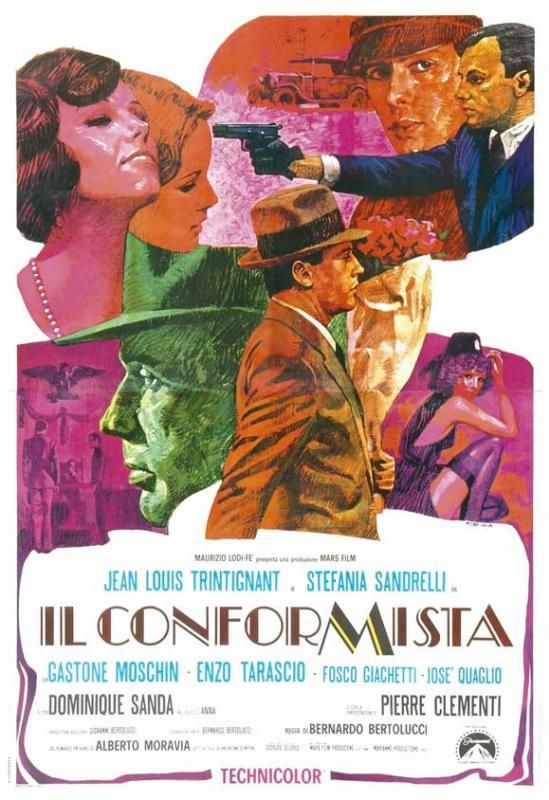
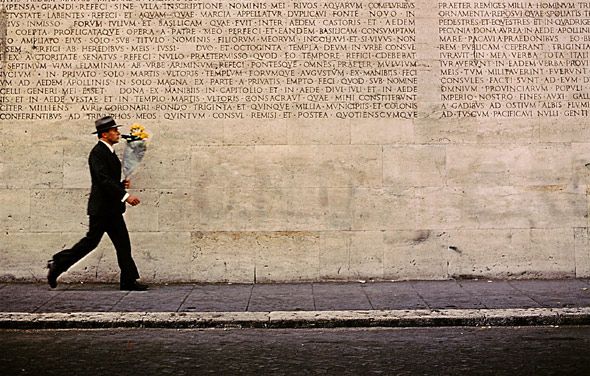
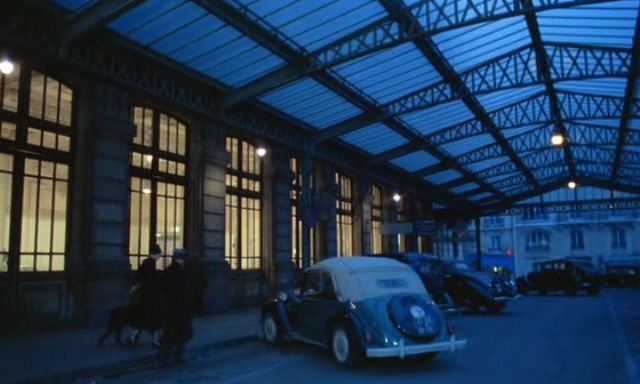
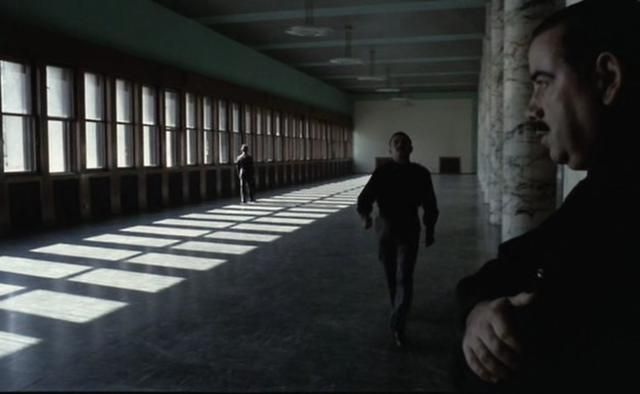
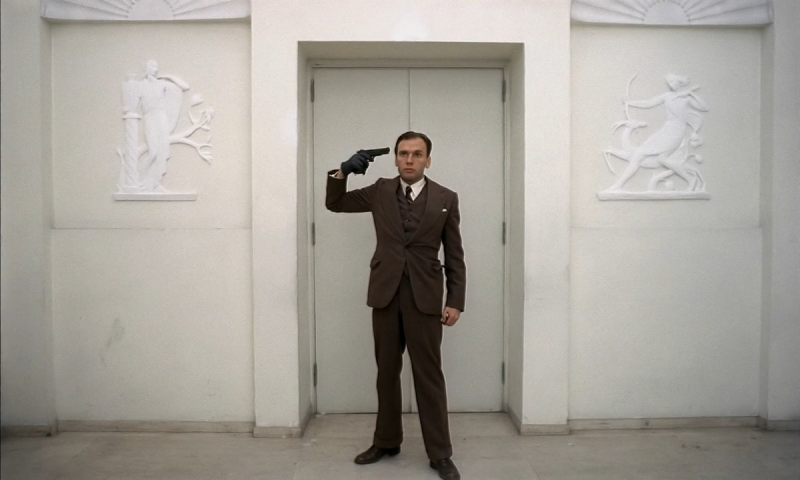
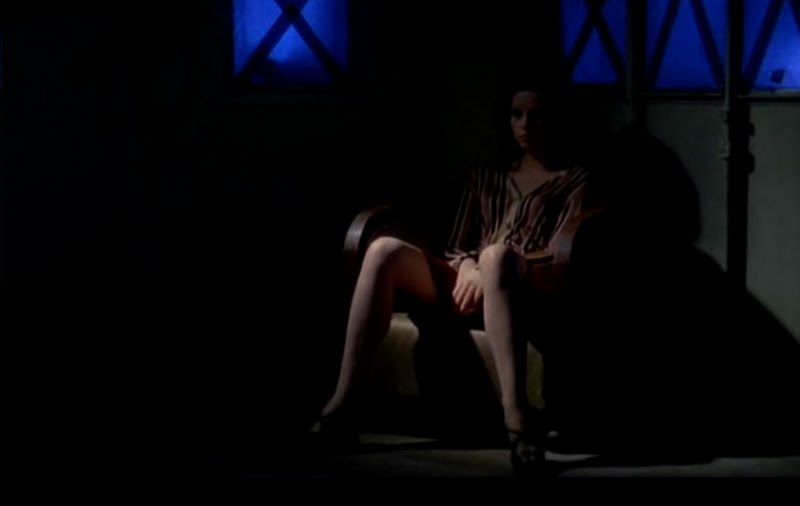
The best part of The Conformist is the drop dead stunning cinematography (evidenced here by my inability to choose no less than seven shots of it to accompany my review, because it's my review, dammit, I can have lots of pictures if I want).  This film is GORGEOUS.  Mostly achieved through the production value and distinct sets, Bertolucci’s cinematographer, Vittorio Storaro, goes to town with the idea of “hard” fascism.  Sparse, cold, stone sets, vast and empty and intimidating, fill the Rome that Clerici inhabits.  Even when the action moves to Paris, there is an emphasis on stone and metalwork backdrops over natural elements.  There is a sense of using materials to control one’s environment, mirroring both Mussolini’s controlling regime and Clerici’s maddening impulse to fit in.  Additionally, the shapes are constantly square and rectangular.  Rectangles are mean, they are hard, they can hurt, they are sharp, and this is everything in terms of Marcello’s world.  There are so many squares framing nearly every single shot, and next to no softness or circles.  In fact, the first time I noticed any kind of an arched frame in a shot was in Professor Quadri’s apartment, which is significant as the Quadris are running a group of political dissidents loudly vocalizing their displeasure with the fascist dictatorship.  They are against everything that Clerici stands for, so it makes sense that we see Anna Quadri lounging up against a huge curved doorway in contrast to all of Marcello’s rectangles.   

  
After the amazing look of the film is the character of Marcello himself, especially as portrayed by the fabulous Trintignant.  He’s tremendously good here, along with Bertolucci, at slowly building Marcello Clerici.  When we first meet him, he seems incredibly focused on pulling off the job, a cold-blooded assassin.  We then flashback to previous portions of Marcello’s life, not necessarily in chronological order, as it is slowly revealed that he was bullied as a child and sexually assaulted by a transvestite servant whom he then shot.  His mother is a morphine addict who is sleeping with her Asian chauffeur who’s also her supplier.  His father is locked up in a mental hospital writing politically rebellious letters to the government when he isn’t asking to be bound in a straightjacket.  His best friend is smart as a whip but blind as a bat.  Marcello, who has been surrounded by oddballs and estrangement his entire life, is desperate – absolutely over the edge desperate – to fit in.  He hates his memories of his childhood.  He loathes his mother.  Even his blind best friend nauseates him from time to time, and we watch with a horrible dawning comprehension as Marcello pulls away from him, being silent and still so his friend cannot “see” him.  When he speaks so callously of his fiancée, I get it.  As awful a person as he is, I understand why Marcello feels the need to conform.  Realistically, it’s something I face every day in my own classroom.  I see the students who have something about them that is different, and instead of embracing their differences, they shun them and try so hard to fit in with the “cool kids.”  They might have more in common with some of the other “outsiders,” but they want nothing to do with them – they only want to be just like the “cool kids,” they want to conform.  If it means being cruel, then so be it.  Such are some of my students, and such is Marcello.  Sad, really.

  
Trintignant’s body language is brilliant.  He holds Marcello’s body as if Marcello is afraid to really move it to its fullest potential.  He’s uncomfortably staid and upright, even uptight.  He never loosens, not for a second.  Trintignant’s Marcello is always rigidly in control of his own action.  Watch him get a gun for the first time – he mimics the movements he’s seen others make with a gun, but the actions don’t seem natural on him.  He moves like a robot.  He doesn’t turn his neck so much as he does his entire body.  Even when he’s with his wife Giulia, he feels uncomfortable with the sexuality of the situation; it’s like he doesn’t wholly know what to do.  It’s a brilliant way of showing Marcello’s mental rigidity manifested outwardly.

  
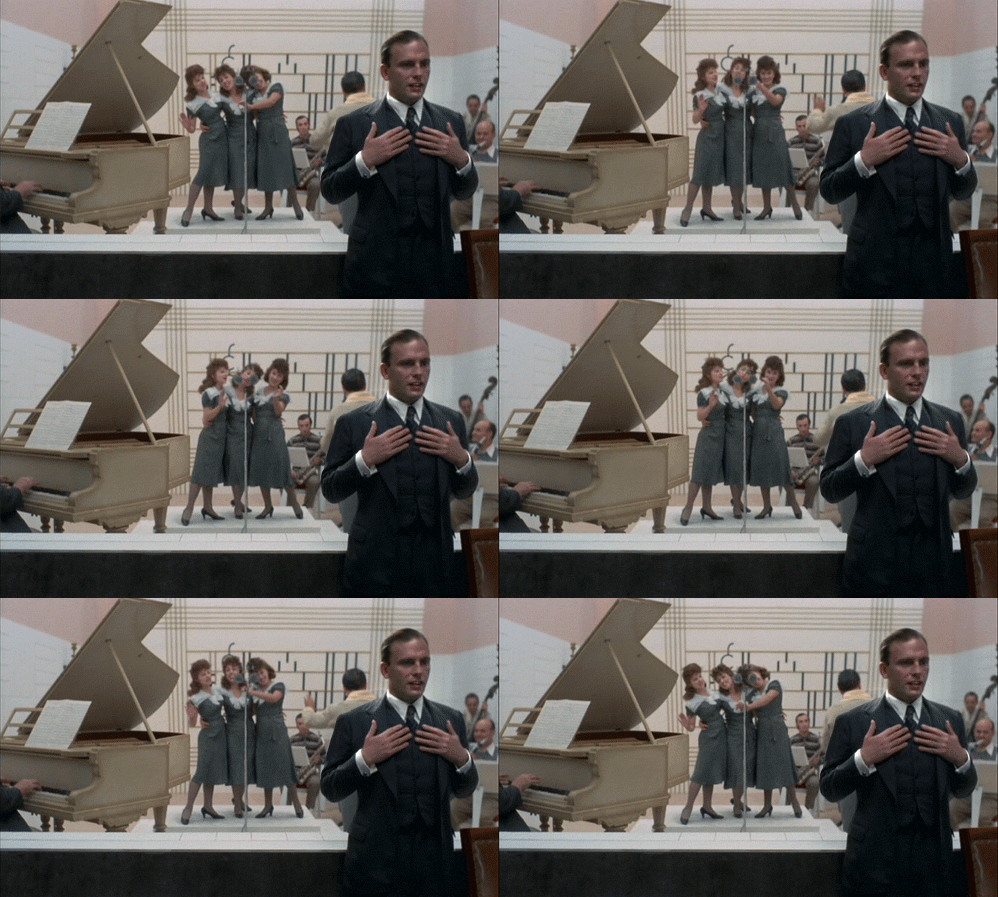
When you combine Marcello’s horrifying descent into frightening levels of conformity with a heavily politicized narrative, I understand the fear that The Conformist could be too dark, too heavy, and all in all too much.  Unexpectedly, however, there is a distinct lightness in tone and many moments of humor that pop up in the oddest of places.  Why, for example, is Marcello’s boss’ desk completely covered with almonds?  Why do we first really meet Marcello when there is a girl group singing a ridiculously cheery popular ditty in the background, complete with silly choreography?  Why is just a gigantic statue head of Mussolini being continually carted around a government building?  These little touches of surrealist humor make the film feel less downtrodden.  Watch Marcello randomly grab Anna and duck into a silly little closet.  Watch Marcello desperately try to wave off his security guard (Moschin) when he doesn’t want to be followed while at the same time not alerting Giulia to his presence.  It’s actually pretty darn funny.  And speaking of Giulia, she goes a long way to lightening the mood of the film; Giulia is all girly superficiality and silliness, and when she can’t keep her hands off Marcello, especially in an early scene, I laugh.  Laughing!  In a movie like The Conformist!  


*******************************DISCUSSION OF THE ENDING**********************************

Realistically, though, the power of Bertolucci’s The Conformist lies mostly in how he chooses to end the film, and although I dislike talking about endings of films in general, I want to talk about this one.  Marcello’s situation in the film, although certainly serious, is always tempered with the oddball touches of humor I mentioned above.  All of that utterly dissipates in the final twenty minutes of the film.  Here, the Fascist regime shows what it is truly capable of and Marcello realizes just how deeply he’s in for it.  He sits by, paralyzed by fear, and watches with inaction as Quadri and Anna are coldly killed.  What’s so utterly unnerving in their death scenes is that their deaths do not come quickly.  They are killed slowly and they are utterly consumed by fear and terror before they are killed.  Listening to the terror in Anna’s voice as she desperately screams for help, and it’s chilling.  It’s scary.  You see precious little blood or gore (again, this was 1970 after all), but the lack of background music and their prolonged deaths are frightening enough.

But it’s not these death scenes that really cap the film off.  No, it’s the epilogue where we cut to Marcello’s life a few years later on the night of Mussolini’s fall.  What horrifies me most about this sequence is Giulia’s character.  In the entire film up to that point, Giulia has been silly and narcissistic and flighty, comedic relief and that’s it.  When we see her a few years later, all of that is gone.  She is stoic and silent, and frankly, it’s horrifying.  This is how I understand the cost of Marcello’s conformity.  Marcello is still Marcello, although he is cracking at this point and he will have his breakdown, but it’s Giulia’s utter, devastating deflation that underlines the tragedy of the situation.  His action (or inaction) has robbed her of her persona, dragging her down to a sad relic of her former self. 

********************************* DONE WITH THAT THEN*****************************************

  
Oddly funny, stunning cinematography, a great lead performance, and a tale that I sadly see too often in modern day high school students meant I got so much more out of my second viewing of The Conformist than I did the first time around.  I’m really not a huge fan of Bertolucci’s work, but this one really struck me.  It was more than worthwhile seeing it in a theater.

Arbitrary Rating: 8/10.  Definitely better than I remember.

Monday, March 25, 2013

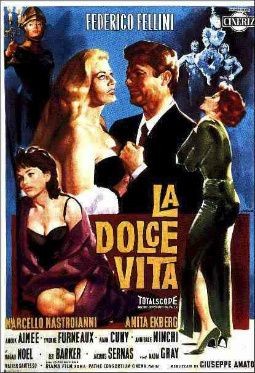
La Dolce Vita


La Dolce Vita (re-post from my previous site)
1960
Director: Federico Fellini
Starring: Marcello Mastroianni, Anouk Aimee, Anita Ekberg, Yvonne Furneaux

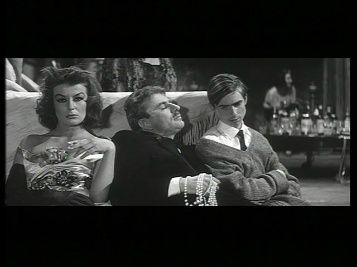
La Dolce Vita opens with a very famous shot of a helicopter flying a gigantic statue of Christ over the city of Rome, and the ludicrous nature of this action, in a way, completely sets the tone for this incredibly famous film.  What on earth is going on, you may ask.  To which Fellini replies: Exactly.

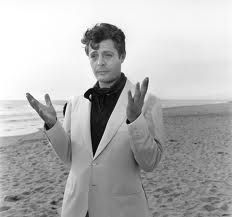
Marcello Rubini (Mastroianni) is a gossip columnist who kind of sort of both loves and hates his life.  The movie doesn’t exactly have a plot; it’s more an exploration of a “day in the life” of this man.  We move from episode to episode, all the while following Marcello as he is buffeted from one situation to another.  He is not exactly in control of his fate, and we are along for the ride as life moves him through the film.


Marcello as the central character is interesting.  He is not a hero, not in the least.  I’m not even sure he’s a good man.  He’s a weak man, a man who talks of being taken seriously then gets distracted.  He has a girlfriend and a lover and still gets seduced by other women.  He flirts with anything in a skirt, yet he does so because he feels he has to, not because he wants to.  He speaks of love with such shallow feeling, it’s frightening.  Yet for all of this, he is not condoned by the film.  I do not envy his life; I don’t see how anyone could.  He is a man sick to death of his life – why would you envy that?  Yes, his life throws him in the path of celebrities and beautiful women, but he takes such little enjoyment from it, it’s downright depressing.  Ultimately, though, Fellini loves his Marcello for all his faults.  It’s a fascinating character study, really.  Marcello is not good, but he’s not evil.  He’s not a hero, but he’s far from a villain.  He’s just a man.  An ordinary, tired, almost middle-aged man who wonders what his life has become.  If anything, Marcello is sad.  That’s how I read him at least, and if ever there was a character open to interpretation, this is it.


There are moments of tremendous poignancy which, for me, emotionally ground the film in the middle of all the whacko-nutso behavior.  Two sequences in particular stand out as moments of sad gravity: the Steiner sequence and the scenes with Marcello’s father.  In the first, Marcello meets with his old friend Steiner.  Steiner is everything Marcello is not: serious, focused, married, a father.  Marcello idolizes Steiner and treats him with reverence.  Marcello goes to a dinner party at Steiner’s apartment, and the people who are there are serious artists – or, at least, much more serious about art and living than all the vainglorious celebrities that Marcello reports on.  I found myself thinking, “Ah!  At last!  We have found the hero of the film!  This is the man that will make over Marcello!”  Fellini, knowing all too well the pedestal that he had seated Steiner upon, knew it would not do to have a hero, not in this film, and in a shockingly sad and devastating sequence, reminds us that people like Steiner, as wonderful as they may seem, are only human too. 

In the second sequence, Marcello’s father, a traveling salesman, comes to visit unexpectedly.  Marcello takes him out on the town to a cabaret, where they all get drunk and Marcello marvels at his father’s excesses.  Perhaps he was cut from the same cloth?  Marcello’s father goes home with a cabaret girl but has some sort of an episode, and he winds up leaving her apartment looking weak and frail.  This, to me, is not the sad part.  The part that sticks in my mind is what immediately follows.  Marcello begs his father to stay one more day in Rome.  Begs.  Completely begs.  And his father says no.  This simple exchange, only a minute or two on screen, is beyond sad.  A grown man has finally realized that he doesn’t know his father but that he WANTS to know his father, and his father steadfastly refuses.  This little moment of heartbreak and agony in the midst of all the excess of the rest of the film reminds you that Fellini can do serious just as well as he can do ridiculous.

 
How Fellini chooses to inhabit his world is fascinating.  I don’t just mean the main characters, but all the people who appear on screen.  When watching this film, watch the extras.  Look at them.  They are just as bizarre as the characters with lines.  Look at the woman with the spider rhinestone glasses.  Who is she?  No one is incidental in Fellini’s world – even his extras have enormous stories that they aren’t telling.

 
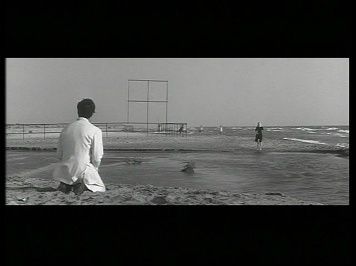
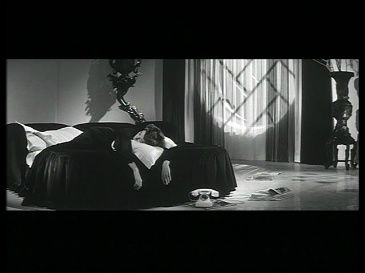
I was struck by the unbelievable shot composition of La Dolce Vita - even in comparison with other fantastically photographed films.  Holy cow, but Fellini has an impeccable eye.  It’s not something I really noticed the first time I watched it about five years ago.  I admit that, in that first viewing, I had no idea what the eff I was watching.  I feel like I was watching it just to watch it, without really understanding it.  I don’t pretend to understand La Dolce Vita completely after my second viewing, but I feel like I got more out of it this time around, and I was amazed the shot composition more this time around.  Scene after scene is breathtaking.  I put it right up there with Sven Nykvist’s work in The Seventh Seal, an absolute favorite of mine.  Fellini clearly loves black and white, as he uses black and white phenomenally well, not just in the photography but also the costumes.  Some shots are symmetrical, beautiful in their alignment.  Others are point of view – when Marcello runs up the tower steps, we suddenly see the curved wall through his eyes, and get a rush of excitement.  And Fellini loves the panorama.  His crowd-scapes are fascinating.  I can’t even try to logically put my feelings into words – you just have to see it for yourself.

 
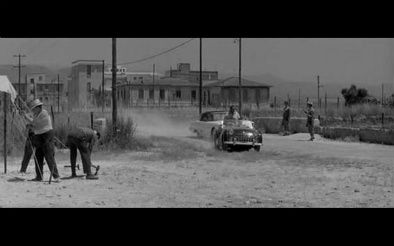
One thing I have recently started to notice about films is the location they present.  I don’t mean, “Hey, look, shot in London!”  Rather, what is the version of the location that the director is showing us?  The New York City shown in, say, Sex and the City is a very different New York City shown in Midnight Cowboy.  So through the lens of these new glasses, I find it interesting to discover Fellini’s Rome.  For this is, most definitely, Fellini’s Rome.  It is a city of dirt roads right next to glittering new high rises.  There is dust and construction and clutter all over the place, contrasting with the clean, white lines of sophisticated buildings, lending the city a constant sense of pandemonium.  The city seems to be in the middle of nowhere – characters drive for two seconds and are then in the country.  Fellini’s Rome seems an isolated place to me.  

 
In many ways, La Dolce Vita is a bit of a tough nut to crack.  Made between Nights of Cabiria and , La Dolce Vita clearly straddles Fellini’s transition from straightforward, realistic narrative to off-the-deep-end whimsy and surrealism.  There are elements of both in this, the middle film.  It’s a film that demands repeated viewings; I have a feeling that what I get out of it will change the more I live my life.  As a film, I feel like I still don’t totally get it, but it’s a heady ride.

Add-on: Because I’m me and I’m still copying old reviews from my previous site onto this one (as is the case with La Dolce Vita – this review was written about a year ago), I seriously wanted to re-evaluate the score I gave this.  Do I really like Fellini THAT much?  No, I thought; I’m not really a Fellini fan, and he goes to some really weird places in his later films.  But then I re-read what I wrote, and I remembered exactly how excited this movie made me.  Just how good the photography is.  Just how sad parts of it really get.  Just how much it really did touch me, in a strange Fellini-esque way.  I will NOT let my less than enthusiastic opinion of Fellini in general deter me from recognizing how much I actually enjoy this film of his.

Arbitrary rating: 8/10, and in terms of Fellini, one of my favorites.  I tend not to enjoy him nearly as much after he went off the deep end with his later works.