Showing posts with label erich von stroheim. Show all posts

Wednesday, August 7, 2013

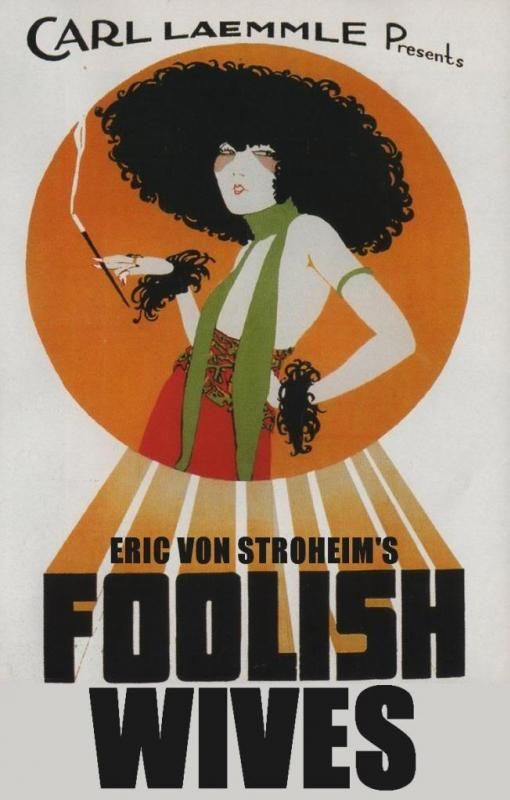
Foolish Wives


Foolish Wives
1922
Director: Erich von Stroheim
Starring: Erich von Stroheim, Miss Dupont, Maude George, Rudolph Christians

Erich von Stroheim has done it again!  Jump with joy for the anticipation of an overlong, completely over the top morality play!  Oh thank goodness, because there really isn’t enough of that in my life at the moment.

“Count” Sergius Karamzin (von Stroheim) is a con artist masquerading as an aristocrat, preying off of the gullible upper class in Monte Carlo with the aid of his “cousin,” Princess Olga Petchnikoff (George).  When an American dignitary (Christians) and his much younger wife Helen (Dupont) arrive, the tricksters immediately set their sights on fleecing the couple for everything they have.  Sergius sets to work charming Helen, slowly, of course, and trying to keep the husband relatively unaware.  Ultimately, however, Sergius’ womanizing ways catch up with him.
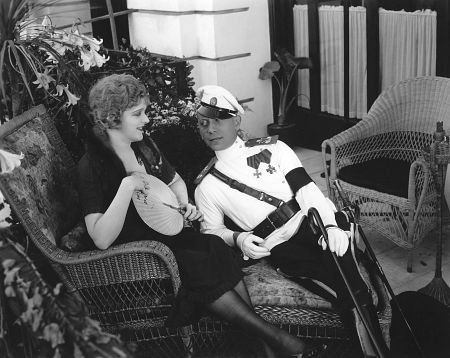
  
As I watched Foolish Wives for a second time, I kept on trying to put my finger on what the story reminded me of.  Was it soap opera?  No, soap opera moves slower than this.  Was it crappy romance novels?  No, crappy romance novels have a hero, and Foolish Wives has no hero, just ridiculous naïve characters and Evil Villains of Evil.  And then it finally hit me.  I thought to myself, “Sergius is Don Juan.”  Which then made me think Don Giovanni, (in particular, Mariusz Kwiecien in Don Giovanni… mmm, Mariusz Kwiecien…) Mozart’s operatic reimagining of Don Juan.  And that’s precisely what Foolish Wives is: it’s an opera plot without the actual, y’know, opera.

Now, I am a definite fan of opera.  Like, pretty darn big time.  All my students know it.  All my friends know it.  Opera rocks, man.  I will preach this from the highest hilltop.

But Foolish Wives does NOT rock, despite this association I made.  Why?  The last thing I’m looking for from my opera is plot, and that’s ALL that Foolish Wives has going for it.

The plots of operas are not the point of the opera itself.  If you wanted interesting story development, no one in their right mind would think, “I know!  Let’s all hit up Il Barbiere di Siviglia tonight!  That’s got one crackerjack plot!”  The operatic plots are mere scaffolds on which fantastic music is hung.  What’s more, they are usually simple to their core.  Any opera I’m familiar with can be summed up in two sentences, three at the most.  If it’s a comedy, it’s “mistaken identities prevent the hero and heroine from proclaiming their love for one another while a baritone gets in the way.”  If it’s a tragedy, “everyone makes bad decisions then dies.”  Yes, I’m oversimplifying, but not by much.  And opera plots are notoriously slow to progress.  Because the plots are so simple, there isn’t a tremendous amount of plot progression, and the story can move rather slowly.  The arias are rarely about plot progression in an opera, instead being about the fabulous music.  Even my mother, whose only experience with opera is when I’ve tied her down and shoved some Juan Diego Florez in her eyeballs, noticed that “everyone tends to repeat themselves in the songs, just singing the same thing over and over.”  Yes, exactly.  And what they’re repeating is usually something straightforward, like “I love her.” Or “I hate him.”  Or “Wow, I’m so happy.” 
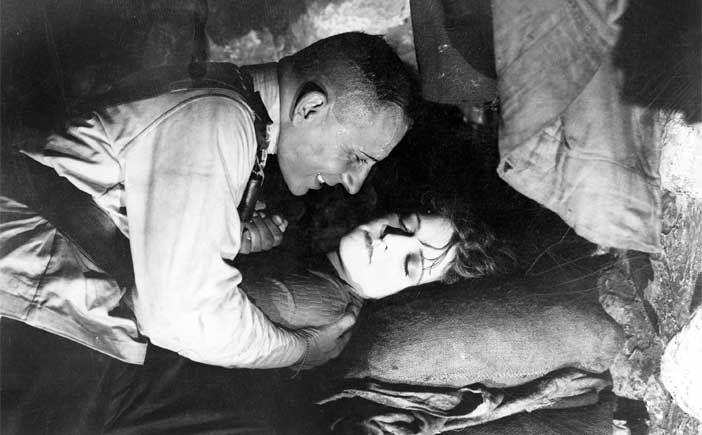
 
To bring this back to Foolish Wives, imagine now that simplistic plot that operas have, where everyone says the same thing over and over again, where the plot is ridiculously slow to progress, and then remove the awesome music from it, and you have this movie.  A plot so utterly simple – con man corrupts gullible wife – and a story that moves so damn slowly – I don’t understand why this has to be two and a half hours – that is absolutely full of the characters doing or saying the same thing over and over again – how many scenes do we need of Sergius being a smarmy bastard to Helen?  Add them all together, and you get Foolish Wives, the non-opera opera story.  I don’t watch opera for plot, I watch it for tremendous singing and amazing music, both of which Foolish Wives lacks, making the whole movie rather dull.

What is impressive about Foolish Wives are the sets.  Watching this through, I assumed it was partially shot on location somewhere; if not Monte Carlo itself, then a spot that looks like Monte Carlo.  But no, it wasn’t.  Nope, von Stroheim being the egotistical bastard he was, he built Monte Carlo, complete with a fake lake, in studio backlots.  Alright, von Stroheim, I’ll give you your due, that’s rather amazing.  Although not perhaps as grand as some of the set work in Intolerance, it’s pretty close.  
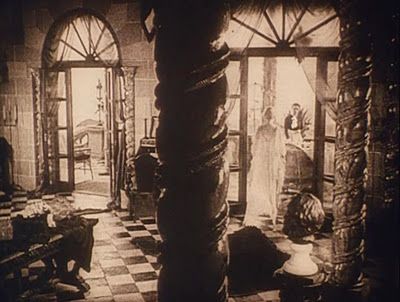
  
Many silent films do not translate well with modern audiences.  There are some that do, and some that are still spectacular today, but most feel dated in many ways.  Time has not been kind to Foolish Wives.  The story is one that modern audiences would barely register an interest in, and when you throw on von Stroheim’s ego in insisting this be an “epic” in terms of length, what results is a product few would find compelling. 

Arbitrary Rating: 4/10

Friday, June 14, 2013

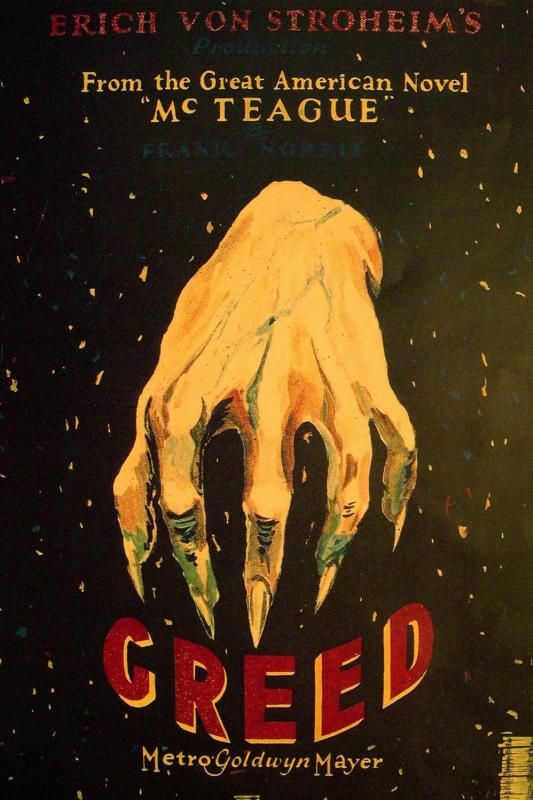
Greed


Greed
1924
Director: Erich von Stroheim
Starring: Gibson Gowland, Zasu Pitts, Jean Hersholt

Y’know, before I ever saw Greed, I was really looking forward to watching it.  Greed has an enormous reputation; it’s on many Best Of lists, and it’s highly regarded by critics.  It had a tremendous build up for me.  And then I watched it.  And then it was four hours of caricatures flailing about.  And I was like “what… the… fuck…”

I should really stop looking forward to things.

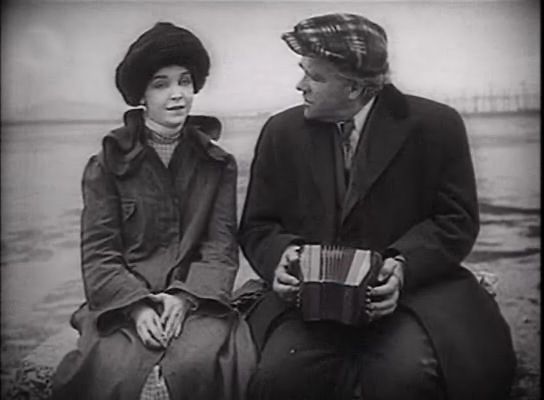
McTeague (Gowland) is a miner in California whose mother dreams of a better life for him, and gets him a position as an apprentice to a dentist.  When he opens up his own dentistry office, he befriends Marcus Schouler (Hersholt), who lives in the same building, and through Marcus, meets Marcus’ cousin Trina (Pitts).  McTeague falls for Trina and sets about courting her.  Things are going well, the wedding is planned, Marcus gives his consent, and then Trina wins five thousand dollars in the lottery.  And over the course of the next three hours of your life, everything goes massively downhill for every single character in the film.

 
Greed, based on Frank Norris’ book McTeague, reminds me of when I had to read Theodore Dreiser’s Sister Carrie for a history course.  My reaction to that book is virtually identical to my reaction to Greed: tiresome.  Utterly and completely tiresome.  Both literary works were published within a year of one another, both follow many years in their characters lives, both have long and rather cumbersome plots, both speak to the social norms and mores of Victorian America, and both are bleak and depressing.  And you know what?  I didn’t really care for Sister Carrie.  Its sensationalism did little to intrigue me.  Ditto for Greed.  You can make the movie as wide and expansive as you want, Mr. von Stroheim, it still won’t change the fact that I am so utterly uninterested in these characters and what happens to them.  And when von Stroheim makes the decision to have this thing be a lumbering eight hour long monstrosity, you’ve almost certainly lost me from the word “go.”  (Thank the lord the eight hour version no longer exists; half its length is more than enough of a struggle, thankyouverymuch.)

 
A large reason for this is because nearly every single character is just a cartoon.  Marcus is our first major entry to the contest of “Who’s the Most Ridiculous?”  Even before the MONEY CORRUPTS message starts to get thrown at you from every angle, Marcus is already entering rooms by throwing his heels up and gadding around like a lunatic.  Things only get worse when he starts to be tortured by the feeling that he somehow deserves Trina’s lottery winnings, because Marcus is incapable of doing anything with a modicum of self-reserve.  Watching him is like watching a meth addict go through the violent phase of detox.  In every. single. scene.

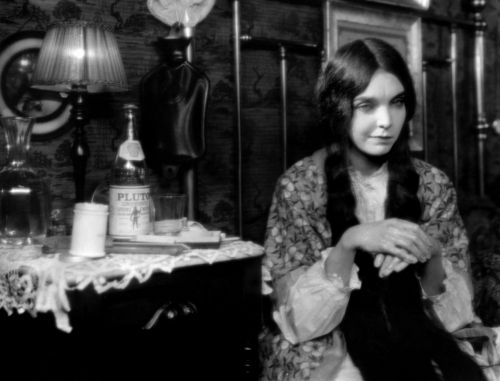
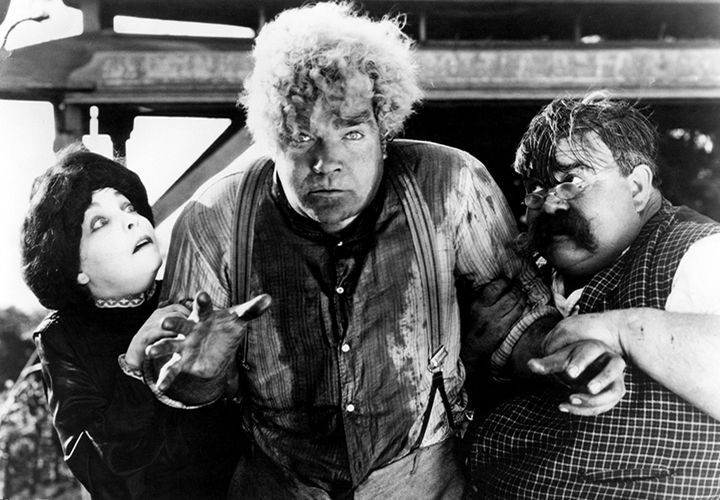
Up next in “Who’s the Most Ridiculous?” is Trina.  Trina’s fairly standard-issue silent film heroine fare for the first hour when she’s courted by McTeague and before she wins the lottery.  Of course, this involves an awful lot of mugging and sighing and clutching and gasping, but still, that’s pretty standard for silent films.  Unfortunately, just as her character starts to get a bit interesting and nonstandard as Trina becomes utterly obsessed with her cash, the performance goes so ridiculously over the top that it becomes difficult to appreciate what’s going on.  Apparently, Pitts thought that the only way to possibly convey Trina’s poisoned mind was by continually squinting as though she was having eye spasms and holding up a finger to her mouth.  For the entire second half of the film.  And don’t even get me started on her hat made of hair.  Of all the…

 
Our final entry is, sadly, McTeague himself.  What starts out as a promising character, one who will manage to somehow not turn into exactly the type of demonic brute Gowland is made up to look like, holds out for most of the film.  Uncharacteristically displaying a degree of sensitivity and, dare I say, subtlety, everything goes to hell with about an hour and a half left in the movie.  What had been a surprisingly sympathetic character turns into exactly the type of monster you would expect, what with rage issues, violence issues, and a rather complete abandonment of reason, and Gowland doesn’t try to present it in any other way than glowering meanly at the camera and flailing his limbs about.  

 
So all three major characters manage to be completely bonkers and the actors playing them, not much better.  Quite frankly, it’s not really worth my time or effort going into the ridiculousness that is the supporting parts.  There’s Trina’s father, the Kaiser whose over the top German accent managed to make the intertitles a joke; Maria and Zwerkow, the junk obsessed equivalents of Dickens’ scroungers in A Christmas Carol only less appealing; and the eye-roll inducing parents of McTeague, who thankfully both die before the we get too far into the movie.  Oh, was that insensitive?  I just sat through four hours of this garbage, I’m past the point of caring.

 
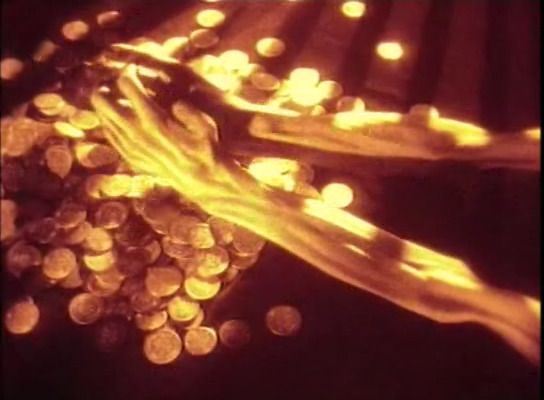
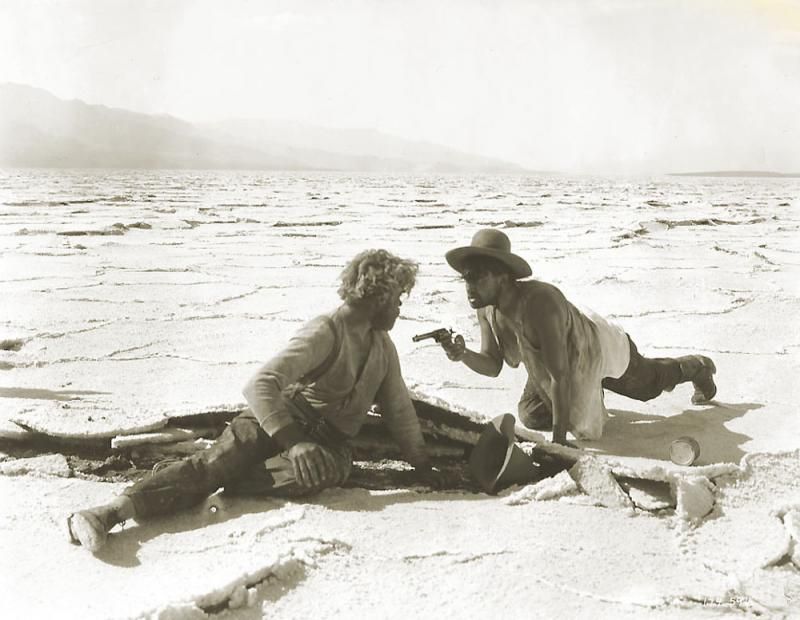
And yet for all of the “mother of all that is holy when will this self-induced torture end,” there is some interesting, quality stuff in Greed.  First of all, it is kind of intriguing watching the different characters be affected by money in different ways.  Trina’s odd obsession with her winnings, which becomes fully sexualized when she lets her hair hat down and rolls around in bed naked with her money, is memorable, to say the least.  Marcus is immediately poisoned into distrusting his friend.  Maria dies based on the mere suggestion of money.  And honestly, it’s a bit sad (for, like, a second) to see McTeague finally be corrupted.  The ending of the film, which finds McTeague and Marcus in the middle of Death Valley with no water and no transport and no prospects for survival, managed to retain some power (despite the fact that I was desperate for it to be over).  And I’ll give von Stroheim credit: Greed is unexpectedly gory.  When characters are killed, we see it.  We see blood streaming down faces, bits of body parts falling off, all of it surprisingly graphic for 1924.  There isn’t really any shying away from violence in Greed.

Are you thinking about watching Greed?  Here, let me spare you four hours of your time: Money corrupts people.  Got it?  Good, go do something else with your life.

Arbitrary Rating: 5/10.