Showing posts with label 1991. Show all posts

Tuesday, January 7, 2014

The Rapture


The Rapture
1991
Director: Michael Tolkin
Starring: Mimi Rogers, David Duchovny, Kimberly Cullum

I’ve made it a point to avoid organized religion in my life.  I’m not averse to the concept of a higher power, but religion bothers me.  Despite these personal preferences, however, I am more than open to films that explore faith and religion, and especially how the two converge.  By partaking of art that deals with these topics, I know that I am working out some of my own questions while I watch.  I was looking forward to seeing The Rapture because I knew the basic premise – moral degenerate finds faith – and was hoping to delve into these issues yet again.  In all honesty, though, The Rapture let me down. 

Sharon (Rogers) is a telephone operator who says the same twenty odd words at her job all day long and goes trolling for sexy locals with her swinging friend at night.  She meets Randy (a mulleted pre-X-Files Duchovny), picks up a hitchhiker, and overhears her co-workers talking about some sort of religious dream involving a pearl.  Eventually, she realizes she has been living in sin and becomes essentially a born-again Christian, believing fully that the Rapture will come any day now and she will be whisked away to Heaven.  She manages to ditch her old ways and converts Randy, getting married to him and having a child, Mary (Cullum).  Things get interesting, however, when several events happen to test her faith.


My big problems with The Rapture have little to do with the fact that it’s about faith and Christianity.  I’m cool with that.  I’ll watch that story.  No, my problems with it are all about Sharon’s journey.  Sharon has two major character changes to go through, the first where she finds faith and the second where she might lose it.  I’ve seen several films that deal with either finding or losing faith, and find them fascinating… when done well.  I didn’t buy either of Sharon’s transformations, and as such, I was annoyed with this movie.

Frankly, the movie had me for about the first half hour or so.  There are signs and hints in the movie up to this point that suggest some sort of mythical, mystical, slightly cult-like faith.  Door-to-door messengers for God have an intriguing conversation with Sharon.  Sharon is fascinated with an enormous pearl tattoo on the back of one of her sexual partners.  Conversations with Randy, before their conversion, bring up issues of right and wrong and the messages of religion.  There is a feeling here of something unknown, unknowing, just beyond the grasp of human consciousness.  I am 100% in favor of this sort of mood in a film.  It’s the same mood that permeates The Last Wave, another movie indirectly about the Rapture and issues of faith, and I think The Last Wave is pretty damn good.  For the first half hour, I was excited, because The Rapture was shaping up to have this same sort of aura of mysticism and faith.  Great!  I’ll take it, I will gladly watch your movie.


But then we run into trouble.  Sharon feels these slight pulls around her, she can smell that something seems to be happening, but then BAM she wakes up one morning born-again.  She transitions too fast, far too fast, and with absolutely zero self-doubt.  I didn’t buy her conversion in the slightest.  One minute she’s having sex with David Duchovny (lucky girl) and the next she tells him to get out of the bed because the sheets are unclean and so is she and she wants her salvation and will meet her God, and in the same scene she’s quoting the Bible.  Wait… what?  This is how religious conversion works?  Just like that, in the flash of a moment, you go from zero to sixty?  Now, I cannot speak for those who do, in fact, claim to be born-again, so maybe it really does work that way, but it doesn’t work for me.  I can’t believe it for a second, and for this movie to work, you really have to believe Sharon.  What’s worse, Sharon later manages to convert Randy, but we never even see his conversion.  He goes from cynical lay-about to Christian leader in the space of a film edit.  Maybe this is my problem; I enjoy seeing people grapple with faith and religion, and that is not what I was treated to in this film.  I was expecting things The Rapture had absolutely no intention on providing me with.  Perhaps my expectations did me in, but I really cannot forgive a movie that is so much about one woman’s journey in faith for not actually SHOWING me a damn lick of that journey.

The other major problem in Sharon’s story is her facing a loss of faith in the final act of the film.  For the middle third of the film, the story has managed to convince me, somewhat against my will, that Sharon has become a God-fearing proselytizing good Christian wife and mother.  The film spends a tremendous amount of energy proving this is true.  Fine, okay, I’ll bite, despite the fact that you never really show to me how she gets there, she whole-heartedly believes in Jesus Christ and God.  Fine, if it’s necessary for the story you want to tell me, I’ll believe it.  And then, just as suddenly, she’s losing her faith and might never get it back again.  Wait, what?  REALLY?  No.  Even facing the tremendous and horrible tragedies that Sharon goes through, I cannot believe that the woman the film spent such effort getting me to buy into would suddenly become so damn obstinate in her lack of faith, especially when the unthinkable occurs and she actually gets some PROOF.  Sharon is not as obnoxious as that, except, well, she apparently IS.  I just don’t buy it for a second.  And I’m angry at the film for making these two huge shifts in character development with tremendously little to go on.  Frankly, it’s bad writing, and Mimi Rogers isn’t nearly talented enough to overcome it.


It’s really too bad.  I wanted to go along with Sharon’s journey, I really did, and the rest of the movie serves well to bolster up around her story; for example, the production design is full of silence and tension and the delicious burn of a slow build.   But it falls so spectacularly flat.  Not even Will Patton and Patrick Bauchau, veteran character actors, can save it.  Not even several truly shocking twists in the final act are enough to save it.  Heck, not even David Duchovny’s ridiculously ripped abs can save it. 

It’s so frustrating to want to like a movie, but then realize it’s going to disappoint you.


Arbitrary Rating: 5/10.

Friday, August 30, 2013

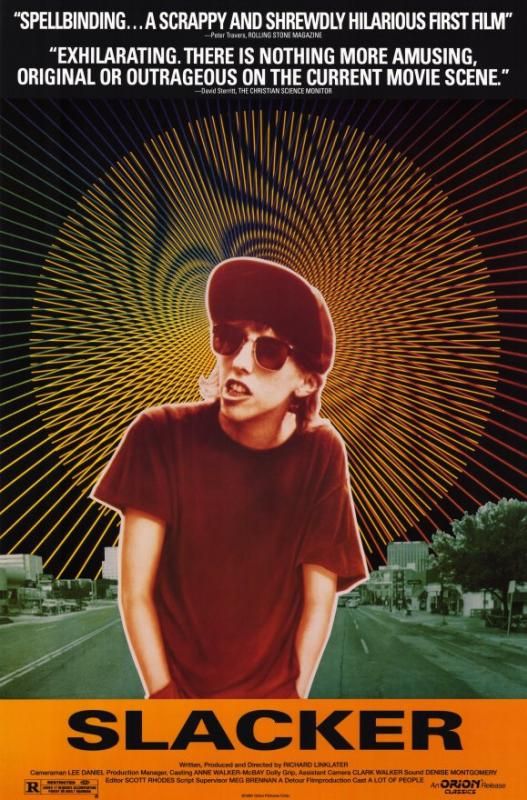
Slacker


The end of summer vacation is a bitch, full of much gnashing of teeth and tearing of hair, and many many little anxiety attacks.  

 
Slacker
1991
Director: Richard Linklater
Starring: um… Austin, Texas

Technically speaking, I am part of Generation X.  However, I am on the tail end of what chronologically defines Gen X, and I grew up with enough awareness of the term to understand all the negative connotations that go along with it.  The characters in Slacker are full on Gen X, no doubt at all, and watching it makes me feel oddly nostalgic for the early days of The Real World.  I shudder, though, that this film represents a generation with which I am technically a part. 

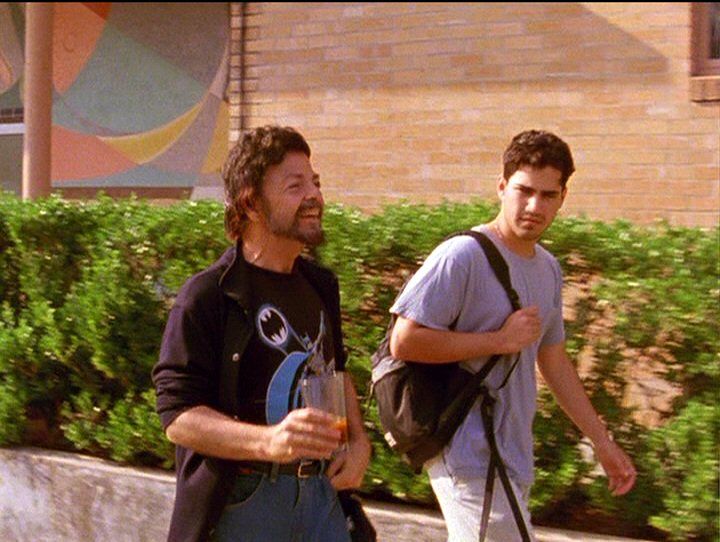
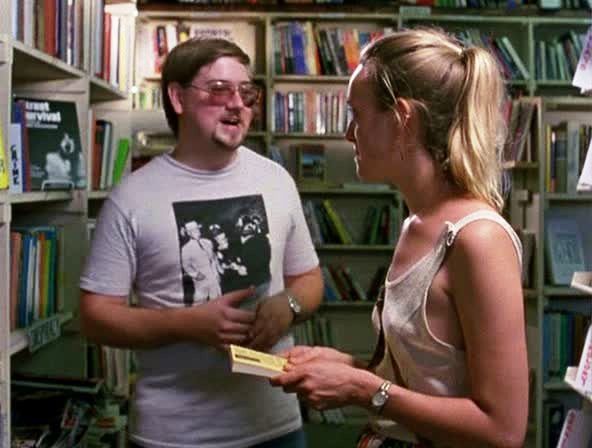
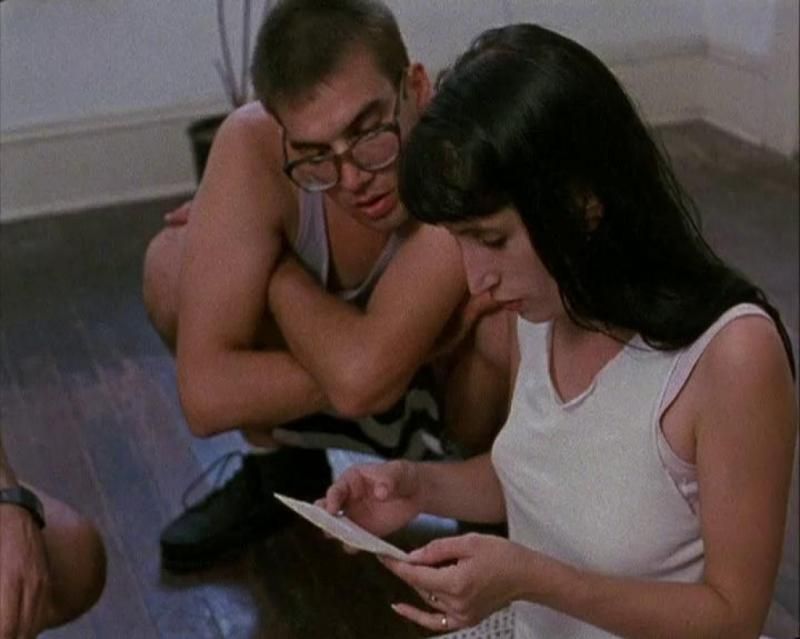
Slacker isn’t so much a story as it is a conceit: it is essentially a series of vignettes strung together by coincidence set in the city of Austin, Texas.  We watch a few people, who are almost always young, unemployed, and pseudo intellectuals, as they have a conversation.  After a few minutes, one of the group leaves the conversation and the camera follows and moves on, finding a new conversation and a new group of young people.  This continues as we spend our whole day meandering around the city, jumping from group to group.  There are conspiracy theorists, nutjobs, anarchists, New Age gurus, and lots and lots of ramblers.

  
I’m not a huge fan of this movie, but it has its moments, most of which I find a bit blackly comic.  I’m particularly amused by the conspiracy theorist, credited at imdb by the role “Been on the moon since the 50s.”  His utter conviction and nonstop spouting made me smile, as did how easily he passed from having a discussion with one young man to having it with entirely different people.  Next up is the young man who’s honest enough to pay for his own newspaper walking into what is easily the most bizarre diner where a patron yells at him to “stop following me!”, the owner tells him to “cut it out!”, and the woman at the counter tells him it’s inappropriate to sexually assault women over and over.  Poor guy… and he just wanted change for the newspaper!  Similarly, one of my favorite sequences is when a would-be robber holds up a homeowner at gunpoint, only to have that homeowner turn out to be a raging anarchist who not only talks the robber down but seriously schools his ass.  The fact that the anarchist is an elderly gentlemen is just icing on the cake. 

There are moments of sympathy in Slacker as well, although they’re few and far between.  A young woman who gives a quarter and a Diet Coke to a homeless man then tolerantly puts up with a Kennedy wingnut’s ramblings and very kindly excuses herself without putting him down in the slightest.  A different young woman makes a slanted illusion to having some fairly serious health issues, and there is definite tension in her conversation with a young man, who rather bluntly steps over her confession and begins talking about himself instead.  Every now and then, through all the meandering conversations that seem to be going nowhere, there is a spark of real emotion, a hint of real kindness or real pain.

  
But for the most part, Slacker is full of void.  This is obviously on purpose, as it is a commentary on the “Slacker” mentality that seemed to be the defining feature of Gen X in the early nineties.  Rambling conversations by pretentious unemployed dicks about Dostoyevsky or the power of the video image are so maddeningly vacuous that I wind up wanting to throttle half the characters.  And this is really my biggest issue with Slacker; I wouldn’t mind the portrayal of this sort of mentality as much if I myself felt more removed from it.  I find myself in this odd duality, where I know that I’m a member of Gen X, this generation portrayed here in Slacker, and yet I feel absolutely no kinship with anyone in the story.  I bristle that this is how “my” generation is seen.  And yet, maybe it was this portrayal of my generation in the media at large that I grew up with that helped me NOT become this.  I remember watching The Real World in the early years, watching Clerks when it just came out on home video, and certainly I remember how much everyone talked about Reality Bites.  Heck, I even did a research paper in high school comparing and contrasting Hemingway’s Lost Generation with Gen X.  I was incredibly aware of this media portrayal, and maybe, in some small part, it drove me to NOT fall prey to the Gen X stereotype.  After college, I fucking went to grad school.  I did something, goddammit, I studied and worked in a research lab, then student taught and got a goddamned career. 

I tend to be in favor of nonprofessional actors in films; usually they deliver surprisingly effective low key performances because they’re not trying to “act.”  I’m not sure if the actors in Slacker were nonprofessional or not, but if they were, then this could be the film that puts me off nonprofessionals.  The acting is painful.  PAINFUL.  The conversations are already rather rambling and awkward, and when you add on top of that awkward performances, it does not make for an enjoyable experience.  It’s like watching an Amateur Improv night down at the local comedy club, and not the good one that gets decent performers.  Just stop.  Just stop right there.

  
To end on a positive note, my favorite part of Slacker is also the most incongruous.  Linklater spends the whole film rambling around aimlessly, following people so apathetic they’re hardly breathing, and so then it is curious that he ends it with a segment that is the antithesis of everything that preceded it.  As the film goes from a wingnut driving around in his car shouting absurdities through his roof speakers, we suddenly cut to a group of young twentysomethings out filming their day adventure on a Super 8 camera.  They are happy – unironically happy, even – as they traipse about and “Skokiaan” plays joyously on the soundtrack.  These young people are doing something, they are not moping about indoors simply talking about doing something.  They are happy instead of lethargic.  I choose to interpret this ending as Linklater ending on an optimistic note, recognizing that not everyone in this generation is as downtrodden as the people who inhabit most of Slacker.    Is that what he’s really saying?  Who knows, but that is the ending I need it to be.  I need a bit of energy and happiness and optimism after an hour and a half of mind-numbing apathy.

I like the central conceit of Slacker quite a bit, and it definitely has a bit of nostalgic appeal as I remember growing up with this sort of media representation of who I am supposed to be.  But I am not this aspect of Gen X, and I have never been that way. 

Arbitrary Rating: 6/10

Wednesday, March 27, 2013

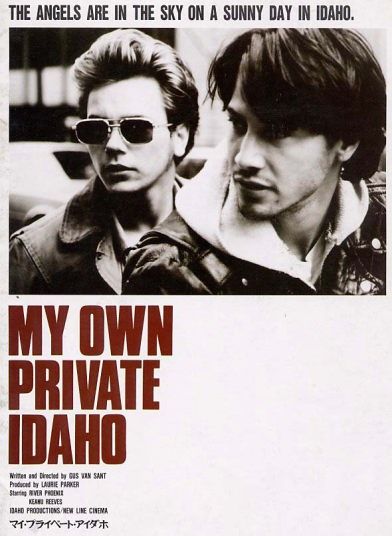
My Own Private Idaho


My Own Private Idaho
1991
Director: Gus Van Sant
Starring: River Phoenix, Keanu Reeves, William Richert

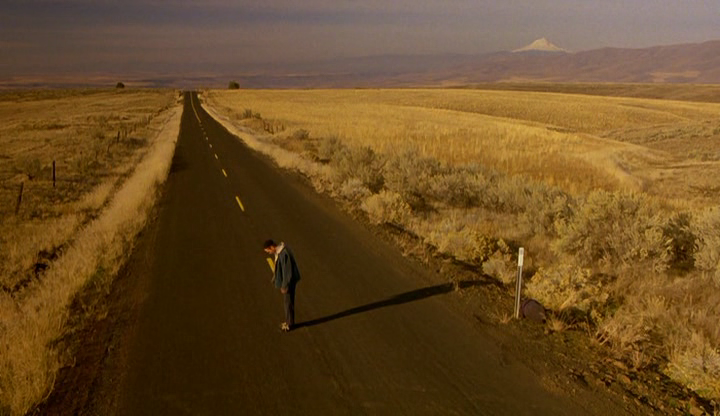
The story opens with a shot of Mike (Phoenix) on a road in the middle of nowhere.  Although the movie will take us far from this location, this is the emotional core of the story.  We learn more of Mike’s story, how he was a street hustler (re: prostitute) in the Northwest, befriending fellow street kid Scott (Reeves), who also happens to be the heir to a wealthy family.  Adventures and hijinx ensue upon the arrival of Bob (Richert), a gay overlord of the displaced street kid family.  Later, we follow Mike as he searches desperately for his birth mother, and feel for him as he falls in love with Scott.

The theme of those living on the outskirts of society has never held a huge attraction for me.  This can probably be traced back to an overly ambitious Reading teacher in seventh grade who insisted we each do a massive project on The Outsiders.  The overexposure turned that story into one of my least favorite ever, and I still get a bit of a bad taste in my mouth when exposed to it.  However, despite not being quite my cup of tea, My Own Private Idaho is very good at portraying that life in a manageable, understandable, yet unsentimental fashion, somewhat on par with the world that Jon Voigt inhabits in Midnight Cowboy.  That’s probably Van Sant’s greatest accomplishment in this film: while watching it, I was bemused and slightly intrigued.  When it was over, I started thinking about what I had seen, and the emotional impact started to hit me.  These are sad, sad people in this film, but Van Sant keeps the crippling depression at bay until the audience is ready to drink it in.  

 
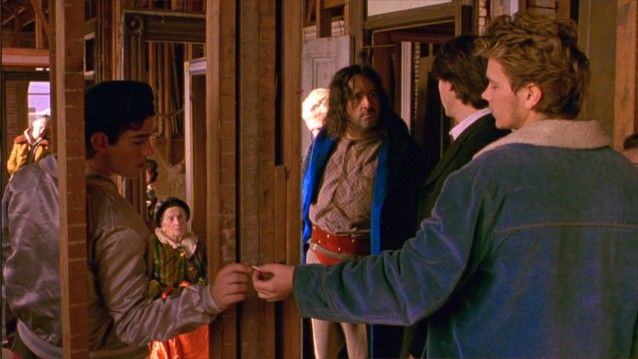
Easily my favorite aspect of the film is the utterly bizarre yet beguiling Shakespearean section in the middle.  About a third of the film, that involving Bob and the street kids as opposed to Scott and Mike on their own, is a full on modern adaptation of Henry IV, with a touch of Henry V thrown in for good measure.  Because of the source material, it’s also an adaptation of Orson Welles’ Chimes at Midnight (1968), which is, you guessed it, an adaptation of Henry IV and Henry V.  Van Sant is paying homage to Welles in these sequences.  Bob is clearly Falstaff, wearing a bathrobe that quickly starts to pass as a cloak, and a costume that seems to have a codpiece.  He practically speaks in iambic pentameter, as does everyone else around him.  To his Falstaff is Scott’s Prince Hal, heir to a fortune but hell bent on sowing his wild oats amongst the street urchins.  Even the soundtrack changes to one of Elizabethan instrumentation.  It doesn’t take long to figure out that My Own Private Idaho has made the turn from loner story to Shakespeare. 

This is my favorite part of the film because I have long been fascinated with how Shakespeare is adapted in film.  I like the idea so much, I did an independent study course on it in college, one-on-one with my Shakespeare professor, despite the fact that I majored in Biochemistry.  I love to see how society continues to find relevance in Shakespeare’s work by updating it and applying it to new situations.  

 
Given, then, my fascination with this idea, I got legit excited when I started to see the Shakespeare in My Own Private Idaho.  Despite the fact that Keanu Reeves started to struggle with the dialogue here (while not lifted directly from the plays, the dialogue is significantly elevated in this section), I loved seeing how Van Sant equates Falstaff’s found family with that of Scott and Mike and street kid prostitutes. 

Imagine my disappointment when, just as abruptly as we dive into a Shakespeare retelling, Van Sant takes us right out of it again.  With the Shakespeare section, we explore Scott and his relationship with the street kids and his father.  The non-Shakespeare section, though, focuses instead on Mike.  This is a much sadder, considerably less farcical portion of the film.  There is humor, to be sure (a German john named Hans was good for a handful of laughs, as was the john who dressed Mike up in aprons and called him “Little Dutch Boy”), but the tone is much more downbeat.  Van Sant keeps it idiosyncratic enough (I very much enjoyed the “talking magazine covers” sequence) to prevent full blown pessimism, but it lacks the energy of the Shakespeare section.

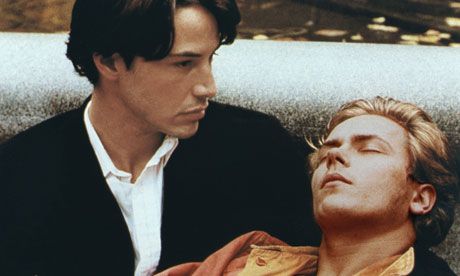
Although I greatly preferred the Shakespeare section, it is in the other two thirds of the film that River Phoenix really shines as Mike.  Mike is a narcoleptic, a fact told to us in the very opening of the film, and he collapses at terrifically inopportune times throughout the story.  Scott is always there to take care of him, though.  Puts him in a cab, pulls him to safety, keeps him out of trouble.  It’s easy to see how Mike, a loner, emotionally attaches himself to Scott, a hedonist, only to ultimately find himself alone yet again.  Phoenix is all physicality, twitchy and tetchy, with his constantly shrugged shoulders showing how he is withdrawing from his world.  He is mumbling and fumbling, but when he slowly and awkwardly admits his feelings for Scott, it’s emotional and sad.

 
Ultimately, I felt too much of a disparity between the Shakespeare portion and the Mike’s story portion.  While Van Sant plays freely with film composition, employing several little oddities (stop-motion camera shots, freeze frames that aren’t freeze frames, animation, iris camera shots), the two parts are too different for me to reconcile them to the same movie, the same story.  Truth is, they aren’t the same story – Mike’s story versus Scott’s story – but it’s too far of a stretch to explain away as simply “idiosyncratic.”  It’s far too cut and paste for my taste.  I ended up wanting more of the Shakespeare section; make a movie of that on its own.  I would love that.  And while yes, Mike’s story is the heavy heart of the film, I’d rather watch the Shakespeare section. 

Overall, My Own Private Idaho is a quirky yet un-melodramatic look at street culture and loneliness.  The search for belonging is one that will never end for some.  The end of the film, somewhat ambiguous, I read as an unhappy epilogue to a fairly unhappy story, indicative of fantasy and perhaps heaven, not reality.  Others read it as a hopeful ending.  It’s a good ending, though; fitting to the oddball little flick that Van Sant created.

Arbitrary Rating: 7.5/10

Thursday, January 24, 2013

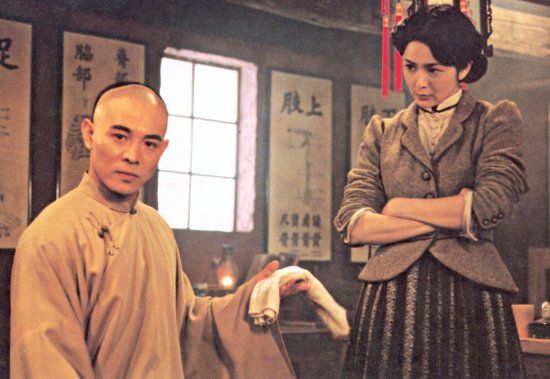
Once Upon a Time in China


Once Upon a Time in China
1991
Director: Hark Tsui
Starring: Jet Li, Rosamund Chan, Yuen Biao

I always think that it’s good for me to stretch myself with the movies I see, and 1001 Movies is a fantastic way to do that.  Still, there are movies and genres I typically find more tiresome than anything else.  While I think the dramatic and beautiful martial arts dramas that have come out of China in the last decade are fantastic, watching their predecessors is a bit of a grueling experience.

The story told in Once Upon a Time in China focuses on Wong Fei Hung (Li), a Chinese historical hero.  Wong didn’t understand the desire to Westernize Hong Kong, and fought the imperialism encroaching from various forces (in this film, mostly British and American).  But the story also delves into some in-fighting between an apparently corrupt local government and Wong’s pure-of-heart band of warriors, a local militia.  There’s a follower, Foon (Yuen), and a love interest, Aunt Yee (Kwan) along the way.

At least, that’s what I think the movie is about.  Rarely have I seen a movie as stupidly difficult to follow as this one.  The battle against foreign entrepreneurs and slave traders in order to preserve Chinese cultural integrity works just fine; I got that message, loud and clear, as randomly presented as it was.  But the warring factions among the Chinese were never fully explained, people appear out of nowhere with backstories that are, at best, glossed over, and characters change allegiance for no apparent reason.  The film left me with a perpetual look of confusion on my face.  By the time I thought I had things figured out, the bad guys were suddenly good guys and I was all, “Wait, WHAT?!?”  It becomes exhausting, watching a film this way.  With a substandard DVD transfer, low budget subtitles (in the version I watched, Aunt Yee was Aunt 13.  Aunt 13.  Really?!?), and painfully obvious and totally awkward overdubbing, this was a very crappy movie experience for me.  One of those where as soon as I put the disc in and saw the quality, the film already had a strike against it, and when I was ten minutes in and was already confused, I knew it would be a long two plus hours.

 
But, having said all of that, I can understand why this movie makes it into the list of 1001 Movies You Must See Before You Die.  As I said in the beginning, the gorgeous Chinese fighting epics of the last decade weren’t magically born, they had to evolve from something.  Although I would never, ever want to watch this particular movie again, I can see how it led to future films like Hero, also with Jet Li.  The importance of preserving cultural heritage in the face of encroaching foreign dangers must have resonated profoundly with the Chinese at the time.  Although I hardly agree with their politics, I can understand how a movie like this would appeal to the patriotism of the people.  Given that the film is set in 1875, one of the things the outsiders bring is guns and rifles; as Wong Fei Hung says, how can kung fu compete with that?  When great warriors are brought down from afar by amateurs with a rifle, there’s a genuine feeling of loss and senseless cruelty.  The ability to fight using the martial arts is presented as something beyond skill; it’s a beautiful talent, a thing of art, and when that is mercilessly bulldozed by a bullet, it’s sad.  When the guns are used on civilians, though, that’s when the film gets angry.  Tsui doesn’t shy away from blood, and there’s an unexpected amount of gore in the film to underline just how horrible gun violence is.

And, of course, there’s the fighting.

 
Like any martial arts picture, it’s the fight choreography that stands out here.  This is Jet Li, after all, so you expect brilliance, and he doesn’t disappoint.  While there’s a little wire work, it’s used sparingly in order to focus on other fighting styles.  Personally, while I find wire work very graceful, the lack of it here helped me appreciate Li’s tireless athleticism all the more.  That dude has moves, man.  There’s a very nice slow motion battle in the rain, and the grand finale of the film where he faces off against an adversary on a series of interconnected and off balance ladders is novel and exciting. 

Ultimately, though, this is too much for me.  It’s too confusing.  I felt my brain giving up on the film very early on, and wound up playing the Countdown Game with my DVD player; never a good sign for a film.  I physically got up and left the room while leaving the movie playing, something I hardly EVER do with a movie I haven’t seen before, because I was so annoyed with the utterly ridiculous plot.  My final thoughts can be summed as such: a progenitor of more enjoyable films, but not enjoyable for me. 

Arbitrary Rating: 4/10.  Moderately interesting redeeming features are not enough to compensate for a poor transfer DVD and an unnecessarily convoluted plot.