Showing posts with label 7.5 out of 10. Show all posts

Monday, July 8, 2013

I Walked with a Zombie


I Walked with a Zombie
1943
Director: Jacques Tourneur
Starring: Frances Dee, Tom Conway, James Ellison

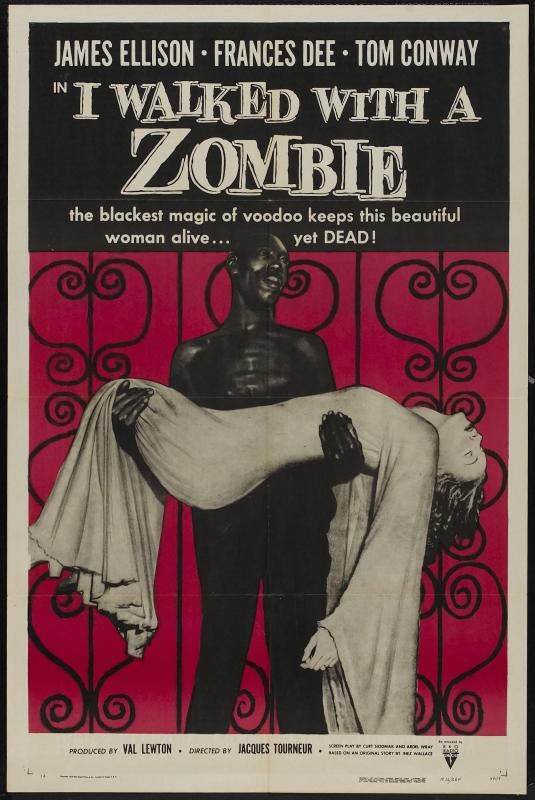
I mentioned before that I have a thing for Shakespeare.  If I get the merest whiff of a film being a Shakespeare adaptation, however transposed, strained, or incomplete, I am automatically predisposed to liking said movie.  The same goes for many classic novels.  I am fascinated by how stories that have been around for hundreds of years can be made new and relevant by putting the story in a different time or place.  And what’s one of my all time favorite classic novels?  Why, it’s Jane Eyre!  I love Jane’s fierce independence and moral code, and I really love brooding, angry, sexy Mr. Rochester.  And here, in I Walked with a Zombie, we have an odd mash-up of Caribbean voodoo culture, zombie ideology, and, of all things, Jane Eyre.  When you throw in the fact that this was directed by Jacques Tourneur and produced by Val Lewton, what results is a decidedly B-picture in overall quality, but one that drips with atmosphere and, despite its shortcomings, really works for me.

 Canadian nurse Betsy (Dee) is sent on assignment to the West Indies to care for Jessica Holland, the pretty but catatonic wife of bitter, brooding Mr. Holland (Conway).  It seems that although Jessica can breathe and walk and follow simple commands, she is completely unresponsive.  A bit of snooping and prying and Betsy learns of a family tussle involving Jessica and Mr. Holland’s brother, Wesley Rand (Ellison), who had hoped to run away with the seductive Jessica, leaving Mr. Holland in the lurch.  Finding herself falling for her employer, Betsy becomes determined to awaken Jessica from her state and even turns to the island natives and their voodoo culture in the hopes of bringing Jessica around.  But is Jessica really still alive?

 
There are two fundamental plot lines running through I Walked with a Zombie, that of Betsy and Mr. Holland’s attraction and the sadness and pain surrounding it, and the exploration of voodoo culture.  The former takes up the focus of the first half of the brief film and is clearly ripped directly from Jane Eyre (apparently by Val Lewton to spice up the source material for the film), and the voodoo scenes are the focus of the second half.  Although there are certainly deviations from the novel, and some pretty big ones too, I rather love that Lewton managed to put Jane and Mr. Rochester in such a foreign, disparate environment and still have some semblance of the spark that courses through the original story.  Mr. Holland is angry from the get-go, speaking of how this apparently beautiful island is made of nothing but death.  Betsy has several exchanges with Mr. Holland that are almost one-to-one with conversations from Jane Eyre.  And when Mr. Holland and Betsy realize they’ve fallen in love with one another and yet are both stymied by the existence, however brain dead, of Jessica Holland, I fall in love with I Walked with a Zombie.  Yes, that’s really all I need.  Does that make me shallow?  No, I think not, but definitely idiosyncratic.  When I think of Mr. Rochester as possibly the most swoon-worthy character in all of fiction, I will latch on like a limpet to any iteration of him I can find, even if he’s played somewhat woodenly with a George Sanders-esque delivery in a movie with “Zombie” in the title.  
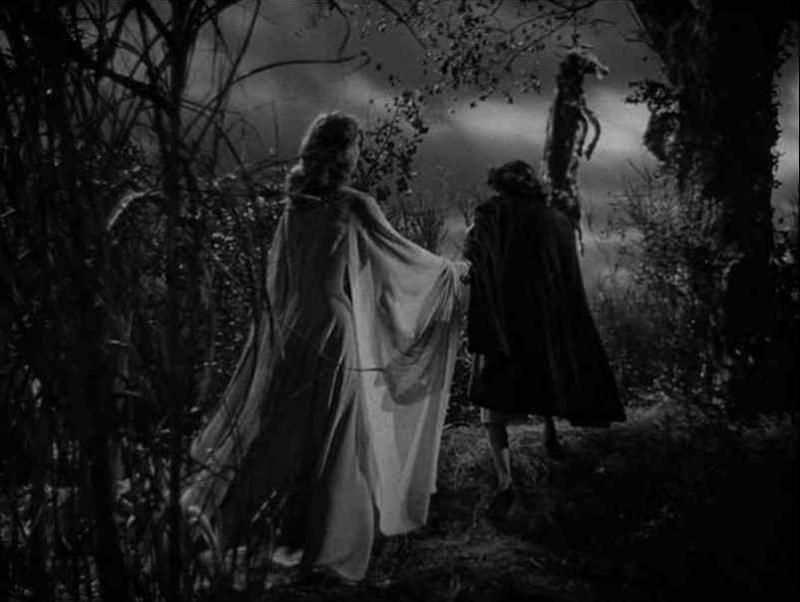

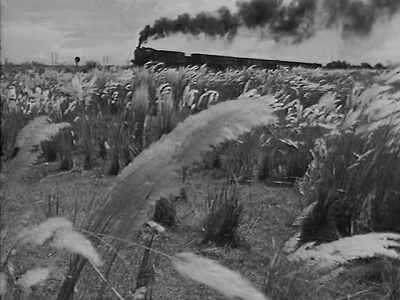
It is in the second half of the film where focus shifts to the native island religion of voodoo is where Tourneur really gets to show off his love of dark and shadows and atmosphere.  Tourneur’s camerawork is downright stunning in places, showing fantastic shot composition and emphasizing long shots over close ups, making you very aware of the dangerous and dark surroundings.  While hardly frightening by today’s standards, and I’ll add right here right now that I Walked with a Zombie shouldn’t scare you in the slightest, it has scenes that are hypnotic and darkly beautiful.  The nighttime walk through the sugar cane fields by Betsy and Jessica is easily a highpoint of the film, and where the memorable zombie Carrefour is introduced.  Full of tension with little payoff (which only manages to heighten the mood), Tourneur fills the screen with shadows and your ears with the percussive beats of the native drums, all of which leads up to a voodoo ceremony that feels distinctly un-Hollywood for 1943.  This hypnotic dance at the aforementioned ceremony was oddly compelling.  Dare I say it, Tourneur seems to treat voodoo culture with a modicum of respect.  By the end of the film, it is the white family that seems to be foolish, not the locals.  Do I buy into the culture that Tourneur is showing me?  No, not at all, but what he’s constructed here works to fill the story with a sort of nonthreatening dread, and one that feels oddly believable, especially for the time the film was made.  
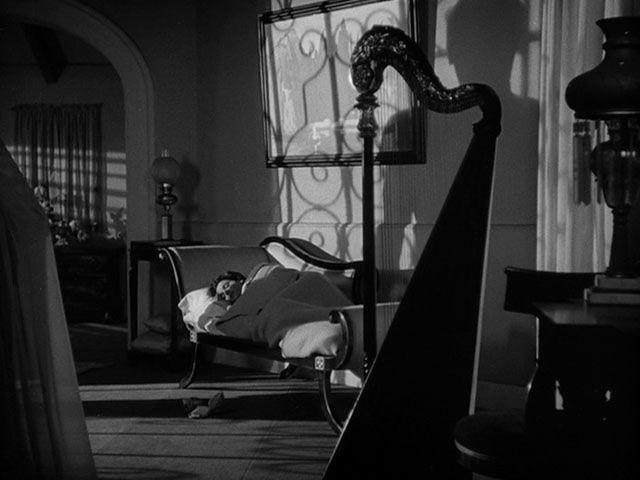
OK, that is a pretty, pretty shot.

Where I Walked with a Zombie works least for me is in the actors’ performances.  Everyone here seems straight from the bottom of the second or third tier barrel, with not one lead actor managing to deliver their lines in anything resembling a naturalistic way.  Rand and Holland’s mother was played by an actress who was the same age as actors Conway and Ellison, and her makeup and wig is hardly convincing.  Although he doesn’t help things along with his performance, I did like how the character of Wesley Rand managed to be less an out-and-out villain and more a sympathetic character.  The two most haunting performances were by the two zombies of the film, Carrefour, played with silent menace by Darby Jones, and Jessica, played by Christine Gordon.  Although it’s true Gordon doesn’t have much to do in the film, she manages to make catatonic into something disconcerting.  Those empty eyes, that strange compulsion, her unnatural thinness… yes, it’s not a challenging part, but Jessica is haunting.
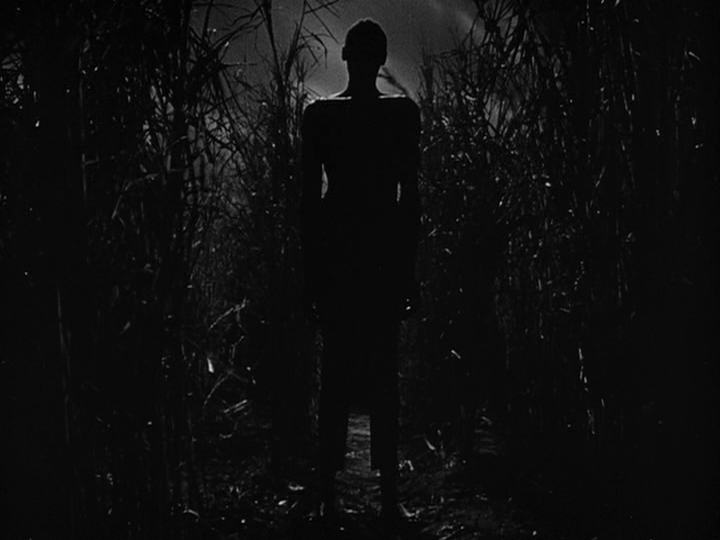
  
Look, I Walked with a Zombie is hardly Citizen Kane.  But it doesn’t pretend to be, and I respect that.  It’s hardly aspiring to be more than an atmospheric voodoo love story, and you know what?  It works for me on both those levels.  I love Jane Eyre, and I love the sensibilities of filmmaking in the 1930s and 40s.  I Walked with a Zombie doesn’t make you, as a viewer, do much work, but I need that every now and then, and it’s a perfectly acceptable and rather fun way to pass the time.

Arbitrary Rating: 7.5/10

Friday, June 21, 2013

Pather Panchali


Pather Panchali
1955
Director: Satyajit Ray
Starring: Subir Banerjee, Uma Das Gupta, Karuna Banerjee, Chunibala Devi

For everything the modern American filmgoer thinks they know about Indian cinema, none of it would exist without Pather Panchali and Satyajit Ray.  Although Ray’s work is light years away from the flashy Bollywood spectacles, and much more akin to the Italian neorealist movement, Ray’s work put Indian cinema on the map, and this is the one that started them all.  Is Pather Panchali an easy film, or even an entertaining film?  No, not really, but it occupies a significant place in film history.

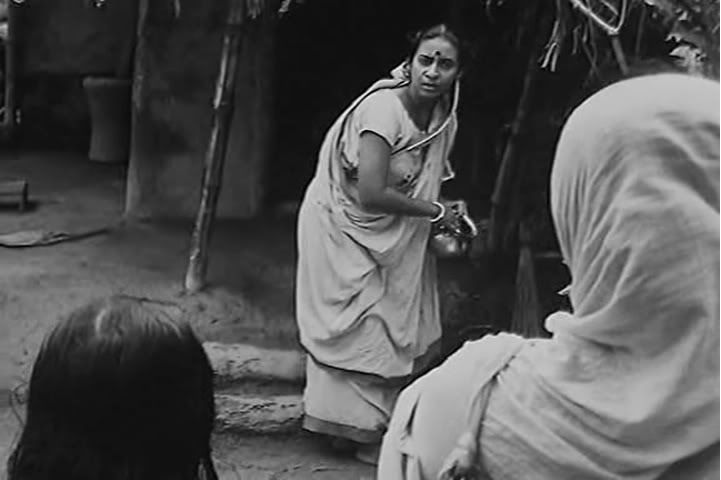
The film follows a small, poor Indian family living in the country in the early twentieth century.  The mother (Karuna Banerjee) is constantly worrying about money, as her husband is a priest and playwright who works only sporadically and doesn’t bring many wages home.  She’s also looking after an elderly relative Auntie (Devi) while tending to her two children, daughter Durga (Das Gupta), who is the first born, and young son Apu (Subir Banerjee).  


And that’s about it.  There is no overarching storyline from beginning to end; we merely observe this family living its life throughout the film.  It’s not even episodic; there are not distinct threads we explore and then fulfill.  No, we just watch and observe, become a part of the family’s life for the period of the film.  This works very well to paint an image of the lives we are following, but, to be honest, it makes for a rather difficult and long film to take in.  At two plus hours, it tends to move at a snail’s pace, and it’s a bad sign when, thirty minutes in, I feel like we should be halfway through.  I appreciate greatly Ray’s desire to draw for us these wide swaths of poverty-riddled rural India, and there is absolutely no doubt that this film exposes me to a world I would otherwise not have known.  But it’s a bit of a rough journey along the way, the end result being not exactly the most gripping film.

Now, having said that, there is tremendous beauty in Pather Panchali.  The film is set in the countryside, and Ray goes to town with some gorgeous shots of a small path in the woods, of rain falling on a pond, of fields of wheat, of old buildings nestled amongst trees and streams.  For a filmmaker making his first film (and a director of photography shooting his first film, and several actors acting in their first film), there is an extraordinary sense of confidence in Pather Panchali.  Ray plays with light and shadow in some scenes, we have a tracking shot through the women in the village square, and constantly, there are subdued performances from all the lead actors, and at the end of the film, there is the feeling that this is exactly the movie Ray wanted to make.  

 
Once again, here is a film that uses mostly nonprofessional actors to fill the leads.  The father, played by Kanu Banerjee, had some experience, as did the actress playing Auntie, but all other parts were filled by amateurs.  What I tend to like about nonprofessional film actors, is how they typically underplay their scenes, as this can be very effective.  It’s no different in Pather Panchali.  The emotional range of the story is great, starting with birth and going to death and back again.  The actors, though, leave histrionic fits at the door and instead are simple and open in their delivery.  Ray apparently had little script to work with, so these actors were also improvising based on his notes for the scene.  When it came to the two siblings, Durga and Apu, this approach led to a very natural relationship.  Durga and Apu feel like real siblings, a brother and sister who play together, fight together, and do chores together.

 
Additionally, my favorite aspect of Pather Panchali, and, indeed, most of Ray’s films, is probably its use of music.  As this is not Bollywood, there is little to no singing, and music is mostly for soundtrack purposes.  The music in Pather Panchali is mostly that of long instrumental ragas, songs that are repetitive in nature, but that I also tend to like.  Wikipedia tells me that ragas can be defined as “a tonal framework for composition and improvisation,” and this definition seems fitting.  There is a distinct sense of hypnotism in this sort of music, in its gentle yet insistent percussive repeats, where lack of a distinct melody actually works.  Every time Ray uses soundtrack in Pather Panchali, I feel the movie works better.  It’s a shame, then, that he chooses not to use soundtrack for the majority of the film.  In the quiet of the simple dialogue, I watch the family with a bit of a sense of tedium, but when Ray adds music, it’s magical.  The music provides a further emotional underpinning to Ray’s message, and I love it.  All the pieces are distinct enough to emphasize the particular scene they were chosen for, and there is a wide range of emotional set pieces and therefore, a wide range of musical accompaniment.  But it’s all good stuff.

 
Ultimately, Pather Panchali is a film that deserves your respect, even if you don’t exactly enjoy yourself while watching it.  It’s a bit tedious at times, and more than a little depressing at times, but it’s also full of beauty and warmth.  Pather Panchali was a huge bounding step forward not only for Indian cinema, but international cinema as a whole, as it speaks to the fact that people in every country have a story to tell with which the whole world will identify. 

Arbitrary Rating: 7.5/10

Tuesday, April 23, 2013

Blow-Up


Blow-Up
1966
Director: Michelangelo Antonioni
Starring: David Hemmings, Vanessa Redgrave

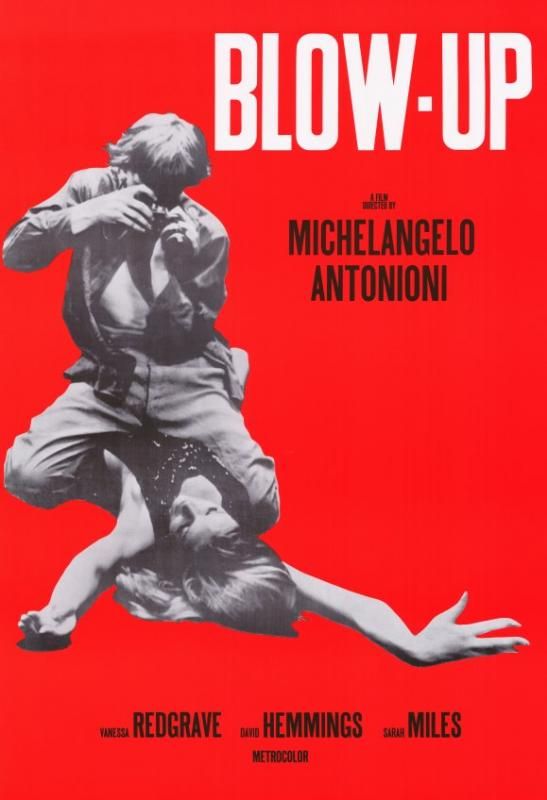
Antonioni is a director that I struggle with, and I don’t feel ashamed to admit it.  His work is hardly what anyone would call “easy.”  He likes to make films about alienation, which is not an easy or entertaining topic.  Of all the Antonioni films I’ve seen, Blow-Up is the most accessible, but even that’s not saying much.  This is my second pass at Blow-Up, and while I feel as though I “get it” a bit more than the first time, it is not what I would consider to be entertaining.

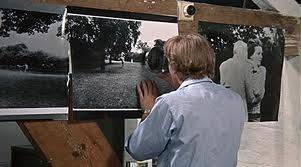
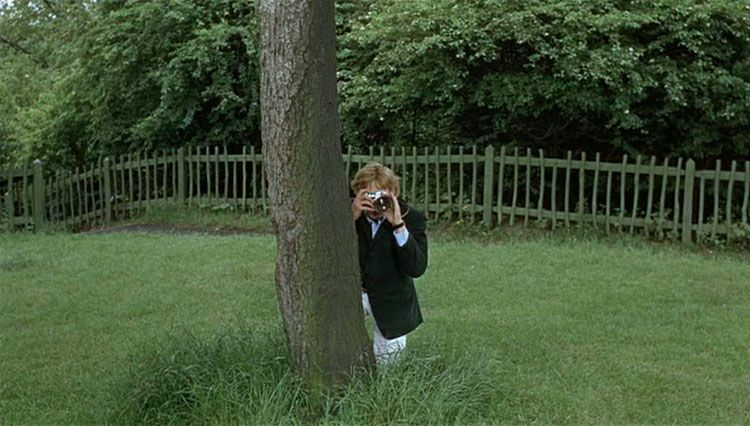
Set in a swinging London mod scene that is everything Austin Powers was skewering, a trendy photographer (Hemmings) is bored.  Bored bored bored.  So one day, to escape the boredom of shooting more vapid fashion shots, he takes his camera to a park and starts shooting landscapes.  He sees a young woman (Redgrave) and an older man who seem to be canoodling, and keeps shooting.  The young woman gets distraught when she sees him and demands the film.  He refuses, she tracks him back to his studio and tries to seduce him to win back the film.  He still refuses, then starts examining this precious film.  The more he looks at it, the more he thinks he sees… something.  But what, exactly, and what does it mean?

 
I think the reason I was a bit disappointed when I first watched Blow-Up, and why I was less so this time, was that initially, I thought it was about the mystery of what was on the photos.  Let me be as explicit as possible here: if you watch Blow-Up expecting a great mystery, don’t.  Just don’t.  That’s not Blow-Up.  The mystery, such as it is, occupies approximately half the film, if that.  The other half of the film is about the photographer’s lifestyle, and that, to me, is what this movie is REALLY about.  By “lifestyle,” I don’t mean the ridiculous swinging mod London, sex with groupies, or rock concerts.  No, I mean the photographer’s personality.  His alienation.  His existential coma.  

 
The first half hour of the film sets up the photographer’s boredom.  He comes alive most when he is taking photos, but not even taking photos is a guarantee that he will enjoy himself.  Look at how awful he is to the models during the early fashion shoot, barking orders at them and treating them with cold cruelty.  He doesn’t seem like he’s having any kind of fun.  We can feel him rolling his eyes as some groupies try to get his attention, and even a conversation with his neighbors, who he appears to like, does little for him.  In the park, though, he gets excited.  We see a sort of animal spirit begin to appear.  This same excitement, after ebbing, comes back when he starts examining the film.  Antonioni seems to be saying that our photographer (IMDB says his name is “Thomas,” but he is never properly given a name in the film) has a life that is empty and hollow, but when he is most embroiled in his craft – in taking pictures of things he likes, of developing interesting film, of blowing up certain shots – then he is most alive.  Then he is not a dead soul.  The possibility of a mystery engages him in a way that vapid sex doesn’t, but the film closes in the last half hour with his spiritual awakening ebbing away for good.  The mystery starts to fade, the proof begins to disappear, and slowly, our photographer is drawn – perhaps against his will, perhaps not – into his superficial life of the beginning of the movie.  The final shot of the film, in which our character literally disappears (that is NOT a spoiler in any way), is a huge statement about this superficiality.  That is the journey of the film: watching a man find something that interests and engages him, then watching it run out of his fingers like cupped water.

Antonioni is known for his color work, and there is very nice color work in Blow-Up.  There are bright reds and blues on the buildings of London, insanely bright whites and ebony blacks in the photographer’s studio, but my favorite is the green of the park.  The park is perhaps the most significant set in the film as it sparks, and then concludes, our photographer’s interest.  This is a brilliant green, a terrific emerald green.  The grass is green, the trees are green, the fence is green.  And the park is surprisingly vacant – the green is not interrupted.  The sky, interestingly, is not blue, but gray and overcast.  I think that’s significant.  Antonioni was highly specific about his colors, to the point where he actually shot the park sequence twice in Blow-Up because he didn’t like the green of the grass on the first go, so he had it spray-painted just the right shade and then shot it again.  If he had wanted the sky to be blue, he’d have waited for a nicer day.  But no, he must have wanted the sky to be gray.  In a way, this seems to make the other colors pop.  I love the contrast of the gray and the green together.  Gray, overcast days are my favorite type of weather, and I think a feel a bit of a connection to seeing this onscreen.

 
This is a very silent film.  I wouldn’t be surprised if all the dialogue from the film could fit on ten pages worth of script.  There are long, loooooooooooong stretches where no one says anything.  And Antonioni doesn’t help cut the silence by providing background music, oh no.  There is almost no soundtrack to this film.  No one talks, and there is no music.  During the scenes where the photographer starts to delve into the mystery of the film, this silence is effective in building tension and excitement.  But for nearly every other part of the film, though, this silence feels tedious.  Yes, it underlines our main character’s dreariness, but it itself is also dreary.

Which leads nicely into my final feelings about Blow-Up.  I understand now, better than previously, that Blow-Up is about ennui.  But does that make it something I like?  I don’t think so.  Frankly, watching a movie about someone who’s bored is, well, boring (Jeanne Dielman, anyone?).  A film about someone suffering from swinger angst, bored to death of his tedious glittering lifestyle?  I have very little sympathy for our main character.  He disappoints me by sick and tired of his superficiality, but then is completely unable to extricate himself from it.  I *was* more engaged in this second go-around, again because I knew not to expect too much from the mystery and to look more at the photographer’s emotional arc, but this film does not earn a rave from me.  I get Antonioni’s message.  But, y’know, that’s about it. 

Arbitrary Rating: 7.5/10.  It was good for me to watch this a second time.  I found more there.  This score is more about appreciation than entertainment, though.