Showing posts with label 1967. Show all posts

Monday, July 29, 2013

The Graduate


The Graduate
1967
Director: Mike Nichols
Starring: Dustin Hoffman, Anne Bancroft, Katharine Ross

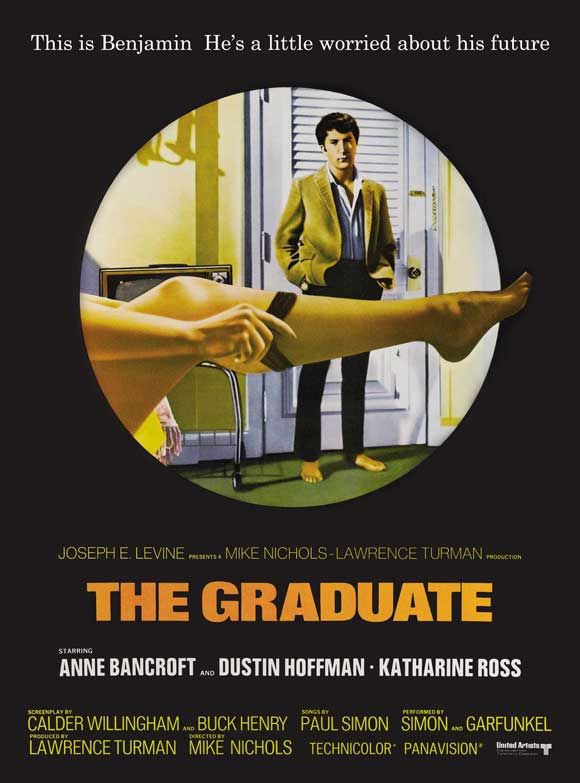
While not as definitive or landmark a film to me as it is to many people, especially those of my parents’ generation, The Graduate remains a potent, awkwardly comic, and ever-unsettling coming of age story.  Given that the first time I saw it, I had not yet really “come of age,” it makes sense that it was mostly lost on me then.  Re-evaluating it, however, in order to write this piece, I found myself smiling, cringing, and appreciating The Graduate in a way I distinctly do not remember doing before.

Benjamin Braddock (Hoffman) has just graduated with awards and honors from college, but he isn’t in a celebratory mood.  Upset and disconnected, he doesn’t know what he wants to do.  Enter Mrs. Robinson (Bancroft), his father’s business partner’s wife, a woman he has known since childhood.  When Mrs. Robinson tells Ben that she would like to sleep with him, the two enter into the least sexy affair you’ve seen in some time, one born of a desire to escape boredom rather than any kind of attraction.  Things get immensely complicated when Mrs. Robinson’s daughter Elaine (Ross) comes home from college on break and Ben finds himself falling in love with her.
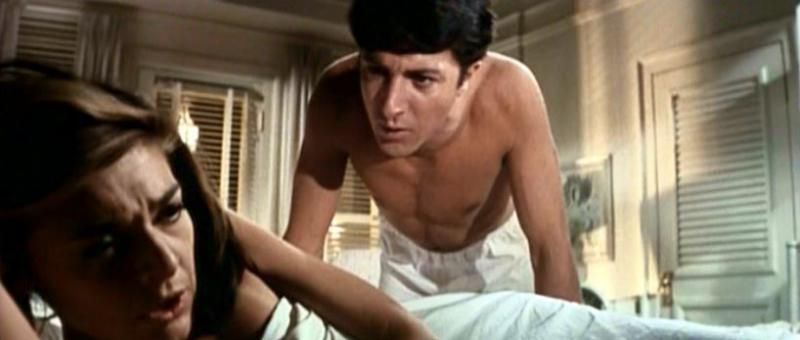

Part of the reason I felt so massively underwhelmed by The Graduate when I first saw it was its advertisement as a comedy.  In seeing it a second time, I think I chuckled maybe three times, and smiled about half a dozen times.  If you’re watching The Graduate expecting a laugh riot, well, don’t.  Categorization of this film is tough, as there are certainly comic moments (“Plastics” is good for a smile, as is “You’re the most attractive of my parents’ friends”), but overall, I find it a very emotional story.  Terms like “dramedy” were invented with films like this in mind.  But I remembered that I didn’t find it laugh out loud funny, and approached The Graduate a second time watching it as a drama.  The film makes more sense to me this way. 

Benjamin’s tale is a difficult one; a young man who has achieved much in school but now finds himself lost.  He is Hemingway’s Lost Generation, he is Generation X of the nineties, as he battles this sort of existential angst that threatens to consume his very soul.  Benjamin does many things in The Graduate to try to distract himself from this frighteningly hollow sense of emptiness and despair, but he never really manages to succeed; the famous final shot is proof enough of that.  Mrs. Robinson is a physical distraction, and her daughter Elaine isn’t much more.  Benjamin becomes obsessed with the idea of Elaine rather than Elaine herself, and I have trouble buying that his protestations of love for her are real.  He sees in Elaine a kind, gentle young woman and suddenly a possible pathway out of his despair appears to him.  Had it been a different girl at a different time, he would have been pounding on the window of a different church at the end.  It was not Elaine in particular, it was the notion of her.  But neither the thought of Elaine nor Elaine herself can save him from his life, as the ambiguously downbeat ending seems to say.  Nor is Benjamin terribly likeable.  While, as the definite central character of the film, there is an automatic tendency to want to root for him, Benjamin does many things that make this difficult.  Stalking Elaine, for instance, after knowing her a relatively small period of time and upsetting her greatly; engaging in emotionally self-destructive behavior for another.  I suppose he is the “hero” of The Graduate, but that does not make him good.  
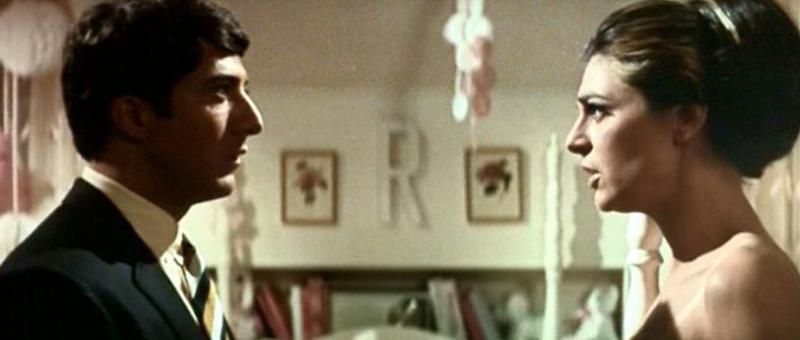

Hoffman, in his first major film role, is tremendously good as Benjamin.  His performance in the first half, before Benjamin has met Elaine, is nothing short of phenomenal.  Hoffman is awkward and uncomfortable in everything he does, from robotically grabbing Mrs. Robinson’s breast to sitting on the bottom of the swimming pool in a diving suit to nervously checking out a room at the Taft Hotel.  Rather than the Hoffman that is more well known today, one who overacts and typically delivers broad performances, this is an incredibly self-contained Hoffman.  We feel how much he is holding on the inside as Benjamin, how much unnamed pain he carries around, how unhappy and depressed he is as he presents a bland smile to the camera.  Hoffman loosens Benjamin up in the second half after Elaine has been introduced, hinting at her as his possible salvation, but the performance isn’t quite as interesting.  It makes sense, yes, just not as compelling. 

Mike Nichols, in only his second feature film (after Who’s Afraid of Virginia Woolf?), directs a visually fascinating story.  The influence of the French New Wave is all over The Graduate, most notably in the montage where Benjamin is against a black background and we see him watching TV or sleeping with Mrs. Robinson or avoiding his parents.  There are a few nifty match cuts (jumping on a raft switches to jumping on Mrs. Robinson), some interesting point-of-view scenes (watching from Ben’s view as he is in his scuba suit and all we hear is breathing), and a lack of fear about getting too far away or too close to the actors.  There are times when he physically distances the camera from the actors, there are long takes, and scenes where we cannot hear the conversation being carried out.  The Graduate burst on the scene in 1967 to much acclaim, and with filmmaking techniques this innovative for the time, it’s easy to see why.  It still felt fresh to me, despite the fact that the film is *gulp* coming up on its fiftieth anniversary.  
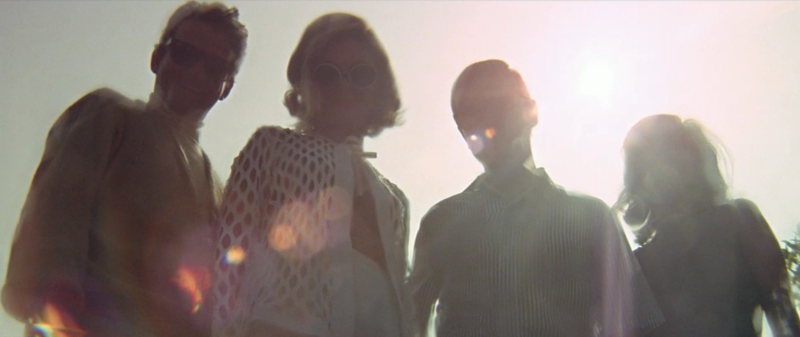

Having lived through my horrible twenties and some slight adventures in depression, I can, in some way, relate to Benjamin Braddock.  I don’t approve of his actions, but his feeling of discontent feels all too familiar.  Brilliant performances by Hoffman and Bancroft (which I did not mention here, but she fills the screen as the dominatrix-esque Mrs. Robinson), Simon and Garfunkel’s iconic soundtrack, Nichols’ glorious cinematography, and its undeniable place as a touchstone film for an entire generation ensure that The Graduate will continue to be discussed for years to come.

Arbitrary Rating; 8/10

Monday, July 1, 2013

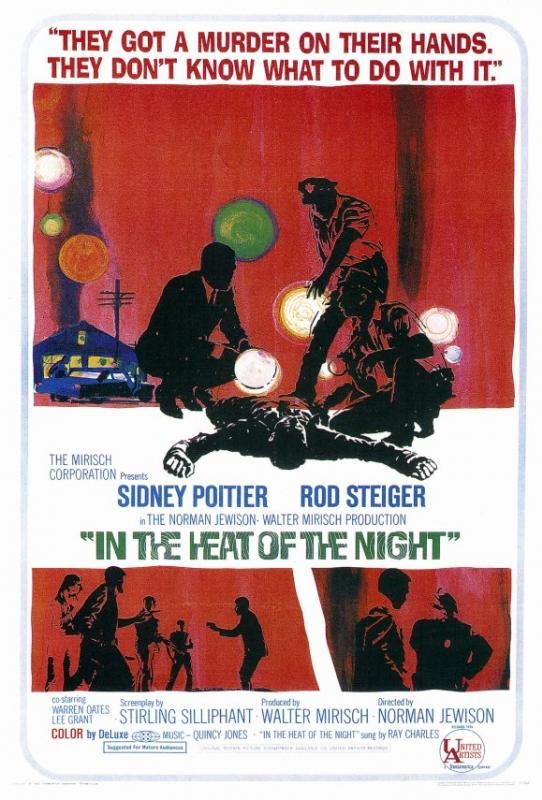
In the Heat of the Night


In the Heat of the Night
1967
Director: Norman Jewison
Starring: Sidney Poitier, Rod Steiger, Warren Oates

Message films can be a difficult sell.  They have to make a point, a point they feel is terrifically important, and this usually results in the filmmakers going to great lengths to drive that point home.   Which, in turn, inevitably leads to heavy handed and soggy films at which I wind up rolling my eyes. 

This is not the case with In the Heat of the Night, no sir, not in the slightest.  It has a point to make, and it makes it fiercely, but it never once feels soggy or ham fisted. 

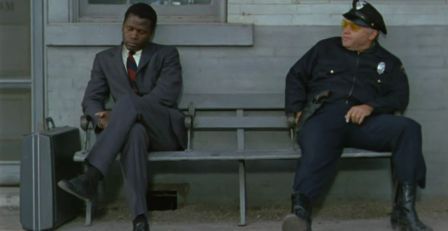
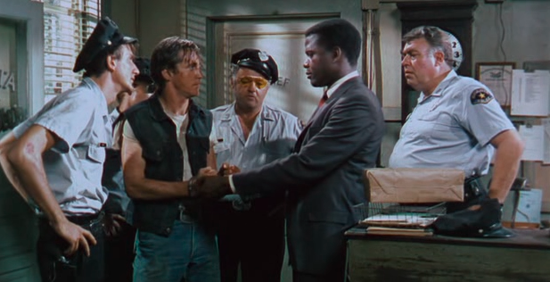
Cop Sam Wood (Oates) comes across a dead body on his night patrol in the teeny Mississippi town of Sparta.  Police Chief Gillespie (Steiger) is flummoxed, so when Wood finds a black man in the train station, he thinks he has his killer.  Turns out he couldn’t be more wrong, as instead he found Philadelphia cop and expert homicide detective Virgil Tibbs (Poitier), who slowly and reluctantly starts to help the local cops solve the case while coming up against dangerous racial prejudices at every turn.  

  
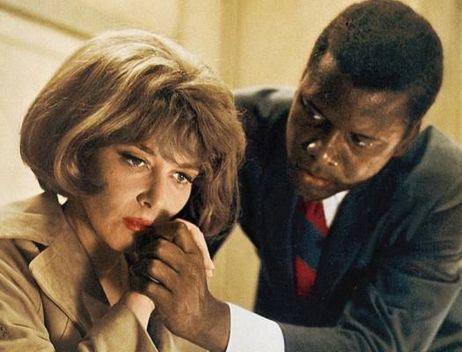
The performances and the smart writing, which work hand in hand with one another, are what set In the Heat of the Night apart from other, lesser message movies.  This film was adapted from its source novel with the specific intention of being a vehicle for Sidney Poitier, and he fills the screen with his enormous, quiet, powerful charisma every moment.  Poitier, who barely utters more than two dozen words in the first twenty minutes of the film as his character is arrested without being questioned, nonetheless exudes a palpable feeling of barely reigned in righteous indignation.  He holds such disdain for the bigoted people he finds himself surrounded with, yet also knows that he has to be careful, too careful, in order to get out of his situation alive.  Poitier exudes this frustration, only rarely allowing it to bubble to the surface, but when it does, as in the famous scene where he slaps a rich and influential white man after being slapped first, it is powerful and almost a little frightening.  Watch how he utterly commands Harvey Oberst when he is locked in a jail cell with him by merely raising a finger.  In the half dozen films or so that I’ve seen of Poitier’s, this is the role that feels most iconic to me.  When I think Sidney Poitier, I think smart, reserved, unrelenting Virgil Tibbs.


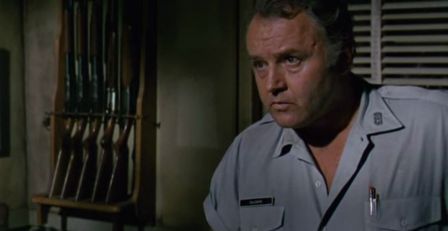
Matching Poitier every step of the way is Rod Steiger as Chief Gillespie, a role that won Steiger his Oscar.  As much as I love Poitier in this film, I grudgingly admit that it is Steiger who has a more challenging role to play.  Gillespie has to slowly, too slowly, come to terms with his own racial prejudices and begin to overturn them, but never too quickly, and probably not altogether.  What makes this movie work so well is the central tension between Gillespie and Virgil Tibbs.  Things are not resolved once it is revealed that Tibbs is a cop; if anything, that’s just the beginning of the turmoil.  Steiger’s Gillespie keeps me on my toes in this film as the very definition of unpredictable.  One moment he’s practically begging Tibbs for his help on the case, and the next he’s chucking him back on a train to go back home.  It’s this vacillation that Steiger plays so well, laying bare for us a man who is very proud and cannot admit he was wrong, yet he must, and does.  In one of the scenes leading up to the finale, Gillespie and Tibbs share a drink at Gillespie’s house, and Gillespie starts a monologue about being lonely.  The moment that Tibbs shows any empathy for Gillespie, Gillespie retreats back into his hardened shell and tucks his soft underbelly away from the barbs of the outside world.  It’s a great scene, and a fantastic example of what I mean when I say this film is never heavy handed about its message.  A lesser film would have the two men crying in each other’s arms, overwhelmed with their newfound respect for the other, but In the Heat of the Night, and Rod Steiger as well, knows that things are rarely that simple.  Gillespie battles with himself every single step of the way, and Steiger is towering in his portrayal of a prejudiced man learning to be better.


On top of the two sizzling performances of the leads, I love how the detective story unfolds in In the Heat of the Night.  Yes, In the Heat of the Night is first and foremost about racial tensions, but it is also a murder mystery.  What I find interesting in how the mystery unfolds is that it is an early example of how forensics and hard evidence are used to solve a case, winning out over “gut” and “instinct” and “hunches.”  Tibbs is a crackerjack Philly homicide cop because he uses forensics; Gillespie is old school and relies on hunches, a fact not helped along by his prejudices.  Tibbs has to fight Gillespie every step of the way with hard evidence, and that’s frustrating, adding on another layer of tension to the already tense film.  Tibbs has to prove his story, and he does it well, but with every new piece of evidence comes a new wrong conclusion that must be fought.  Considering forensic crime dramas command a significant percentage of the television airwaves these days, it may seem quaint to see such simplistic evidence analysis in In the Heat of the Night, but there’s something to be said for being an early trailblazer.  


As I watched In the Heat of the Night, I kept on thinking to myself “would a black man today really get beat up, or even killed, just for being black?”  I know how I’d like to answer that question; I want desperately to say “No.”  But then I remember the all-too-recent case of Trayvon Martin, and I gulp down my answer.  And then I transplant the word “black” with the word “gay,” and the question becomes even harder to answer.  Prejudice is still with us, undeniably, as much as I wish it wasn’t.  The message in films like In the Heat of the Night, filled with great performances and smart writing, are still just as relevant today, even though I badly wish they weren’t.

Arbitrary Rating: 9/10.

Sunday, September 16, 2012

Playtime


Playtime
1967
Director: Jacques Tati
Starring: Jacques Tati and his sets

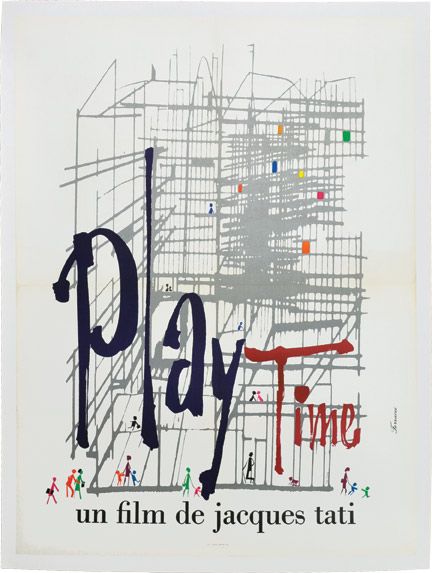
Director Jacques Tati’s third film starring his own character Monsieur Hulot, Playtime is a significant deviation from the previous two Hulot comedies. It takes on larger issues and is, in my opinion, darker and bleaker. Less about the individual than society as a whole, the film is also nothing short of a visual treat, essentially being two hours of nonstop sight gags.

The story, which is very limited and not the focus, centers somewhat around Monsieur Hulot (Tati) as he finds himself in the big city, ultimately revealed to be Paris. Everything is sleek, modern, and technological to the point of utter absurdity. In an office building, Hulot tries to navigate his way around. At night, he gets invited into the modern home of an old friend. We then spend an extended sequence at a nightclub that has just opened up where nothing is quite yet working. The film concludes with a carnival sequence.

Friday, September 7, 2012

Week End


Week End
1967
Director: Jean-Luc Godard
Starring: Mirielle Darc, Jean Yanne

I’m not a fan of French New Wave. I know, right? How can I consider myself a fan of films if I don’t pee myself over French New Wave films? Well, it’s true. I can absolutely appreciate everything that the French New Wave did to change film, yet I’d never count a single one of them amongst my favorites. I do not enjoy them. Godard, in particular, is troubling for me. I have never felt entertained or amused or even moved by a Godard film. Instead, I tend to just sit there with a look of “WTF?” on my face. Have I completely ruined any credibility I may have had by now?

The “plot” is about Roland (Yanne) and Corinne (Darc), an upper class married couple who openly want to murder the other. They go for a getaway on a weekend to visit her father, who they also want dead, and along the way, increasingly tragic and violent (and bizarre) things happen to them.

To me, when I think French New Wave, and ESPECIALLY Godard, I think about rule-breaking. To me, that was what the Nouvelle Vague was all about, and by breaking tried and true cinematic “rules,” it managed to move cinema light years into the future. Like any Godard film, there is all kinds of rule-breaking in Week End, both cinematically, narratively, and sociologically.

Sunday, July 1, 2012

Le Samourai


Photobucket


Le Samouraï
1967
Director: Jean-Pierre Melville
Starring: The too-pretty-for-his-own-good Alain Delon

I have found that when it comes to watching quiet, intense dramas, it helps to be rather tired when watching them. I know that may sound a little weird, but the idea is that you’re not distracted by having too much energy. You’re not jumping around in your seat, and you can really settle into the film. It helps enormously when watching intense but slow-moving fare like Le Samouraï.

Why do I mention that? Because if you’re in the right frame of mind when watching a film, it can make or break the experience. For me, it completely made Le Samouraï. I encourage you to check it out under similar circumstances.