Showing posts with label 1948. Show all posts

Saturday, September 14, 2013

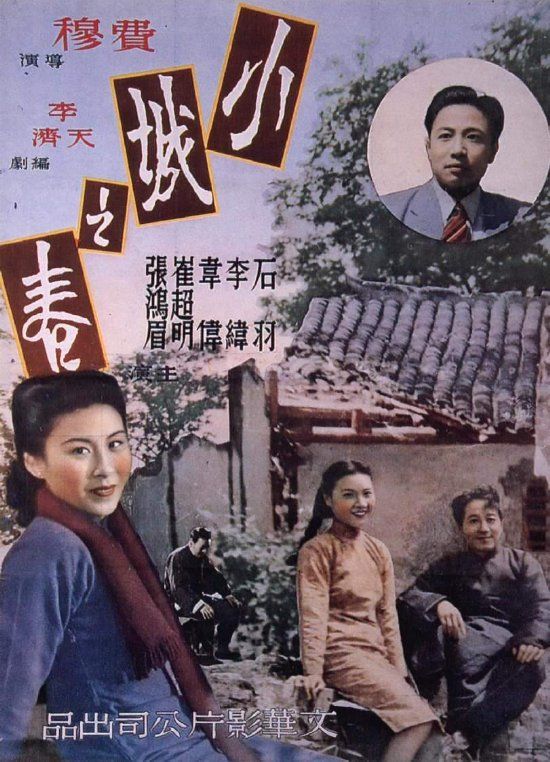
Spring in a Small Town (Xiao cheng zhi chun)


Spring in a Small Town (Xiao cheng zhi chun)
1948
Director: Fei Mu
Starring: Wei Wei, Shi Yu, Li Wei

When I took my first, massive swipe at knocking off titles from 1001 Movies, I went chronologically by decade, something I’m very glad of in retrospect.  The biggest advantage to doing this was to encounter trends in filmmaking as they happened.  The second advantage was watching how national cinemas appeared, or perhaps disappeared.  Take Germany for example: going chronologically, I watched lots of German films in the beginning, then nothing, not for decades.  Rather poignant, that.  On the flip side, there is only one Chinese film that predates Spring in a Small Town in 1001 Movies, indicating that, at least according to the editors of this book, Chinese cinema was still in its birth during the early decades of filmmaking.  Spring in a Small Town was one of the first Chinese films to rise to international stature, one of the first to be considered worth preserving and worth seeing still to this day.

The story is ripped straight from standard drawing room drama tales.  Yuwen (Wei) has been married for eight years to her invalided husband Liyan (Li).  We learn very early on that theirs is a loveless marriage, although they are still affectionate with one another.  She is bored and suffocated by her endlessly repeated existence.  Enter Zhichen (Shi), Liyan’s friend from childhood and Yuwen’s former love.  Her resolve is thoroughly tested as the passion she used to feel and thought dead and buried begins to rise again.
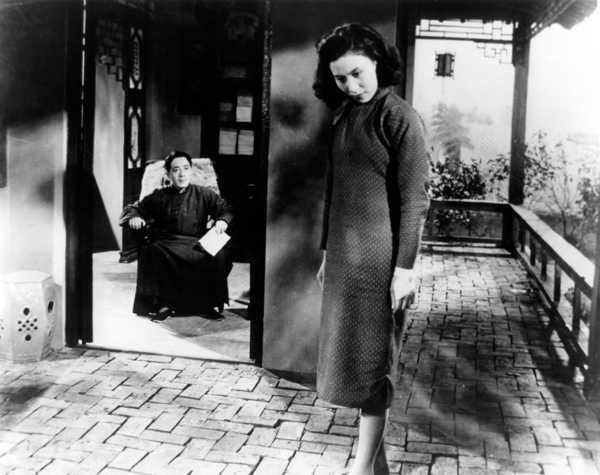
  
I find it fascinating to discover the same sort of tropes I’m used to encountering in Western costume dramas here, in a Chinese film from the forties.  I think that’s telling; it indicates that there are similarities between all cultures, even in basic romantic storylines.  How often have I seen this story played out, this sad sort of repressed love?  Many, MANY times.  I don’t hold this against Spring in a Small Town, the fact that it’s telling a story I’ve heard before; if anything, I like it more for telling a story I am familiar with from its own unique cultural perspective.  And the China that is on display in Spring in a Small Town is from a very distinct time period and culture.  (I will at this point reiterate my comparative ignorance about world history – thank you, New Hampshire public education – so please, this is just a quick review of what I taught myself on the interwebs; if I am grievously mistaken on anything, please let me know.)  The second world war was over, China was no longer under Japanese control, but the Communist Revolution had not yet taken over.  This was a relatively short time period, and the artistic result is a film with very little, if any, political commentary.  Spring in a Small Town is a simple, sad little romance about a repressed woman and her long lost lover who is definitely NOT her husband.  It does not feel allegorical or symbolic of larger issues.  No, it is simply a romantic drama, nothing more or less.  This is probably a large reason of why, when the Communist Revolution did succeed, Spring in a Small Town was roundly denigrated, then forgotten, and nearly destroyed.  I’m glad the film survived, though; it’s worth a viewing, at least one, because of its purity of intent and because, well, it certainly does repression well.
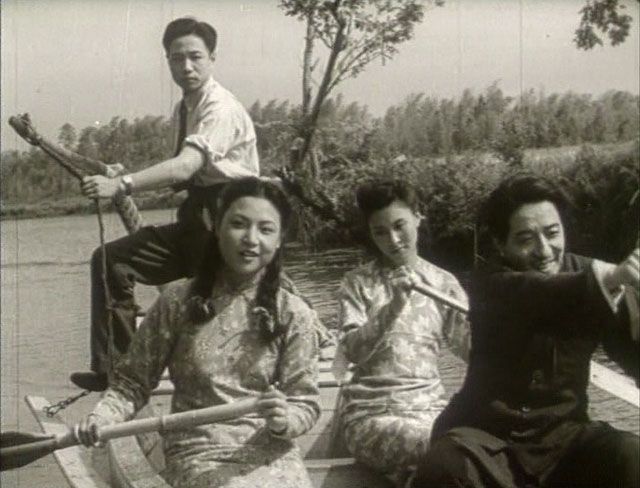
  
Spring in a Small Town gets very angsty.  It moves slowly – it is practically the definition of the slow burn.  And there’s little payoff.  In my first go around with Spring in a Small Town, I remember feeling enraptured by this furtive, repressed romance between Yuwen and Zhichen.  This time, I was less affected by it, but it still has its moments.  Despite the, um, VERY slow build up, I was still caught up when Yuwen gets drunk, slips up, and throws herself at Zhichen.  And it takes every smidgen of strength he has to do the honorable thing.  And I rather enjoy it.

Spring in a Small Town is very reminiscent of Brief Encounter.  Repressed woman narrating her own tale of romantic feelings for a man, a doctor, who is not her husband?  Brief Encounter.  Frankly, Brief Encounter does it better – loads better – but the voice over narration in particular I find important in Spring in a Small Town.  Just like in Brief Encounter, it is crucial in providing us a critical window to Laura’s soul so we understand her, we need that gateway to Yuwen, perhaps even more so.  As much as Laura presents a calm façade to the outside world, Yuwen is one hundred times more serene on the outside, never letting on for a second what might be happening under the surface.  This is actually a bit of a detriment to the film; I needed more than a voice over to convince me of the magnitude of Yuwen’s feelings, and the actress didn’t quite manage to convince me on performance alone.
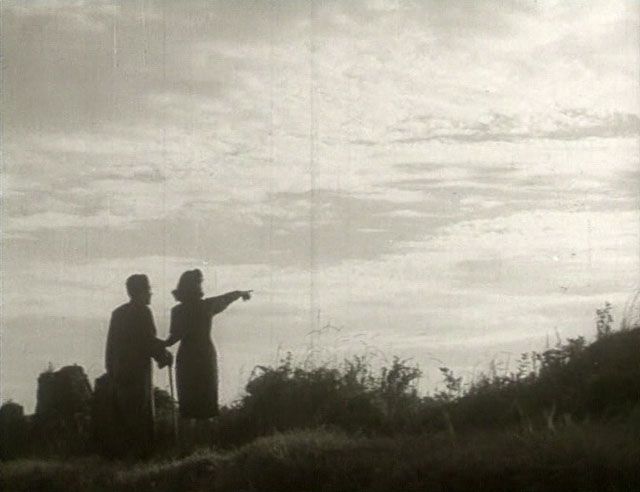
  
The other major mark against Spring in a Small Town is the condition of the film itself.  This is, sadly, a film that has not been preserved well in the slightest.  The DVD is watchable, certainly, and the English subtitles were clear (not always a given), but the image is hazy and foggy and full of scratches.  The sound isn’t any better; it’s muffled and the background static is incredibly loud.  Even the original filming conditions seem less than perfect, as the background noise cuts out in certain parts of scenes, indicating that there was just no sound, PERIOD, while recording.  The story works well enough in Spring in a Small Town, but the logistics are incredibly lacking.  It’s very difficult when it’s this bad not to let this affect my read on a movie. 

Spring in a Small Town was remade in China in the early 2000s, and I’m not surprised.  The story is universal enough and works pretty well, but the original film could use a brush up, more style, better acting, and any sort of a soundtrack.  I have not seen the remake, but I’m glad at least someone thought it worthy of telling again.  Frankly, though, if I want angsty romance, there are plenty of other films I’d choose over Spring in a Small Town (Brief Encounter most definitely).

Arbitrary Rating: 6/10


Monday, April 1, 2013

Secret Beyond the Door


Secret Beyond the Door
1948
Director: Fritz Lang
Starring: Joan Bennett, Michael Redgrave

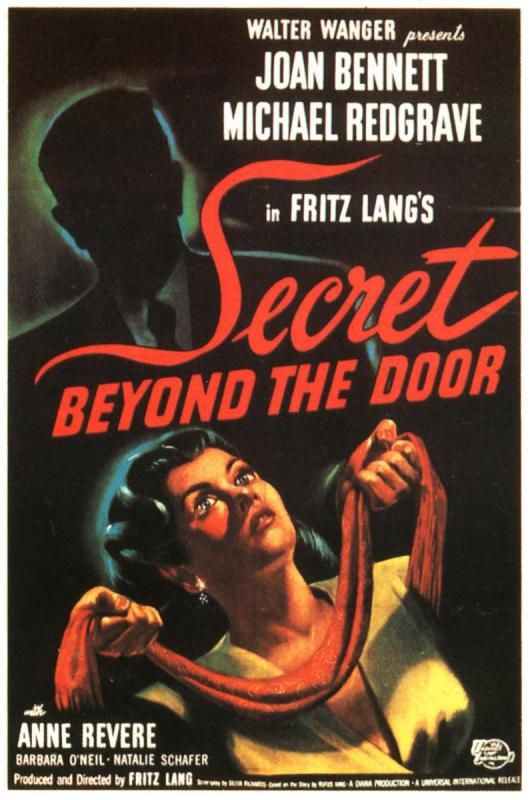
Fritz Lang, as a director, is rightly remembered and revered for his work in the 1920s and 1930s in German Expressionism.  When he moved to Hollywood in the thirties, though, his work took a step down; still good, but perhaps not as masterful as what preceded.  Secret Beyond the Door doesn’t come close to his earlier work, but it’s a fun thriller noir in its own way.  It’s a little silly, but I responded well to its air of threatening mysticism.

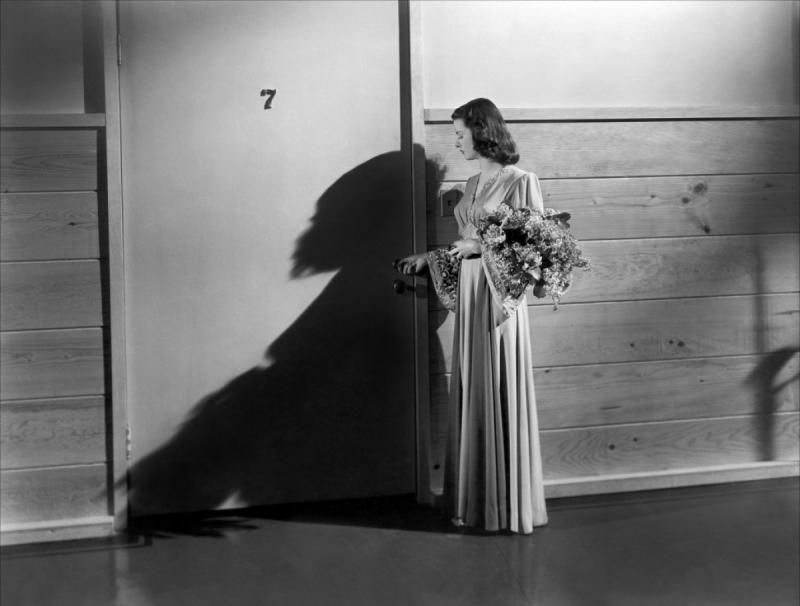
Celia (Bennett) is a wealthy socialite in New York City not knowing where she’s heading with her life.  On vacation in Mexico, she locks eyes with stranger Mark Lamphere (Redgrave) during a knife fight in the town square.  The two instantly fall passionately in love and are married three days later.  But soon, far too soon, Mark starts acting oddly around Celia, and his oddness only compounds when he brings Celia back to his estate in America.  Turns out, Mark has quite a few skeletons hidden in many closets, one of which is a penchant for collecting “murder rooms.”  Ominously, one of these rooms remains perpetually locked.  Naturally, this mystery drives Celia to distraction.

 
There’s stuff to like with Secret Beyond the Door, but it also suffers from many cases of silliness.  Let’s discuss the things that work here first.  The biggest thing I was intrigued by was the fairy tale aspect of the film.  I saw this at the Dryden (yay Dryden, I need to start a tag for that) and the nice man who introduced the film brought up this point: that Secret Beyond the Door is essentially a modern noir retelling of the Bluebeard fairy tale.  I was unfamiliar with that particular fairy tale, which surprised me because as a young child, I was fascinated with fairy tales and consumed as many as I could get my hands on.  In all honesty, one of the major themes of fairy tales that kept me coming back for more (and more, and more) was the danger and violence and flat-out blood lust inherent in every single story (which is also, of course, something that Disney has worked tirelessly to remove from its recent adaptations). I looked up the Bluebeard fairy tale when I got home and was thrilled, when reading it, to rediscover that same violence and gore right alongside true love and magic; in fact, I felt very much like my ten-year-old self whilst reading the tale and had a lovely little moment of nostalgia.  In short, for those unfamiliar (as I had been) with the Bluebeard tale, Bluebeard the man keeps on getting married to different women, only to have those women mysteriously disappear.  His most recent wife is given freedom to move about his estate at her leisure with the exception of one room, which she naturally becomes most curious about.  I’ll stop there, because by now, you should have a good idea how this relates to Secret Beyond the Door.  Even the name of Lang’s film is a clear reference to the original French folk/fairy tale. 

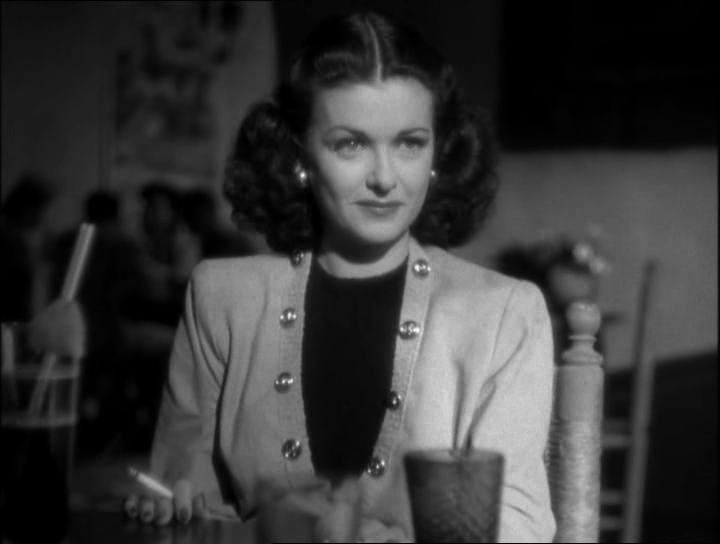
And quite frankly, watching the film (for a second time) with this sort of slant in mind helped the film make a lot more sense.  Secret Beyond the Door is not intended to be realistic.  If you expect it to be realistic, then frankly, you’ll be disappointed, because it comes off squarely on the ludicrous side of veracity.  Instead, it’s a bit of a fable.  The movie opens with Joan Bennett’s incomparably husky voice-over narration speaking about dreams, all while we watch some illustrated shots of daffodils and rivers.  There is a dream-like quality to the opening that gets a bit lost as the film progresses, but nonetheless helps to underline this sort of mystical association Lang was clearly going for.  Bennett, as Celia, provides narration for most of the film, a fact that, in and of itself, is not that unusual, least of which for noirs of the forties.  But Bennett’s narration is somehow otherworldly.  She speaks so low and carefully and her voice is so delicious, it reinforced the trance-like aura of the film, contributing to the fairy tale feel.  Frankly, I couldn’t get enough of hearing her speak, to the point that I forgave her character for continually lighting cigarettes.

  
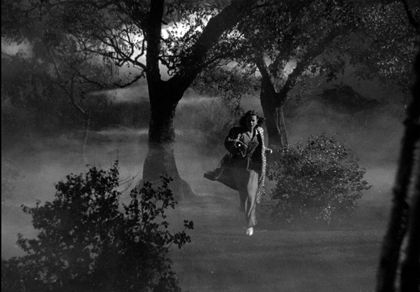
Additionally, when it’s suspenseful, it’s very suspenseful, and Lang is very good at creating an atmosphere of intrigue and danger.  The idea of the murder rooms is deliciously salacious.  Mark literally rebuilds rooms where infamous murders took place; he doesn’t copy them, he acquires the actual furniture and wallpaper to legitimately rebuild the room.  This is somewhat horrific but also fascinating to me, and clearly, Celia feels the exact same way.  Watch how she stares in horror at Mark when she realizes this is his “hobby,” then watch as she takes a step toward him as well, as if she is inexplicably drawn to him despite his dark obsession.  This is a highly charged part of the film, and Lang doesn’t shy away from taking advantage of the titillated audience and ratcheting up the tension in the film.  We are on edge from here on out in terms of not knowing who to trust.  Is Mark good?  Is he evil?  Does he love Celia, or is he simply trapping her?  A sequence where Celia runs into the fog-filled grounds is excellent, as is a scene where she takes it upon herself to break into the locked secret room once and for all.

  
That is the good stuff in the film, and it provided me with a pleasant viewing experience.  But, as mentioned above, Secret Beyond the Door is also silly.  It just is.  There’s no escaping it.  My biggest problem with the film is its insistence on using the utterly ridiculous forties idea of psychobabble to explain away homicidal tendencies.  Following on the heels of Hitchcock’s Spellbound (easily one of my least favorite Hitchcock films), Secret Beyond the Door depends far too heavily on the simplistic idea of explaining away complicated personalities using childhood traumas that, really, when you hear them, are hardly that traumatic.  Really?  That’s the conclusion we’re left with?  It’s disappointing to say the least.  I have little patience for psychobabble, and while Secret Beyond the Door is not quite as rife with it as Spellbound, it’s present with enough frequency to get me rather annoyed. 

Additionally, the acting is a bit spotty.  In all honesty, if Michael Redgrave did not have the surname “Redgrave,” which lets me know he comes from acting royalty, I would think he’s a really shitty actor.  Because holy cow for a phoned in and downright laughable performance.  He’s believable when he’s playing a Mark head over heels in love with Celia, but when he becomes “odd” and then, later, threatening, he just… silly.  Really really silly.  I don’t buy Redgrave as a main villain in the slightest.  Not at all.  Nope.  I giggle at his menace.  And Joan Bennett isn’t exactly making a case for Best Actress either.  Seeing a film in a theater can both heighten the viewing experience, but also point out flaws with greater clarity.  It’s a bad sign when you can tell the director was going for “suspense,” but the entire theater laughs out loud at the actress’ actions and lines in a scene.  Not a good omen.

  
Additionally, there are far too many shades of Rebecca in Secret Beyond the Door.  This is problematic, at least to me, because I think Rebecca is very good, and when making such obvious parallels, Secret Beyond the Door comes off as a pale shadow of the original.  It’s as if Lang (who, apparently, had a bit of a rivalry going with Hitchcock at the time) tried to do a mash-up of Spellbound and Rebecca, but couldn’t quite pull it off.  And that just feels a little sad.

When Secret Beyond the Door is channeling its fairy tale-cum-film noir tale, it is at its most charming.  When Lang tries to make the film an imitation of Hitchcock, it falls spectacularly flat.  Overall, Secret Beyond the Door is an entertaining film – I could certainly think of worse uses for my time – but it’s a bit too uneven to feel successful as a whole.  It has good stuff there, but it pales in comparison to Lang’s earlier work.

Arbitrary Rating: 6/10.  It kept me entertained, but occasionally for the wrong reasons.  Oh, and good score by Miklós Rózsa.

Monday, October 22, 2012

Rope


Rope
1948
Director: Alfred Hitchcock
Starring: James Stewart, Farley Granger, John Dall  

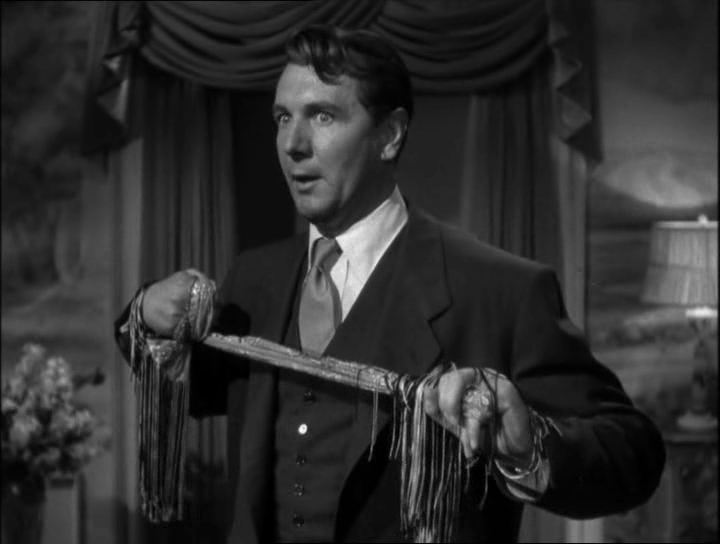
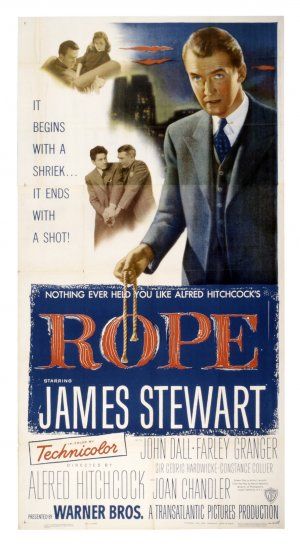
Rope is alternately absolute classic Hitchcock, and very novel Hitchcock. Famous (or, perhaps, infamous) as being shot in only ten takes, this is a fact that sometimes seems to overwhelm the story itself. While being an exercise in a novel technique for presenting the story, Hitchcock plays with his classic themes of suspense and psychological battles, all while peppering black humor throughout.

The film opens with the murder by strangulation (using rope, of course) of David (Dick Hogan) by Phillip (Granger) and Brandon (Dall), David’s school friends. Phillip is horrified by what he’s done, but Brandon is pleased. It appears they committed the murder in order to see if they could, and David was deemed disposable. After hiding David’s body in a large chest, they begin to prepare for a dinner party attended by David’s friends and family. Brandon is so smug, he even serves the food off of the chest in question. But when Rupert Cadell (Stewart), an old teacher of theirs, shows up at the party as well, he shrewdly starts to deduce what Phillip and Brandon have done.