Showing posts with label jacques tourneur. Show all posts

Monday, July 8, 2013

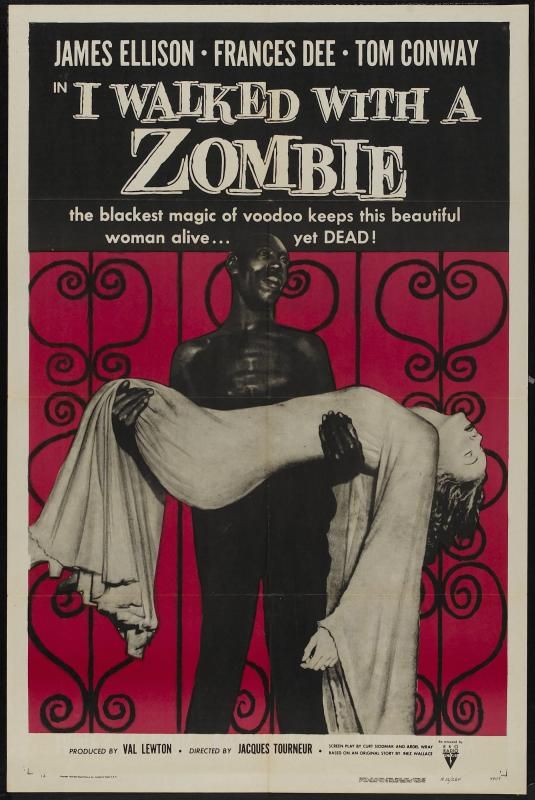
I Walked with a Zombie


I Walked with a Zombie
1943
Director: Jacques Tourneur
Starring: Frances Dee, Tom Conway, James Ellison

I mentioned before that I have a thing for Shakespeare.  If I get the merest whiff of a film being a Shakespeare adaptation, however transposed, strained, or incomplete, I am automatically predisposed to liking said movie.  The same goes for many classic novels.  I am fascinated by how stories that have been around for hundreds of years can be made new and relevant by putting the story in a different time or place.  And what’s one of my all time favorite classic novels?  Why, it’s Jane Eyre!  I love Jane’s fierce independence and moral code, and I really love brooding, angry, sexy Mr. Rochester.  And here, in I Walked with a Zombie, we have an odd mash-up of Caribbean voodoo culture, zombie ideology, and, of all things, Jane Eyre.  When you throw in the fact that this was directed by Jacques Tourneur and produced by Val Lewton, what results is a decidedly B-picture in overall quality, but one that drips with atmosphere and, despite its shortcomings, really works for me.

 Canadian nurse Betsy (Dee) is sent on assignment to the West Indies to care for Jessica Holland, the pretty but catatonic wife of bitter, brooding Mr. Holland (Conway).  It seems that although Jessica can breathe and walk and follow simple commands, she is completely unresponsive.  A bit of snooping and prying and Betsy learns of a family tussle involving Jessica and Mr. Holland’s brother, Wesley Rand (Ellison), who had hoped to run away with the seductive Jessica, leaving Mr. Holland in the lurch.  Finding herself falling for her employer, Betsy becomes determined to awaken Jessica from her state and even turns to the island natives and their voodoo culture in the hopes of bringing Jessica around.  But is Jessica really still alive?

 
There are two fundamental plot lines running through I Walked with a Zombie, that of Betsy and Mr. Holland’s attraction and the sadness and pain surrounding it, and the exploration of voodoo culture.  The former takes up the focus of the first half of the brief film and is clearly ripped directly from Jane Eyre (apparently by Val Lewton to spice up the source material for the film), and the voodoo scenes are the focus of the second half.  Although there are certainly deviations from the novel, and some pretty big ones too, I rather love that Lewton managed to put Jane and Mr. Rochester in such a foreign, disparate environment and still have some semblance of the spark that courses through the original story.  Mr. Holland is angry from the get-go, speaking of how this apparently beautiful island is made of nothing but death.  Betsy has several exchanges with Mr. Holland that are almost one-to-one with conversations from Jane Eyre.  And when Mr. Holland and Betsy realize they’ve fallen in love with one another and yet are both stymied by the existence, however brain dead, of Jessica Holland, I fall in love with I Walked with a Zombie.  Yes, that’s really all I need.  Does that make me shallow?  No, I think not, but definitely idiosyncratic.  When I think of Mr. Rochester as possibly the most swoon-worthy character in all of fiction, I will latch on like a limpet to any iteration of him I can find, even if he’s played somewhat woodenly with a George Sanders-esque delivery in a movie with “Zombie” in the title.  
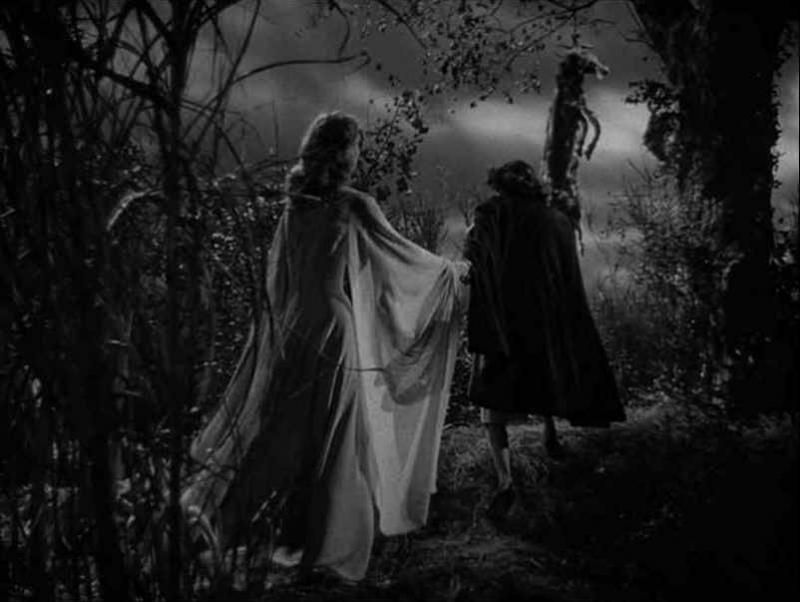

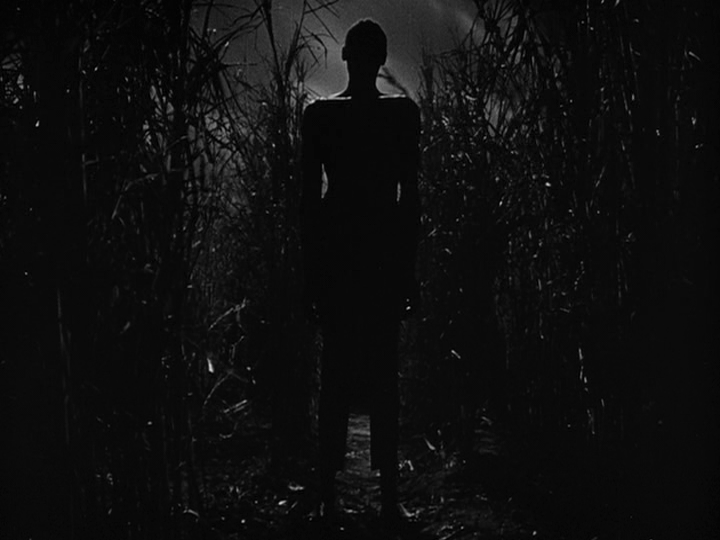
It is in the second half of the film where focus shifts to the native island religion of voodoo is where Tourneur really gets to show off his love of dark and shadows and atmosphere.  Tourneur’s camerawork is downright stunning in places, showing fantastic shot composition and emphasizing long shots over close ups, making you very aware of the dangerous and dark surroundings.  While hardly frightening by today’s standards, and I’ll add right here right now that I Walked with a Zombie shouldn’t scare you in the slightest, it has scenes that are hypnotic and darkly beautiful.  The nighttime walk through the sugar cane fields by Betsy and Jessica is easily a highpoint of the film, and where the memorable zombie Carrefour is introduced.  Full of tension with little payoff (which only manages to heighten the mood), Tourneur fills the screen with shadows and your ears with the percussive beats of the native drums, all of which leads up to a voodoo ceremony that feels distinctly un-Hollywood for 1943.  This hypnotic dance at the aforementioned ceremony was oddly compelling.  Dare I say it, Tourneur seems to treat voodoo culture with a modicum of respect.  By the end of the film, it is the white family that seems to be foolish, not the locals.  Do I buy into the culture that Tourneur is showing me?  No, not at all, but what he’s constructed here works to fill the story with a sort of nonthreatening dread, and one that feels oddly believable, especially for the time the film was made.  
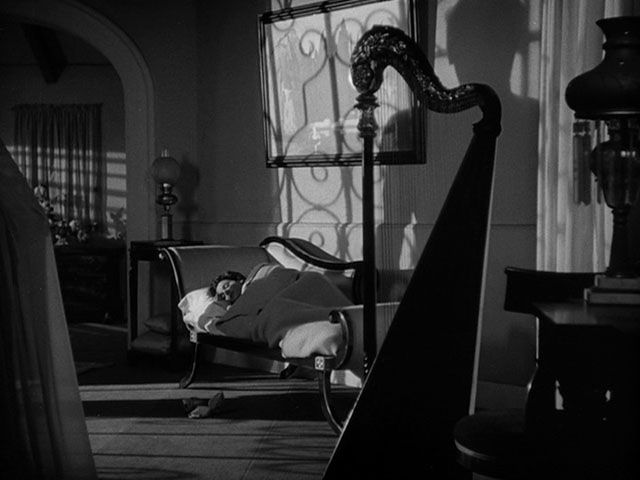
OK, that is a pretty, pretty shot.

Where I Walked with a Zombie works least for me is in the actors’ performances.  Everyone here seems straight from the bottom of the second or third tier barrel, with not one lead actor managing to deliver their lines in anything resembling a naturalistic way.  Rand and Holland’s mother was played by an actress who was the same age as actors Conway and Ellison, and her makeup and wig is hardly convincing.  Although he doesn’t help things along with his performance, I did like how the character of Wesley Rand managed to be less an out-and-out villain and more a sympathetic character.  The two most haunting performances were by the two zombies of the film, Carrefour, played with silent menace by Darby Jones, and Jessica, played by Christine Gordon.  Although it’s true Gordon doesn’t have much to do in the film, she manages to make catatonic into something disconcerting.  Those empty eyes, that strange compulsion, her unnatural thinness… yes, it’s not a challenging part, but Jessica is haunting.
  
Look, I Walked with a Zombie is hardly Citizen Kane.  But it doesn’t pretend to be, and I respect that.  It’s hardly aspiring to be more than an atmospheric voodoo love story, and you know what?  It works for me on both those levels.  I love Jane Eyre, and I love the sensibilities of filmmaking in the 1930s and 40s.  I Walked with a Zombie doesn’t make you, as a viewer, do much work, but I need that every now and then, and it’s a perfectly acceptable and rather fun way to pass the time.

Arbitrary Rating: 7.5/10

Sunday, June 16, 2013

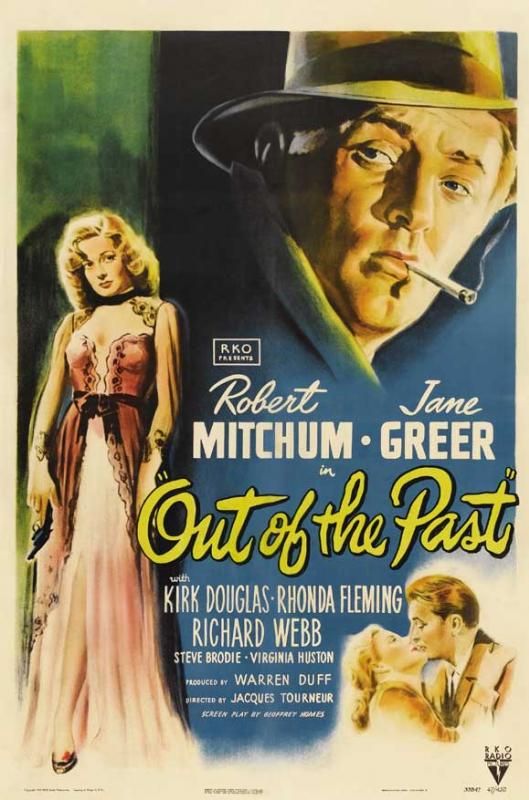
Out of the Past


Out of the Past
1947
Director: Jacques Tourneur
Starring: Robert Mitchum, Kirk Douglas, Jane Greer, Virginia Huston

Damnit I love noir.  And holy cow if Out of the Past isn’t as noir as noir can get.  I didn’t appreciate this one the first time I saw it, not in the least, but that was before I got bitten by the noir bug.  Now that I’m infected with noir love, Out of the Past is like a potent drug, heady and heavenly and absolutely wonderful.  

  
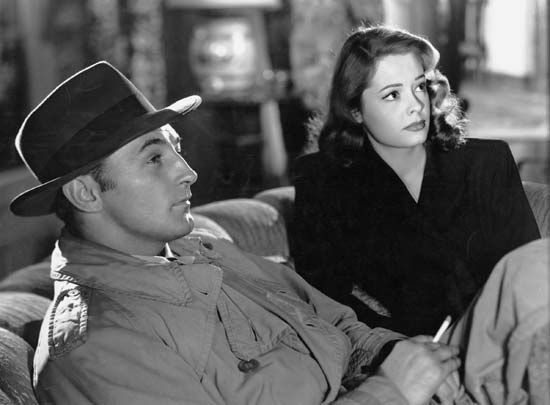
Jeff Bailey (Mitchum) runs a garage in a small town in California and is dating good girl Ann (Huston).  One day, though, a stranger comes to town who talks of knowing Jeff in a previous life.  This prompts Jeff to open up to Ann about his past where he worked as a private detective, and specifically about a case where a rich man Whit (Douglas) hired him to find a dame, Kathie Moffat (Greer).  Jeff remembers finding Kathie in Mexico and the two of them starting an affair together, and the ugliness that followed when he tried to break from Whit.  But Whit doesn’t like unfinished business, and he doesn’t care a jot that Jeff has made a new life for himself.  Jeff’s old life comes crashing into his new one with the consequences we only ever find in film noir.

  
The plot is almost as convoluted as one could imagine.  Jeff’s flashback to finding Kathie in Mexico starts to feel like the actual plot of the movie, until we remember that ‘oh yeah, he’s just remembering.’  And as soon as Whit comes back to real-time Jeff’s life, things get crazy as they only can in noir.  More characters get thrown in the mix, there are objects that have to be stolen from other people, money that has to be accounted for, and who knows who has any of it.  When I tell you that I’ve seen this movie at least four or five times and I still can’t quite keep everything straight, you’ll understand.  But what is absolutely necessary to understand about noir – good noir – is that this doesn’t matter.  It’s not about all the red herrings, the ancillary characters who dance around the edges of the film, or the plot devices.  It’s about the central characters and the mood and the dialogue.  Jeff is cryptic, brooding, and powerful; Kathie is devious, snakelike, and seductive; Whit is smart, careful, and manipulative.  This trio is phenomenal, and when they spit out hard-boiled dialogue left, right, and center, you really needn’t worry about trying to follow the plot.  Just sit back and enjoy the ride.

  
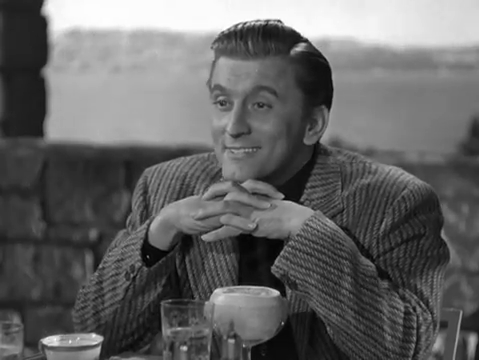
It’s hard for me to pick a favorite part of Out of the Past, mostly because I’m such a fan of film noir that I love so much about it, but in Out of the Past, Kirk Douglas shines.  Really shines.  Out of the Past was only Douglas’ second film role, and with a nice, hefty, supporting role here, it’s more than easy to understand why he became a superstar.  Douglas is beyond phenomenal as the snaky, conniving Whit.  Over the course of his career, Douglas would do many fine roles in many fine pictures, but he would often play characters that were BIG and BLUSTERING in some way, shape, or form.  You need someone who can jut his chin out and make grandiose speeches to a crowd of hundreds, if not thousands?  Douglas is your man.  Which is the main reason why I like him so much in Out of the Past; he is decidedly not this persona when he plays Whit.  Whit is cool, subtle, and plays his cards close to his chest.  He’s a devious villain in that he’s razor-sharp, intelligent, and diligent, with a dangerous smile that lets you know you’re in for something bad, and soon.  As Kathie says, he never forgets, and he’ll smile his evil smile while he remembers every trick you tried to pull on him.  This is a Kirk Douglas unlike most future Kirk Douglas’.  I love it.  I can’t get enough.  I might even go out on a limb and say this is my favorite Kirk Douglas performance.  As I said, I might even call him my favorite part of Out of the Past, and Out of the Past is crackerjack full of good stuff.  Not that I was in danger of disliking Out of the Past, but Douglas really puts it over the top for me.


While I just love Douglas in Out of the Past, it wouldn’t be the movie it is without Robert Mitchum.  Mitchum, the masthead of the entire film noir genre, is beyond iconic in his role here as Jeff (so much so that Alain Delon’s character in Le Samourai is modeled after him and even called Jef).  His drooping eyelids, laconic voice, and dripping cynicism are pure noir.  When you add in the hat, the dangling cigarette, and the battered trench coat, it’s just icing on the cake.  Jeff is trying to make a regular life for himself, but he cannot extricate himself from his previous shady dealings.  One look at Robert Mitchum and I believe that there is no way in the world that Jeff could ever make a “regular” life.  In fact, the most awkward parts of Out of the Past are where Jeff is making bland, dull love to Ann (easily the most nondescript character in the entire cast).  Mitchum was born to play a character like Jeff, all hardness and sarcastic smiles.  My favorite line of the film is one of Mitchum’s, when he and Kathie are falling in lust down in Mexico.  She spouts some nonsense to him about not actually stealing the money Whit thought she did, and he pulls her in for a kiss and says, “Baby, I don’t care.”  It’s just… perfect.  (For what it’s worth, “Build my gallows high, baby,” comes a close second.)

  
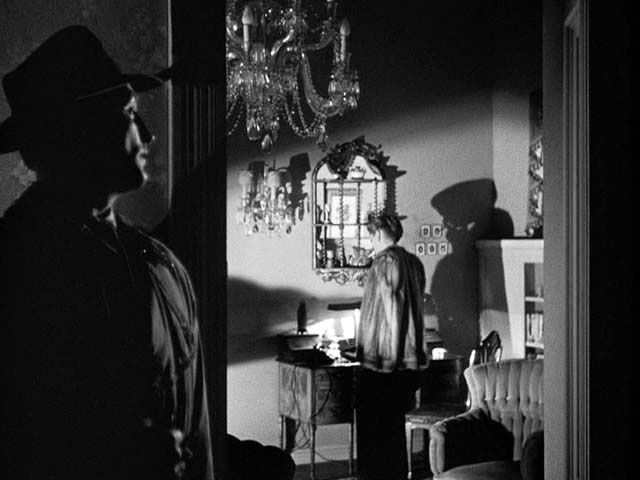
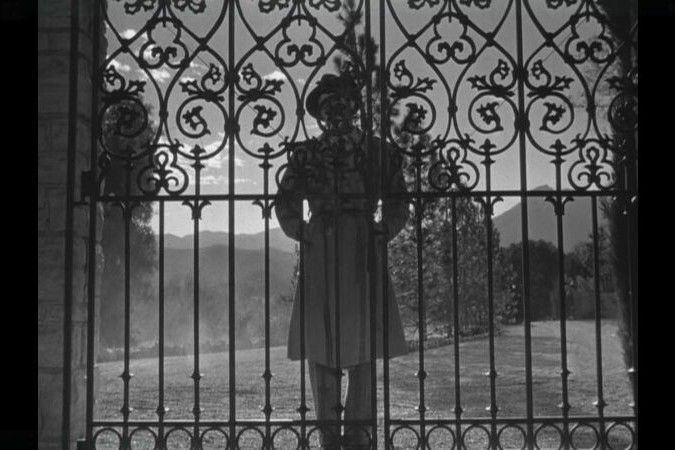
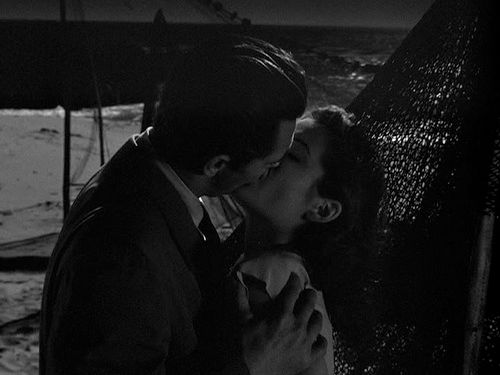
Tourneur’s direction and photography are excellent.  There are so many smart choices made that repeatedly play up Jeff’s dual lives.  When the film opens in Jeff’s pretend “normal” life, we are awash in bright whites.  Every scene is bathed in pure sunlight, and there are almost no shadows.  As soon as Jeff’s old life starts to reappear, things get dark and fast.  Enter all the standard shadows and low-key lighting you can handle.  When Jeff starts to get mixed up with Kathie when you just KNOW he shouldn’t, cue the apropos fishing nets in the background.  Jeff is caught in Kathie’s net, and there’s no escaping it.  Tourneur knew what he was doing, and it shows. 

Mitchum may have called them B pictures instead of noir, but this is a damn fine B picture.

Arbitrary Rating: 9/10