Showing posts with label off book. Show all posts

Sunday, June 1, 2014

Summer Stock


Summer Stock
1950
Director: Charles Walters
Starring: Gene Kelly, Judy Garland, Eddie Bracken, Phil Silvers

I make no secret of my love of musicals.  MGM musicals of the forties and fifties are like crack to me. They will always be there for me.  They will always make me happy.  I can watch them a hundred times (and I have) and they won’t get old.

So I thought writing about some of my favorite non-list musicals might not be a bad idea. 

I know that I alienated nearly all of my regular readers with the preceding paragraphs, but, well, I’ve had a really rough year and MGM musicals make me happy.  Consider yourself warned.

Jane Falbury (Garland) is the beleaguered Falbury sister who is stuck running the family farm while younger sister Abigail runs around chasing her dreams of being on the stage.  When Abigail, on a whim, brings an entire Off-Broadway show to the Falbury Farm with the idea of putting on the show on Jane’s premises, Jane balks at first, but Abigail’s boyfriend and show director Joe Ross (Kelly) convince her to allow the show biz folks to stay by providing Jane with necessary cheap farm labor in between rehearsals.  Sparks fly between Jane and Joe, but Jane’s fiancĂ© Orville (Bracken) and the fact that Joe is somewhat engaged to Jane’s sister are pretty big barriers.  When Jane shows a hidden predilection for the stage, though, nothing can get in the way of true love.


Gene Kelly.  Gene Kelly.  Gene Kelly.  Judy Garland.  Gene Kelly AND Judy Garland.

Jesus Christ, I never stood a chance.

The plot of Summer Stock is not why one watches Summer Stock.  It’s simplistic at best and requires more than a little suspension of disbelief.  It’s one of the ultimate “let’s put on a show” musicals, a gag that was getting whiskers even in 1950.

But Gene Kelly.  And Judy Garland.  Falling hopelessly in love with each other.  While singing and dancing. 


Of all the gags in musicals, the “let’s put on a show” bit is not my favorite – even *I* admit it’s a bit silly – but… Gene Kelly is SO pretty.  Were it not for him (and Judy), I would undoubtedly not be speaking so fondly of Summer Stock.  For those keeping a record, he (along with Cary Grant) are in my Holy Trinity of Sexiest Classic Hollywood Actors.  My feelings for Gene Kelly run deep, and looking back at my childhood, I’m pretty sure he’s the first adult actor (by that I mean not a teen heartthrob) that I had a crush on.  My tag for him on tumblr is “eternal crush on Gene Kelly” because in the twenty-plus years I’ve been watching Gene Kelly movies, I have never not been in love with him. 

And my goodness, if you love Gene Kelly, you NEED to put this movie in your eyeballs as soon as possible.


Reasons why Gene Kelly was never sexier than as Joe Ross in Summer Stock:

1.  Quite literally, he spends the ENTIRE movie with either rolled up shirt sleeves or super tight short sleeves that show off his ridiculously sexy arms the ENTIRE TIME.  I wish men realized just how sexy rolled up shirt sleeves are.  Every time my husband comes home with rolled up shirt sleeves because it was hot at work, I want to jump his bones.  Men, listen up: no matter your body type, ROLLED UP SHIRT SLEEVES.  It works.  It’s a godsend.  And in this movie, ladies (and some gents, I’m sure), you get your fill of Gene in tight rolled up shirt sleeves.  Unnnnnnnnnf…


2.  Jeans.  He wears JEANS.  JEANS.  ROLLED UP JEANS WITH LOAFERS.  Gene Kelly was certainly known for being a bit more down-and-dirty than his cohort Fred Astaire, but still, he rarely wore jeans.  HE DOES HERE.  And if you don’t understand why I find that so ridiculously attractive, then I’m sorry, I can’t explain it to you.  BECAUSE JEANS.  ON GENE KELLY.  KILL ME NOW.


3. He does quite a lot of macking.  For the first half of the film, when his character is still pretty devoted to Abigail, every time they are in the same room, they greet one another by making out for as long as the Hays Code would allow.  And in the second half of the film, he finally gets to start macking on Judy Garland.  There is a LOT of kissing Gene Kelly in this flick.  GOD BLESS. 

4.  Joe Ross is quite possibly the sweetest character Kelly ever played.  In most of his musicals, Kelly’s character usually has some slightly dark or even misogynistic streak.  In both On the Town and Anchors Aweigh, for example, he plays a sailor intent on getting as much booty as he possibly can until the right girl wins his heart.  Even in Singin’ in the Rain, his character is called out for being egotistical at the beginning of the film.  In nearly all the other films I’ve seen of his, Kelly’s character is one who starts out as brash/arrogant/egotistical until he meets The One Girl who wins his heart and changes his ways.  But not so in Summer Stock.  As Joe Ross, he starts as so ridiculously, endearingly honest and kind and caring that we know from the get go that silly, materialistic Abigail is NOT right for him, that only honest, kind, and caring Jane will do.  He’s so winning from the get go, he’s practically the epitome of Prince Charming.  Joe Ross, as a character, is basically a female wet dream written into one person.  He tells Jane that he won’t marry her sister unless he can guarantee their financial stability.  STAHP IT YOU’RE KILLING ME.  He is overcome with guilt by his feelings for Jane due to his obligation to Abigail and doesn’t want to hurt either lady.  DEAD I AM DEAD YOU DEADED ME.  It’s only when Jane effectively ends her “relationship” with Orville, and when Abigail runs away from the show and Joe (oh sorry, spoilers?  Eh, I don’t care, the movie is 65 years old) that Joe finally feels alright with making a move on Jane.  I adore a man with principle and holy crap, but Joe has principle.


Okay, so I have an undying obsession with Gene Kelly.  But believe it or not, he’s not the only reason to watch this movie (if you like musicals.  Because if you don’t like musicals, just give the whole thing a pass).

Oh dear lord the chest hair.

Judy Garland.

Yes, I love Gene Kelly, but I also love Judy Garland.  And not the Judy from The Wizard of Oz (which, ironically, is probably my least favorite Garland flick).  No, I love the Judy Garland from other movie musicals, the one who was allowed to be an adult and allowed to have breasts and play the breathy, shaky female lead love interest.  Judy Garland had such irrefutable star quality.  I once read a quote that said that she was the only dancing partner Gene Kelly ever had who drew your eyes to her more than to him (debatable, given my obsession with Kelly, but I get the gist of the argument and it’s a valid point).  In Summer Stock, Garland is just as luminous as always.  And yes, although she was going through personal hell off screen during the filming, it doesn’t show on the screen.  She is so pretty, so gorgeous, so loveable, I just want to take her and cuddle her and tell her it will be alright.  I could get lost in those big, beautiful brown eyes.


And shut up about pairing Judy with Gene.  Take a male actor I am desperately in love with and put him up against a female actress who brims with gorgeous geniality, and I’m a goner.  The internet even informs me that there’s a name for the pair of Judy Garland and Gene Kelly: Jugenea.  Apparently.  Well, whatever the name is, Judy is easily my favorite pairing for Gene Kelly, probably because she has such inherent star quality in her to provide a suitable pairing to his RIDICULOUS SEXINESS. 


The dancing is top-notch, but I wouldn’t expect any less from a Gene Kelly musical.  His first number, Dig for Your Dinner, is a Kelly solo, and god bless for that.  His dancing duet with Judy, Portland Fancy, at the local dance, is so ridiculously cute and sweet you’ll get tooth decay.  But the two show stoppers are later solo numbers.  The first is the obvious Get Happy, Garland’s defining moment in more ways than one, where Jane finally embraces her interest in the stage and performs in the production with all the gusto that we expect from Judy.  Judy Garland has never been sexier than she is in that number, wearing a smart costume of suit jacket and little else, letting her legs stretch on forever.  If Summer Stock is remembered for nothing else, it will be that number, and rightfully so.  It’s iconic.  The other show stopper is Kelly’s later solo, You, Beautiful You, a gorgeous empty-stage piece where Joe just can’t help but dance about his feeling after having first kissed Jane.  Kelly choreographed the piece and it shows the brilliance that was to come a few years later in Singin’ in the Rain.  Kelly needs only a creaky floorboard and a few sheets of newspaper to make an utterly beguiling dance number, one that even Steve at 1001plus likes!  Seriously, if you like musicals, Summer Stock delivers on the musical number side.


And that’s just Gene and Judy.  Phil Silvers and especially Eddie Bracken are such superb comic relief in this film.  Eddie Bracken steals nearly every scene he’s in as Jane’s practical fiancĂ© who is allergic to pretty much everything under the sun.  Phil Silvers is as goofy as always (if truth be told, more obnoxious than goofy), but I love him because he brings out Gene Kelly’s goofy side.  One of my favorite things about Gene Kelly is that he was never afraid to let himself look like a fool, and every time he’s paired with Phil Silvers, you know they’ll have at least one utterly ridiculous song together.  In fact, every time I get too wrapped up in my Gene Kelly fixation, my husband likes to show me a picture from Summer Stock of one of his duets with Phil Silvers to knock him off his sexy pedestal just a bit. 

Nope, still sexy.
If I may go off on a tangent (like I haven’t already), I showed this film to my good friend Angie (who shares my Gene Kelly obsession) and naturally, she immediately fell in love.  Like I said, if you love Gene Kelly, you need this movie.  Regardless, there is one scene where Eddie Bracken and Phil Silvers, both of whom wear glasses, bump into one another, knock off each other’s glasses, then put the wrong glasses on.  Angie, in all her fangirl awesomeness, immediately started talking about shipping them together.  And now that’s all I can think.  I love to imagine that Orville and Herb run off together and have very nebbish gay sex together at the end of this movie.  Thanks, Angie.  You did this to me.


Is this one of the best movies ever made?  No.  Is it one of my favorite movies?  Yes.  Do I recognize its shortcomings?  Yes, empirically I recognize that this is not Citizen Kane.  Do I care about its shortcomings?  Hell no.  Will this movie always make me happy regardless of my mood?  YES. 

Arbitrary Rating: I’m giving this a very personal 10/10.  It has flaws, for sure, but my love of it overrides the flaws.  Gene Kelly, get in my pants.

Saturday, February 1, 2014

Her


Her
2013
Director: Spike Jonze
Starring: Joaquin Phoenix, Scarlett Johansson, Amy Adams

Upon checking Spike Jonze’s filmography, I somewhat shamefully realized that the only other feature film of his I’ve seen is Being John Malkovich.  Now I rather love Being John Malkovich, but the heaviest criticism I lay before it is that it’s a rather cold film.  Don’t get me wrong, sometimes there’s nothing wrong with cold films (*cough*Stanley Kubrick*cough*), but Being John Malkovich THINKS it has a heart when in reality, any heart that’s there is pretty darn small.  In the near-fifteen years between Malkovich and Her, I am astonished at how much heart Jonze has managed to grow into.  Because Her is a film absolutely overflowing with heart, for acres and acres, miles and miles.  The last thing anyone would call this film is “cold.”

Theodore Twombly (Phoenix) – what a great character name – works as a personalized letter writer for a company in the not-too-distant future.  He sees an ad for a new operating system with artificial intelligence that tailors itself for your own personal life and, on a whim, he purchases it.  Upon installing it, the OS announces its name is Samantha (Johansson), and Theodore realizes that this artificial intelligence is the real deal.  He and Samantha quickly become very close, developing a deep emotional bond that soon turns into a romantic relationship.  This isn’t an anomaly; Theodore’s close friend Amy (Adams) installed the same OS and became best friends with hers.  Theodore and Samantha go through all the normal relationship ups and downs, but can a relationship with an OS really stand the test of time?


Like his typical work, there are lots of little futuristic twists and oddities and quirks in Her, but unlike Being John Malkovich where the oddities ARE the film, the oddities in Her are ancillary.  Strip away the fact that Samantha is artificial intelligence, and what you really have in Her is a relationship film.  That’s what it is, pure and simple.  Theodore is broken and damaged following a divorce from a woman he deeply loved, and with Samantha, he finds the courage to open up to someone new.  He goes through all the various explorations of this, to hesitating and pulling back when things get really serious, to pain when he thinks that he is being left once more, to getting a bit too petty over silly things.  Samantha isn’t perfect, either; she is overzealous on occasion, she needs a bit of coddling every now and then, and as she grows as a “person,” (OK, as an AI OS) she changes and wonders about the relationship just as much as Theodore.  This, to me, is what makes Her so utterly brilliant.  Jonze takes something that, on first whisper, sounds utterly absurd, and makes you, as an audience, invest every last emotion you have into this relationship.  The relationship is real and honest and flawed and beautiful, and so help me if it didn’t reduce me to tears on more than one occasion.  I wouldn’t hesitate for a second putting Her up along with some of the great cinematic romances of all time, not least of all because the brutal honesty with which it is portrayed is far more palatable to me than most silly fairytale romcom “romances.”  (and infinitely more enjoyable than Jack and Rose.)


When I’ve mentioned Her in conversation with my real life friends and acquaintances, most of them responded with some variation of “that movie sounds so weird, he falls in love with his COMPUTER wtf?”  One of the things I loved about the movie, though, is that Jonze removes pretty much every negative connotation about “falling in love with your computer” in his near-future world.  Theodore hesitatingly starts telling people that his girlfriend is an OS and no one bats an eye.  “Cool, bring her along!” they say.  There is no stigma about “dating your OS” in Her, and while that’s quirky, it’s also brilliant.  It’s part of Jonze’s MO to get you to buy into the concept, so he removes the barriers.  In fact, the one character in the film (other than Theodore himself) who shudders at the idea of Theodore dating Samantha is Theodore’s ex-wife, and frankly, don’t we expect that?  Wouldn’t we automatically anticipate our exes to be judgmental of the new people in our lives? 

Apart from the pure shot of emotion that Her serves up on a glorious platter, I adored the production design.  The film is set in the future, but it’s a recognizable future.  This isn’t a sterile, silver-clad, no-collar jumpsuit sort of future.  This is a “in ten years’ time” sort of future.  A “this is where we’re on track to turn into sooner than you think” sort of future.  Twombly’s job – writing personalized letters for people who are too busy to write themselves – is an interesting extrapolation of our current culture.  Theodore lives in Los Angeles, and the film was shot there, but carefully.  Additional scenes were shot in Shanghai, and the blending of current LA with a feeling of foreign oddity (signs are not hidden, so occasionally there is a neon sign in Chinese in the background) makes the city seem recognizable and completely strange, all at once.  There is a softness to the future in Her that is reflected in the architecture, all curves and pods and clean without feeling sterile.  The softness nicely underscores the heart of the film, the focus on the strong connection between these two people (because really, Samantha has the heart of a person). 


And god help me, I loved the sets and costume designs.  Everything is flushed in reds, oranges, yellows, and creams.  Nearly every scene has some swath of the red-orange hue that is the film’s trademark, a color which yet again feels warm and soft and rife with emotion.  All the characters are dressed as the natural progression of today’s hipster designs.  There are high waisted wool and cotton pants, oversized cardigans, and leather shoes.  Because we see Theodore the most we begin to assume that this is his personal aesthetic, but when we do occasionally see other human characters, they are dressed nearly identically.  It’s a great prediction of what we might be wearing in ten years; no denim, few belts, but still the same type of silhouette.


Her is a wonderful little futuristic sci-fi romance.  What an odd combination, but because Jonze focuses first and foremost on the “romance” part of that description, the film has an emotional anchor that positively bleeds with truth.  This is Jonze injecting his typical quirkiness in a smart way, around the edges of a story that we can all relate too. 

Even if it is “guy falls in love with his computer” movie.

Arbitrary Rating: 9.5/10. Exactly the sort of movie I love.


Saturday, January 4, 2014

Musings on Mandela, Philomena, American Hustle, and Nebraska.

I’ve been struck with the unusual-for-me desire to get my butt to the cinemas to enjoy the pickings for 2013.  In these, the first three days of 2014, I’ve done two double-headers at my favorite cinema that shows current releases.  And, because I’m still me, I can’t simply “watch” these movies, I have to also think about and analyze them.  But four 1000-word-plus reviews is a bit too daunting, especially when my blogging skillz are a bit rusty.  So I figured I’d do a briefer review of these four flicks.

Up first:


Mandela: Long Walk to Freedom
2013
Director: Justin Chadwick
Starring: Idris Elba, Naomie Harris

The utterly inevitable movie of Nelson Mandela’s life hits the big screen with brilliant casting being the best thing going for it.  As my students are wont to say, not gonna lie, the only reason I went to see it was Elba.  Idris Elba as anything is automatically worth it; the man is a force of nature, and him as Mandela seemed too good to pass up. 

The film follows a mostly straightforward biographical movie outline, starting with voiceover reminiscences to golden memories of youth, then plunging us almost immediately into young man Mandela’s difficulties and following, in a linear fashion, through the imprisonment we all knew was coming, as well as the release and election.  We also follow the life of Mandela’s second wife Winnie (Harris), who stands by her man while he’s in prison by continuing to lead the revolution movement, even to the point of becoming militant.  Director Chadwick makes an effort to humanize the mythic Mandela, showing him as a red-blooded young man who was a hound dog with the ladies and not exactly husband of the year to his first wife.

Elba does not disappoint as Mandela, filling the screen with rage, righteousness, and then powerful pacifism, and he is easily the strongest aspect of the film.  Harris is also very good as the sweet yet steely Winnie who must also weather great injustices in the family-lead fight to end apartheid.  But the performances are all I can truly recommend; the story feels too disconnected to my liking.  Years pass, peoples’ opinions fundamentally change, and we are given little to no reason for it.  The resolution of the film feels like a hasty mash-up, as if the director realized he had painted himself into a corner of racial warfare and had no idea how to get out.  Now granted, this was undoubtedly a similar situation to the feeling in South Africa at the time, but the 180 that this film pulls feels more than a little incongruous.

Worth it for the performances, but not a hearty recommendation from me.  I will add, for honesty’s sake, that biopics are really not my thing, not in the slightest, so I was predisposed to not being completely moved by this one to begin with.

Arbitrary Rating: 6/10


Philomena
2013
Director: Stephen Frears
Starring: Judi Dench, Steve Coogan

After my final statement about Mandela having a strike against it simply because it wasn’t my type of film, I will now own up and say that going in, I knew Philomena WAS my type of movie, and after seeing it, yes, most definitely, it’s my type of flick, for sure.  Objectively, though, I do believe Philomena is a stronger film (although, probably not as much stronger than Mandela as my rating will reflect).

Judi Dench plays the titular character, a silly, elderly lady who loves her salad buffets with toasty croutons, snacks on the road, and frivolous romance novels.  But Philomena’s secret of fifty years, that she gave birth to a baby boy when she was just sixteen years old at a Catholic nunnery in Ireland who was then later adopted against her will, is gnawing at her.  With the help of recently-unemployed big time journalist Martin Sixsmith (Coogan), who needs a human interest story to set him back on track, she goes about finally trying to track down her long lost son. 

Everyone knows that Judi Dench can act circles around pretty much anyone, but what’s unusual in her performance here is how utterly ordinary and regular Philomena is.  I’m used to Judi Dench playing either someone of great esteem (a la Shakespeare in Love) or someone with something unusual about them (a la Iris).  Philomena is neither.  Yes, you can certainly argue that having a long lost son is unusual, but after seeing the film, Philomena still feels ordinary.  She’s just a fussy, aging Irish Catholic woman who colors her hair and wears old lady clothes, and Dench does her proud, giving her grace and humanity and a full range of emotions alongside all her silliness.

Maybe more surprising than Dench playing such a regular character is the fact that Steve Coogan can play a straight man (in the comedic sense, not the sexual sense).  For everything that Philomena loves about ordinary, middle-class comforts, Martin is used to the finer things.  As a former international political journalist, Martin is an Oxford-educated, BMW-driving, boutique-restaurant-frequenting perfect foil to Philomena.  Watching her get on his nerves and under his skin is half the film, but it’s an enjoyable relationship to explore, as Dench is careful to never let Philomena get too silly, just as Coogan is careful to keep Martin from being too snobby or curmudgeonly. 

Because ultimately, silly caricatures aside, this film has tremendous depth of heart.  The story that is explored, about the long lost son, is done so with as few clichĂ©s as I’ve ever seen.  When you think you know where the story is headed, it throws you an enormous curveball, one that requires both lead actors to show us new aspects of their characters, or expand tremendously on ideals that have already been established.  It’s sweet and funny but never cloying, never overly sentimental. 

To reiterate, this is very much my kind of film.  The wry British sense of humor is on full display, it touches without manhandling you, and who knew Steve Coogan could hold his own against powerhouse Dench. 

Arbitrary Rating: 9/10.


American Hustle
2013
Director: David O. Russell
Starring: Christian Bale, Amy Adams, Bradley Cooper, Jennifer Lawrence

Perhaps the buzziest of the films I’ve seen recently, American Hustle is certainly riding a wave of good press and award nominations. Without necessarily meaning this as an insult, American Hustle is the type of film meant to appeal to Academy voters.  I won’t use the term Oscar-bait due to its negative connotations, but American Hustle feels exactly the sort of edgy, flashy, seriocomic film that the Academy can feel terrifically justified in nominating.  “Look how hep we are, we’re recognizing American Hustle!” they proclaim with glee.

Overweight and balding Irving (Bale) is a con artist working out of New York who falls madly in love with Sydney (Adams), a beautiful creature who eagerly joins him in his cons.  The fact that Irving is already married to Rosalyn (Lawrence), a slightly crazy hausfrau, is a minor hiccup.  But when they are nabbed by an FBI agent (Cooper), they both agree to his terms of running a con to bring down some politicians in exchange for a reduced sentence.  But really, when politicians, the mob, the FBI, and con artists are all thrown into the mix, who’s conning who?

The style of American Hustle was probably my favorite part.  The late seventies, in all its glitzy, superficial glory, is on full display, and we have our fill of overdone hair, polyester shirts, and New Jersey accents.  Amy Adams is terrifically sexy in shirts and dresses that plunge to her navel, and Jeremy Renner as a Jersey politico happily prances around in pale blue tuxedos with frilly sleeves.  The film is dressed in golds and browns, giving the entire story an air of wistful nostalgia, as though our con artists are recounting their glory days.

The performances are, again, top notch.  Particularly delightful was Jennifer Lawrence as Rosalyn.  Unhinged yet manipulative all at the same time, Lawrence pulls it off and then some.  She’s definitely making a strong case for being up for the big prize for a second year in a row.

However, there’s something that never quite coalesces in American Hustle.  Like Mandela, the finale feels somehow inadequate to the tremendous build up it is given.  Is it about the con or is it about the drama of the characters at hand?  Frankly, the film waffles on this question, and ultimately, I felt there were unanswered issues on both of those sides.

I enjoyed American Hustle, but not absolutely.  It is a good film, a strong film, but it didn’t blow me away.

Arbitrary Rating: 8/10


Nebraska
2013
Director: Alexander Payne
Starring: Will Forte, Bruce Dern, June Squibb

Full disclosure: I am a slavering little Alexander Payne fangirl, due in no small part to the fact that I’ve now met him twice, have his autograph, and a picture with him.  I’ve even spoken to him about his filmmaking style.  I enjoyed his films before I met him, but now?  Now I’m a devotee for life.  Given that he only makes a film once every two to three years, it was an utter no brainer for me to see his latest.  Spoiler: I loved Nebraska.  But then, frankly, I was always going to love Nebraska.

David Grant (Forte) sells speaker systems and electronics in a strip mall in Billings, Montana.  His father Woody (Dern) is an alcoholic and not altogether with it retired auto mechanic.  When Woody gets one of those magazine promo letters proclaiming that he’s won one million dollars (provided his number matches and he buys some magazine subscriptions), all he sees is the one million dollars.  Convinced he just hit it big, he becomes obsessed with the idea of getting to Lincoln, Nebraska, to claim his winnings, and ultimately, a harassed David agrees to take him.  On the way, they stop in Hawthorne, Nebraska, the tiny near-ghost town where Woody grew up.  Woody visits with his old family and friends, all the while spreading the news about his apparent good luck.

There are so many things I adore about Alexander Payne, and this film has them all.  I was amused as the credits rolled at the end, because Nebraska was precisely what I expected it to be given what I know about Payne’s filmography.  I don’t think this is a bad thing; on the contrary, I think it means that Payne knows clearly who he is as a filmmaker and can deliver his message in a vivid and consistent manner.

I have decided that Alexander Payne is in love with the American working class, but he is also determined to show them as they are, not as they think they are or wish to be.  There is so much truth in Nebraska in this regard that the number one criticism I have seen leveled at the film is that Payne is mocking the small town folk of his film.  I could not disagree more.  There are some less-than-positive characters and moments in Nebraska, but nothing ever feels as though it is played for cheap laughs.  Instead, everything feels… real.  Painfully real, but thoroughly real.  I went to college in an area not unlike those shown in Nebraska, and I visited friends’ homes who lived close by whose families behaved precisely – and I do mean PRECISELY – like the family in Nebraska.  That’s why I don’t think there is any mocking meant here; I’ve seen these scenes before, I’ve seen these places before, just never on the big screen.

Furthermore, Payne himself is from Nebraska.  He shot his first feature Election (the film that made me a fangirl of his to begin with) in Nebraska, and when I’ve heard him speak, he always spoke lovingly of the area in which he grew up.  A year ago when I last saw him, he announced this film and I could hear how excited he was to make a film about his home.  I see affection, not mocking, in Nebraska, culminating in the gently poignant yet utterly devastating finale sequence.  There is so much love in the ending of the film that, while Payne undoubtedly calls out the less than savory characters in the story, showing them for the superficial assholes they ultimately become, he also knows there are heroes in his story, and they are glorious.  Mocking?  Not in the slightest.  Loving yet careful not to romanticize?  Absolutely.

Apart from the simple characters who reek undoubtedly of truth, my favorite aspect of Payne’s work is his production design.  Or perhaps, lack of production design.  What I passionately adore about Payne is his devotion to filming on real locations, locations that haven’t been meticulously manicured.  He uses real houses, real motels, real bars, real chain restaurants, and his extras are real people.  When he does need to film on a set, more often than not, the set is modeled on an actual house or room.  There are knick knacks everywhere, dirty dishes in the sink, cracks in the driveway, leaves in the pool, and scratches on the linoleum.  It’s not that his films are dirty or dank; it’s that they’re fucking REAL.  The living room looks like a real living room, warts and all.  I’ve always noticed and responded to this in his films, and it’s what I had a chance to ask him last time I saw him.  When I mentioned this to him, that I loved that he uses real places, I remember so vividly that he smiled broadly, and responded with “I don’t understand why we need to prettify everything.”  Indeed.

While Payne plays the utter ordinariness of the world around his characters in most of the film as flat and banal, he also shoots the film occasionally with great beauty.  When the film reaches its emotional climax, suddenly the everyday locations around seem majestic.  Payne lingers on a shot of a wide open field, the sun breaking through a magnificent cloud formation.  Because truly, there is extraordinariness in the everyday.

Bruce Dern as Woody is brilliant in quietly showing us a sad old man desperately clinging to one last wish for glory.  Are we annoyed with Woody or do we pity Woody?  Well, both, sometimes at the same time.  As David discovers more about his father on this road trip, we see far more in the simple facial expressions than the curmudgeonly drunk we meet at the beginning.  Will Forte is easily an unusual casting choice, as he is known almost completely for broad comedic work, playing a caricature of a caricature.  Here, though, he carries off a decidedly downbeat performance, following in the footsteps of Jack Lemmon in The Apartment.  It’s not as brilliant a performance as Lemmon’s is, but I can see the influence, and I imagine Forte being inspired by Lemmon in this role. 

I knew what to expect from Nebraska, so when I found myself sobbing rather uncontrollably at the quiet finale of the film, I wasn’t surprised in the least.  I was happy, though; happy that Payne had delivered once again on a simple human story, relatable to the last, that kept me happily engaged throughout its entirety and then packed an inevitable punch at the end.
Arbitrary Rating: 9.5/10.  The only thing I can level against Nebraska is that the pacing isn’t always as tight as it could be, and it drags a bit in the middle.  But in terms of what I want from Alexander Payne, Payne proves that he knows how to deliver it in a mature and confident manner.  I also recognize that if Payne’s previous films haven’t floated your boat, you will undoubtedly find Nebraska incredibly grating.

Up next for Siobhan: eagerly looking forward to Her being released wider next weekend.  I might make an effort to see Inside Llewyn Davis as well.  Might try to catch Gravity when it comes to the second-run theater in town.  And of course, whenever The Grand Budapest Hotel finds its way to my local theaters, I’ll be there with bells on.  I’ll also be looking out for Blue is the Warmest Color playing any wider, and I’ve got my eyes peeled for whenever Walesa: Man of Hope plays around here.  Because I NEED to see that movie.

Frankly, it’s been rather lovely seeing some more current release films in theaters again.  I do love this time of year for current releases, when the theaters are full of films trying their hands at Oscar nominations, when small character-centric comedy dramas are the order of the day rather than big blow ‘em up action flicks. 

In terms of 1001 Movies, my job is… more under control now than it was in the fall.  I’m looking to recommit myself, in the non-sanatorium sort of way, to blogging and The Club. 

Oh, and in a personal plug, I’ll find out end of January/beginning of February if my proposal for presenting at a national conference this summer was accepted.  Personally, I think my workshop idea is pretty darn awesome, but still, wish me luck. 

OH, and my old laptop finally started crapping the bed in December, so this entire review is coming to you from my bright, shiny, brand new touch screen Asus laptop.  No optical drive, so it’s gorgeous and light and doesn’t overheat every hour and doesn’t need to be constantly plugged in (thus defeating the point of a laptop).  YAY CHRISTMAS YAY NEW TOYS!!!

Friday, June 28, 2013

Galaxy Quest


Off Book: Galaxy Quest
Director: Dean Parisot
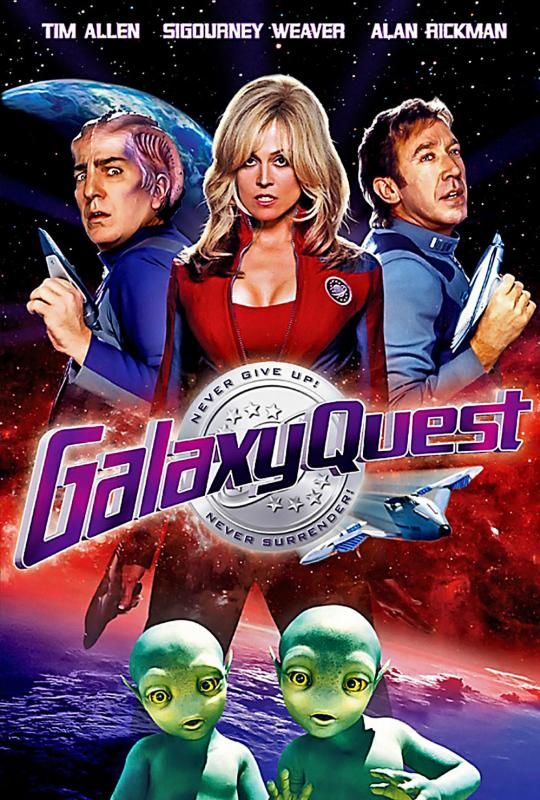
Starring: Tim Allen, Sigourney Weaver, Alan Rickman, Enrico Colantoni
1999

This looked liked the stupidest movie in the world when it came out.  It looked like a crappy parody of Star Trek.  ‘From the people who brought you Scary Movie 4 and Date Movie comes Galaxy Quest for all your mindless idiotic juvenile humor needs!’  Blech.  Who wants to see that?  Not me.  Then, about a year later, my parents and my sister, all intelligent people whose opinions I trust, informed me that I MUST see this movie.  I scoffed.  My husband scoffed.  My family chained me down in front of a television and made me watch it.

And then I laughed.  And laughed.  And laughed some more.

Holy crap, this movie is funny!  Not only is it funny, but it’s good!  Legitimately good!

  
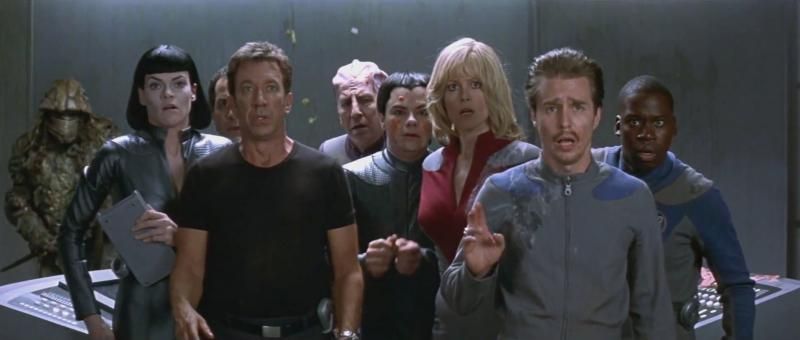
As the movie opens, we learn that Galaxy Quest was a science-fiction TV show set in space that has long since stopped filming.  Its actors, however, cannot escape the enormous cult following the series has gained, and as such, they are stuck perpetually in their TV roles, going from convention to convention… until a group of aliens approach them about helping them fend off an attack from the evil alien Saris.  Turns out, these aliens saw the show in space and thought it was real.  Given the crew’s ability to solve any problem and defeat any enemy in the original series, the aliens figure that the crew of the Intrepid is the only group capable of dealing with their perilous threat.  Soon, the hapless washed up actors find themselves being asked to really pilot a spacecraft, to really defeat aliens, to really solve complicated technical problems, and to really save the day!

What might at first sound like a blundering parody of the pop culture phenomenon that is Star Trek is really an enormously loving homage.  This is not parody; parody is vulgar and crass, with jokes coming at the expense of story and characters.  Think Spaceballs.  Spaceballs is parody.  But homage respects and reveres its source material, sending it up lightly without being mean or vicious.


If you’ve ever seen any episode of Star Trek in any incarnation, any of the Star Trek movies, or even just have a basic idea of what Star Trek is about, you will enjoy this film.  Speaking as someone who has seen every single episode of Star Trek: The Next Generation multiple times, this movie gets it right.  Galaxy Quest, the TV show, IS Star Trek.  Moreover, I fully believe that it’s most meant to resemble The Next Generation, with one notable exception.  Tim Allen’s character, Jason Nesmith, played Commander Peter Quincy Taggert, a brash, chest-thumping commander who is a thinly veiled alter-ego of Captain Kirk.  After initially seeing the film, George Takei remarked that Allen had gotten William Shatner’s swagger down pat.  


There is so much classic Star Trek in this movie.  The basic spaceship design and the jumpsuit uniforms are the fundamentals, but true fans will get a kick out of more subtle details.  Dr. Lazarus (Alan Rickman as Alexander Dane), who is CLEARLY supposed to be Lt. Worf, has to eat horrid Kep-mok blood ticks that aren’t yet dead.  WORF DID THAT ALL THE TIME.  The “away mission” down to the rock planet to retrieve a replacement beryllium sphere, with the tricorder programmed with the location, the small blue baby aliens, and the fight with the pig-lizard and then rock monster, could be straight from any Star Trek episode – save for the washed up actors not knowing what to do on the mission.  Saris’ ship was clearly modeled on the Romulan vessels.  The fancy metallic casts for broken arms and legs are incredibly familiar.  The ship has to separate at the end of the film, something that was seen in a handful of Star Trek episodes.  Jason Nesmith and Gwen Demarco (Weaver, terrifically funny playing the polar opposite sci-fi heroine from her strong, empowered, courageous Ripley role) end up in the ducts of the Intrepid in order to evade enemy capture and save the day.  Given that all of these wonderful references and settings are couched in the conceit that the people in this situation have absolutely no idea how to handle themselves in space is even more delightful.


Galaxy Quest is hands down one of the funniest movies I’ve ever seen.  It’s that rarest of all comedies, a comedy that actually improves with successive viewings.  Most comedies run out of ammo after the first viewing.  The good ones last another five to ten screenings before running out of steam.  The great ones last forever and seem to actually get funnier the more often they’re viewed.  Galaxy Quest more than meets this last description, and what’s more, it manages to be funny without any sex, violence, or cursing.  Actually, the movie was originally filmed with a handful of swear words which were removed in ADR.  The most notable instance is one scene where Sigourney Weaver says, “Well screw that!” but her mouth does not match, mouthing instead the big f-bomb.  It’s actually refreshing to find a comedy that decided cursing was unnecessary.  Somehow, it didn’t need the swearing to be funny, a concept I wish more modern comedies would embrace.

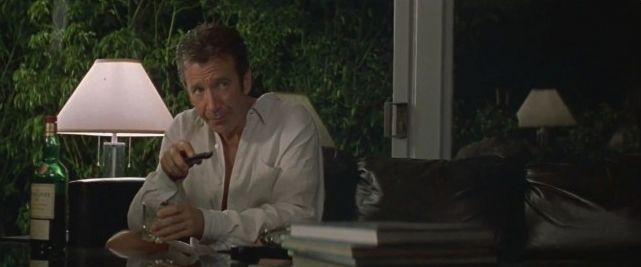
Alan Rickman as Alexander Dane as Dr. Lazarus absolutely slays me.  Alexander Dane is a tortured British actor who used to do Shakespeare.  Now he does conventions in a silly alien headpiece.  The pain that is written all over his face when he is forced to say his character’s signature line (“By Grabthar’s hammer, you shall be avenged!”) is hysterical, not least of which when he has to say it at the opening of an electronics store.  Easily in my top five favorite lines of the film is Rickman’s drawn out and deadened delivery of “By Grabthar’s hammer… *long pause*… what a savings.”  He is so pained by having to say those words, I descend into a fit of the giggles every damn time.  On the blu-ray extras, Rickman admits to having trouble getting out that line because he kept laughing so much.

 
Speaking of favorite lines, this movie has them in spades.  Sam Rockwell gets to deliver most of them as Guy, an actor who played Crewman No. 6 and was killed before the first commercial break in episode 81 of Galaxy Quest.  He is the only one of the actors who ever watched the show with regularity, and as such, is much more aware of the peril of their situation than the others seem to be.  He knows the rules of Galaxy Quest, as it were, so when he says, “There’s a red… thingie… moving towards the green… thingie.  I think we’re the green thingie!” you’re dying with laughter.  Or on the away mission when the pod door opens, “Is there air?  You don’t know!”  Or better yet, “Look around you, can you construct a rudimentary lathe?”  Or even better, when all the other crew members want to cuddle the cute-as-a-button blue baby aliens on the away mission, “Sure they’re cute now, but in a second they’re gonna get mean, and they’re gonna get ugly somehow, and there’s gonna be a million more of them…. Did you guys ever WATCH the show?!?”  To which Gwen eventually responds, “Let’s get out of here before one of those things kills Guy!”

 
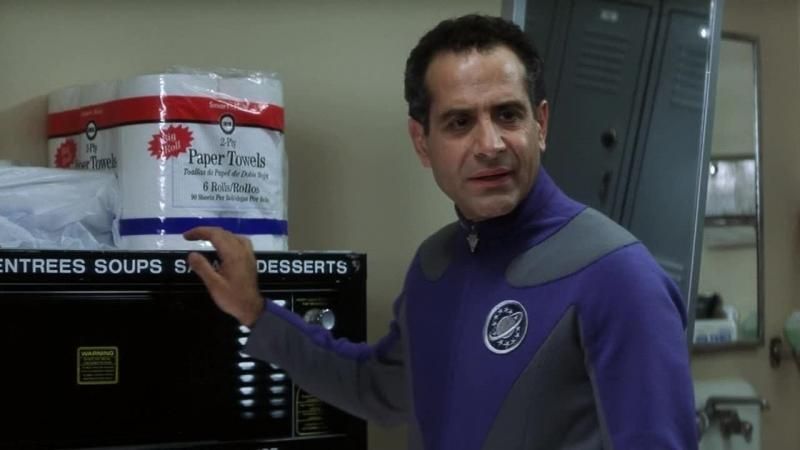
Oh god, and Tony Shalhoub as Fred Kwan as Tech Sgt Chen is HYSTERICAL.

I recently had the unbelievable pleasure of watching Galaxy Quest at the Dryden (the capstone of their “To the Moon in June” series).  I chatted a bit with the head programmer right before the movie started, and she was shocked at just how many people were there.  While certainly not full, the theater was very busy for a Wednesday night show; Galaxy Quest was a much larger draw than they had anticipated.  And then as soon as the movie started, the laughter started.  The whole audience, self included, was in stitches in every scene save for the two serious ones.  Every SINGLE scene, and nearly every single line got a laugh.  I missed some of my favorite jokes because people were laughing so hard.  Heck, Guy’s “rudimentary lathe” line actually got extended applause, as did the film when the end credits rolled.  I was hoping that the audience at the Dryden would be as appreciative of this film as I am; needless to say, my expectations were more than met.

Really, trying to explain just how funny I find this film is an exercise in futility.  It makes me laugh every single time.  It is reverent of Star Trek and manages to send it up at the same time.  It’s a feel-good movie too, watching as the actors overcome their inabilities to actually outwit and defeat the tyrannical Saris (named after a film critic!).  If it’s been a long week, if I really need a chuckle, Galaxy Quest is guaranteed to lift my spirits and bust my gut with laughter.

Arbitrary Rating: 10/10