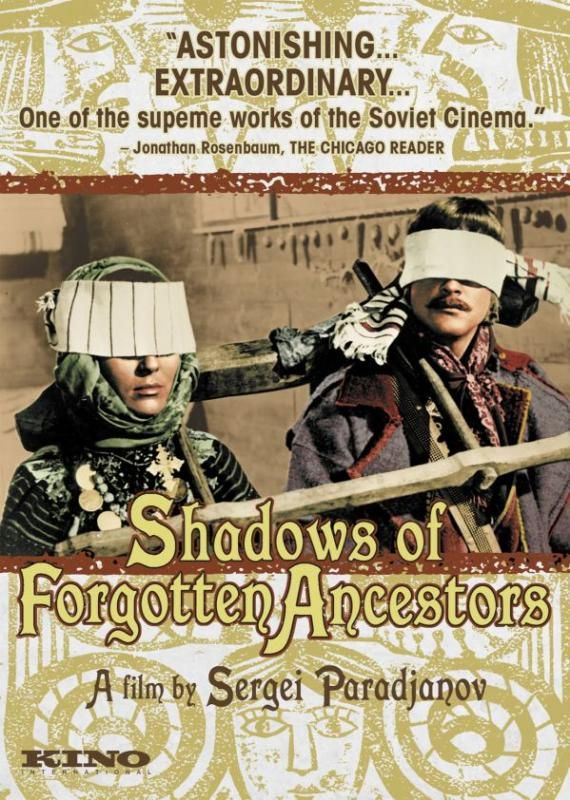
Shadows
of Forgotten Ancestors (Tini zabutykh predkiv)
1964
Director: Sergei Parajanov
Starring: Ivan Mykolaichuk, Larisa
Kadochnikova, Tatyana Bestayeva
In
watching Shadows of Forgotten Ancestors a second time in order to review
it, I borrowed the DVD from the local library and wanted to watch it on the big
TV in our living room. My husband was in
the room as well, so I asked him, “Is it okay if I put on a really weird Soviet
movie?” He looked up from his video game
and said, “Yeah, that’s fine.” Ten
minutes later, he turned to me and said, “You really weren’t kidding, this is
weird.”
Indeed.
Alright,
“weird” is not exactly the most fitting adjective here, but still, Shadows
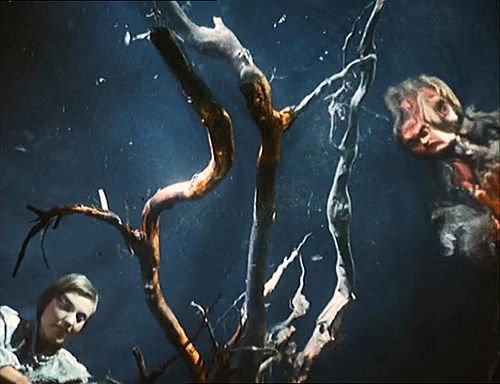
of Forgotten Ancestors is hardly typical cinema. The story is about young Ivan (Mykolaichuk as
an adult), a boy growing up in a Hutsul village in the Carpathian mountains of
Ukraine. As a boy, he falls in love with
Marichka (Kadochnikova as an adult) despite the fact that her father killed his
father. The two grow up together
inseparable, but when Marichka dies in an accident, Ivan is
grief-stricken. Ultimately he marries
Palagna (Bestayeva) but still thinks of Marichka. After not producing any children, Palagna
turns to sorcery which causes a rift between her and Ivan.
I
can understand why Shadows of Forgotten Ancestors is included in 1001 Movies,
but it is not a movie I enjoy. So, why
is it in 1001 Movies, then?
Because first and foremost, Shadows of Forgotten Ancestors is
about the Hutsul tradition. It’s
essentially a fictionalized ethnography, for lack of a better term. Part of why I am so committed to not just
watching but writing about the 1001 Movies book is because I know it
will stretch me outside my comfort zone, and this film is exactly that. The culture and traditions in Shadows
of Forgotten Ancestors are wholly unlike those I am familiar with; the
movie has exposed me to a time and place I would otherwise not have known, and
that’s important.
There
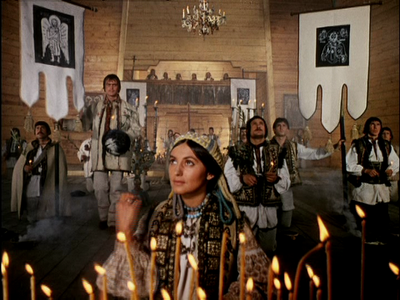
are many cultural traditions on hand here, starting with the simple church
service that opens the film, but is full of such colors and sets to feel very
different. There are the requisite
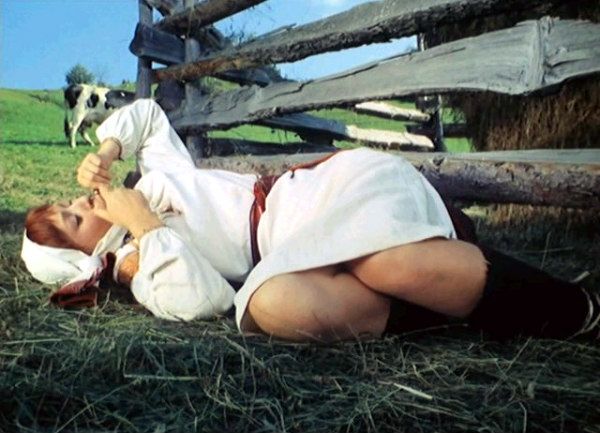
weddings and funerals, but also the Christmas holidays, simple pub outings, a
winter market, and tending to the farm.
What makes me prefer the type of cultural education presented in Shadows
of Forgotten Ancestors to that in a more traditional ethnography is
that this is all presented in terms of a fictionalized and fantasized
story. We see all these events through
the window of wistful nostalgia and mysticism.
Parajanov’s manages to weave cultural education together with a
fairytale-like atmosphere of images and sounds and feelings. I prefer that Parajanov leaves many ceremonies
completely unexplained; I’m still not sure why those villagers were wearing
ridiculous masks in one scene, but I don’t think I really care. It was as if I was an impartial observer,
simply sitting back and watching this village without knowing the
language. What results is a whirlwind of
color and dance and costume and sound, and it’s pretty heady.
Additionally,
on a personal level, I live in an area with a rather high Ukrainian
population. In my classes over the years
I’ve been teaching, I’ve had several Ukrainian students; last year alone, in a
class of only thirteen students, I had a Rostislav, a Petro, and a Vladimir,
and they would frequently speak Ukrainian to one another. Heck, sometimes they would go back and forth
between Ukrainian and English in the same sentence. (and really, the amusement
factor of watching two high school students yelling in Ukrainian at one another
because they each think the other botched their chem lab results is pretty damn
high… I will always remember Rostislav barking out incomprehensible orders to
Petro from across the room.) Because of
this fact, I am a bit more interested in discovering Ukrainian traditions now
than before I started teaching, if for no other reason than having a better
understanding of where my students are coming from. I understand that my students are separated
by years from the traditions on display in Shadows of Forgotten Ancestors, but
it is still interesting to discover nonetheless.
Speaking
of sound, I rather enjoyed the music in this film. Having played symphonic and large group
classical music all my life, Russian and Soviet music always stems from its
small town cultural roots. When you
listen to Tchaikovsky’s works where he is not writing to please Western
European tastes (as in “Capriccio Italien”, for example), there is – obviously
– significant Russian undertones and thematic elements. Some of my favorite pieces of classical music
are from the Eastern European composers, such as Shostakovich (forever associated
with Stalin’s regime, unfortunately), Rimsky-Korsakov, Rachmaninov, Stravinsky…
the list goes on and on. One of my
favorite concerts I’ve ever performed with a community band was when we played
Tchaikovsky’s “Marche Slave”, Mussorgsky’s Pictures
at an Exhibition (yes, all of it), Shostakovich’s “Finale” from Symphony No. 5, and assorted smaller
works, like Rimsky-Korsakov’s “Dance of the Tumblers” and Prokofiev’s “March”
from The Love for Three Oranges. It was staggering music, full of such
cultural richness and tones, and an absolutely drop dead fantastic
concert. The soundtrack in Shadows
of Forgotten Ancestors, all music composed directly for the film, is
ripped from that same tradition. It
could fit right in beside Rimsky-Korsakov easily. If nothing else, the aural and visual
components of Shadows of Forgotten Ancestors are very striking, and this is
why I understand why it makes it into 1001 Movies.
But.
Shadows
of Forgotten Ancestors
is not exactly a fun watch. It’s not
brutal or tortuous, in the way that horrific war films are, and nothing bad
really happens, but it’s… trying. Plot
is not the point. Subtitles that precede
the film call it a “poetic drama.” A
visual tone poem, if you will. At only
an hour and a half, it’s not too long, but it’s still a bit of a task to sit
through it. The pace is decent enough,
never really too slow or lingering too long on one thing, but I still struggled
to pay attention. In short, there is a
great deal to appreciate about Shadows of Forgotten Ancestors, but
much less to actually like. I wouldn’t
exactly recommend this film to anyone who wasn’t going through 1001 Movies,
not because I think it’s a crap film, just because I don’t think anyone would
really like it.
And
ultimately, this is my final opinion of Shadows of Forgotten Ancestors. I can appreciate it, but I don’t particularly
care for it. If I’m looking to watch a
Soviet visual tone poem, I’ll reach for Tarkovsky’s Zerkalo or Stalker
in a heartbeat over Shadows of Forgotten Ancestors.
The colors and music and cultural richness is fine, maybe even
important, but this movie is also the filmic equivalent of being forced to eat
my vegetables.
Arbitrary
Rating: 5/10.