Showing posts with label 1980s. Show all posts

Sunday, November 10, 2013

The Official Story


The Official Story
1985
Director: Luis Puenzo
Starring: Norma Aleandro, Hector Alterio

Although I cannot be entirely certain on this, I’m fairly sure that The Official Story was my first Argentinean film.  That’s one of the things I’ve truly appreciated about 1001 Movies, getting a chance to see films I normally wouldn’t have known existed that have brought me to new countries and new stories.  At its core a political story about the atrocities committed against civilians by the military rule in Argentina from 1976 to 1983, The Official Story comes wrapped in a big fat bow of Lifetime melodrama in an effort to make the story easier to digest.

Alicia (Aleandro) is a high school history teacher at an all-boys school with a wealthy businessman husband Roberto (Alterio) and an adopted five year old daughter Gaby.  Theirs is definitely a life of upper class ease.  During a night of fun with an old high school friend, Alicia learns how her friend was detained and tortured by the government.  While that’s certainly horrifying enough, her friend also tells her of pregnant women who were detained at the same time and whose babies were taken from them and sold to families who didn’t ask questions.  Alicia starts to wonder exactly how her husband came to adopt Gaby, and her curiosity draws her into the unstable social fabric of the country.


Definitely the biggest strength of The Official Story is how it manages to educate about a challenging and destructive time in recent Argentine history without getting overly political or preachy.  By giving the audience a story that, at its core, is really just about a mother and her daughter, it fits in the political message around the edges.  Better than a documentary in that regard, we see Argentinean history in terms of how it impacts Alicia’s life; by personalizing the tale it brings something that might have been too vast for us to understand to a smaller, more palatable scale.

Aleandro is quite good as Alicia, and she completely carries the film.  She is believable as a conservative woman who starts to open her eyes to the political atrocities she has been ignoring because the reality comes to her through a particularly sensitive conduit, her daughter.  Although I do not for the life of me understand why such a well-off, conservative woman would teach high school at what can only be described as an inner city school and NOT be involved in political protests or even aware of the world around her, I suppose I turn a blind eye to that particular plot hole.  Aleandro slowly and carefully opens Alicia up, and we watch as she finds the strength to ask questions she’s not sure she wants answered.  The movie never really answers them either, but I think that’s fitting.  What do you do, as a mother, when you think your child is not your own?  Aleandro is, frankly, masterful as showing us the conflict this question causes.

 
Having said all of that, though, I also think that the biggest flaw in The Official Story is how damn long it takes to get started, and even then, how long it takes to focus on the central story.  I appreciate taking time to establish characters, I truly do, but we don’t even get a whiff of the concept of these stolen babies until a quarter of the way through the film, and Alicia doesn’t really start to dive in full throttle into her investigation until about the halfway point.  It’s desperately slow getting off the mark.  The second half is solidly focused on how the mangled politics threaten to tear apart our small family, but it takes awhile getting there.

Furthermore, there’s more than a few side stories that distract rather than enhance the central story.  I understand this is an Argentine film made for the Argentine people, but I felt up against a steep learning curve in terms of understanding the politics the film alludes to.  When you throw in a rather complicated side story involving Roberto’s business dealings and, for all I could tell, a possible affair with Alicia’s old school friend, I was, well, confused.  An extended argument between Roberto and his family had me flummoxed.  I could barely tell when the argument had started, let alone why it had started.  Frankly, this left me feeling frustrated with about a third of the film, the parts which did not deal directly with Alicia’s awakening.  And I cannot stand feeling frustrated with a film.  

  
The ending, which I alluded to earlier as ending on an ambiguous note as we are uncertain about Alicia and Gaby’s future, nevertheless manages to devolve from the strong drama that had been created thus far by delving into rather predictable domestic dispute areas.  Alicia’s struggle is a good one to follow, but it feels a bit cheapened at the end by the thoroughly out-of-nowhere violent fight with her husband.  I stared in what can only be described as disappointed horror as I watched the scene play out.  Is this the big dramatic finale, when you’ve been building a story built on ambiguous politics and horribly tricky family issues?  This is how you resolve them, by having the husband slap the wife and beat her up a bit?  Quite frankly, it’s a letdown.  The story deserved a better climax between Alicia and Roberto. 

As 1001 Movies rightly notes, The Official Story undoubtedly won the Oscar for Best Foreign Language Film for its portrayal of the recent political landscape of its country rather than the cinematic techniques on display (which are fairly standard, but hey, nothing wrong with standard).  That is most certainly the strongest part of the film, and for most of the movie, it manages to maintain a nice balance between politics and melodrama.  But it’s a bit slow to start, a bit too unfocused at times, and parts of the ending made me stare at the screen in disbelief.  I liked the story, but that’s about it.

Arbitrary Rating: 7/10.  Anyone else think that Gaby is a rather frightening lookalike to the kid from Close Encounters of the Third Kind?  Because I sure do.

Tuesday, October 1, 2013

Happy Birthday to ME (AND SUNNY D!!!)


It's sad when my birthday gift to myself is FORCING myself to leave work after "only" working a 10 hour day instead of my typical 12.  

ANYWAY, YAY IT'S MY BIRTHDAY SO HERE!!!  HAVE A REVIEW OF A FILM I VERY MUCH ENJOY!!!


Tampopo
1985
Director: Juzo Itami
Starring: Tsutomu Yamazaki, Nobuko Miyamoto, Ken Watanabe

“So, you’re watching a movie too?  What are you eating?”

A guilty pleasure show for both me and my husband is Guy Fieri’s Diners, Drive-Ins and Dives on the Food Network.  We call it food porn because everything looks so damn good, and it makes both of us really hungry for really greasy food.  But when it comes to true food porn, I don’t think anything can really surpass Tampopo, a film that is quite possibly the best foodie movie I’ve ever seen.  A little bit of everything and never taking itself terribly seriously, Tampopo is nothing if not exuberant about the joy of eating.

Tampopo (Miyamoto) is a widowed young mother running the noodle shop her husband left her, but not running it very well.  Toro (Yamazaki) is a truck driver who wears fedoras and is accompanied by sidekick Gun (a young Watanabe).  When Toro and Gun stop by Tampopo’s place, taste her mediocre noodles, save her son from bullies, and beat up the bad guys infesting her restaurant, she begs them to stay to teach her, train her, and help her become the best ramen noodle shop around.

This central story, while not the only focus of the film, is a fascinating journey of doing one thing, and doing it well.  I can only think of the word “joy” to describe watching Tampopo transform her noodle shop.  It’s such a simple premise, but it works.  Slowly, step by step, Goro guides Tampopo through the process of becoming a great chef.  It’s just fun, watching them find a broth expert, then a noodle expert, then an interior design expert.  Everything gets a makeover, including Tampopo herself, and it gives the movie focus, and if there is some skewering of Japanese and American customs along the way, so much the better.  It’s honestly difficult to tell at certain points if Tampopo is presenting its story as tongue-in-cheek, or if it really is just blushingly sincere, and quite frankly, the film can be read either way.  For me personally, however, despite my rampant cynicism in other areas of my life, I choose to read Tampopo’s tale as one of straightforward zeal.  When Tampopo triumphantly serves her excellent ramen at the end of the film, the story has been building so subtly but so insistently that I find myself wanting to stand up and cheer.  Over a bowl of noodles.  There is nothing cynical, to me, in her final success, and I am with her every step of the way.

And yet, if that’s all you think Tampopo is, you’re missing out.  The above is merely the main storyline, the connective thread from start to finish, but there’s so much more here.  There are tangential vignettes, comedy spoofs, and montage sequences that hold everything together, creating some bizarrely humorous yet incredibly endearing whole.  A group of Japanese women are taking lessons on how to eat Italian spaghetti and fail miserably at not slurping the noodles.  A young businessman thoroughly outclasses his older colleagues at French restaurant.  A woman on her death bed rises in order to prepare dinner for her family (it sounds sad, but it’s actually laugh out loud funny, especially when Dad tells the kids to “eat it while it’s still hot!” right after Mom dropped dead).  And then there is piece de resistance, the actual food porn.  I wasn’t kidding with my opening; there is a couple dressed in white that is continually cut back to that include food thoroughly in their love play.  Seriously, this part of Tampopo is food porn.  But it’s never too serious or too melodramatic or even too vulgar; all these odd little asides from the main story help to create a mood of charm and whimsy, that key atmosphere of irreverent and joyous fun that makes Tampopo so special. 

 
Tampopo runs fast and thick with movie references, ranging from the obvious (a Rocky training session even involving the gray sweat suit) to the more subtle (I swear, when a “vagabond” makes a rice omelet for Tampopo’s son, it’s meant to mimic Charlie Chaplin).  Not what you were expecting from a movie about food?  Me neither, but that’s one of the wonderful things about Tampopo.  Goro wears a fedora nearly identical to Indiana Jones’, and in a dream sequence, Tampopo herself is in full-on American Western garb as the film takes on a decidedly “Gunfight at the OK Corral,” John Ford feeling.  The Western themes, in particular, are laced throughout the entire film and are easily the most recognizable to American audiences.  So what if, ten minutes later from the aforementioned dream sequence, Tampopo then swings wildly away by referencing the heartbreaking final scene from Ichikawa’s The Burmese Harp?  Don’t overthink it.  Tampopo is all about food and reverence for food, but only slightly below food is a reverence for cinema. 

All of this makes Tampopo wonderful, but what really sets it over the edge is how the film becomes sneakily emotional in its climax.  Yes, there are hints of a romance between Tampopo and Goro throughout the film, but in the finale, when she finally reopens her wonderful new shop and serves her wonderful new ramen to hordes of people who appear as if from nowhere, the movie becomes sadly wistful.  Goro gazes at Tampopo and sees… what?  Regret?  Pride?  A lost love?  A job well done?  The answer is all of these things, but this is a scene thick with unsaid emotion.  There was definitely a lump in my throat and my eyes got a little misty.

Again, all in a movie about noodles.

With a soundtrack taken mostly from Mahler’s First Symphony (an interesting East-meets-West comment right there) that is as whimsical yet powerful as the film itself, you really can’t go wrong with Tampopo.  It is a joyous celebration of food, life, and cinema, all blended together, never getting too serious, but getting just serious enough.  My only warning is that you will be absolutely dying for a bowl of good quality ramen by the end of the film.

Arbitrary Rating: 9.5/10

Sunday, September 8, 2013

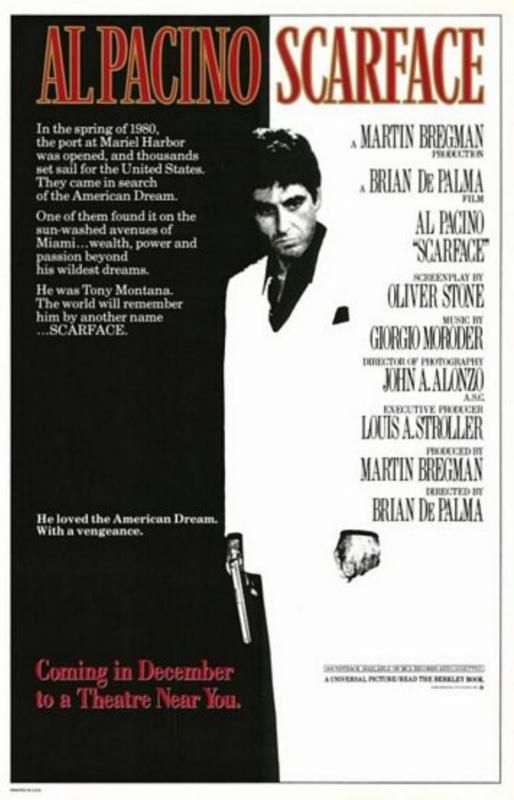
Scarface


Scarface
1983
Director: Brian De Palma
Starring: Al Pacino, Steven Bauer, Michelle Pfeiffer, Mary Elizabeth Mastrantonio, Robert Loggia

Scarface is one of the more notable titles on my “List of Shame.”  It’s achieved a definite presence in pop culture that persists to this day, finding new fans amongst the young all the time.  I ask my students questions about their likes throughout the year (“Favorite comedy,” “Favorite dessert,” “Favorite author”) and nearly every year, Scarface will get a few mentions in various categories.  While it feels good to be able to check this film off, I’ll say right here, right now, it was a film that was precisely what I thought it would be, and I didn’t think it would be for me.

Tony Montana (Pacino) arrives in Miami from Cuba in the late seventies after essentially being told to leave his homeland by Castro, who purged his land of political dissidents and a fair share of criminals.  Montana falls in the latter category.  He and his friend Manny (Bauer) work their way into Miami’s drug syndicate by catching the attention of boss Frank Lopez (Loggia).  Montana, for his part, pays attention to Frank’s girl, Elvira (Pfeiffer), a woman who doesn’t exactly follow the rule of “Don’t get high on your own stash.”  Tony is cruel, hard, and ruthlessly ambitious, so it is inevitable that his climb to the top of the drug power ring comes at a cost.  When his beloved sister Gina (Mastrantonio) becomes drawn into this world, however, Tony’s problems push him over the edge.


While not the start of Pacino’s acting career, I will make the case that Scarface was the start of Pacino’s overacting career.  Pacino’s work in the seventies was phenomenal.  I think of The Godfather and its first sequel, Serpico, and Dog Day Afternoon, and Pacino delivers intense yet fairly subdued performances that rise when they need to, but also fall when they need to.  But in Scarface, we have the start of the Pacino that has now become a caricature, a performance that is nothing but highs and yelling and shouting and craziness.  To be fair, from what I’ve seen of his filmography, this was the first time he turned in a character whose volume is set at eleven throughout the entire performance, and people were obviously impressed.  If I hadn’t known Pacino for such a type of character, I’d have been far more impressed with his turn as Tony Montana.  But the problem with seeing iconic films after you’ve already seen a metric ton of other films, though, is that you lack this historical perspective.  To me, this is just another example of Pacino being over the top, crazy Pacino.  It felt like a Pacino caricature.  It felt like I had seen it all before during skits on Saturday Night Live.  And personally, I’d rather have the seventies Pacino. 

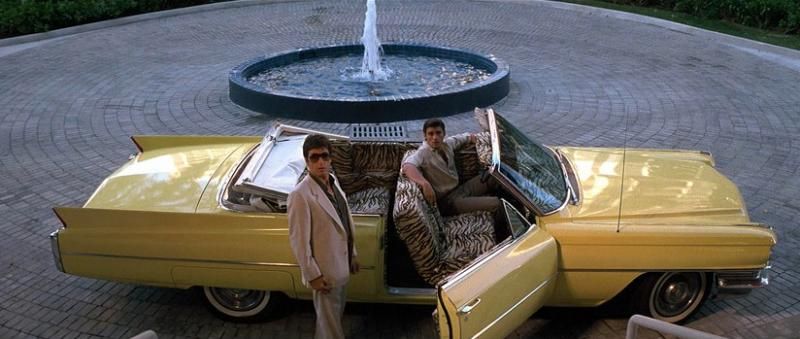
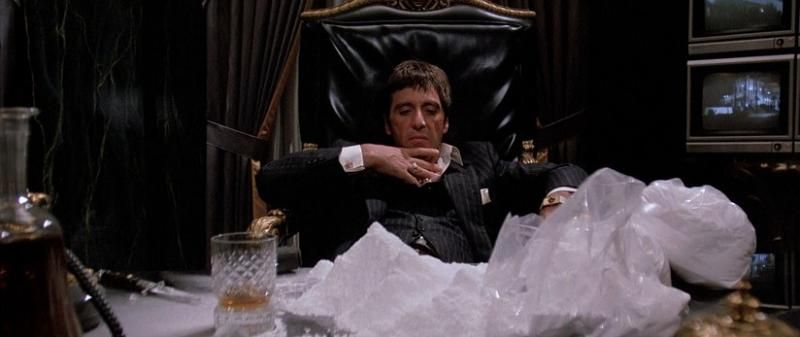
Scarface is so eighties, it hurts.  It physically hurts me.  Which, of course, is fitting, because Scarface is all about excesses, and so were the eighties.  As this film came out early on in the eighties, it is also easy for me to see how Scarface’s success could have shaped and defined this sort of celebration of immoderation throughout the rest of the decade.  The sets are utterly ridiculous, reeking of gilded age glitz and spending money like it’s going out of fashion.  Tony’s estate in the second half is painfully eighties.  Then there’s the montage sequence halfway through that separates Tony’s rise from his fall.  Shown with the requisite synthesizer music in the background, it was so stereotypically eighties, it actually made me laugh.  I threw my hands up in the air and bent over, I was laughing so hard.  I suppose there’s little else for me to do than embrace all the ridiculous eighties trademarks in Scarface, though.  


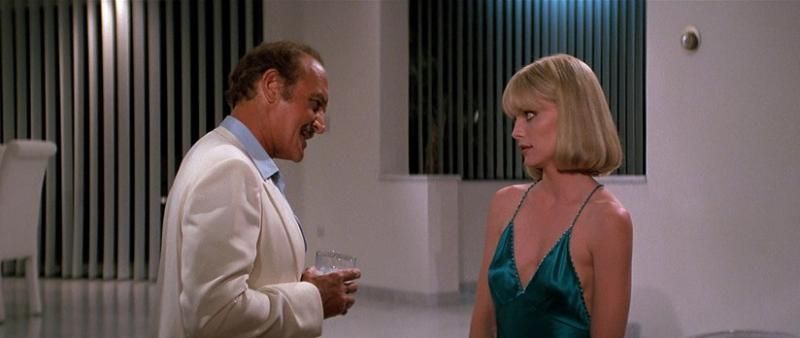
I was irrationally bothered by the – hm, do I actually call it racist?  Yes, I’ll call it racist – racist casting in Scarface.  Almost the entire cast of characters, with only a few exceptions (the most notable being the fact that Manny, a significant character, is actually played by a Cuban), are meant to be Hispanic – Cuban, Colombian, Bolivian – but only the minor characters and extras were actually played by Hispanic actors.  What was most galling was the decision that Italians = Cubans.  Pacino, Loggia, Mastrantonio.  This really, REALLY bothered me, and although this sounds odd, I’m not entirely sure why.  It’s certainly nothing new in film; look at the movies from the twenties, thirties, forties, etc, and just how much blatant racism they contain.  White actors playing black characters, white actors playing Hispanics, white actors playing Asians.  I tend to forgive this when I come across it as a “sign of the times.”  Unfortunate and ugly, yes, most definitely, but, well, it was how Hollywood used to operate.  I find myself willing to overlook it.  Why, then, am I so bothered by the exact same idea in Scarface?  The only possible answer I can come up with is that I had hoped that by 1983, we would have known better.  By 1983, I think I was hoping I wouldn’t have to sit through the painful experience of watching Robert Loggia, an actor who celebrates his Italian roots, ridiculously try to pull off a Cuban accent.  I didn’t buy it, not for one damn second.  I didn’t buy Mastrantonio, I didn’t buy the actor who played Sosa.  I marginally bought into Pacino as Tony, but that was the only one.  Am I being irrational here?  I might be, and I completely own up to that, and on reflection, I don't expect ALL of the actors to be of Cuban descent.  And yet, there's something that gets under my skin about seeing actors who are not only not Cuban, but AGGRESSIVELY Italian (for the most part) playing Cubans.  It reeks of blackface to me.  As I said, I know that I am willing to forgive similar faults in older movies.  Why can’t I forgive it here?  I'm not entirely sure, but it was a major block to my involvement in the film.

She's all, "Bitch please, you ain't even CLOSE to Cuban."

One thing I will definitely say Scarface got right is knowing precisely how to pull off a remake.  As readers of this blog undoubtedly know, this Scarface is a remake of Scarface, sometimes subtitled “The Shame of the Nation,” from 1932 starring Paul Muni.  Both films follow the same general plot structure – aspiring mobster rises then falls from power – but feel worlds apart.  And that right there is precisely what a smart remake ought to be.  Scarface, the remake, doesn’t try to pull off a thirties gangster picture, but instead introduces the drug syndicate angle, something that would have resonated far more with modern audiences.  It feels current and slick and stylish, and not at all like it’s trying to simply copy a film that came before.  What’s more, there are several reverent touches in Scarface, the remake, alluding to the original, to show that De Palma and producers really do respect their predecessor.  The message “The World Is Yours” is significant in both films, and De Palma actually dedicates his Scarface to the writer and director of the original Scarface. 

Scarface is a fairly straightforward story of someone’s rise and fall from grace.  Nearly every plot device it employs was telegraphed to me miles in advance, so absolutely nothing came as a surprise.  Then again, I am most definitely not the film’s intended audience.  Ultimately, though, it is nice to have seen this film, even if I have zero compunction to see it again; it is a film that survives, it is still seen and loved and quoted by today’s youth, and if nothing else, I can now laugh at Kendra’s obsession with it when I guiltily watch reruns of Girls Next Door.

Arbitrary Rating: 5/10.