Showing posts with label 2000s. Show all posts

Monday, August 25, 2014

Babel


Babel
2006
Director: Alejandro Gonzalez Innaritu
Starring: Cate Blanchett, Brad Pitt, Adriana Barraza, Rinko Kikuchi

My husband rarely watches my 1001 Movies flicks with me.  He’s not a movie buff the way I am, and I would never want to force him to watch, say, an intense Swedish film – like Bergman – unless, for some reason, he really wanted to.  Which normally, he doesn’t.  But he wound up watching Babel with me, almost on accident, in that he was playing a video game in the same room and wound up getting pulled into the film, watching the last hour with the video game on pause.  Do not let this be a comment on Babel amazing quality, however, as when it was over, we turned to look at one another and vocalized our almost identical reactions. 

“That could have been so much better.”

Waving the ride of the concept of telling multiple interconnected stories, Babel’s interconnected stories are in Morocco, California and Mexico, and Tokyo.  An American couple (Blanchett and Pitt) are vacationing in Morocco when the wife is accidentally shot on their tour bus.  The shooter is a young Moroccan boy out tending goats with his older brother; the two were simply monkeying around with the new rifle their father bought for killing jackals.  While the young boys panic and try to hide what they did, the husband of the stricken wife desperately searches for medical attention in the remote farmland of a country whose language and custom he does not know.  Meanwhile, back in California, the children of the American couple are taken to Mexico by their live-in nanny Amelia (Barraza) because her son is getting married and she can find no one to look after them.  While things are fine initially, problems eventually arise.  And finally, in Japan, a teenage deaf-mute Chieko (Kikuchi) is frustrated enough at the world for not understanding her condition; her distant father and dead mother don’t make things any easier.  Chieko starts acting out in possibly dangerous ways as we begin to understand just how angry and hurt she really is.


The reason I said above that this could have been so much better is because the central themes of Babel are good ones, solid ones, even necessary ones.  The very idea that we live in an age of international connectivity is one that is vital to moving forward, and yet this remains an idea that many people, cultures, and countries eschew.  The issues Babel raises around this theme, that of language barriers and lack of communication, are equally profound.  We are all connected to one another, and we must embrace this as the world becomes smaller and smaller, but we have a great deal of barriers in our way that prevent us from truly embracing the similarities we all have.  This idea is important.  Babel deals with important and significant cultural debates. 

It just doesn’t delve into these questions nearly as well as it thinks it does.

Three of the four central tales in Babel are all clearly linked to one another.  The American woman is shot by kids in Morocco while the woman’s own children attend their nanny’s son’s wedding in Mexico back home.  Yes, three stories, all with a very clear thread of connectivity.  Then there’s the Tokyo story.  Yes, there is a link between Chieko’s tale and what’s happening with the other characters, but it’s flimsy at best and feels like a big stretch, as if the writers came up with this great Tokyo plotline but had to find a way to shoehorn it in to the other threads.  Right away, this takes away from Babel’s strength as a film, as there seems to be an oddball tale awkwardly fitted in between the other, related plotlines.  Which is really a shame, because for my money, the Tokyo plotline was easily the most interesting part of the film.  Granted, the type of story and characters in this chapter make me predisposed to liking it more – few, introspective characters, internal turmoil, drama and angst, as opposed to the distinct action/adventure/thriller aspect of the other three tales – but even my husband admitted to finding the Tokyo story (a phrase I cannot type without thinking Ozu) the most compelling, and he’s definitely an action/adventure/thrilling kind of guy.  Honestly, I wish it had been its own film; Kikuchi’s Chieko is devastatingly honest and a frightening pillar of uncontrolled strength and emotion.  When she is not commanding the screen, the film lags, as if Babel itself wishes it could have spent more time with Chieko.


Although for my money, Kikuchi is the best of the bunch, the performances in Babel are all stellar and were probably the biggest strength of the film.  Naturally, Cate Blanchett is amazing, but that’s rather a given.  It’s easy to understand why Adriana Bazzara earned a Best Supporting Actress Oscar nomination, but it’s Brad Pitt and the nonprofessional Moroccan actors who really manage to buoy the entire film.  Pitt is an actor easy to underestimate; his non-stop tabloid presence and impossible good looks can work against him.  But here, he is very good, very strong as a man who finds himself entirely out of his league and facing a life and death situation.  Right alongside him, the actors portraying the Moroccan family torn asunder by a rifle do a tremendous job.  The two young boys underplay most of their scenes, a fact that works best with child actors, and the Moroccan father believably carries the role of emotional heavy in what is a gut-wrenching tale.  Innaritu must be commended for coaxing such strong performances from every single member of such a varied cast.

*********************************SPOILERS FOR THE ENDING************************************

But ultimately, I have a bit of a problem with the overall message of the film, and this is why I say it could have been such a better movie.  When considering the ending of all four stories, I have to ponder what exactly Innaritu managed to say.  Think: the Moroccan family is completely torn apart, facing jail and possibly the death of one of its own.  Their lives will never be the same again.  The Mexican maid is ungraciously deported, forced to leave behind her entire life and not allowed even a suitcase of her belongings.  Chieko’s emotional future is anything but certain as she pushed herself to dangerous places.  Three of the four stories have distinctly downer endings.

But what happens to the white people?  Oh, no worries, everyone survives and gets back home in one piece.  Really, is that the message we’re going with?  Everyone’s interconnected in this world of ours, and bad stuff happens all over the place, but if you’re American, everything will be fine?  Is this some sort of subtle commentary on white privilege by Innaritu?  Although you may disagree with me on this one, I don’t think it is.  Rather, I feel like the writers felt the need to have one story end happily and they picked the white Americans one.  I really wish they hadn’t.  It would have felt so much stronger to have one of the stories involving a different culture, a different set of people, end well and to have something sad happen to the Americans.  But no, Babel is fundamentally an American film, marketed and shown to American audiences, and we can’t have our American audiences having their delicate sensibilities upset.  So we’ll force all the tragedy onto the people of color and ensure that our own get through unscathed.  This wrapping up of the plotlines undercuts the international message of the film, and thus much of the power of Babel.  Again, this could have been better.

Edit to add: After a bit of time away from this, perhaps the above is the point? Perhaps Innaritu is actually brilliantly calling out white privilege by having that plot line be the only one that has anywhere near a happy resolution. Actually, I don’t believe that is the case, I don’t feel this movie is quite that… clever, but I admit it’s a possibility.

***************************************DONE WITH THAT THEN*******************************

Babel smacks too much of a film specifically designed to make you feel like crap.  The stories continually scream at you to “BE SAD!!”  And if that isn’t enough, all the ancillary filmmaking techniques, such as score and cinematography, belabor the point, yelling at you to “BE SADDER!!!!!!!!”  While a perfectly acceptable film in that there isn’t anything too egregiously wrong with it, I was left a touch underwhelmed.  This is disappointing, as the issues Babel raises are interesting ones.  Again, I reiterate that the biggest message I got from it was wishing that Chieko’s plotline had been developed into a standalone film, as I would rather have watched that.


Arbitrary Rating: 7/10.

Sunday, February 9, 2014

Lost in Translation


Lost in Translation
2003
Director: Sofia Coppola
Starring: Bill Murray, Scarlett Johansson, Giovanni Ribisi

I need to say this straight off the bat: I can’t write a normal review of Lost in Translation.  Expect precious little of what’s to follow to be my typical attempts at any sort of analysis of the filmmaking techniques, production design, or story symbolism.  Apologies if that’s what you wanted.

Right. On with it then.

I’ve only seen Lost in Translation twice; once, in 2004 after it came out on DVD, and just a few days ago for the 1001 Movies Blog Club.  Despite the decade since I last saw it, I vividly remember that initial experience.  It was late at night, I was a little tired, my then-boyfriend-now-husband had gone to bed, and I sat down to watch this film that my friend Dyami had been gushing over.  I really enjoyed it – I knew I would – but as it came to a close, I remember being overcome by incredible emotion.  I remember sobbing my way through the final scenes, then continuing to sob rather uncontrollably for at least another thirty minutes.  Something in this film had touched a nerve, a very raw nerve, that the lateness of the hour and my tiredness only exacerbated.  In seeing it for a second time, that nerve was not quite as exposed, but still there nonetheless.

Bob Harris (Murray) is a middle-aged washed up movie actor being overpaid to promote whiskey in Tokyo, Japan.  He forgets his son’s birthday while his wife FedExes carpet samples to his hotel room.  Charlotte (Johansson) is a college grad who majored in philosophy and now finds herself married to a photographer (Ribisi) and without any idea what to do with her life now that she’s tagged along with him to Tokyo.  Both Bob and Charlotte feel completely alienated by not only Tokyo but their lives, and this is enough of a commonality for them to strike up an unlikely friendship.


Bill Murray is so wonderful in this film, and I remember, at the time, that it was such a BIG FREAKIN’ DEAL in the media.  Everyone, and I do mean everyone, was all “holy F*%@ Bill Murray can actually act and express emotions and everything!”  He was nominated for his one and only Oscar for his role as Bob Harris, but something I’ve been thinking about is that no one should have been THAT surprised.  Frankly, Murray’s filmography for the ten years prior to Lost in Translation was building up to this, a perfectly seriocomic role.  In my opinion, it all starts with Groundhog Day in 1993, then goes on to Ed Wood with Tim Burton in 1994, then most significantly on to Rushmore in 1998 and The Royal Tenenbaums in 2001, both with Wes Anderson.  The fact that Murray was specifically choosing work that defied his early slapstick routines (he also managed to be in a Shakespeare movie before Lost in Translation) was apparent.  Since Lost in Translation, he has continued his relationship with Wes Anderson, becoming in some ways a grand duke of the indie film scene, and has also cultivated a relationship with Jim Jarmusch of all people.  I give Murray all the credit in the world for clearly seeking divergent film roles, because he is just wonderful when he tones down the stupid comedy and allows the sadness to peek through.  I’m not surprised at all that a generation of younger filmmakers have wanted to use him in their work. 

I don’t often write about it on my blog, but back in 2004, I was in a PhD program doing biochemistry research.  I was utterly miserable, but I hadn’t yet realized I was miserable.  (It would take another 18 months for me to finally face the issue and leave the program, moving on to something that DIDN’T take a jackhammer to my sense of self-worth.)  Like Charlotte, I was in my early to mid-twenties and I felt adrift.  And that night that I watched Lost in Translation for the first time, this film was an enormous trigger that managed to convey some of the hopelessness and lack of direction I was drowning in.  Although I still could not completely admit it to myself at the time, now with 20/20 hindsight I have no doubt that the minor breakdown this film gave me was because I identified a bit too much with the emotional message here.  When I watched it just a few days ago, the tears at the end were caused not by a current sense of angst in my life, but of remembrance; recalling just how emotionally draining and numbing those years in the lab were, recalling just how pathetic I felt then, how utterly useless and ineffectual I thought I was because my experiments never worked (not once, not ever, not even the goddamned controls did what they were supposed to do), how much of a failure I thought myself.  Quite frankly, this film isn’t the easiest thing in the world for me to watch, not because it’s bad or horrific, but because it has a way of pulling all those old emotions out to surface. 

Which is definitely a bit of a testament to the film, because I was working in a biochemistry research lab and Charlotte was in Tokyo for a few weeks.  Not exactly the same thing.


It’s very difficult for me to be objective or analytical about this film.  This is a much more subjective experience for me, as I just watch this and feel.  I feel Charlotte’s depression as she tries to tell her friend she doesn’t know who she married only to have the friend blow her off.  I have also had a friend during this time in my life who was a bit like Bob Harris, someone who, although a generation apart from me, I connected with and who I got along extraordinarily well with and who made me forget, albeit for short periods of time, how much sadness I was really hiding.  Although an argument can be made, depending on your frame of mind, that Coppola pushes the relationship between Bob and Charlotte to the brink of sexual tension, and I honestly do not think that I ever had *that* kind of relationship with my friend, I relate yet again to understanding the feeling of respite caused by an unlikely friend. 

This movie.  This movie was my early to mid-twenties.  The deep seated denial that I was sad (I wasn’t supposed to be sad, I was in biochemistry PhD program for crying out loud), the feelings of hopelessness and uselessness that almost consumed me, Lost in Translation brings it out in a beautiful, sadly poignant way.  On the surface, my story is not at all like Charlotte’s, but Sofia Coppola knew what she was doing, knew that her particular story of cultural alienation could really strike far deeper. 

This is not a movie I can watch lightly or “have on in the background.”  I’m in a much better place now than I was ten years ago, but the experience in the lab was a bit emotionally scarring and I still struggle with some of those feelings of loss of self-worth (and I have a feeling I will always feel like something of a failure).  Lost in Translation is a film that reminds me of that phase of my life, for better or for worse, and while it makes me happy to know I’m not there anymore, this movie has a way of reminding me just how painful those years were.

For the record, I think this movie is awesome.  It just strikes a bit too close to home for me to watch it with any regularity.


Arbitrary Rating: 9/10, and apologies if you actually wanted me to talk about the movie rather than whinging on about myself.

Saturday, November 16, 2013

Monsoon Wedding


Monsoon Wedding
2001
Director: Mira Nair
Starring: Naseeruddin Shah, Vasundhara Das, Shefali Shetty, Vijay Raaz

There was a time in my life, for quite a few years, actually, when my cinematic diet consisted entirely of the same fare that is Monsoon Wedding.  In the past ten years or so, I’ve stretched myself, imbibing film after film that is far beyond genres I usually watch, learning to love movies outside my comfort zone.  It’s been a wonderful experience, and one that I wouldn’t change, but every now and then, it feels incredibly comforting to settle down with a frothy little romantic dramedy.  Seeing Monsoon Wedding for the first time took me back, man.

Aditi (Das) is getting married.  Her father (Shah) is stressed, the wedding planner (Raaz) is an incompetent goofball, and her cousin Ria (Shetty) seems to be depressed.  Aditi herself isn’t terribly jazzed about the arranged marriage to an Indian man from Houston, Texas she’s never met, especially as she’s still in love with her married ex-boyfriend.  As the scores of relatives descend upon the family house for the days of wedding ceremonies, romance blossoms in unlikely places just as old family secrets are revealed.  Nothing like a wedding to bring out the best – and worst – in people.

  
Undoubtedly, the central theme of Monsoon Wedding is the universality of the Crazy Family.  This is a film cut from the same cloth as My Big Fat Greek Wedding, with a cast of cacophonous characters doing their best to confuse you with their identities and separate plights.  There are several storylines continually being developed by the rather large cast, but in the end, it doesn’t matter, because it’s really just about this family muddling through.  Wait, there’s one scene where the father mentions money problems but it doesn’t really go anywhere?  No worries.  The story of the younger brother being sent off to boarding school feels markedly unresolved?  Don’t trouble yourself.  Just as in real life, not every tangent can find a conclusion in the time span of a long weekend.  Monsoon Wedding is about family, plain and simple, and how everyone in the family carries their own cross to bear, but ultimately love, be it romantic or familial, finds a way to triumph. 

Multiple plotlines and large casts can feel confusing, and when you add in the fact that Hindi, Punjabi, and English are all spoken in Monsoon Wedding, sometimes even in the same five minute period, the film constantly feels as though it’s teetering on a knife’s edge.  Credit where credit is due, then, to director Mira Nair, who manages to keep all the balls in the air and continually moves the film forward by focusing on Aditi’s wedding ceremony.  I’ll admit I was a bit overwhelmed during the first half hour of the film, but when I realized that this is a classic example of ensemble casting – and when I turned on the English subtitles for the English lines – everything started to fall into place.  I might not have every character’s name down pat, but by the end, I knew who was interested in whom and how the conclusion benefited which person and why.  Everything comes out in the wash.

  
The romance in Monsoon Wedding was rather lovely.  Although overshadowed by the focus on Aditi’s wedding and her angst about an arranged marriage and her ex, my favorite of the multiple romantic plotlines was easily that of inept wedding planner Dubey and household maid Alice.  Aditi’s family is most definitely upper middle class, if not upper class, and this was the one part of the story that dared delve into class distinctions in India.  Dubey is shown to live in a tiny apartment with a nagging mother, and Alice is the maid.  Watch her face when she first accidentally bumps into Dubey and he says “Forgive me.”  You can read her shock that she wasn’t blamed for the accident, that it wasn’t assumed it was her fault.  Right from that very first moment, I knew how this romance would blossom, but I didn’t care that it was already spelled out.  I wanted to watch these two, whose lives were definitely a bit harder and rougher than Aditi’s family, find their little bit of happiness.  The fact that Aditi’s family includes them in their own wedding ceremony at the end of the movie is heartwarming.

Like every decent romantic dramedy out there, there is more than a whiff of the fairy tale in Monsoon Wedding.  Things wrap up a little too nicely, especially in Aditi’s plot line, to be believable.  At all.  Not every plot line is based on romance, but even in the more serious story line, things seem to resolve a little too nicely.  But you know what?  I’m okay with that.  I wasn’t expecting hard-hitting realism in a story about an Indian upper class wedding.  It’s nice, every now and then, to bid adieu to any semblance of real life and live in a world where everyone gets their happy ending.  Like I said, I used to subsist on a cinematic diet of nothing but films like this.  I welcome the fairy tale, the fantasy, the happy ending.  

  
And yet what really makes Monsoon Wedding work is that it is a fairy tale masquerading as a real life story.  There is a great blend of the two, and although the story tiptoes near the borders of Bollywood excess, it never pushes over the edge.  Sweet without being sickening and with just enough emotional poignancy to make it feel substantial, Monsoon Wedding achieves its goal.  It’s diverting, escapist, well-made fun. 

Arbitrary Rating: 8/10

Monday, August 5, 2013

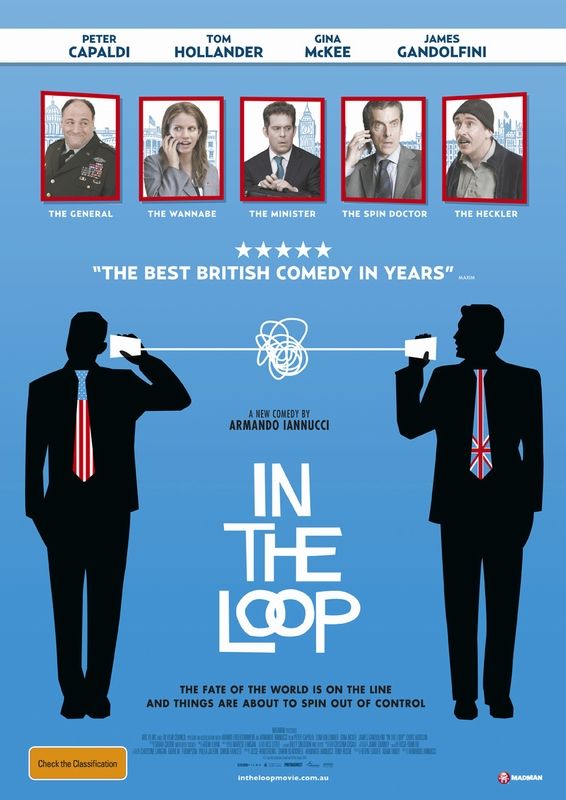
In the Loop


I am not a Whovian, but yesterday I got to watch all my Whovian internet friends explode with the announcement of the casting of Twelve.  And then I realized that I have a review for one of Twelve's films!  So congratulations, Peter Capaldi, you get a special post today!

 
In the Loop
2009
Director: Armando Iannucci
Starring: Tom Hollander, Peter Capaldi, Mimi Kennedy, Chris Addison, Anna Chlumsky, David Rasche, James Gandolfini

My dad likes to tell a story about when I was young and couldn’t sleep.  He’s always been a night owl, and when I was but a wee Siobhan, three years old or so, and couldn’t sleep, he’d stay up with me, and more often than not, he’d turn the television to PBS.  That late at night, PBS wasn’t running children’s programming.  No, we’d watch whatever British comedy happened to be on.  My father likes to tell people how he was scared when, as a three year old, I’d be laughing at all the right places during an episode of Monty Python.  With such an upbringing, it’s not too much of a wonder that classic Britcoms have been with me for a long, long time.  I mention this because I’ve always found British comedies funnier than many American comedies, and In the Loop is no exception.  Thing is, though, I think it’s even better than many of its own ilk because it takes the dry wit and black humor and scathingly applies it to the current political climate, a landscape that desperately needs some skewering.

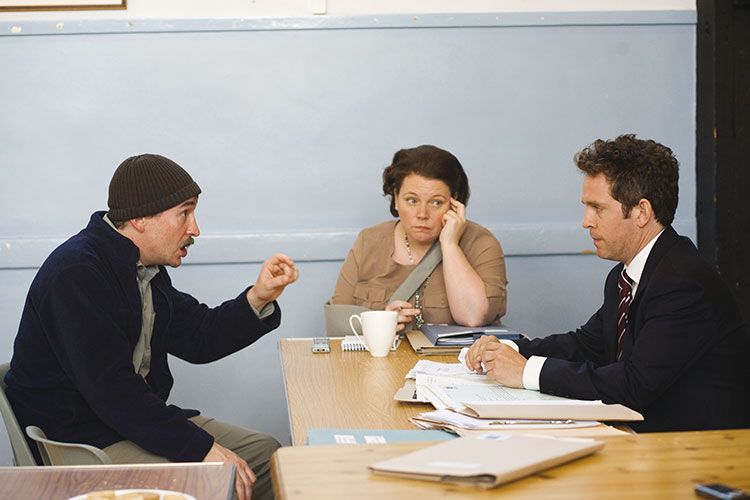
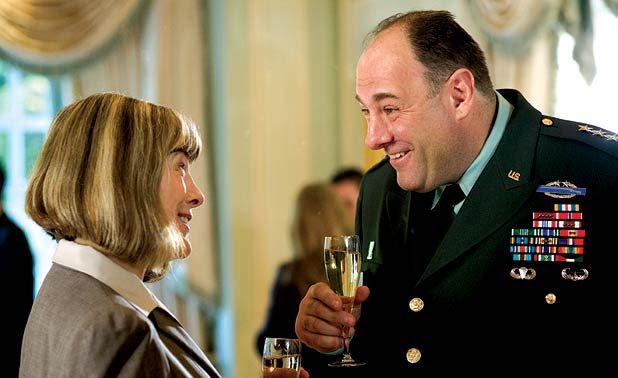
Malcolm Tucker (Capaldi) is a foul-mouthed and ruthless director of PR for the British Prime Minister who has his hands full with slightly dense elected official Simon Foster (Hollander). The problem is that Foster hasn’t toed party lines when it comes to the government’s pro-war position for the impending Middle East conflict, having unintentionally given the press an anti-war sound bite.  Things get even more confusing when Foster tries to backpedal but instead ends up providing yet another unintentional sound bite, but this time it’s pro-war, and Foster’s new assistant Toby (Addison) is put in charge of handling the situation.  American politicians jump all over Foster’s comments on both sides, trying to leverage him as British support for their arguments.  This includes Karen Clark (Kennedy), an anti-war politician, and her assistant Liza (Chlumsky), as well as Linton Barwick (Rasche), who wants war at all costs.

  
Before getting into the massive political commentary rife throughout In the Loop, I’d like to state that this is the funniest movie I’ve seen in a long, long time.  I find a great deal of things funny, but I tend not to laugh out loud all that often.  Sometimes my husband thinks something is wrong; we’ll be watching an amusing show, he’ll look over after a good joke and ask, “Why aren’t you laughing?”  Just because I don’t laugh at something doesn’t mean I don’t find it very funny.  I mention this because when something actually DOES make me laugh out loud, it means I think it’s positively hysterical.  And I was laughing out loud throughout almost the entirety of In the Loop.  I’m not entirely sure why I’m wired that way, and why so little comedy manages to elicit belly-laughs from me, but I do know that when I come across something that DOES (which, by the way, more often than not is British comedy), I latch onto it like crazy, and I know it’s a good thing.

Mostly improvised from script outlines, the dialogue is rip-roaringly funny.  Akin to a British political version of Christopher Guest’s Best in Show, I am always staggered by the skill of people who can make up such incredibly funny lines on the spot.  When an angry Scot says of opera “It’s just vowels!  Foreign, subsidized vowels!” I lost it.  A particular favorite was “Difficult, difficult, lemon difficult,” a line which, admittedly, out of context, probably doesn’t come across as that funny, but one that almost had me falling out of my chair when I first heard it in the film, and then when it was later repeated I almost peed myself.  

I cannot tell you how badly I want this to be Twelve's catchphrase.

And bringing up more of the comedy, one of my other favorite lines was when Malcolm ended a phone call by yelling “Fuckity bye!”  In the Loop has some of the most creative vulgarities I believe I have ever heard.  F-bombs are dropped nearly every other sentence – heck, sometimes, every other word, but it’s not just about the swearing.  Such massively unique insults are hurled with lightning reflexes, it’s hard not to be impressed.  Every character has someone they intensely dislike, and a great deal of the exchanges in the film are these people simply tearing one another down.  It would be sad and maybe a bit depressing but for the fact that it’s more than clear that every character has immensely thick skin and knows how to let these barbs simply run off their back.  Fuckity bye!

Alright, so In the Loop is the funniest movie I’ve seen since Borat, the film that had me reaching for an oxygen tank.  But when that comedy is used to make frightening political commentary, then we’ve really got something.  Just like Borat uses its humor to tear down America’s conception of itself, In the Loop rips the political world to shreds.  The entire plot is about whether or not a war will be started, but all the action takes place in the world of politics.  It’s only mentioned once or twice that the war in question will take place in the Middle East, which underlines the point that this war is not about the enemy.  No reason for the war is ever given – EVER – which makes the point that this war is not about a valid motive.  But we are constantly given politicians politicking, which means that the grey, unnamed war in In the Loop is entirely and only about politics and people in suit, miles away from any kind of actual conflict.  

  
And what’s truly frightening is that this philosophy feels barely removed from the truth.  In the Loop is deathly funny, but also more than a bit scary because it strikes far too close for comfort.  The sort of unintelligent double speak, where politicians manage to talk endlessly while saying nothing at all, is all too much of a reality.  The behind-the-scenes wrangling, where minutes of meetings are shamelessly altered, where articles are rewritten to only present pro-war arguments, are stomach-churning in how conniving they are, but the scary thing is it feels all too possible.  Is this what politics is really like?  As sad as it is, I could buy In the Loop as a documentary, a world where no character is pure, where every character is backstabbing and has their own ulterior motives, where each side is ridiculous in their faults.  There are no heroes in In the Loop, but there are many villains.

  
In the Loop is funny, biting, and incisively clever.  Like I said, I rarely laugh out loud at comedies, but I did here, and by the end of the film, it had definitely become a bit of laughing and crying mixed together.  In the Loop is smart, very smart, and it’s a little sad, if not wholly unsurprising, that I had never even heard of it except for its presence in 1001 Movies.  It’s too easy to understand why it didn’t get enough press in America to make its way onto my radar. 

I now want to end all of my phone conversations with “Fuckity bye!”

Arbitrary Rating: 9/10