Saturday, September 29, 2012

Sullivan's Travels


Sullivan’s Travels
1941
Director: Preston Sturges
Starring: Joel McCrea, Veronica Lake, Sturges’ stable of stock supporting staffers

I love screwball comedies, and if one loves screwball comedies, then Preston Sturges is like manna from heaven. No one made screwier screwballs than Preston. But poor Preston couldn’t leave well enough alone. Oh no, he had to go getting all serious, trying to make a “big social point,” and in my opinion, lost nearly all his magic with Sullivan’s Travels. That the film is typically regarded as his finest work is a bit beyond me.

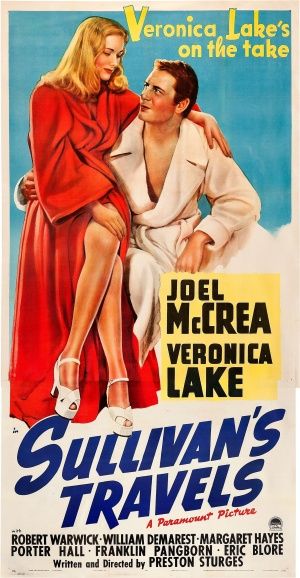
Hollywood screwball comedy director John L. Sullivan (McCrea) wants to make a big serious drama, a movie that strikes at deep issues and social problems. His studio heads want him to make another comedy. In order to learn about poverty in America for his big serious drama, Sullivan decides to go on the road undercover as a hobo, with only ten cents in his pocket. Along the way he meets a charitable girl (Lake), and he eventually tells her who he really is. She insists on accompanying him as he continues his little experiment. Situational antics ensue.

I understand why Sturges wanted to make such a movie. It must be tough, being so brilliant at a genre of films that is easily discarded and denigrated. It’s something that hasn’t changed with time, either; consider, each year, how many dramas are nominated for Oscars, versus comedies. Sullivan, something of an alter-ego for Sturges, wants to make a “big important drama.” Well, why does he want to do this? He gives little reason, he’s just insistent to the point of absurdity that’s what he wants to do. My guess, for both Sullivan and Sturges, it is the desire to be taken seriously and to win some acclaim. Frankly, I can understand that desire. It’s always nice to have someone tell me that they realize how hard I work and they think I am doing a good job. The greatest comedies look so easy, and when something looks easy, most people tend to assume it didn’t require any work to create it.

Thursday, September 27, 2012

Mishima: A Life in Four Chapters


Mishima: A Life in Four Chapters
1985
Director: Paul Schrader
Starring: Ken Ogata

Ah, Mishima. Yet another sterling example of why I love, adore, and cherish 1001 Movies You Must See Before You Die. The first time I saw this movie, I had never heard of it and knew nothing about it. Half an hour in, I was a little confused, but beguiled. By the end of the film, my jaw was on the floor and my heart was in my mouth. It had shocked, stunned, and most importantly moved me. This movie is phenomenal.

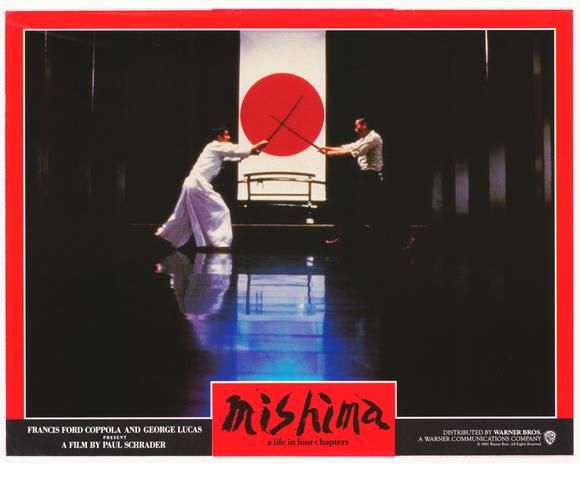
Ostensibly a biopic, although more on that later, Mishima is about Japanese writer, poet, dramatist, actor, nationalist, and all around artist Yukio Mishima, brilliantly portrayed by Ken Ogata (he who broke my heart over and over again in The Ballad of Narayama). Mishima is a legendary figure in modern Japanese history, and the film opens on the day in 1970 that he and four members of his private army successfully broke into a Japanese garrison and held the general hostage. We flash back to various earlier points in Mishima’s life and various pieces of fiction he wrote, a significant portion of the film, all while returning occasionally to the day of the garrison raid. By interweaving the art with the life of the man, Schrader paints one of the best cinematic portraits of an artist I’ve ever seen.

Tuesday, September 25, 2012

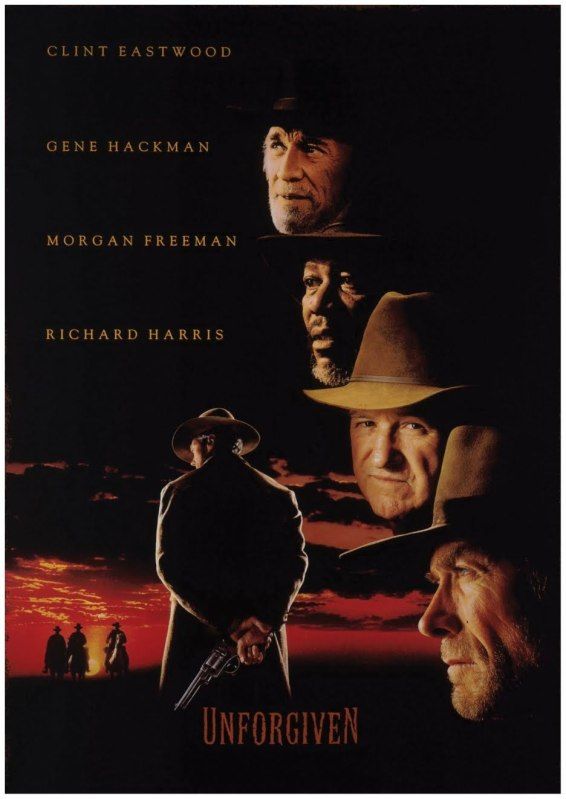
Unforgiven


Unforgiven
1992
Director: Clint Eastwood
Starring: Clint Eastwood, Gene Hackman, Morgan Freeman, Frances Fisher, Richard Harris

Clint Eastwood made a lot of westerns in his career. His is a face that is forever linked with the genre. Unforgiven plays like a swan song; indeed, thus far, it’s the last western Eastwood made. It feels like Eastwood is thanking the genre for what westerns have done for him as he gracefully exits stage left.

A cowboy attacks a prostitute with a knife, cutting up her face. This prompts the madam at the brothel, Strawberry Alice (Fisher), to call for the man’s blood. The sheriff in town, Little Bill (Hackman), decides on a much more sedate punishment, prompting Alice to offer reward money. First to town comes outlaw English Bob (Harris), who is promptly dealt with by Little Bill. But the money also tempts William Munny (Eastwood) out of retirement, along with his friend Ned Logan (Freeman), leading to the inevitable showdown.

Sunday, September 23, 2012

Yi Yi


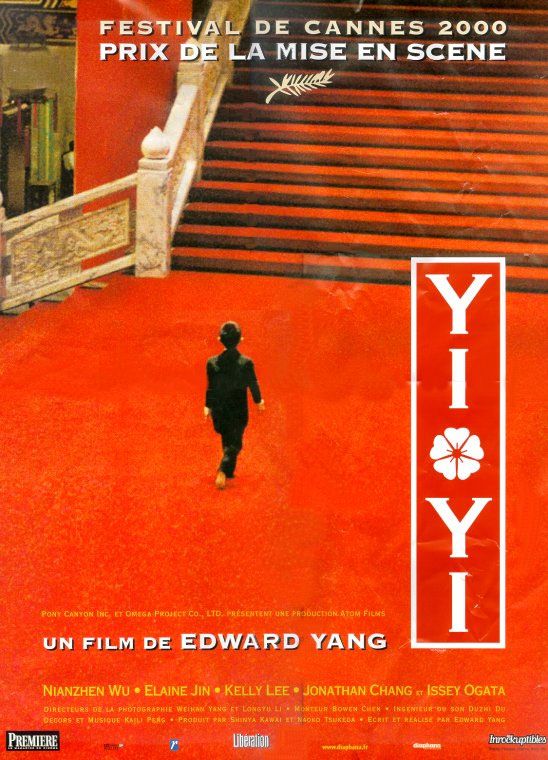
Yi Yi (A One and a Two…)
2000
Director: Edward Yang
Starring: Nien-Jen Wu, Kelly Lee, Jonathan Chang  

Yi Yi focuses on the life of a Taiwanese family living in Taipei in 1999. The father NJ (Wu) has two children, a teenage daughter Ting-Ting (Lee) and a young son Yang-Yang (Chang). Around them swirls the extended family and neighborhood: a broke and bumbling brother-in-law and his young pregnant wife, the grandmother who starts the film by falling into a coma, and the apartment neighbors who argue loudly and often. The movie takes place over the course of about one year as we watch this family go through the typical trials and tribulations of life.

In a film as rambling as this, filled with many small moments but no overall narrative direction, it practically invites the viewer to interpolate their own meaning. For me, throughout nearly all the vignettes, I got the feeling of the sorrow of banality. Is life really meant to be simply a series of repeated days, one exactly like the other? The mother’s speech when she is in the throes of an existential crisis nicely sums up this particular point. There is so much of the mundane in this film; the father’s work seems utterly boring and life-draining, as does the mother’s. The wedding that opens the film seems less a celebration and more a strange party at which drunkards, fools, and bullies waste their time. I don’t see Yang as delineating the joy of the little things, but more the pathos of them.

Saturday, September 22, 2012

Shadow of a Doubt


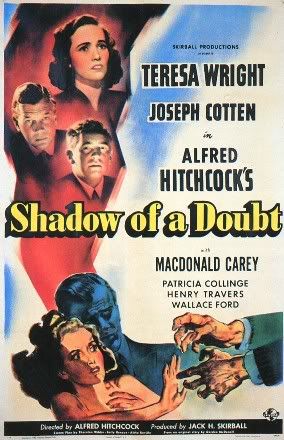
Shadow of a Doubt
Director: Alfred Hitchcock
Starring: Teresa Wright, Joseph Cotten
1943

When Francois Truffaut interviewed his mentor Alfred Hitchcock, Hitchcock himself admitted that this film was his personal favorite. Indeed, the DVD extras have a featurette entitled “The Making of Hitchcock’s Favorite Film.” This is definitely a Hitchcock film in terms of suspense and danger, but there’s a lovely sense of restraint and understatement in it, as compared to his phenomenal – but flashy – films like Rear Window or North by Northwest.

Young Charlie (Teresa Wright) is bored to tears in her small town life, until her much beloved and fascinating namesake Uncle Charlie (Joseph Cotten – no, Microsoft Word, I did NOT spell that word incorrectly) decides to pay the family a little visit. Young Charlie is delighted, as is everyone else, until she starts to suspect that her uncle might be… well, he might be up to no good. A growing sense of dread and unease builds as young Charlie tries to grapple with conflicting feelings – before it’s too late.

Tuesday, September 18, 2012

The Lady From Shanghai


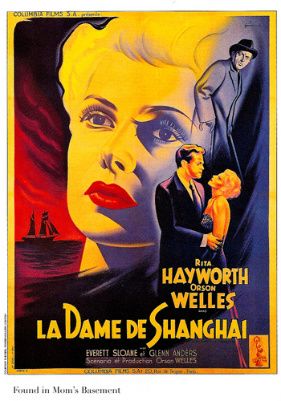
The Lady from Shanghai
Director: Orson Welles
Starring: Orson Welles, Rita Hayworth, Everett Sloane
1947

Orson Welles is such an enfant terrible. His films are brassy and bold, ballsy and gutsy, flying in the face of tradition. With The Lady from Shanghai, Welles, married to Rita Hayworth at the time, managed to piss off most of Hollywood by taking Hayworth’s gorgeous long red locks, cutting them all off, and dying them blonde. This move, heretical in terms of Hollywood’s star system, sets the tone for the rest of the film. Welles set out to make a film noir, and ended up making a film noir on crack.

Welles plays Michael O’Hara, a sailor who becomes infatuated with beautiful Elsa Bannister (the gorgeous Hayworth), only to find out she’s married to a leech of a cripple of a criminal lawyer (Sloane). Bannister the lawyer employs O’Hara on his yacht, practically inviting danger, and when things turn murderous, everyone’s in trouble.

Sunday, September 16, 2012

Playtime


Playtime
1967
Director: Jacques Tati
Starring: Jacques Tati and his sets

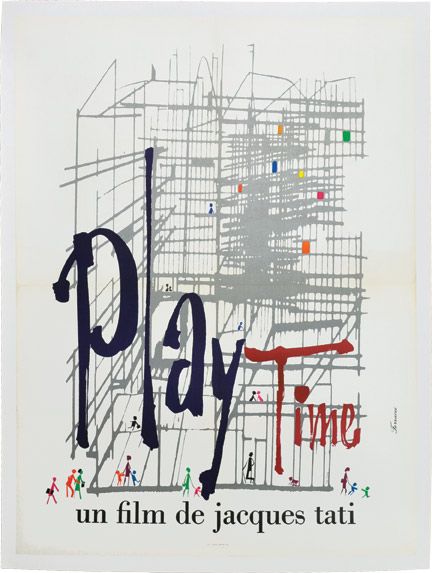
Director Jacques Tati’s third film starring his own character Monsieur Hulot, Playtime is a significant deviation from the previous two Hulot comedies. It takes on larger issues and is, in my opinion, darker and bleaker. Less about the individual than society as a whole, the film is also nothing short of a visual treat, essentially being two hours of nonstop sight gags.

The story, which is very limited and not the focus, centers somewhat around Monsieur Hulot (Tati) as he finds himself in the big city, ultimately revealed to be Paris. Everything is sleek, modern, and technological to the point of utter absurdity. In an office building, Hulot tries to navigate his way around. At night, he gets invited into the modern home of an old friend. We then spend an extended sequence at a nightclub that has just opened up where nothing is quite yet working. The film concludes with a carnival sequence.